HVAC Mafia

HVAC Jobs With Paid Training: How to Earn While You Learn

Yes, you can get paid while you learn HVAC, and you do not need experience or a tuition bill to start. Contractors across the country hire beginners as full-time employees, pay them during training, and move them into a technician role when they are ready. The trick is telling a real training program from a job that just says “will train” in the ad. That is what this guide is for.

We built HVAC Mafia as a job board and community for the trade, and the founder has 36 years in HVAC, so we have seen both kinds of employer. Registered members see openings from real contractors, and membership is free for techs. More on that below.

Thehvacmafia
thehvacmafia.com
Find HVAC Jobs That Train
HVAC Mafia members can see job openings from real contractors, along with trade-focused guidance on pay, career paths, and certifications.

Visit

TL;DR

  • Paid HVAC training comes in three forms: a company academy of about 8 to 12 weeks, a multi-year registered apprenticeship, and an entry-level helper or trainee role.
  • Most employers want you to be 18, hold a high school diploma or GED, and have a valid driver’s license. Most do not require HVAC experience.
  • Pay starts modest and rises with skill. Benefits such as health insurance, a 401(k), tools and a company vehicle often matter as much as the hourly rate.
  • Ask every employer about hours, classroom time, certification support and the path after training before you accept.
  • Join the free HVAC Mafia membership to see trade-only openings that regular visitors cannot.

Table of Contents

The three kinds of paid HVAC training

Not every “paid training” job works the same way. Knowing the type tells you how long you will be a trainee and what you will have at the end.

Company academies

Some contractors run their own short programs. Peterman Brothers hires you as a full-time employee, pays you while you learn, charges no tuition, and trains you in the classroom, a lab and the field, including ride-alongs on real service calls. Cheeky Tech Academy pays $16 to $20 an hour through 8 to 12 weeks of structured training and asks for no experience.

Morris-Jenkins runs a 10-week Tech Builder program of paid training that leads to a full-time technician job. HELP’s HVAC Maintenance Trainee role in Cincinnati, Ohio is also 10 weeks of paid training with no prior experience required.

Registered apprenticeships

An apprenticeship is the longer road. You work full time, learn on the job under experienced techs, and attend classroom instruction on top of it. Programs registered with the U.S. Department of Labor follow set standards, and the hours you log count toward journeyman status.

The Tustin Group’s BUILT TO LEAD apprenticeship is a four-year, self-paced commercial HVAC program with 2,000 field hours a year. Trane’s posting describes a four-year apprenticeship registered nationally through the Department of Labor, with paid instruction and on-the-job training.

Union programs run longer. Plumbers and Pipefitters Local 94’s apprenticeship is a five-year paid program with 1,700 to 2,000 on-the-job hours and at least 252 classroom hours a year, benefits after 300 working hours, and a progressive wage scale.

Entry-level helper and trainee roles

These are the “we will train you” jobs. Upton Air in Sacramento lists an entry-level apprentice and helper role that needs no HVAC experience and includes paid onboarding, ride-alongs, mentorship, and company-paid EPA 608, NATE and manufacturer training. Just Right Plumbing, Heating & Cooling’s paid trainee role also needs no experience and includes company-paid certifications.

These roles can be great, as long as the employer spells out what the training is. We get to that checklist further down.

What you need to qualify

The bar is lower than most people expect. Employers are hiring for attitude, reliability and a willingness to learn.

The Trane posting says no industry experience is required. Applicants must be at least 18, hold a high school diploma or equivalent, and have had a valid driver’s license for at least 12 months, with no major or frequent traffic violations in the past three years. Formal HVAC schooling is not required, but it is considered when setting your starting pay.

Crosstown Mechanical asks for the same basics: 18 or older, a diploma or GED, a clean enough background check and a valid license. No HVACR experience needed.

Two takeaways for you:

  • Your driving record matters. You will likely drive a service vehicle, so a clean record opens more doors than a trade school certificate does.
  • Schooling can raise your starting wage. If you have completed a trade school program, say so. It can move your starting pay up.

You will also hear about EPA Section 608, the federal certification required to handle refrigerants. Many paid-training employers cover it. If you want to see how long certification takes, read our guide on how long it takes to get HVAC certified.

How the training actually works

A good program has structure: hours in the field, hours in the classroom and a clear schedule. Here is how the numbers look in some real programs.

Program type Length Training hours Source
Company academy 8 to 12 weeks Classroom, lab and field Cheeky Tech Academy
Company academy 10 weeks Intensive paid training, then a technician job Morris-Jenkins
Employer apprenticeship 4 years 2,000 field hours a year The Tustin Group
UA-partnered apprenticeship Multi-year 2,000 paid OJT hours and 216 classroom hours a year Crosstown Mechanical
Union apprenticeship 5 years 1,700 to 2,000 OJT hours and 252+ classroom hours a year Plumbers and Pipefitters Local 94

Crosstown Mechanical’s program, run with the United Association, also offers up to 45 transferable college credits and says apprentices often see their pay double when they become journeymen. A journeyman is a fully qualified tech who has completed the apprenticeship.

Wage scales climb over time. The Mechanical Contractors Association of America’s apprenticeship standards describe a five-year term with at least 8,500 on-the-job hours, with pay rising from 45% of the journeyworker rate in the first 850 hours to 90% in the last 850. Those standards date from 2011 and were updated in 2012, so treat the percentages as the structure, not today’s wage. Your employer’s scale is what counts.

Want the year-by-year breakdown? We cover it in HVAC apprentice pay.

Pay and benefits to expect

Paid training pays less than a seasoned tech makes. You are trading some wage today for skills and a path. What the postings show:

  • Trane’s apprentice posting listed a base-pay range of $15.07 to $26.37, day-one health insurance, up to 15 vacation days, paid holidays, a 401(k) match and tuition assistance.
  • Howe, Inc. in Sioux Falls pays a $20 an hour starting wage with full benefits, a 40% raise over four years, and up to $3,000 in tools in year one.
  • Cheeky lists medical, dental, vision and life insurance, a 401(k) with up to a 4% match, three-plus weeks of PTO, and a company vehicle after graduation.
  • Lickety Split in Jacksonville and St. Augustine pays $600 a week during training with no tuition and EPA 608 prep.

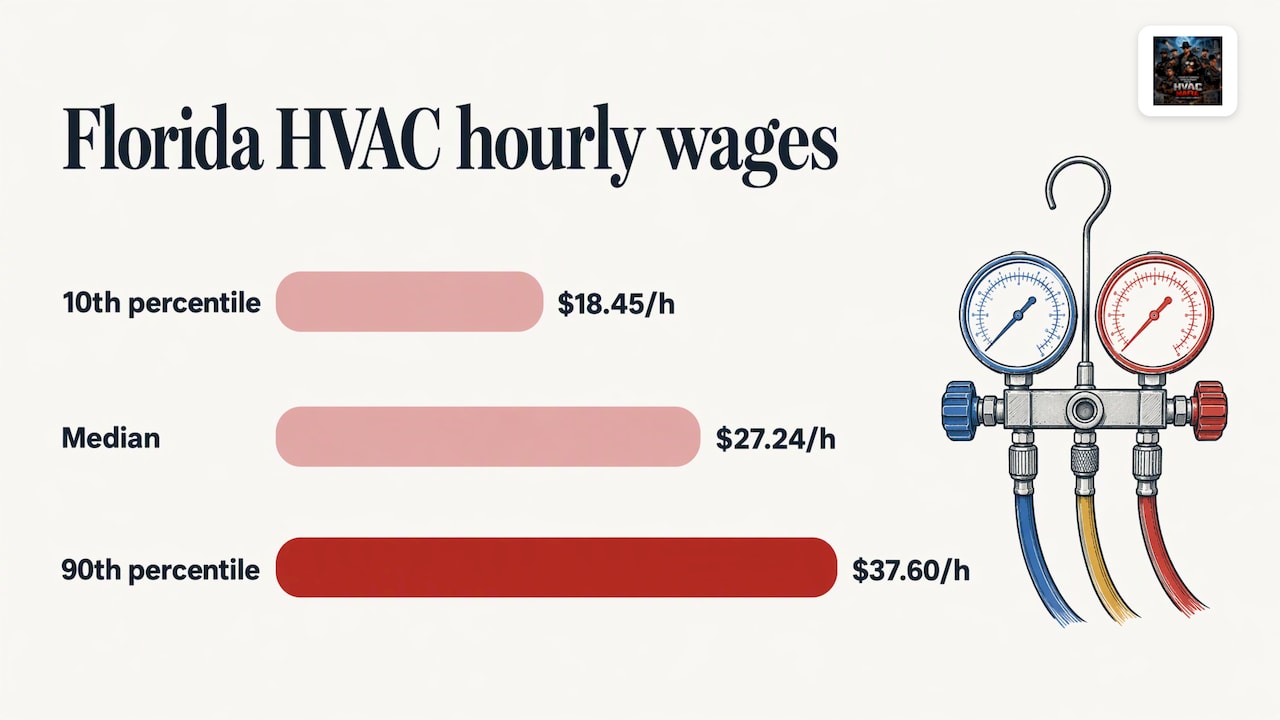
Wages vary by region, so check local numbers too. We have state-level breakdowns for Texas and Florida, and a look at commercial HVAC salaries.

Don’t stop at the hourly number. Compare the whole package: insurance premiums, retirement match, tools, truck, paid certifications and time off. Our guide on HVAC employee benefits shows what techs should expect.

Be careful with big earnings claims in ads. Some employers say graduates reach six figures. Morris-Jenkins says many Tech Builder graduates make more than $100,000 a year, and Just Right says experienced service techs average $100,000. Those are employers’ own statements about their own shops. Read them as what the job can grow into, and ask what a typical second-year tech makes there.

Where paid training leads

The training is the start. The better question is what you can be in five years.

Upton Air lays out a career path from apprentice to install tech, service lead, master tech and field manager, with pay that scales by skill and certification level, plus bonuses for installs, repairs and customer-rated work. Cheeky’s ladder runs from Maintenance Technician at $18 to $24 an hour through Service, Senior and Master Technician, where Master Technicians are listed at $36 to $40-plus.

The Tustin Group says advancement can go toward technician, specialty, mentoring or leadership roles depending on performance. If you like the idea of running a team one day, see our look at HVAC service technician careers and service manager jobs. Still deciding whether the trade is for you? Start with Is HVAC a good career?
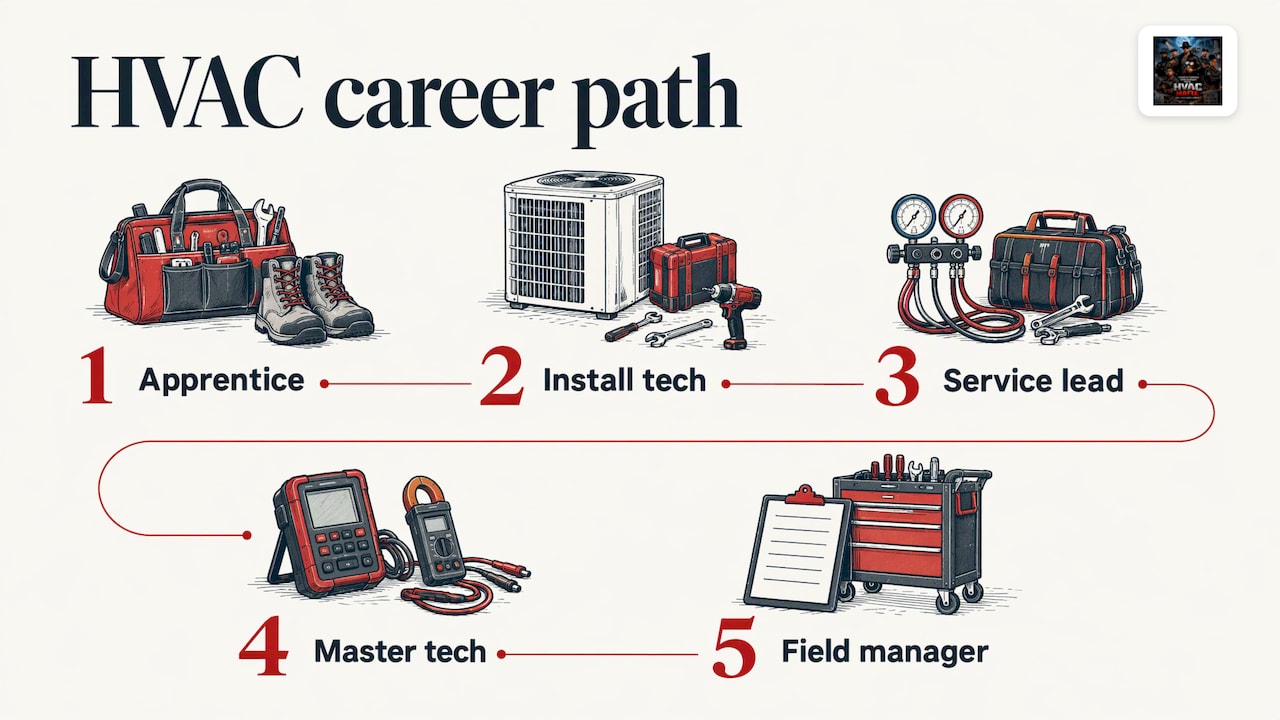
Where paid training leads

Questions to ask before you accept

A paid-training offer should survive a few plain questions. Ask them in the interview. A good employer likes that you asked.

  1. Is the apprenticeship registered with the Department of Labor, or union-run? Registered programs follow set standards, and your hours count toward journeyman status.
  2. How many field hours and classroom hours a year? Compare with the numbers in the table above.
  3. Who trains me, and how many techs do they train at once? A ride-along with a patient lead tech is worth more than a week alone in a van.
  4. Which certifications does the company pay for? EPA 608 is the baseline. Ask about NATE and manufacturer training.
  5. What are the tools and vehicle arrangements? Some employers give a tool allowance or a company vehicle after training. Get the conditions in writing.
  6. What happens at the end? Ask what the pay step is after training and what the next role is.
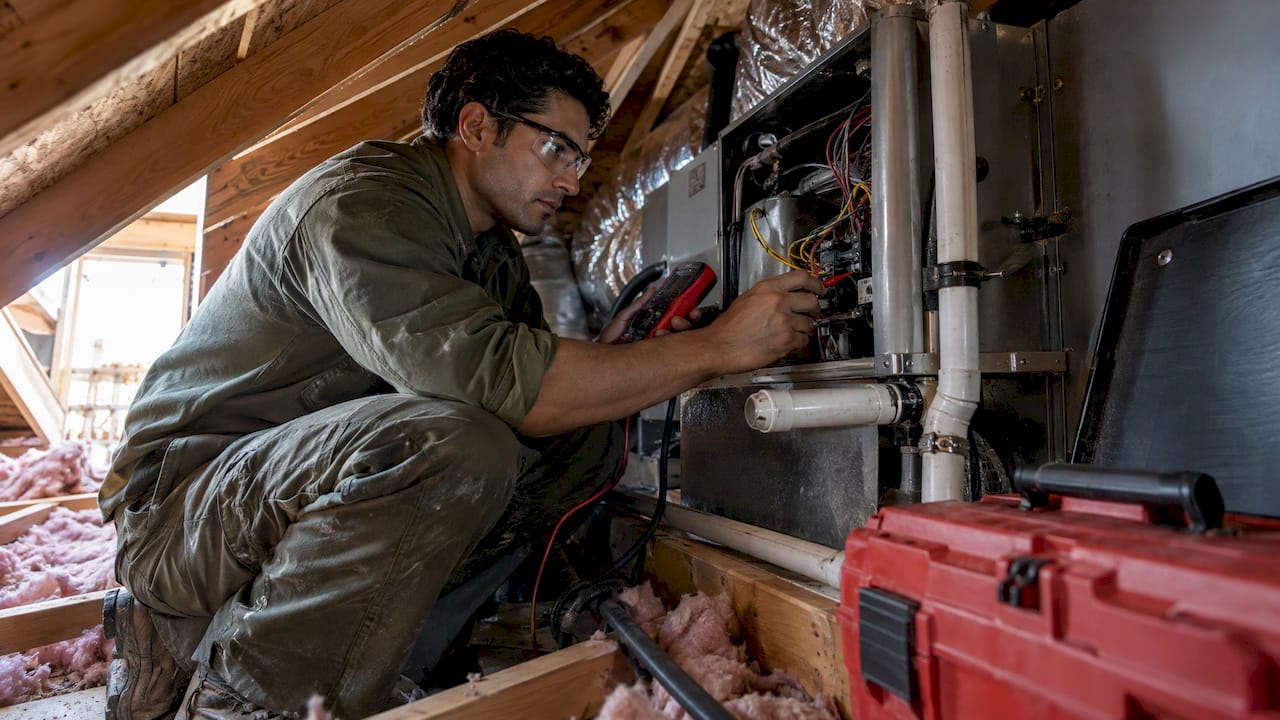
  7. How do you handle safety? You will work on rooftops, in attics and around electrical and refrigerant systems. Ask about safety training and equipment before day one.

And talk to the techs who work there. That is exactly why we built the Tech Talk forums: you can ask other techs what a company is really like.

Perspective

I have spent 36 years in this trade, and I owned a dealership. I know what it costs to hire a tech who walks off in month three, and I know what it costs a young person to take a job that never trains them.

Here is what we believe. The best paid-training jobs are an honest trade: you show up, work hard and learn, and the contractor invests in you with real hours, real mentors and a real path. When both sides take that seriously, you get a tech who stays and a shop that grows.

That is why HVAC Mafia is trade-only. Our job listings and community are restricted to verified HVAC trade professionals, so techs see openings from real contractors and talk with people who do the work, with no homeowner or outsider noise. We give techs straight talk on pay, career paths, certifications and how to spot good and bad employers, and Company Spotlight profiles let shops show their culture, pay and benefits up front.

If you are starting out, we would rather you find the right shop than the first shop. Join the family, ask the hard questions and build a career, not just another paycheck.

the author

Find paid training openings on HVAC Mafia

The openings on our board are hidden from non-members. Registering is free for technicians, apprentices and trade school students, and you never pay. Once you are in, you can browse jobs from real contractors, read about pay and employers, and join the Tech Talk forums and the HVAC Underground Podcast. Join as a member and start looking.

For contractors who train

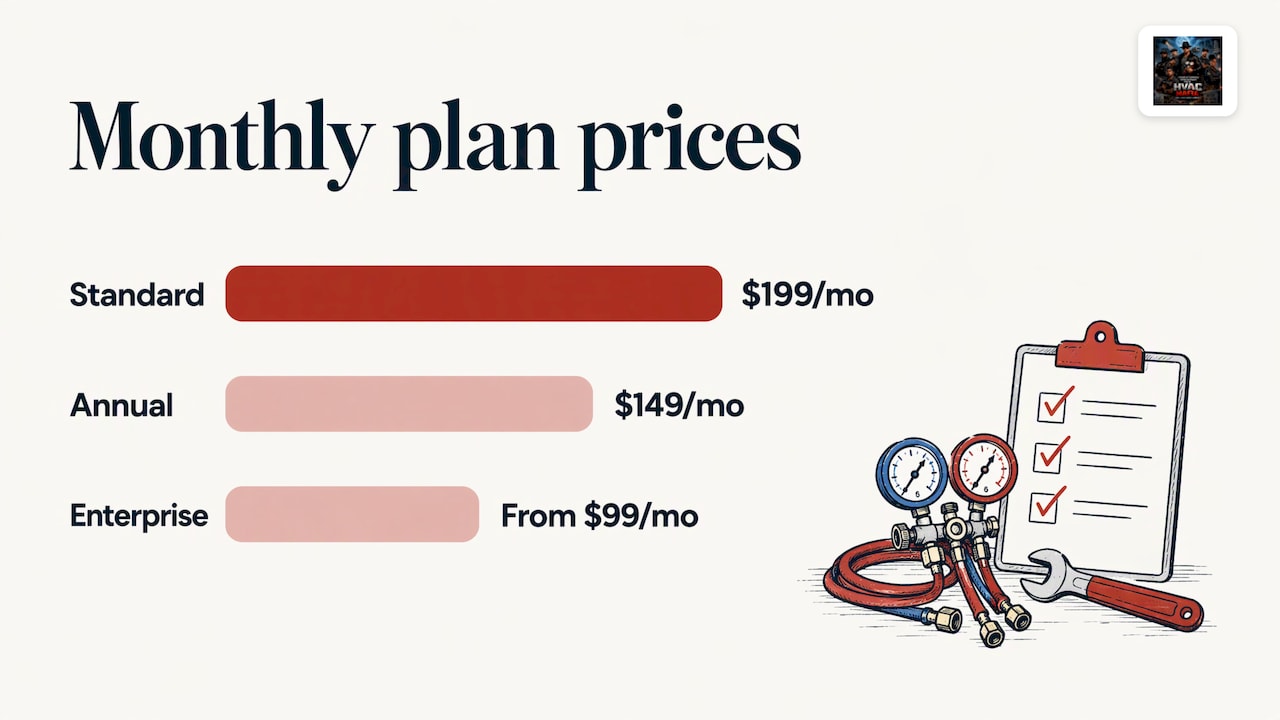
If you run a shop with a training program, your ad should say so, with hours, pay and what happens after. Contractors post to a trade-only audience of nearly 100,000 HVAC followers, and applications go straight to your own hiring system. Our job posting plans are Standard at $199 per month per position, Annual at $149 per month per position, and Enterprise from $99 per month per position. A Company Spotlight profile is $149 per month or $1,699 per year, and shows techs your culture, pay and benefits. For help writing the ad, see our guide on HVAC installer recruitment.

FAQ

Can you get paid while learning HVAC?

Yes. Company academies, registered apprenticeships and entry-level trainee roles all pay you as an employee while you train. Programs like Peterman Brothers’ academy charge no tuition and include classroom, lab and field training.

Do I need experience or a certification to start?

Not usually. Many postings, including Crosstown Mechanical’s, require no HVACR experience. They do ask for a minimum age of 18, a diploma or GED and a valid driver’s license. Employers often pay for certifications such as EPA 608 once you are on board.

How long does paid HVAC training last?

It depends on the type. Company academies run about 8 to 12 weeks, such as Cheeky’s. Registered apprenticeships run four to five years, with about 2,000 field hours a year in programs like The Tustin Group’s.

What does a paid trainee earn?

It varies by employer and region. Postings range from $15.07 to $26.37 an hour in Trane’s apprentice listing to a $20 starting wage at Howe, Inc.. Pay rises as you gain skills and certifications.

How do I find HVAC jobs with paid training near me?

Register free with HVAC Mafia to see openings from real contractors. Then compare each one on training hours, certifications paid, benefits and the path after training.

Thehvacmafia
Talk About Starting in HVAC
Email Randy with questions about finding HVAC opportunities, building trade skills, or what to look for in an employer.

Sources

HVAC Job Advertising Costs: What Posting a Tech Job Really Runs

HVAC job advertising costs depend on where you post and how long the job stays open. On HVAC Mafia, a trade-only job board, a posting runs $199 a month per position on the Standard plan, $149 a month per position on the Annual plan, and from $99 a month per position on Enterprise. That is a fixed, published price for a trade-only audience, so you know the bill before the first application comes in. The real number to watch is what you spend per technician you hire, and this article shows you how to work that out.

Thehvacmafia
Reach HVAC Technicians Looking for Work
Post openings for a trade-only audience, with applications going straight to your own hiring system.

Visit

TL;DR

  • Posting plans on HVAC Mafia: Standard is $199 per month per position, Annual is $149 per month per position, and Enterprise starts from $99 per month per position.
  • Extra visibility is priced separately: Spotlight runs $149 per week, $499 per 4 weeks, or $349 per month for ongoing placement, each per position.
  • Company Spotlight profiles, which show techs your culture, pay and benefits, cost $149 a month or $1,699 a year.
  • Judge any ad spend by cost per hire and by how long a truck sits idle, not by the sticker price of the listing.
  • Techs never pay. Registering is free, so your audience is made of people actively looking.

Table of Contents

What you actually pay for when you advertise an HVAC job

Most owners think of job advertising as one line item. It is really three costs stacked together.

  1. The listing itself. The fee to put the opening in front of people.
  2. Extra visibility. Featured placement, a company profile, anything that moves you above the pile.
  3. Your own time. Reading applications, returning calls, screening people who were never HVAC techs to begin with.

The third one is the one that quietly eats a service manager’s week. It is also the one you control most by choosing where you advertise. A general site sends you a flood. A trade-only board sends you fewer people who know what a TXV is.

That is the idea behind HVAC Mafia. Listings and community are restricted to verified HVAC trade professionals, so you reach skilled techs without homeowner or outsider noise. Openings are visible only to registered members, and applications go straight into your own hiring system.

HVAC Mafia posting prices, plan by plan

Here is what is published on the job posting plans page. Everything is priced per position, so one open lead tech role is one position.

Plan Price Best for
Standard $199 per month per position One or two openings, month to month
Annual $149 per month per position Shops that hire all year
Enterprise From $99 per month per position Multi-location or high-volume hiring

A quick example. You need two service techs and an install lead, three positions. On Standard that is 3 x $199 = $597 for a month. On the Annual plan the same three positions are 3 x $149 = $447 a month. If you hire steadily, the difference over a year is $1,800.

If you are running a lot of openings across branches, Enterprise starts from $99 per month per position. Ask about it before you build a hiring budget around the other two.

HVAC Mafia posting prices, plan by plan

Spotlight options: when you need to be seen first

Some openings cannot wait. A busy season is coming, a tech just walked, or the role is hard to fill. Spotlight on the Spotlight pricing page is the paid step up.

Spotlight length Price per position
1 week $149
4 weeks $499
Ongoing $349 per month

Run the math before you pick. Four weeks at $499 is $125 less than four straight one-week buys at $149 each ($596). Ongoing at $349 a month is the lowest monthly figure if you expect the role to stay open longer than a month. A 2-week and an 8-week option exist too, and their prices are on the pricing page.

Company Spotlight: advertising the shop, not just the job

A job post says what you need. A Company Spotlight profile says why a tech would want to work for you: your culture, your pay and your benefits, laid out where techs who have choices can read them.

It costs $149 a month or $1,699 a year, listed on the Company Spotlight page. The annual plan works out to about $141.58 a month, so it is the cheaper way to keep a profile live if you hire more than a few times a year.

Why does that matter for cost? Because the profile works for every posting you run. Techs who read how you pay and how you treat people arrive with fewer questions, and the ones who do not fit the shop tend to remove themselves before an interview.

The number that matters: cost per hire

Let’s make this practical. Take everything you spent on a hire and divide by the number of techs you actually hired.

Cost per hire = listing fees + visibility add-ons + hours spent screening and interviewing (at a real hourly value) + signing bonus or referral bonus, divided by hires.

Worked example: you run a Standard posting for 2 months ($398), add 4 weeks of Spotlight ($499), and spend about 12 hours on screening that you value at $50 an hour ($600). Total: $1,497 for one lead tech hire. On the Annual plan the posting cost drops to $298 for the same two months, so the total is $1,397.

Those are illustrations of the method, not benchmarks. Plug in your own hours and your own rates.

Now compare it with the cost of leaving the position open. A van that is not running is a van that is not billing, and a tech who is overworked covering for a missing teammate is a tech thinking about leaving. The job board fee is almost always the smallest number on the page.

Why the HVAC hiring market makes the audience matter

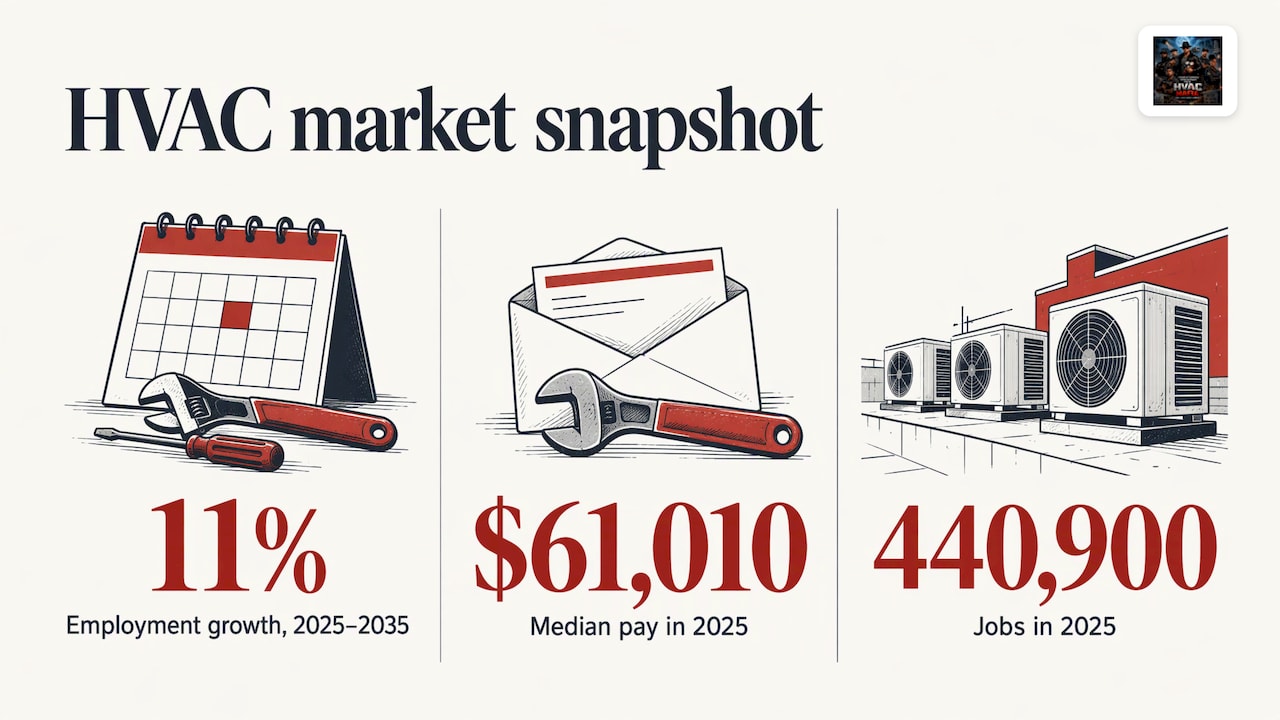
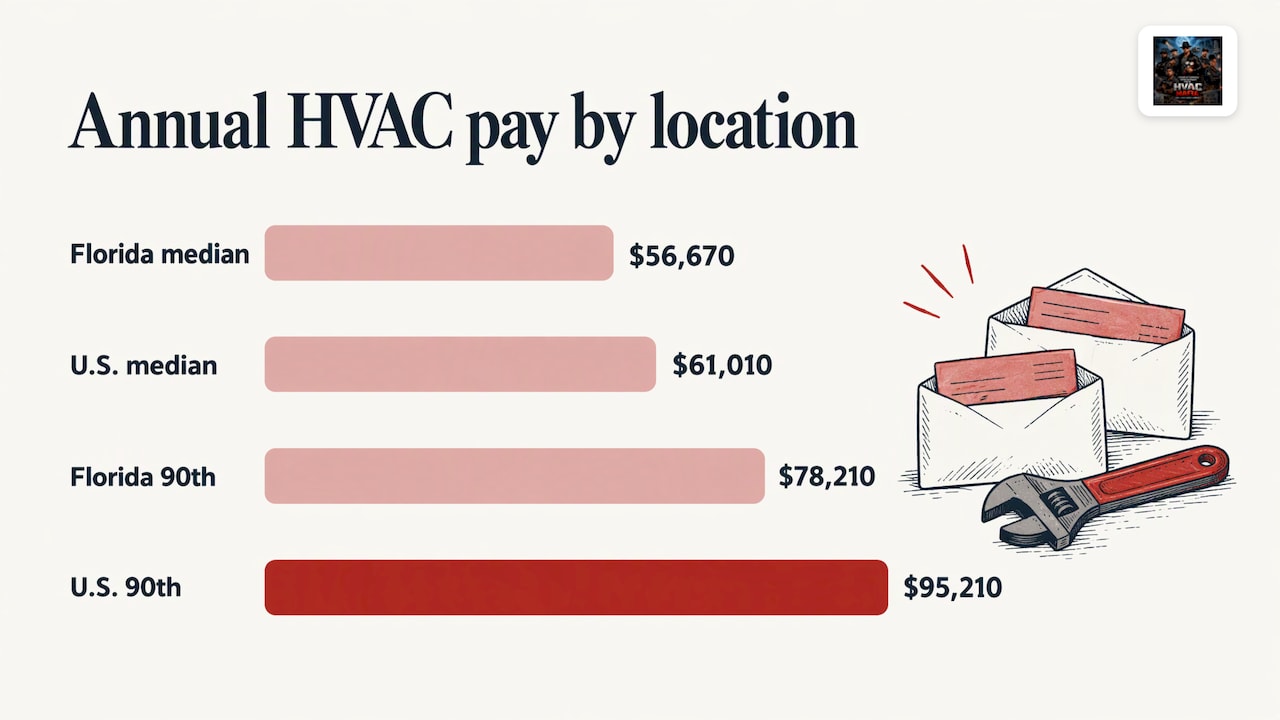
Demand for techs keeps growing. The Bureau of Labor Statistics projects 11 percent employment growth for heating, air conditioning and refrigeration mechanics and installers from 2025 to 2035, much faster than the average for all occupations. The same page reports a 2025 median pay of $61,010 a year, with about 440,900 jobs in 2025.

What that means for an advertiser: you are not just competing with the shop down the road. You are competing with every contractor who wants the same candidates. Your ad needs to reach techs who are looking, and tell them something real once they get there.

If you want the hiring side in depth, our guide to HVAC technician recruitment walks through how contractors hire and keep techs. For specific roles, see HVAC installer recruitment, commercial HVAC hiring and HVAC service manager jobs.

Why the HVAC hiring market makes the audience matter

How to make each advertising dollar go further

Put the pay in the posting

Techs scroll past ads without a number. Post the range. It cuts the time you spend on people who were never going to take the job, and it signals that your shop is straight with people.

Write for the tech, not for HR

Say what they will drive, what they will work on, what the on-call rotation looks like and who they will report to. Compare a vague “seeking motivated HVAC professional” with “Residential service tech, 5+ years, take-home van, 4 ten-hour days.” The second one gets the right calls.

Be specific about the role

A lead install tech, a refrigeration tech and a service manager are three different searches. Our listing for an HVAC install lead technician in Sharonville, OH shows the kind of specific, role-focused posting techs respond to.

Count your referrals

Your own techs know other techs. A referral bonus is a cost you only pay when it works. Our guide to building an HVAC referral recruiting program covers how to set one up, and it pairs well with a paid posting because the posting catches everyone your team does not know.

Keep the people you hire

Every tech who stays is a hire you do not have to advertise for. Retention is the cheapest recruiting you will ever do. Practical ideas for improving employee retention in a small business can help you keep recruiting costs from climbing every year.

Perspective

I spent 36 years in this trade, and a lot of them running a dealership. I know what it feels like to have a good truck and no one to put in it.

The mistake I see contractors make is shopping for the cheapest listing. The cheapest listing is not the cheapest hire. If your ad lands in front of people who have never touched a furnace, you pay with your own time, and your time is the most expensive thing in the shop.

That is why we built HVAC Mafia as a trade-only board. Techs register free, they see real openings from real contractors, and they find straight talk on pay, careers and what makes an employer worth working for. Contractors get a trade-only audience of nearly 100,000 HVAC followers, and applications go straight to your own hiring system.

Post the pay. Show your culture. Treat the people who answer like the professionals they are. Do that, and the listing fee is the easy part.

the author

Ready to post your opening?

If you have a position to fill, start with the job posting plans. Standard is $199 per month per position, Annual is $149 per month per position, and Enterprise starts from $99 per month per position. Want your shop to stand out too? The Company Spotlight profile shows techs your culture, pay and benefits.

HVAC Stickers — Vinyl Decals for Toolboxes  Trucks | HVAC Mafia

Techs and apprentices looking for work can join as a free member to see openings from real contractors.

FAQ

How much does it cost to post an HVAC job on HVAC Mafia?

Postings are priced per position per month: $199 on the Standard plan, $149 on the Annual plan, and from $99 on Enterprise. Spotlight placement is extra, at $149 for one week, $499 for four weeks, or $349 a month for ongoing placement. Current prices are on the job posting plans page.

Do HVAC technicians pay to see or apply for jobs?

No. Technicians, apprentices and trade school students use HVAC Mafia for free. They register as members to see openings, and they also get access to career guidance, Tech Talk forums and the HVAC Underground Podcast.

What is the difference between a job posting and a Company Spotlight?

A job posting advertises one open position. A Company Spotlight is a profile of your shop that shows techs your culture, pay and benefits. It costs $149 a month or $1,699 a year and supports every opening you post.

How do I know if my job advertising is working?

Track cost per hire: total spend on listings and add-ons plus the hours you put into screening, divided by the number of hires. Also watch how long each position stays open and how many applicants are actual HVAC techs. If those two numbers improve, your spend is working.

How many positions should I post at once?

Post every role you are actively trying to fill, because pricing is per position. If you have several openings across locations, ask about Enterprise, which starts from $99 per month per position.

Sources

HVAC Technician Productivity: How to Measure and Improve It

HVAC technician productivity is how much sold, finished, paid-for work a tech turns out of each paid hour. It is not how busy the truck looks. Most of the gap between an average shop and a great one is not tech skill. It is drive time, parts runs, callbacks and dispatch gaps, and those are fixable. Fixing them also takes the right people on the right trucks, which is why we built HVAC Mafia as a trade-only job board and community where contractors and techs find each other.

This guide is for techs who want to know how they are judged, and for service managers and owners who do the judging. We will keep the math simple, use real benchmarks, and show what moves the numbers.

Thehvacmafia
Build a Stronger HVAC Team
Explore a trade-built community where contractors connect with technicians and find straight talk on hiring, retention, pay, and career growth.

Visit

TL;DR

  • Productivity, utilization and efficiency are three different numbers. Utilization is billable hours divided by paid hours. Efficiency is how your actual time compares to the time the job was supposed to take. Productivity is the output you get per paid hour.
  • A 2026 report on 300 HVAC companies found about 5.7 of a tech’s 8.8 paid hours a day are billable, roughly 65%. The rest goes to travel, waiting, paperwork and callbacks.
  • The biggest wins are logistics: tighter routes, standard truck stock, fewer callbacks and fewer shop minutes.
  • Read the numbers in pairs. A tech with sky-high utilization can still be your least productive one.
  • Good productivity is also a hiring and retention issue. Techs who see fair measurement and good pay stay.

Table of Contents

What productivity, utilization and efficiency actually mean

People use these words as if they were one thing. They are not, and mixing them up leads to bad coaching.

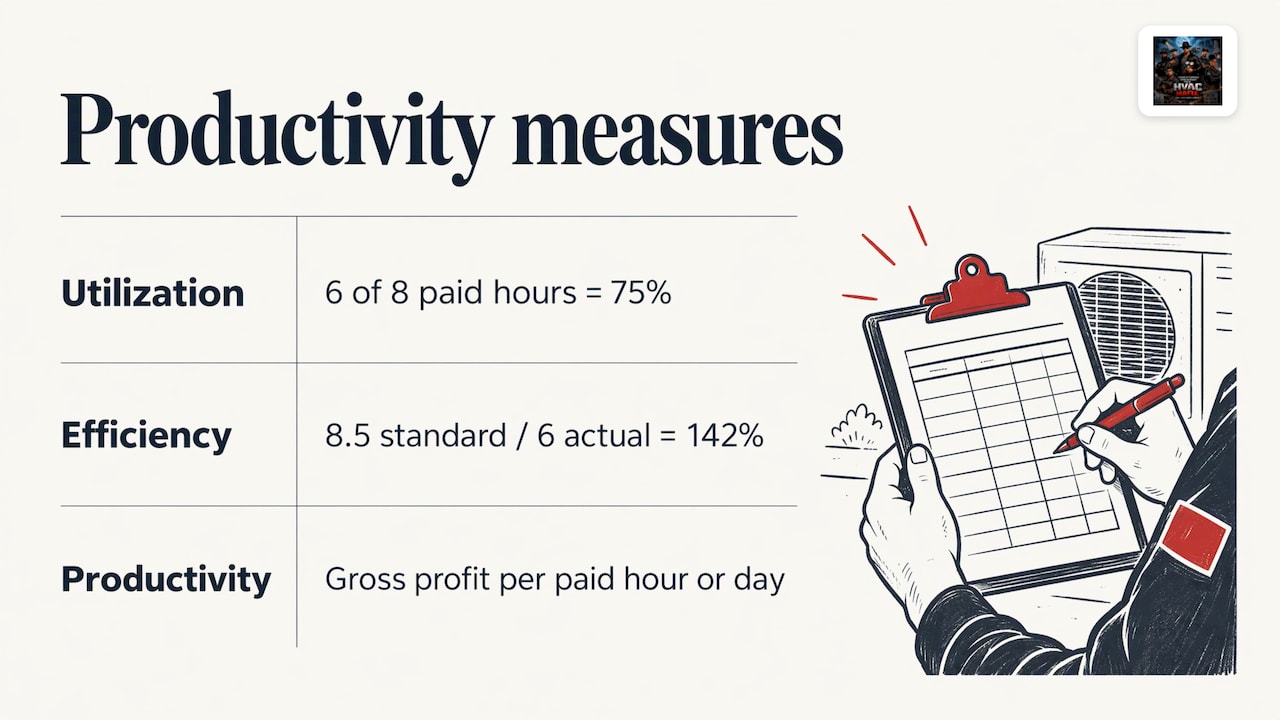
Utilization answers: was the day sold? Take billable hours, divide by total paid hours, multiply by 100. A tech with 6 billable hours in an 8-hour day is at 75%.

Efficiency answers: how well did the tech use the time on the job? It compares actual time to the standard time for that work. If a tech finishes work that was priced at 8.5 hours in 6 hours on the clock, that is about 142% efficiency. It rewards good diagnostics, the right tools and the right parts on the truck.

Productivity answers: did that time produce results? Many shops measure it in gross profit per paid hour or per day, not revenue alone. A tech can be on tools 90% of the day and still deliver little if the jobs were low value or poorly planned.

The three connect. Utilization is mostly the office’s job: dispatch, routing, scheduling. Efficiency is mostly the tech’s craft, supported by the price book and truck stock. Productivity is the result of both, plus how the work is sold.

What productivity, utilization and efficiency actually mean

Why “busy” is not the same as productive

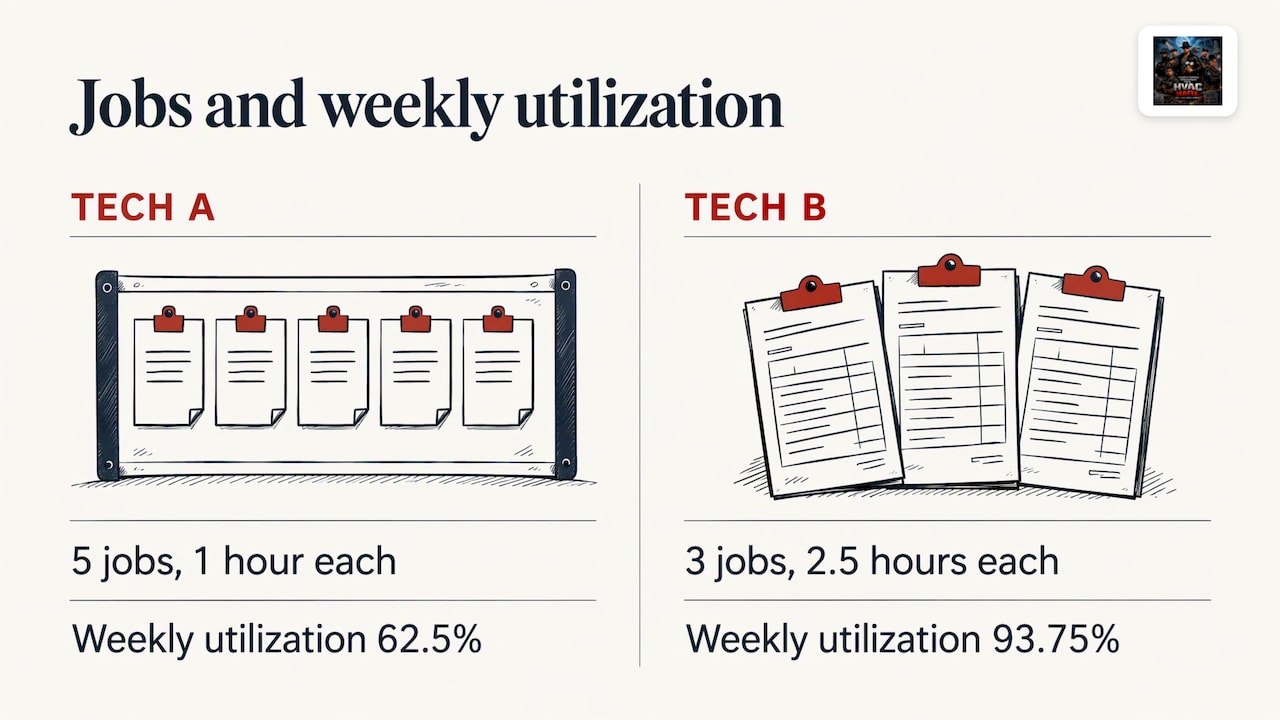
Here is a simple example. Tech A runs five one-hour jobs in a day. Tech B runs three jobs that each take two and a half hours. Tech A looks busier on the dispatch board, but job complexity changes what the numbers mean. A PTC walkthrough shows a five-job tech landing around 62.5% weekly utilization while a three-job tech with long repairs reaches 93.75%. Jobs per day alone tells you very little.

Utilization comparison for two HVAC technicians

How to calculate it: a worked example

Pull one tech’s week and do the math in four lines.

  1. Paid hours: 40.
  2. Billable hours: 28.
  3. Utilization: 28 ÷ 40 × 100 = 70%.
  4. Output: gross profit for the week divided by 40 paid hours, or by five days if you track per man-day.

Then add efficiency: if the jobs closed that week were priced at 32 standard hours and the tech spent 28 on them, efficiency is 114%.

Now compare to the field. The Field Promax report covered by ACHR News looked at more than 10,000 data points across 300 HVAC companies and found 5.7 of 8.8 paid hours per day were billable, about 65%. By that yardstick, 70% is solid, not a problem.

Older industry data shows the same pattern. The ACCA, the contractor trade association, has noted that non-billable time averages about 50% for service technicians, counting shop time, travel between jobs, holidays, callbacks, no-shows, warranty work and errands. Definitions differ between shops, so compare your own tech to your own history first, and to outside numbers second.

Benchmarks worth knowing

Use these as reference points, not report cards. Check the date and the type of shop each one comes from.

Measure Benchmark Source
Billable share of paid day About 65% (5.7 of 8.8 hours) ACHR News, June 2026
Non-billable time, best-in-class contractors 5% to 10% per year MCAA 2022 benchmark survey
Residential service tech annual sales At least $250,000 at 63%+ gross margin HVACR Business, 2018
Gross profit per service tech per day $630 HVACR Business, 2018
Callbacks Under 5%, with 1% best in class HVACR Business, 2018
Installer gross profit per day $825 per installer, $1,400 per two-person crew HVACR Business, 2018

Two cautions. The MCAA survey covers service contractors that tend to be mechanical and commercial, so a residential replacement shop will look different. And the HVACR Business figures are from 2018, so labor rates and ticket sizes have moved. Treat them as a structure for your own targets: sales, margin, billable time and callbacks.

The same HVACR Business piece describes a typical residential day as four service calls at a $250 average invoice. If your techs run three calls at $400, you may be more productive than the benchmark even though the call count looks low.

What actually drains a tech’s day

The Field Promax findings, as reported by The Hardwire News, point to the same five culprits: travel, dispatch gaps, paperwork, waiting and callbacks. Callbacks hurt most because the company pays for the second trip and usually cannot bill for it.

In plain terms:

  • Drive time. Jobs scattered across a metro area burn hours that nobody pays for.
  • Parts runs. Every run to the supply house is time off the unit.
  • Dispatch gaps. A tech finishes at 2:10 and the next job is at 3:30.
  • Paperwork. Notes, photos and invoices done at the end of the day, or at home.
  • Callbacks. A repair that did not hold. The first-visit fix rate matters because a miss costs a truck roll, a customer’s patience and a second tech hour.

That last one is often a systems problem, not a skill problem. Missing information on the work order, a part not on the truck, or a poor handoff can all produce a callback from a good tech.

What managers can do this month

The ACHR report lists concrete fixes. Here is the short version, with why each works.

  1. Group jobs by neighborhood and cap drive time between appointments at 30 minutes. Less windshield time, more wrench time.
  2. Standardize truck stock. When any truck can take any call, one missing common part does not wreck two routes.
  3. Start and end the day near home. Put each tech’s first and last jobs closest to where they live.
  4. Hold back about 5% of each day for emergencies. A schedule booked to 100% breaks at the first no-show.
  5. Run separate dispatch boards for installs and service. The report gives an example of two installs and four service calls per truck.
  6. Trim shop time. Cutting 15 minutes twice a day adds up to about 120 hours per tech per year.
  7. Set a 30-minute weekly truck maintenance window so a bad truck does not eat a billable morning.

The report also estimates that cutting unbillable time by 30 minutes a day saves $15 a day for a tech earning $30 an hour, about $39,000 a year across a 10-tech shop. It is an estimate, but the point holds: small minutes compound.

HVACR Business adds two ideas worth stealing. Keep a customized inventory list for each tech to cut supplier runs, and keep unbillable time under 25%. It also suggests a weekly training session on diagnostics and catching failures before they happen, and a required tool list for each job function so nobody is missing a tool at the customer’s door.

Measure with the right tools, but not just any tools

You cannot fix what you cannot see. Time data does not need to be fancy. A shop that wants to understand where paid hours go can start with clean clock-in data, and this look at time tracking return on investment for billable field crews shows how that data turns into payback. On the front end, a clear HVAC quote template gets estimates out the door faster, which keeps admin time from eating the end of the day.

How to evaluate performance without gaming the numbers

Every number you put on a board becomes a target, and targets get gamed. A tech measured only on utilization will take easy jobs and avoid the long diagnostics. A tech measured only on revenue will oversell. Some habits that hold up:

  • Read metrics in pairs. Utilization with first-time fix rate. Revenue per tech with callback rate. Average ticket with customer rating.
  • Use the same measures for every tech over the same period. Weekly reviews work better than a surprise at the end of the month.
  • Separate what the tech controls from what the office controls. Utilization is largely a scheduling outcome. Do not coach a tech on a number that dispatch drives.
  • Show techs their own scorecard. People improve when they can see the gap.
  • Pay for gross profit with quality guards. Compensation that rewards billable hours far more than unbillable ones lines up incentives, as HVACR Business suggests, but pair it with callback and customer-rating checks.

A reasonable starting scorecard for a service tech: utilization, first-time fix rate, callback rate within 30 days, average ticket, revenue or gross profit per paid hour, and customer rating. Six numbers is plenty.

If you are a tech: how to raise your own numbers

You do not control the schedule, but you control more than you think.

  • Own your truck stock. Ask for a stock list based on the parts you actually use. Review it monthly.
  • Diagnose before you pull parts. Many callbacks start with a rushed diagnosis. Slow down on the first ten minutes and save the second trip.
  • Write good notes. The next tech, or you in three weeks, should not have to start from zero.
  • Learn the equipment you see most. Skill gaps on specific equipment show up in repeat visits. Training closes them, and training is how you move up. Our guide to the HVAC service technician career covers pay, path and next steps.
  • Know what the shop measures. If you are judged on a number, ask how it is built and what is in it.

One more point. Productivity targets matter most when the shop pays fairly for hitting them. If you are strong on the numbers, you have leverage. Our look at commercial HVAC salaries can help you see what that is worth.

If you are a manager: productivity starts with the people

All the routing and software in the world will not fix a truck without a tech. Service managers tell us the same thing: the numbers sag when a position stays open, when a good tech leaves, or when a new hire has no ramp. Hiring and keeping the right people is part of productivity.

That is also where the pay, culture and advancement conversation lands. Techs with choices look at how a shop schedules, what it pays, and whether the equipment and truck stock let them do good work. If you are stepping into this role, HVAC service manager jobs: pay, path and how to hire walks through what the job demands.

Our perspective

We have spent a lot of years in this trade, and the founder of HVAC Mafia spent 36 of them in it, including running a dealership. Here is what we keep coming back to.

Productivity is not a tech problem. It is a shop problem that shows up on a tech’s timecard. A great tech on a bad route, with a half-stocked truck and no dispatch plan, looks average. A good tech with a clear schedule, the right parts and a boss who coaches looks like a star.

The other half is people. You cannot schedule your way out of a staffing hole. And techs who feel measured fairly and paid honestly stay. That is why we built a place where verified trade professionals talk straight about pay, careers and what makes a contractor worth working for.

For contractors, that means your openings reach a trade-only audience of nearly 100,000 HVAC followers, and applications go straight to your own hiring system. For techs, it means free membership, real openings from real contractors, and forums where other techs tell you how it is.

Build a career, not just another paycheck. Build a shop people want to work for. The numbers follow.

the author

Hire the techs who make the numbers work

If your productivity problem is an empty seat, or a seat that keeps turning over, we can help. Job postings on HVAC Mafia run $199 per month per position on the Standard plan, $149 per month per position on the Annual plan, and from $99 per month per position on Enterprise. You can see the options on our job posting plans page.

Want techs to see what your shop is really like, including culture, pay and benefits? A Company Spotlight profile is $149 per month or $1,699 per year.

HVAC Polo Shirt — Slim Fit Performance Polo | HVAC Mafia

Techs and apprentices, you never pay. Join as a member to see job openings from contractors across the country. Openings are hidden from non-members.

FAQ

What is a good productivity percentage for an HVAC technician?

It depends on how your shop defines it. Billable hours divided by paid hours is the most common definition, and a 2026 industry report found the average is about 65%. HVACR Business has recommended keeping unbillable time under 25%, which means 75% utilization or better. Use your own shop’s history as the first benchmark.

What is the difference between efficiency and productivity?

Efficiency compares the time a tech actually spent on a job with the standard time for that work. Productivity measures what that time produced, often as gross profit per paid hour. A tech can be efficient on low-value work and still have low productivity.

How do you calculate HVAC technician utilization?

Divide billable hours by total paid hours and multiply by 100. A tech with 28 billable hours in a 40-hour week is at 70%. Drive time, shop time, parts runs and callbacks are what usually sit in the non-billable column.

What lowers technician performance the most?

Travel, dispatch gaps, paperwork, waiting and callbacks are the main drains, according to coverage of the Field Promax report. Callbacks are especially costly because the second trip is usually not billable. Missing parts and unclear work orders cause many of them.

How can a service manager improve technician performance?

Start with the schedule and the truck: group jobs by area, cap drive time, standardize stock and leave room for emergencies. Then review a small set of metrics weekly with each tech, and read them in pairs. Fill open positions so your best techs are not carrying the load.

Sources

HVAC Jobs With Training: Get Paid to Learn the Trade

You can start in HVAC without experience and get paid while you learn. Employers hire trainees, helpers and apprentices to work beside experienced technicians, and some run structured programs of 10 weeks to four years. The hard part is telling a real training job from a warehouse job with a nice title. This guide shows what these jobs pay, what they ask for, and how to pick one that builds a career, not just another paycheck.

Thehvacmafia
Find an HVAC Job That Builds Skills
Explore openings from real contractors and find opportunities to grow your HVAC career, from apprentice roles to experienced technician positions.

Visit

TL;DR

  • Three routes lead into a paid HVAC start: an employer trainee program, a registered apprenticeship, or a short trade school course followed by an entry-level job.
  • Listings we reviewed start around $16 to $20 an hour for trainees. Experienced technicians earned a median of $61,010 a year in May 2025.
  • Most entry roles need no HVAC experience, but expect age, diploma and driver’s license requirements.
  • Ask every employer what the training covers, how long it lasts and what your raise looks like when it ends.
  • Technicians register free with us and see openings from real contractors that non-members can’t see.

Table of Contents

Three ways to get paid training in HVAC

The U.S. Bureau of Labor Statistics (BLS) says HVAC technicians typically need a postsecondary nondegree award, such as a certificate, though some enter with less education. New hires typically get long-term on-the-job training, and no related work experience is required. A four-year degree is not part of the picture. Here is how the routes break down.

Employer trainee programs

These are short, paid programs, often 10 weeks, that teach one job: maintenance, installation help or service support. A HELP HVAC Maintenance Trainee listing requires no previous HVAC experience and offers a 10-week paid program. It covers residential inspection, cleaning, maintenance, tools, furnaces, air conditioners, condensers, customer communication and safe work. A Timos trainee listing also offers 10 weeks of paid training at $16.90 an hour. Its duties include diagnostics, routine checks, filter replacement and documentation.

Registered apprenticeships

An apprenticeship is the long road, and often the strongest one. BLS says apprenticeships usually last several years and combine paid on-the-job training with technical instruction. One Trane HVAC Service Apprentice listing describes a four-year registered apprenticeship. It includes paid instruction, mentors, pay increases and a nationally recognized credential at the end. The same listing says no industry experience or formal HVAC training is required.

Trade school first, job second

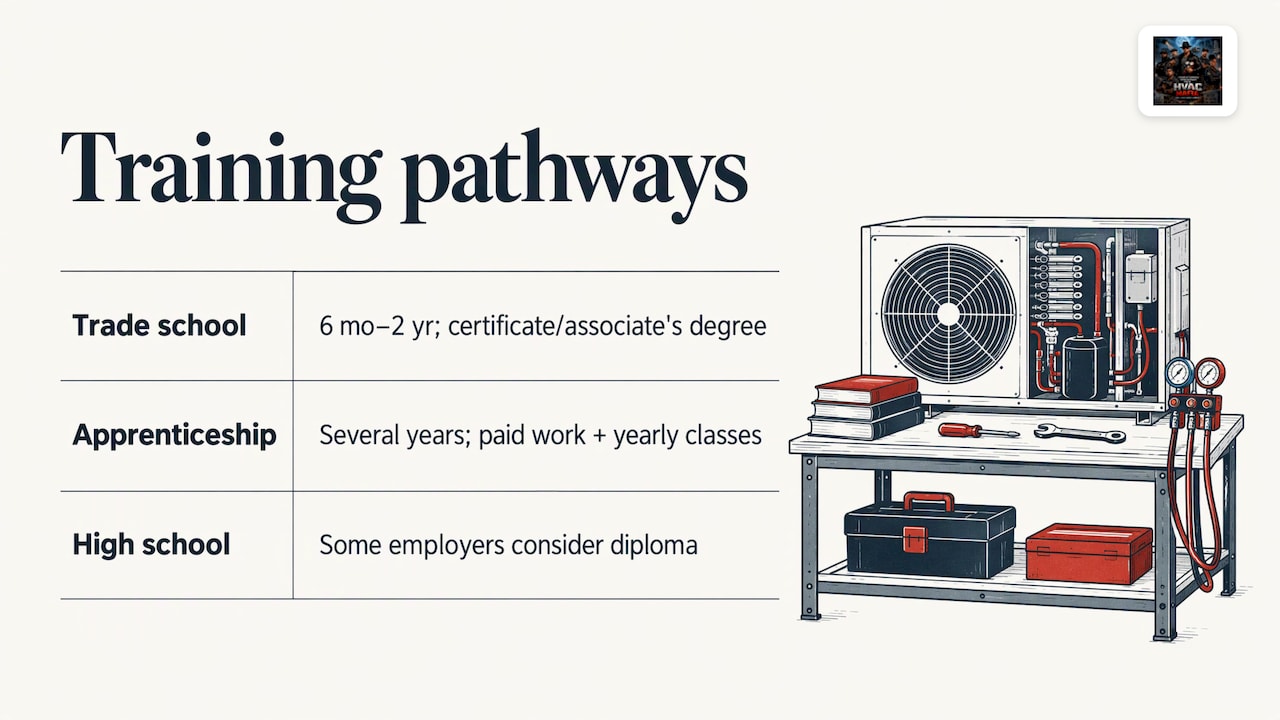
BLS says HVAC programs generally take six months to two years and lead to a certificate or associate degree. Some are shorter and tied to employers. Delaware’s state job portal lists a 12-week, 420-hour HVAC and refrigeration program split equally between classroom and lab. Massachusetts’ Greenfield Community College runs a four-month entry-level program that includes help finding a paid internship or job, plus a year of follow-up support.

School costs money and time before you earn. An employer program pays you from day one. Many people mix the two: start as a helper, then add classes while working.

What the jobs look like day to day

Titles vary, so read the duties. The federal O*NET database lists common titles for the occupation, including HVAC mechanic, HVAC installer, HVAC service technician and refrigeration technician. It defines the work as installing or repairing heating, central air, HVAC or refrigeration systems.

At the entry level, expect this:

Role type What you do Example listing pay
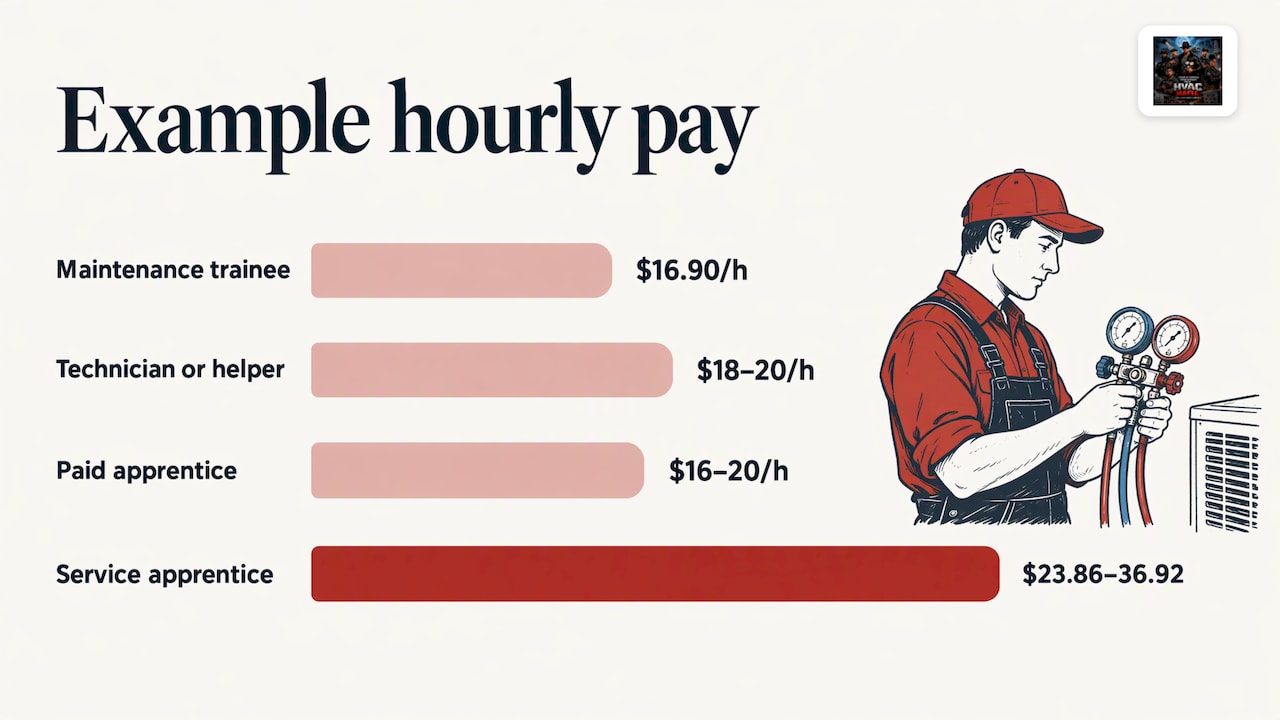
Maintenance trainee Inspections, filter changes, cleaning, tool use, customer contact $16.90 an hour, 10 weeks of paid training
Entry-level technician or helper Assist field techs, learn parts, tools and inventory, sometimes starting in a warehouse $18 to $20 an hour
Paid apprentice Ride-alongs, weekly classroom and hands-on training, maintenance, repairs, installs $16 to $20 an hour
Service apprentice Help install and repair environmental-control systems under experienced techs $23.86 to $36.92 an hour

The pay figures come from the Day & Night entry-level listing, the Cheeky Tech Academy listing and the Trane and Timos listings above. Listings change, so treat them as examples of the pattern. The Day & Night listing shows how real this can be: hires start in a warehouse learning equipment, parts, tools and inventory while assisting field technicians. That is useful time if the employer moves you to the truck on a schedule. It is a dead end if nobody can tell you when.

AAON’s Field Service Technician I listing shows another level. It is an entry role in installation, startup, maintenance, troubleshooting, inspections, documentation and commissioning, under general supervision. Commercial and manufacturer work often looks like this. If you lean that way, read our look at commercial HVAC salaries.

What the jobs look like day to day

What HVAC training jobs pay

Start low, grow fast. That is the honest summary.

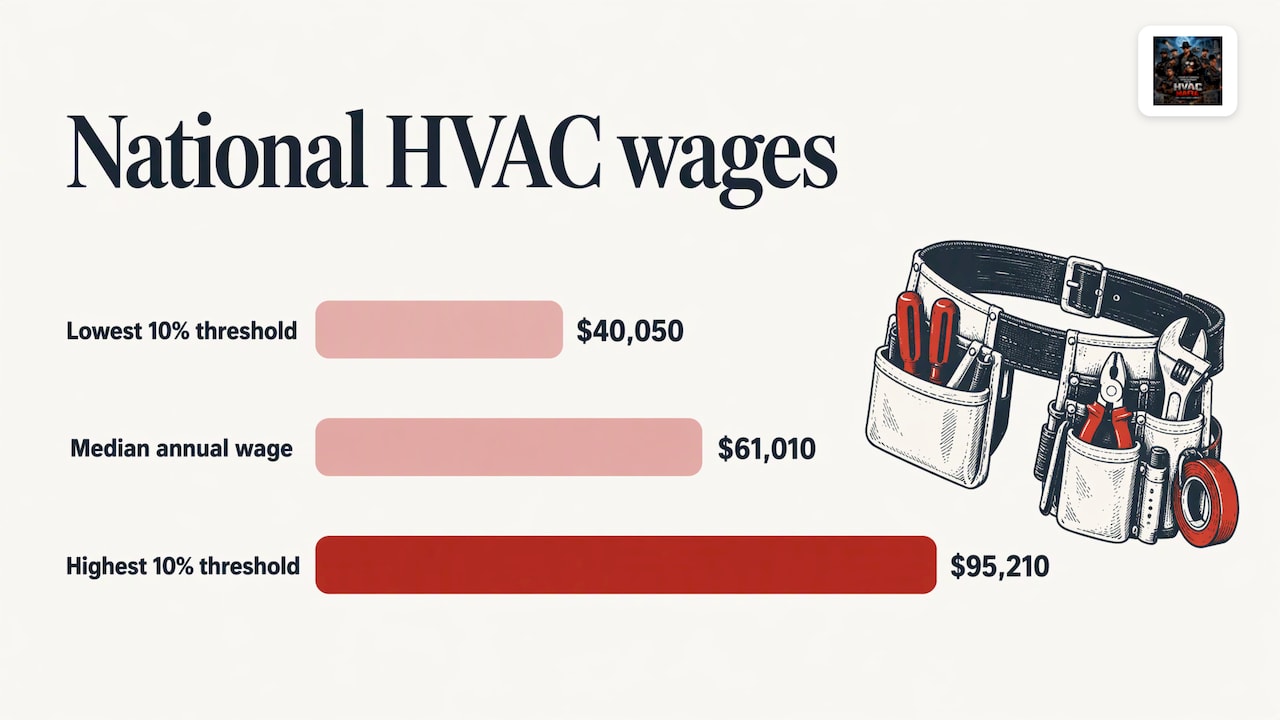
BLS reports that heating, air-conditioning and refrigeration mechanics and installers had a median pay of $61,010 a year, or $29.33 an hour, in May 2025. The lowest 10% earned less than $40,050 and the highest 10% more than $95,210. BLS’s wage table puts the 25th percentile at $48,360 and the 75th at $77,060. These figures cover all experience levels, and BLS updates them annually.

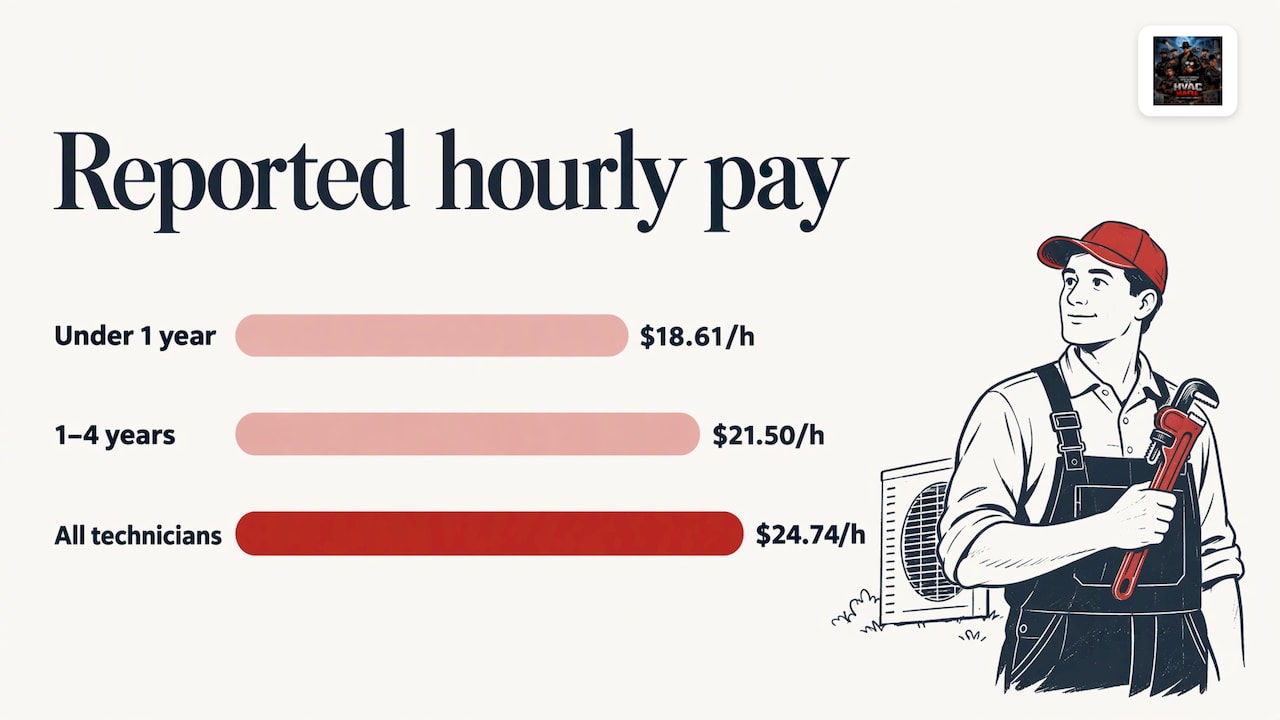
PayScale, which collects self-reported salaries, shows the early-career picture. Its page, updated October 2026, reports average total pay of $18.61 an hour for technicians with under a year of experience and $21.50 for one to four years, including tips, bonuses and overtime. Its median across all technicians is $24.74 an hour, based on 1,201 profiles.

So a trainee at $16 to $20 an hour is not stuck there. The Cheeky listing gives a sample ladder: $18 to $24 an hour for maintenance technicians, $20 to $40-plus for service technicians, $26 to $30 for senior technicians and $36 to $40 for master technicians. That is one employer’s example, not a promise from every shop. Still, it shows what to ask for: a written path with steps and numbers.

Pay also depends on your state and your specialty. For regional detail, see what techs earn in Texas and Florida. For the full ladder from helper to lead, read our guide to the HVAC service technician career.

The demand behind those jobs is steady. BLS counted 440,900 jobs in 2025 and projects 11% growth from 2025 to 2035, about 48,200 additional jobs. Shops need people, which is why they train.

What HVAC training jobs pay

What you need to apply

Most entry-level training jobs ask for the basics, not experience:

  • Age: 18 or older. Both the Trane listing and the Delaware program say so.
  • Education: a high-school diploma or GED. BLS notes that employers sometimes consider applicants whose highest education is a high-school diploma, and that vocational classes, math and physics help.
  • Driver’s license: Trane asks for one held at least 12 months, without major or frequent violations in the prior three years. You will drive a work vehicle to customer homes, so this matters.
  • Physical ability: the Massachusetts program lists lifting over 20 pounds.
  • Screening: the Delaware program lists reading and math testing, a background check and drug testing.
  • Work authorization: the Massachusetts program requires U.S. work authorization.

Program rules differ by state and employer, so read each posting closely. If your resume is thin, lead with anything hands-on: auto shop, construction, electrical, military, even a school vocational class. Our guide to the HVAC technician resume shows how to write it.

Certifications you will hear about

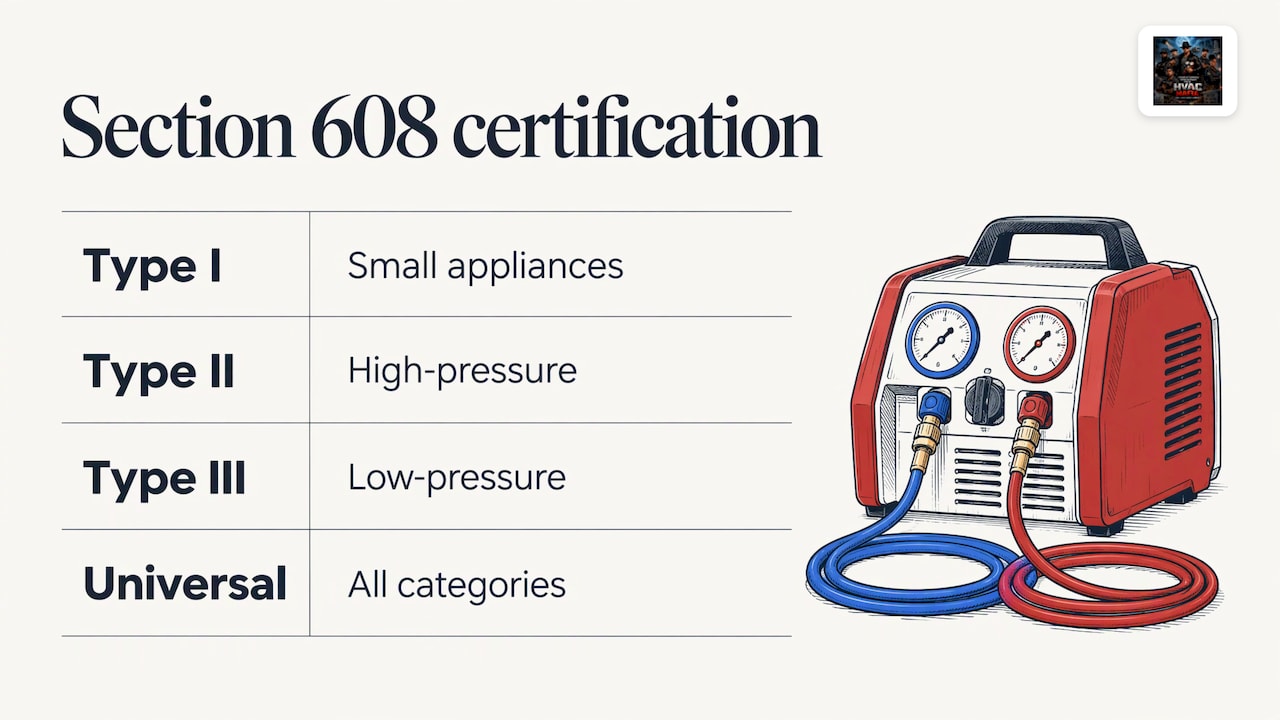
BLS says nearly all HVAC technicians need certification in proper refrigerant handling, earned by passing an exam that is typically included in a postsecondary HVACR program. State or local licenses may also apply. Manufacturer and industry certifications are often optional, but some employers prefer or require specific ones.

The good training jobs build credentials into the program. Delaware’s course lists NCCER Core, NCCER HVAC Level 1, EPA Section 608, first-year apprenticeship certification and OSHA-10 among completion credentials. The Massachusetts program prepares participants for EPA 608 Universal, NORA Bronze, a state oil-burner credential, OSHA-10, NATE Ready-to-Work and credentials for newer refrigerants. Those credentials follow you to your next employer.

A useful question in any interview: who pays for the exam, and do I get paid time to study?

How to tell a real training job from a bad one

A “training” label costs an employer nothing. Ask these before you accept:

  1. How long is the paid training, and what is my pay during it? Ten weeks, one year and four years are all real answers. “We’ll see” is not.
  2. Who trains me? A named senior tech or mentor beats “you’ll ride with whoever’s free.”
  3. How much is classroom and how much is field work? Look for both, such as weekly classroom and hands-on sessions.
  4. What credentials will I leave with? EPA 608, OSHA-10 and others should be named.
  5. What happens when training ends? Ask for the next title and the pay range in writing.
  6. What do techs get besides wages? Tools, truck, health coverage, overtime and PTO. Our guide to HVAC employee benefits lists what to expect.
  7. Is it residential, commercial or refrigeration? Pick the track you want to grow in.

Also ask how long the people on the crew have been there. Turnover tells you a lot about how a shop treats its techs.

How to land the job, step by step

  1. Pick your track. Residential service, installation, commercial or refrigeration. Installation is often the quickest door in, and service usually pays more as you grow.
  2. Get the basics in order. Check your license record, your diploma or GED and your ability to pass a background check.
  3. Write a one-page resume. Hands-on work, reliability and a clean license go first.
  4. Look where contractors post. Register free with us and browse openings placed by real contractors. We built the board for HVAC people, so you see trade jobs and not general noise.
  5. Apply to several, fast. Applications on our board go straight to the employer’s own hiring system, so your answer comes from the shop and not from a middleman.
  6. Interview with your list of questions. Use the seven above.
  7. Plan the first year. Aim for EPA 608 and OSHA-10, learn from your lead and ask for a review at the end of training.

Our perspective

I spent 36 years in this trade, and I owned a dealership. I have hired techs, lost techs and trained a lot of them. A new tech’s first year decides whether they stay. If the first ninety days feel like being thrown away, they leave. If they feel like being taught, they build a career.

The shortage is real. Shops need you more than the posting makes it sound. That means you get to ask hard questions: what does training cover, who teaches it, what does the raise look like? A good contractor will answer without flinching.

That is why we built HVAC Mafia as a trade-only job board and community. Technicians register free and see openings from real contractors. They get straight talk on pay, certifications and spotting good and bad employers. They can also trade stories in Tech Talk forums and on the HVAC Underground Podcast. We think you deserve more than a link to a faceless posting. You deserve a community that has been where you are.

No corporate fluff. No shortcuts. Just knowledge, loyalty and respect.

the author

Find your training job on HVAC Mafia
Registering as a technician, apprentice or trade school student is free, and it unlocks the openings that are hidden from non-members. You will see jobs posted by contractors who are looking for people in this trade, plus career guidance on pay, certifications and what makes an employer worth working for. Join free as a member and start browsing.

Make HVAC Great Again™ Front  HVAC Mafia Back T-Shirt

If you are on the hiring side, you can post a job in front of a trade-only audience of nearly 100,000 HVAC followers. Our job posting plans run $199 a month per position on Standard and $149 a month per position on Annual. Enterprise starts from $99 a month per position. Company Spotlight profiles ($149 a month, or $1,699 a year) show techs your culture, pay and benefits.

For contractors: why a trainee program pulls in applicants

Trainee listings that rank well share a pattern: they say what the job pays, how long paid training lasts and what the tech can earn afterward. Those same details answer the questions careful applicants ask. If you are struggling to hire, spell out the ladder, name your mentors and show your benefits. Our piece on HVAC installer recruitment covers how to hire and get hired, and our guide to whether HVAC is a good career shows what candidates are weighing before they apply.
FAQ

Do I need experience to get an HVAC job with training?

No. Many listings state no previous HVAC experience is needed, including the HELP trainee program and the Trane apprenticeship. BLS also says no related work experience is required for this occupation. Prior training can help with starting pay.

Is a degree necessary to start in HVAC?

No. BLS says technicians typically need a postsecondary nondegree award, like a certificate, though some enter with less. Apprenticeships combine paid on-the-job training with classroom instruction, so you can earn while you learn.
What is the fastest way to get HVAC certified?

The refrigerant handling certification, EPA 608, is the one nearly all technicians need, according to BLS. The exam is typically part of a postsecondary HVACR program. Short programs, like the 12-week Delaware course, include it among their credentials.

How much does an HVAC technician make in the U.S.?

BLS reported a median of $61,010 a year, or $29.33 an hour, for May 2025. Entry-level trainees start lower, often $16 to $20 an hour in the listings above, and pay rises with certifications and experience.

What are common HVAC job titles?

O*NET lists HVAC mechanic, HVAC installer, HVAC service technician, HVAC control technician and refrigeration technician, among others. Read the duties in each posting, because titles differ between shops.

Sources

HVAC Referral Recruiting: How to Build a Program That Works

The best HVAC referral recruiting programs do four things: pay a real bonus, pay it in stages after the hire proves out, make submitting a referral take a minute, and give employees a job post they can share with confidence. Referrals open the door. A visible, trade-only job listing is what keeps that door from being the only one you have. If you are a contractor or service manager short on techs, here is how to set it up, with real bonus numbers from shops that publish them.

Thehvacmafia
thehvacmafia.com
Reach Technicians Beyond Referrals
Put your open roles in front of a trade-only audience, with applications going straight to your hiring system.

Visit

TL;DR

  • Published HVAC referral bonuses run from $200 for entry-level hires up to $2,500 for experienced techs, usually paid in two installments.
  • Pay in stages (30, 90 or 180 days) so the bonus rewards a hire who stays, not just one who starts.
  • Use one short form that goes straight to whoever owns hiring, and write the rules down: who is eligible, what counts, when it pays.
  • Referrals only reach your employees’ circles. Pair them with a job post that technicians can find and forward.
  • Techs and apprentices: register free to see openings from real contractors, then pass the good ones to your crew.

Table of Contents

Why referrals matter more in a shortage

A referral works because a tech vouches for another tech. They know who shows up, who can run a service call alone and who will fit the crew. That is hard to learn from a résumé.

The shortage makes this more valuable. ACHR News reported in June 2026 that the industry is short more than 100,000 technicians and could see a gap of 225,000 within five years. A separate study covered by ACHR News in March 2026 projected that 192,365 HVAC technician jobs will be unfilled by 2030. Enrollment is rising: two-year HVACR programs grew nearly 30% in 2025 and another 16.7% in 2026, according to National Student Clearinghouse data cited by ACHR News. But industry leaders in the same report say retirements still outpace new entrants in many markets.

When good techs are scarce, the ones you already employ are your best recruiters. For the wider picture, see our guide to how contractors hire and keep techs and the real numbers behind the shortage.

What HVAC shops actually pay for a referral

You do not have to guess at a number. Several contractors publish their terms.

Shop Bonus Payout timing
Advance Industrial Mechanical $1,000 when a Field HVAC Technician referral is hired, plus $1,000 more Second $1,000 after 90 consecutive days
Polk Mechanical $2,000 for service role hires 50% at 90 days, 50% at 180 days
Appolo Heating $200 (no HVAC experience) up to $2,500 (5+ years) Two installments, at 30 and 90 days
McWilliams & Son (Texas) Up to $1,000 per hire, plus $2,000 each hire anniversary, as reported in October 2025 Recurring on the anniversary of the hire date
Leap Partners Bonus plus a raffle entry for a $5,000 family vacation check, per ACHR News in March 2023 90-day and six-month anniversaries

Three patterns stand out.

Bonuses scale with experience. Appolo’s tiers run from $200 to $2,500 depending on the hire’s HVAC background. Leap Partners also raises bonuses for more experienced hires. A lead installer is worth more to you than a helper, and the payout should say so.

Payouts are staged. Every program above holds some or all of the money until the hire has stayed 30, 90 or 180 days. That protects you from paying for someone who walks in month two, and it gives the referrer a reason to help the new hire succeed.

Some programs reward loyalty over years. McWilliams & Son’s annual anniversary bonus turns a referral into a long-term stake in the hire staying.

Pick a number you can sustain. If your cost to fill a service tech seat through ads and downtime is high, a $1,000 to $2,000 bonus split across 90 and 180 days is in line with what these shops publish.

How to set up the program, step by step

1. Decide who and what is eligible

Write down which roles qualify (service techs, installers, apprentices, commercial and refrigeration techs, service managers). Decide who can refer: all employees, or everyone except the hiring manager and owner’s family.

Advance Industrial Mechanical’s terms add a useful rule: the candidate must not have applied within the prior 6 months. Without a rule like that, you will argue over whether a referral was really new.

2. Set the bonus tiers and the payout clock

Use the table above as a starting range. Tie the amount to role and experience, then pick your clock: 30/90 days for fast feedback, 90/180 days for stronger retention protection. Say plainly that the bonus is paid on the referrer’s next regular payroll after the milestone, if the referrer is still employed.

3. Handle ties and caps before they happen

Polk Mechanical states that there is no cap on the number of referrals an employee can make, and that if several employees refer the same candidate, the first referrer receives the reward. Both are simple and fair. Copy the logic, not the wording.

Appolo requires the referral to be submitted before the candidate’s first interview. That one line prevents most after-the-fact claims.

4. Make submitting a referral effortless

If a referral takes ten minutes and several logins, you will get fewer of them. A widely used best practice is a single web form that captures the referrer, the candidate’s name and contact information, the role and a short note, and routes it straight into the recruiting system.

For a shop with 10 to 50 people, that can be as plain as:

  • Referrer name
  • Candidate name, phone and email
  • Role and rough experience
  • One sentence on how they know the candidate
  • Whether the candidate has applied before

Put the link on the shop’s group chat, the dispatch board and the break room wall. Techs are in trucks, not at desks, so it has to work from a phone.

5. Track every referral to the end

The same source recommends documenting eligibility, qualification windows and the timeline from referral to bonus payment so employees can find them easily. In practice, keep a simple sheet or your hiring system’s source field with these columns:

  • Date referred and referrer
  • Role
  • Interview date (and whether it came after the referral)
  • Hire date
  • 30, 90 and 180-day check dates
  • Bonus paid or not, and when

Every month, look at three numbers: referrals received, referrals hired, and referrals still employed at 90 days. Those tell you if the bonus is too low, the form is too hard, or you are hiring people who do not last.

6. Tell the person who referred, every time

A referrer who hears nothing stops referring. Tell them when their person interviews, when an offer goes out, and when the 90-day mark passes. Thank them in front of the crew. It costs nothing, and it is where a lot of programs quietly fail.

Make referrals produce hires who stay

Make referrals produce hires who stay

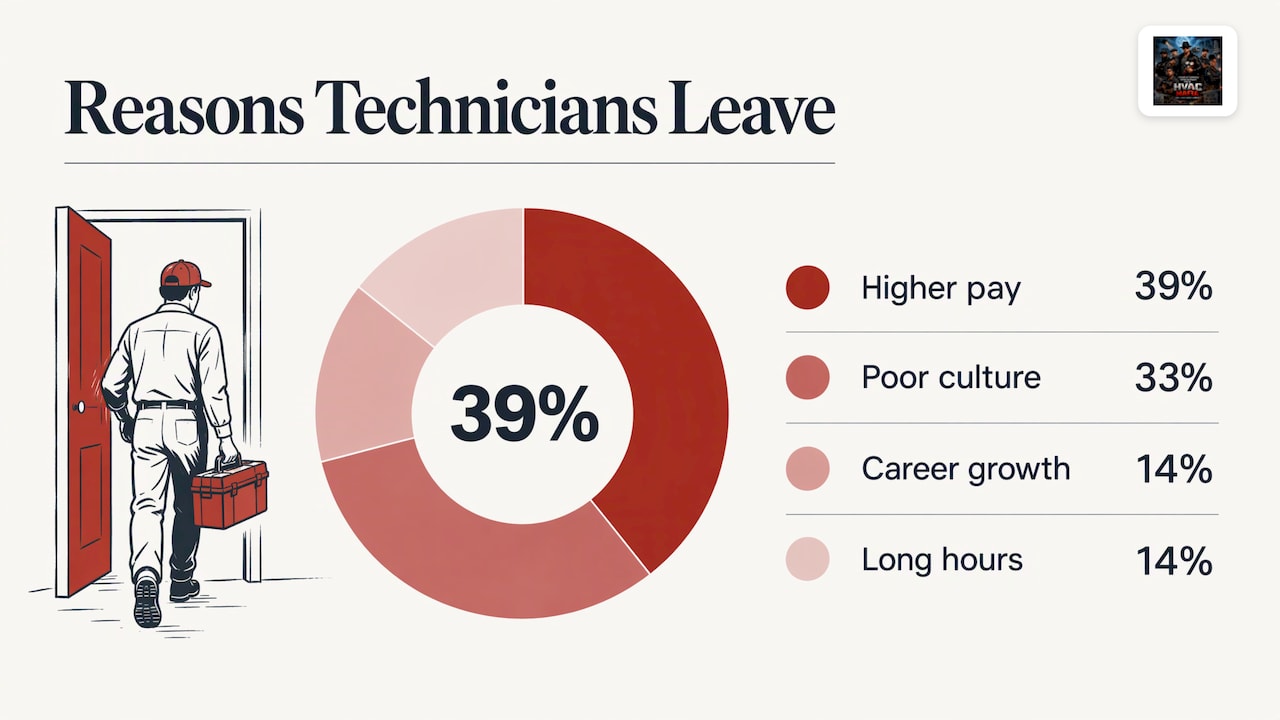
A referral program should fix turnover, not feed it. A Contracting Business survey of 272 respondents found that 39% of technicians leave for higher pay, 33% cite poor culture or management, 14% cite limited career growth and 14% cite long hours.

What that means for your referral program:

  • Referrals only work if people would recommend you. A tech who dreads Monday will not bring in a friend. Pay, culture and a clear path from apprentice to lead tech come first.
  • Show the ladder. Contracting Business notes that a career development ladder with clear expectations helps technicians see a path forward and cuts the temptation to leave.
  • Pick for fit, not just skill. Cardinal’s program, as covered in HVAC Today, pairs financial incentives with employees recommending peers they believe fit the culture. The reported results are faster onboarding, stronger team cohesion and higher retention.
  • Keep hiring fair. Apply the same interview standards to referred candidates as everyone else, and write job requirements down. A referral gets someone an interview, not an automatic offer. If your whole crew refers people from the same circle, also post openings publicly so qualified outsiders get a fair look.

John Cerasuolo of Leap Partners told ACHR News that the most effective recruiting and retention strategies are about engaging and leveraging the workforce rather than spending heavily on traditional fixes, and that retention feeds recruitment.

Referrals for apprentices and early-career techs

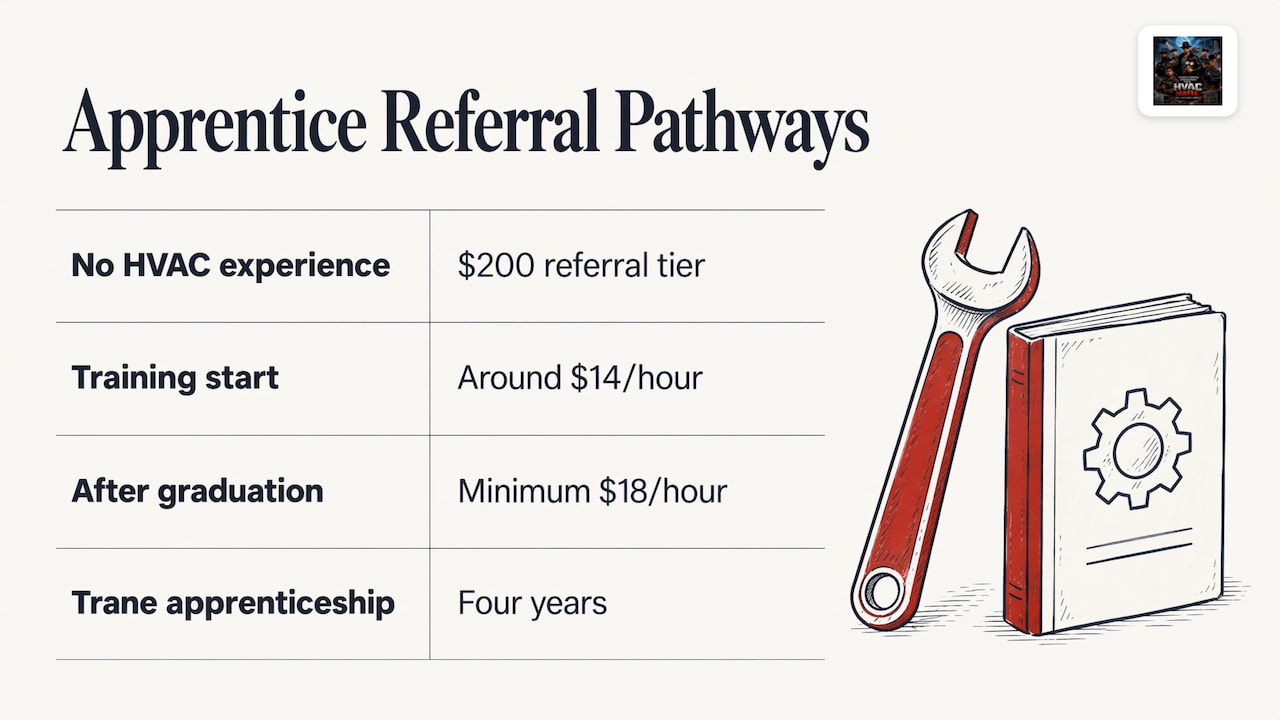
Referrals are not only for experienced hires. Your techs know a nephew finishing trade school, a neighbor leaving retail, a classmate from a community college program. Give those referrals a tiered bonus, like Appolo’s $200 level for candidates with no HVAC experience.

Then back the hire with a real training plan. Stanfield Air Systems starts high school students at around $14 an hour in a training program and brings them in at a minimum of $18 an hour after graduation, treating it as a training investment, as ACHR News reported in November 2025. The same report says apprenticeships build loyalty, reduce turnover and create a steady pipeline.

Formal programs exist too. Trane’s four-year commercial technician apprenticeship is nationally registered and accredited by the U.S. Department of Labor, and ACHR News has written about how contractors can partner with local schools and UA apprenticeship programs to build their own pipeline. If you hire installers, our guide to HVAC installer recruitment covers that path in more detail.

Referrals for apprentices and early-career techs

Where referrals end and a job post begins

A referral program reaches the people your employees know. That is powerful, and it is also a fixed circle. Once your techs have named everyone they can think of, the pipeline slows. This is where the open job has to be visible to techs who have never heard of you.

Two things help. First, a clear, honest posting: pay range, benefits, what a normal week looks like. Our look at what techs should expect from HVAC employee benefits shows what candidates compare you against. Second, a place where only the trade is looking. On HVAC Mafia, job listings and community are restricted to verified HVAC trade professionals, so your opening is not buried under homeowner or outsider noise.

It also gives your referral program something to point at. Your tech can forward a real listing to a friend instead of saying “we’re hiring, I think.” If you recruit for larger jobs, read how commercial HVAC hiring works from both sides of the desk.

Our view: referrals and a trade-only audience work together

I spent 36 years in this trade and ran a dealership. I know what it costs when a van sits in the lot because there is no one to drive it.

Here is what I learned. The best hires I ever made came from my own people. A tech who tells a buddy “come work here” is putting his name on the line. That is worth more than any ad.

But I also learned that referrals alone run dry. Your crew only knows so many people. So we built HVAC Mafia as a place where contractors reach a trade-only audience of nearly 100,000 HVAC followers, and where applications go straight into your own hiring system. Your referral program and your job post feed each other: the post gives referrers something to share, and the referrals give the post credibility.

For techs, it is free. Register, see the openings from real contractors, and read straight talk on pay, certifications and spotting good and bad employers. If you are a shop that treats people right, a Company Spotlight profile lets techs see your culture, pay and benefits before they ever call.

No corporate fluff. No shortcuts. Just knowledge, loyalty and respect.

the author

Put your open roles in front of techs

If you are a contractor with seats to fill, post the role where technicians are already looking. Job posting plans are $199 per month per position on Standard, $149 per month per position on Annual, and from $99 per month per position on Enterprise. You can see them on the job posting plans page. To show off your pay, benefits and culture, there is a Company Spotlight at $149 per month or $1,699 per year.

HVAC Mafia Mouse Pad

Techs and apprentices can join free as a member to see the openings, then share the good ones with the crew.

FAQ

How much should an HVAC employee referral bonus be?

Published programs range from $200 for hires with no HVAC experience up to $2,500 for 5+ years of experience at Appolo Heating. Polk Mechanical pays $2,000 for service role hires. Scale the amount with the role and what a vacant seat costs you.

When should the referral bonus be paid?

Most shops pay in stages after the hire stays. Appolo pays at 30 and 90 days, Advance Industrial Mechanical at hire and 90 days, and Polk at 90 and 180 days. Staged payouts reward retention, not just the start date.

How should employees submit a referral?

Give them one short form that works on a phone and sends the candidate’s name, contact details, role and a note on how they know them to whoever runs hiring. Ask for it before the candidate’s first interview so credit is never in doubt.

Is there a shortage of HVAC workers?

Yes. ACHR News reported in June 2026 that the industry is short more than 100,000 technicians. Enrollment in two-year HVACR programs is growing, but retirements continue to outpace new entrants in many markets, so keeping the techs you have matters as much as finding new ones.

Sources

HVAC Apprentice Pay: What You Earn Each Year

Most HVAC apprentices start between roughly $18 and $22 an hour in open-shop and school-sponsored programs, and the number climbs every year on a written schedule. Union programs start higher on base pay and add benefits on top. The exact figure depends on who sponsors your apprenticeship, where you live and what percentage of a journeyman’s rate your program uses. No national government table sets one apprentice wage, so the real answer is always in the wage schedule your employer or program hands you.

This guide gives you the numbers from programs that publish them, shows how the raise schedule works, and walks through what to ask before you say yes to an offer.

Thehvacmafia
Find Your Next HVAC Opportunity
Explore HVAC Mafia for apprentice openings and straight talk on pay, career paths, and what to ask before accepting a job.

TL;DR

Table of Contents

What a first-year HVAC apprentice earns

Start with the open-shop and school-sponsored side, because that is where most new techs begin.

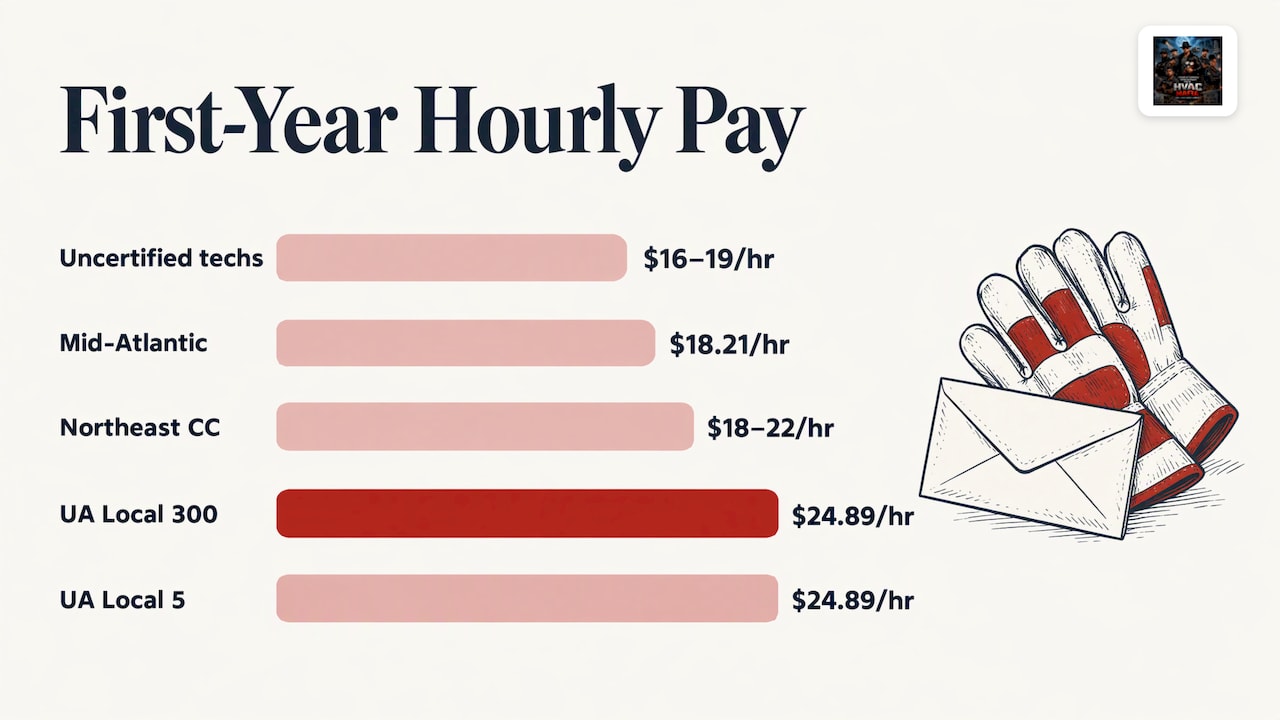
Northeast Community College in Nebraska lists an average starting wage of $18.00 to $22.00 an hour for apprentices in its HVAC Technician Apprenticeship. The program pairs 1,582.5 hours of classroom instruction with about four years of on-the-job learning. That is a real program in a mid-cost region, not a national average, and it is a useful anchor.

The Mid-Atlantic Mechanical Contractors Association says first-year pay in its HVACR apprenticeship begins at $18.21 an hour and rises every year. It adds that journeymen typically earn more than $35.00 an hour after finishing the five-year program.

Put that first-year rate in annual terms. At a full-time year of about 2,000 hours, $18.21 an hour comes to roughly $36,420 before overtime. That is simple multiplication, not a published salary, but it shows what the hourly figure means for your budget.

Now the union side. United Association Local 300 lists its schedule effective August 2026 through June 2027. A first-year apprentice there is at 55% of the journeyman rate, which works out to $24.89 an hour base pay plus $9.19 an hour in fringe benefits. UA Local 5’s training center publishes a different table. Its first year is 45% of the journeyperson rate, also $24.89 an hour on the straight-time column. Two locals, two percentages, one similar starting dollar figure. That is why you should look at the dollars, not just the percent.

You will also see lower numbers online, from $16 to $19 an hour for entry-level techs with no EPA certification. Those usually come from salary aggregators. They are fine as a rough sense of the floor, but a posted wage schedule from a real employer beats any average.

What a first-year HVAC apprentice earns

How the raise schedule works

If your apprenticeship is registered with the U.S. Department of Labor or a state apprenticeship agency, it comes with standards. Those standards call for apprentices to be paid a progressively increasing schedule of wages, based on a percentage of the current journeyworker rate or as set by a local collective bargaining agreement. A collective bargaining agreement is the contract between a union and the contractors who employ its members.

In plain terms: you start at a fraction of what a fully trained tech makes, and every block of hours moves you up a step. The Department of Labor’s HVAC/R technician standards show a five-year term with 8,500 to 10,000 hours of on-the-job learning. Pay starts at 45% of the journeyworker’s rate for the first 1,000 hours and rises to 90% in the final period.

Here is how that plays out in two published union schedules. These are base wages and leave out fringe benefits:

Apprenticeship year UA Local 300 (Aug 2026 to Jun 2027) UA Local 5 JATC (Aug 2026)
1st year 55%, $24.89/hr 45%, $24.89/hr
2nd year 60%, $28.65/hr 55%, $30.42/hr
3rd year 70%, $33.18/hr 65%, $35.95/hr
4th year 80%, $37.70/hr 70%, $38.71/hr
5th year 90%, $42.23/hr 80%, $44.24/hr

Sources: UA Local 300 and UA Local 5 JATC. Check each page for the current effective dates, because these tables are updated when the contract changes.

The pattern holds even where the numbers differ: your pay rises every year, and your fifth-year wage is close to a full journeyman’s. Open-shop employers often use the same percentage idea with a lower journeyman rate, or they set flat dollar raises at hour or skill milestones.

A worked example

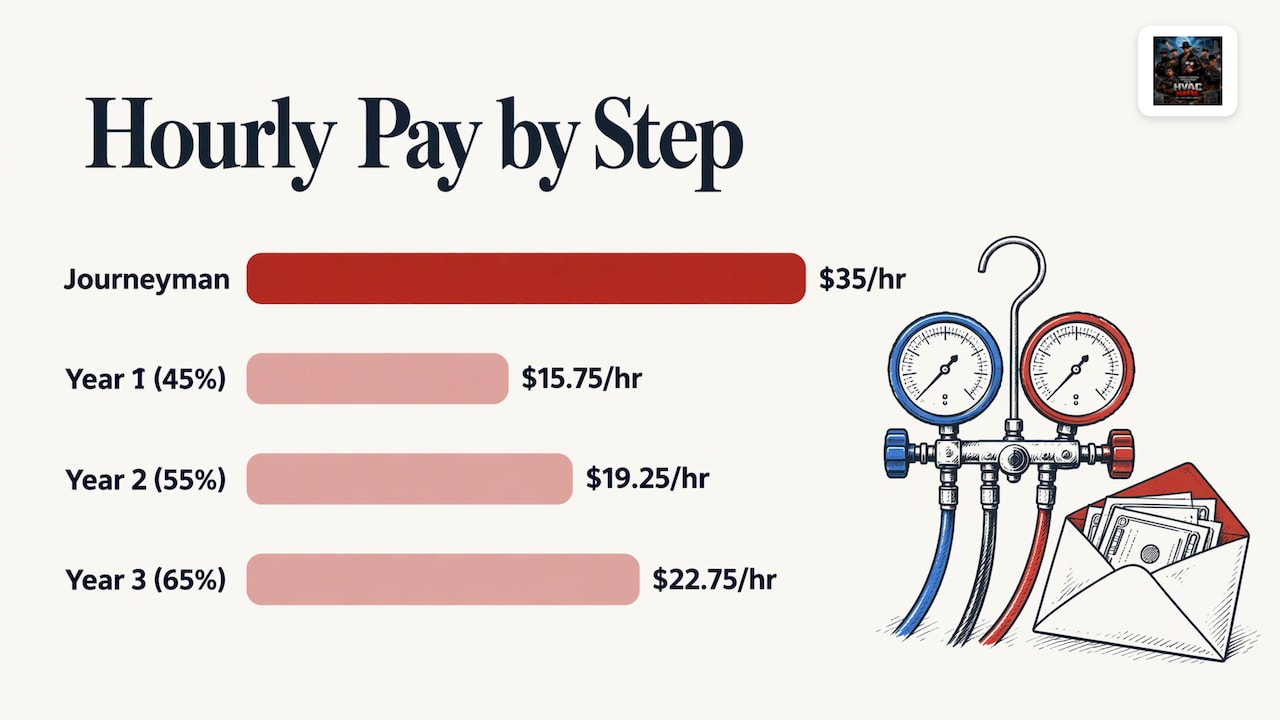
Say a shop’s journeyman rate is $35 an hour and its schedule starts apprentices at 45%. Year one is $15.75 an hour. At 55% in year two you are at $19.25. At 65% in year three you are at $22.75. These are illustrative numbers, not a quote from any employer. The point is the method: take the journeyman rate, multiply by the step, and compare the result with what you were offered. If the shop’s journeyman rate is lower than the market, every step on your schedule is lower too.

Apprentice hourly pay rises across three years

Union and open shop: the total package

Hourly wage is only part of what you earn. Union locals show this clearly because they list the benefit contributions separately.

Benefits contributions in the union world go to health coverage, pension and training funds. In the open-shop world, you see them as a health plan, a retirement match, paid time off, a truck and tool allowance. Our guide to HVAC employee benefits lists what techs should expect, and it is worth reading before you compare two offers that look similar on hourly pay.

Two more things change your take-home:

What moves your pay up or down

Where you live. Pay follows the local labor market and cost of living. Our look at HVAC salary in Texas shows how much one state can differ from the national picture.

Who sponsors the program. Union joint committees, contractor associations, community colleges and individual employers each write their own schedule. Starting pay and wage steps vary by sponsor, region, bargaining agreement and local market.

Residential or commercial. Commercial work usually opens a higher ceiling, especially in controls and larger systems. We cover that in commercial HVAC salaries and how techs get in the door in commercial HVAC hiring.

Certifications. Credentials such as EPA 608 are the standard way to prove you can legally handle refrigerants, and many shops tie a raise to earning one. How long that takes is covered in how long it takes to get HVAC certified.

What triggers your raises. Some programs raise you on hours worked. Others tie raises to classroom progress or competency checks, or a mix. Trade-school guidance says to ask whether a program uses percentages of the journeyworker rate or fixed dollar amounts, and whether steps come at hour or skill milestones. A shop that moves you up only when it feels like it is not running a schedule at all.

How long until the pay catches up

The Department of Labor’s HVAC/R standards use a five-year term with 8,500 to 10,000 on-the-job hours. Individual programs differ. The New Mexico program mentioned above requires at least 576 hours of related instruction and 8,000 hours of on-the-job training, with a normal 40-hour week that can shift with weather. The community college program in Nebraska runs about four years.

So plan on four to five years from first day to journeyman wages. The first year is the leanest. By the end, you have a trade that pays a living wage in most of the country, and the Mid-Atlantic program’s own figure for finished journeymen, more than $35 an hour, shows where the road leads in that region.

If you are still weighing the trade itself, is HVAC a good career lays out pay, outlook and the hard parts honestly.

Questions to ask before you accept an apprentice offer

You are a paid employee from day one, so treat the offer like any other job. Ask:

  1. What is my starting hourly rate, and can I have the full wage schedule in writing?
  2. Is each raise tied to hours, classes, skill checks or a mix?
  3. Is the program registered with the Department of Labor or a state apprenticeship agency?
  4. Do I get paid for classroom time, and who pays for books and tuition?
  5. What benefits start when, and what do they cost me per paycheck?
  6. Is there a truck, tool allowance or boot stipend?
  7. What does the shop’s journeyman earn? That number sets every step of your schedule.
  8. Who will I ride with, and how many techs have moved from apprentice to lead here?

A good employer answers all of these without hesitation. Their answers tell you how they treat people, which matters as much as the first-year rate. Our HVAC technician resume guide helps you get to the interview stage with a clean, honest résumé even when you have no field experience yet.

Find apprentice openings with real contractors

HVAC Mafia is a job board and community built by the trade, for the trade. Techs, apprentices and trade school students join free and see openings from real contractors, openings that are hidden from non-members. Job listings and community are restricted to verified HVAC trade professionals, so you are not wading through noise from outside the trade. You also get straight talk on pay, career paths and spotting good and bad employers, plus Tech Talk forums and the HVAC Underground Podcast.

If you are ready to start looking, join as a free member and see what contractors near you are posting.

HVAC Mafia  Beanie

If you are a contractor reading this because your apprentices keep leaving, the same board puts your opening in front of a trade-only audience of nearly 100,000 HVAC followers, and applications go straight to your own hiring system. Standard listings are $199 per month per position, with lower per-position rates on the Annual plan at $149 per month and Enterprise plans from $99 per month. See the job posting plans.

Our take on apprentice pay

I have spent 36 years in this trade, and I owned a dealership. I have been the guy writing the offer and the guy hoping it was fair. Here is what I know.

The hourly rate gets all the attention, but the schedule is what builds a career. An apprentice who knows exactly when the next raise comes, and what earns it, stays and works hard. An apprentice who gets a vague promise leaves for another dollar an hour. Shops that publish their steps keep their people.

To techs: do not be embarrassed to ask about money. Ask for the wage schedule, the benefits and the path. Good contractors respect the question, and the ones who dodge it just answered it. We built HVAC Mafia so you can see real openings from real contractors, hear from other techs about who is worth working for, and build a career, not just another paycheck.

To contractors: pay transparency is a recruiting tool. A Company Spotlight profile lets you show your culture, pay and benefits to techs who have choices. The shortage is real, and the shops that show their work are the ones that fill seats.

Loyalty and respect run both ways in this trade. It starts on the first day of the apprenticeship.

the author

FAQ

How much does a first-year HVAC apprentice earn?

In published open-shop and school programs, first-year pay runs from about $18 to $22 an hour, and one contractors association starts at $18.21. Union locals publish higher base rates, such as $24.89 an hour plus fringe benefits at UA Local 300 in 2026 and 2027. Your own number depends on your employer, program and region.

How long is an HVAC apprenticeship?

The Department of Labor’s HVAC/R technician standards use a five-year term with 8,500 to 10,000 hours of on-the-job learning, plus classroom instruction. Some programs are a bit shorter, with one college program running about four years. Expect to reach journeyman pay in four to five years.

Do HVAC apprentices get paid during classroom training?

It depends on the program. Apprentices are employees and are paid for on-the-job hours. The Department of Labor’s template says apprentices may or may not be paid for related instruction outside regular working hours. Ask before you sign.

Do union apprentices make more than open-shop apprentices?

Published union schedules show higher base wages and separate fringe benefit contributions, such as the fringe rates on UA Local 300’s schedule. Open-shop pay varies widely by employer. Compare total packages, meaning wages plus benefits, not just the hourly rate.

What should I ask for before accepting an apprentice job?

Ask for the written wage schedule, what triggers each raise, whether classroom time is paid, and what benefits start when. Trade-school guidance recommends getting the current schedule in writing before you accept.

Sources

HVAC Installer Recruitment: How to Hire and Get Hired

HVAC installer recruitment works when a contractor puts a clear, honest job in front of people who already work in the trade, and when an installer can see real openings without wading through noise. That is why we built HVAC Mafia as a trade-only board: installers register free and see openings from real contractors, and contractors post to an audience of nearly 100,000 HVAC followers, with applications going straight to the employer’s own hiring system.

Whether you are a shop owner trying to fill a lead installer seat or an installer deciding where to go next, this guide covers what listings actually ask for, what pay looks like, how to screen and how to size up an employer.

Thehvacmafia
Connect With HVAC Installers
HVAC Mafia puts contractor job openings in front of a trade-only audience, while installers can find real openings and trade insight.

Visit

TL;DR

  • Installer hiring runs on a clear job description, a fast first response, a screening process you control and a pay and training story that holds up when the candidate asks about it.
  • Most listings ask for hands-on installation experience, EPA refrigerant certification, a driver’s license and the ability to lift and work in tight spaces. Licensing beyond that depends on your state or city.
  • Installers should compare total compensation, training support and the one-, three- and five-year path, not just the hourly number.
  • Contractors reach installers fastest on a trade-only board. Our job plans run $199, $149 or from $99 per month per position, depending on the plan.
  • Installers join free and never pay.

Table of Contents

What installer recruitment actually involves

For an employer, it is a short chain: define the role, advertise it where installers look, screen quickly, test the work, make an offer that is specific and keep the person once they start. A break at any link costs you the hire. A vague ad draws the wrong applicants. A slow reply loses the good one to the shop that called back the same day.

For an installer, the same chain runs the other way: find openings that are real, read the pay and training terms closely, ask the questions that expose a bad fit and say yes only when the first 90 days are spelled out.

Employer and installer recruitment steps

The demand behind it is steady. BLS-based projections compiled by JobStack Research show about 8% growth and roughly 40,100 openings a year for HVAC mechanics and installers. Installers have choices, and good contractors recruit like they know it.

What installer job listings commonly require

Read enough listings and the pattern is clear. Here is what shows up again and again.

Education and training

The Bureau of Labor Statistics says HVAC mechanics and installers typically need a postsecondary nondegree award, though some enter with less, and that they then go through a lengthy period of on-the-job training. HVAC programs generally run from six months to two years and lead to a certificate or an associate degree. For apprentices and trade school students, that means a green candidate can be a good hire if you have a real plan to train them.

Experience and certification

Lead installer listings ask for more. One 2026 lead installer posting in New Jersey required five or more years of residential installation experience, at least two years leading crews, EPA Type II or Universal certification, a driver’s license and the ability to lift up to 80 pounds and work in confined spaces.

An Iowa lead installer listing asked for two or more years of residential installation experience, a valid license with an acceptable driving record, and passing background, drug and physical screening. A journeyman license and technical school certification were listed as advantages.

The lesson for both sides: the title “installer” covers a wide range. An entry-level helper and a crew lead are different hires, and the ad should say which one you mean.

What the work includes

Residential lead roles now often involve heat pump and mini-split installs, startup and commissioning, low-voltage wiring, documentation, customer communication and mentoring apprentices, as in a 2026 Pennsylvania listing. BLS also lists customer service, detail orientation, math, mechanical ability, physical stamina, problem-solving and technology skills as important qualities for the trade. If your installers talk to homeowners and fill out digital paperwork, say so in the ad.

Installer checks a wall-mounted mini-split

Licensing: it depends where you work

One requirement is national. BLS notes that the EPA requires nearly all HVAC technicians to be certified in proper refrigerant handling, which means passing an exam, and that state and local licensing may also apply.

That second layer varies a lot. NEEP’s workforce guide explains that EPA Section 608 is nationwide, while other licensing varies by state and municipality. Its examples: no statewide HVAC license in New York but local licensing, several license categories in Connecticut, and a master HVACR contractor license structure in New Jersey.

For contractors, this means your job post should name the exact credential you need, not just “licensed.” For installers moving across state lines, check with your state or local licensing board before you accept an offer, because a license that counts in one place may not count in the next.

What installation jobs pay and where they lead

BLS reported a May 2024 median annual wage of $59,810 for heating, air-conditioning and refrigeration mechanics and installers. That is the middle of the whole field. Lead installers, commercial installers and people in high-cost metros often land above it, and entry-level helpers below it.

Pay structures also differ. One 2026 lead installation listing from Cool Breeze offered $30 per hour during one to two weeks of training, then either $30 per hour or 6% commission on installations led. Commission applies if it exceeds the hourly pay, and commission jobs do not include overtime. Two jobs with the same headline rate can pay very differently depending on how the math works, so ask for it in writing.

The same employer lists a path from lead installation technician to technical trainer or mentor, to project management or HVAC sales, and to commercial installation leadership. That is the kind of ladder good candidates ask about. If you can describe yours in one sentence, you have a recruiting advantage.

Our own job board shows how wide the range is. Listings include a lead installer role in Westchester, NY with a published hourly range, a lead installer opening in New Cumberland, PA and an install lead technician role in Sharonville, OH. Registered members can see the full openings.

For contractors: an installer hiring plan that works

If you are hiring now, this is the routine. For each step, we note where it tends to go wrong.

  1. Define the seat. Decide whether you need a helper, a journeyman installer or a crew lead. ServiceTitan’s recruiting guidance suggests the job description should cover title, responsibilities, required licenses and certifications, experience level, equipment specialization, pay, benefits, schedule and how to apply. Where it goes wrong: ads that list a wish list of skills and no pay. Installers skip them.
  2. Publish the pay. Put the range, any commission formula and overtime rules in the ad. Pay transparency is one of the things we hear technicians ask about most, and an ad that hides it looks like a shop that will hide other things.
  3. Post where installers already are. The same ServiceTitan guidance lists trade schools, unions, job fairs, trade shows, social channels, resume databases, LinkedIn and past applicants as sources. A trade-only board adds one thing the broad sites can’t: every person reading is already in the business. Our listings are restricted to verified HVAC trade professionals, so your post is not competing with homeowner and outsider noise.
  4. Screen by phone first. Ten minutes on the phone filters most mismatches before anyone drives to your shop. Confirm certification, license, driving record, availability and pay expectations.
  5. Test the work, not just the talk. ACHR News reported that Atticman personally screens candidates, builds a model of the ideal installation, uses job photos and checklists and performs next-day quality inspections. You can borrow the idea: define what a good install looks like before you hire, then check every early job against it.
  6. Use a probation period. The same report describes a deliberate 90-day probation. A defined window protects both sides and gives you a natural moment to review.
  7. Make the offer fast and specific. Pay, start date, training plan, truck and tools, and the path to the next role. Good installers are often fielding more than one offer.

Budget the hire as a whole, too. Pay, onboarding time, tools, a truck and training all hit your books before the first install pays back, so many owners bring in accounting support for HVAC companies to forecast cash flow and payroll before they add a crew.

We also cover the wider process in our guide on how contractors hire and keep techs, and the commercial side in commercial HVAC hiring.

Where to post: what it costs on our board

Our plans are priced per open position, so you pay for the seats you are actually filling:

Plan Price
Standard $199 per month per position
Annual $149 per month per position
Enterprise from $99 per month per position

Applications go straight to your own hiring system, so your process stays yours. If you want to stand out to installers who have choices, a Company Spotlight profile shows your culture, pay and benefits. The monthly plan is $149 per month and the annual plan is $1699 per year. For a single urgent seat, Spotlight placements are also sold by the week: $149 per week per position, $499 per 4 weeks per position, or $349 per month per position on the ongoing plan.

Promo: fill your next installer seat

If you have an installer or lead installer role open, post it where trade professionals are already browsing. Pick a plan on the job posting plans page, and add a Company Spotlight profile if you want installers to see your culture and benefits before they apply.

HVAC Stickers — Vinyl Decals for Toolboxes  Trucks | HVAC Mafia

Installers and apprentices do not pay anything. You can join as a member to see the openings that are hidden from non-members.

For installers: how to judge a job and an employer

A posting is only the start. TechForce, a nonprofit supporting technician careers, advises job seekers to look at transparent pay, training and certification support, advancement at one-, three- and five-year points, workplace respect and voluntary turnover. It names vague pay, no answer on advancement, weak onboarding and dismissive attitudes toward training as warning signs.

Turn that into questions you can ask in the interview:

  • What is the full pay structure, including commission, overtime and any training-period rate?
  • Do you reimburse training or certification, and is education time scheduled?
  • What will my first 90 days look like, and who mentors me?
  • Where do installers here usually end up in one, three and five years?
  • How many installers have left in the last year, and why?

TechForce also recommends comparing total compensation rather than hourly pay alone. A $30 base with commission on top and a paid training plan can beat a higher hourly rate with none of that.

Interviews go better with practice, so see our guide to HVAC interview questions and what techs get asked. If you are weighing a specific job, our board has listings like this lead installer role in Glastonbury, CT and an install technician role in Charleston, SC.

Retention starts with recruiting

Hiring an installer you then lose in six months is expensive. The best recruiting message is one you can keep. NEEP found that successful workforce programs combine manufacturers, schools, utilities and trade associations with stipends, paid courses and wraparound support to grow the installer pipeline, in a market where heat pump demand is rising and equipment is getting more complex.

For a single shop, the same ideas scale down:

  • Pay for training. A paid route from helper to journeyman gives people a reason to stay.
  • Show the ladder. Installer to lead, lead to trainer, trainer to project manager or sales. Say it in the ad and in the interview.
  • Respect the crew. Respect shows up in scheduling, tools, trucks and how you handle mistakes.
  • Let people see the culture. A Company Spotlight profile lets candidates see how your shop treats people before they ever walk in.

Our view from the trade

We started HVAC Mafia because the trade deserved a place of its own. Our founder has 36 years in HVAC and ran a dealership, so he has sat on both sides of the hiring table. He knows what it is like to be a contractor with trucks that need to roll and no one to drive them. He also knows what it is like to be a tech who has been sold a job that was not what the ad said.

Here is what we believe about installer recruitment. First, the best installers are not scrolling general job sites for fun. They are in the trade, talking to other techs, and they trust people who talk straight about pay, training and culture. That is why our listings and community are restricted to verified HVAC trade professionals.

Second, the contractor who shows the work wins. A clear pay range, a real career path and a Company Spotlight profile that tells the truth about your shop do more than any slogan. Techs have choices. Give them reasons.

Third, nobody should have to pay to look for a job. Installers, apprentices and trade school students join free, and openings come straight from real contractors. Contractors pay to post, and applications go to their own hiring system, so the process stays theirs.

If you are hiring, post your role with us. If you are looking, join and see who is hiring. Build a career, not just another paycheck.

the author

FAQ

What does an HVAC installer recruiter or hiring manager look for first?

Most listings start with hands-on installation experience, EPA refrigerant certification and a valid driver’s license. Lead roles add crew-leading experience and often a clean driving record. Hiring managers also look for the soft side that BLS lists, such as customer service, detail orientation and problem-solving.

Do HVAC installers need a license?

Nearly all HVAC technicians need EPA refrigerant handling certification, according to BLS. Beyond that, licensing depends on your state or city, and some states have no statewide license while some cities do. Check with your state or local licensing board before you apply or hire across state lines.

How much does an HVAC installer make?

BLS reported a May 2024 median annual wage of $59,810 for HVAC and refrigeration mechanics and installers overall. Individual jobs vary by region, experience and pay structure. Some, like one 2026 lead installer listing, mix an hourly rate with commission, so ask how it works before you accept.

How can contractors hire HVAC installers faster?

Publish the pay, name the exact credentials you need and reply to applicants the same day. Post where HVAC professionals already look. On our board, plans start from $99 per month per position, and applications go to your own hiring system.

Is it free for installers to look for jobs on HVAC Mafia?

Yes. Installers, apprentices and trade school students register for free to see openings, and they never pay. Openings are hidden from non-members, so you need to join to view them.

Sources

HVAC Jobs in Florida: What Technicians Really Earn

A typical Florida HVAC technician earns a median of $27.24 an hour, or $56,670 a year, according to O*NET’s Florida wage data. The range is wide. The bottom 10 percent earn about $38,370 and the top 10 percent earn about $78,210. Where you land depends on your experience, your license, your specialty, your city and, most of all, who you work for.

This guide breaks down the Florida numbers, shows how they compare with the rest of the country, and explains what actually moves a paycheck. It also covers how to find openings that fit your skills. We built HVAC Mafia for techs, so we’ll be straight with you about all of it.

Thehvacmafia
Find HVAC Jobs That Fit Your Skills
HVAC Mafia members can see openings from real contractors and get straight talk on pay, career paths, certifications, and employers.

Visit

TL;DR

  • Florida’s median for HVAC mechanics and installers is $27.24 per hour ($56,670 per year). The middle 80 percent earn roughly $18.45 to $37.60 per hour.
  • That sits below the U.S. median of $61,010 per year, but Florida has no state income tax on wages, and pay varies a lot by metro and employer.
  • Experience, certifications, specialty work, overtime in peak cooling season and employer type move your number more than the state average does.
  • Apprentices start much lower, often in the high teens per hour, and the pay climbs as hours and skills stack up.
  • Free HVAC Mafia membership shows you openings from real contractors that non-members can’t see.

Table of Contents

How much do HVAC technicians make in Florida?

Start with the official numbers. They come from the federal Occupational Employment and Wage Statistics survey, which O*NET republishes by state. For heating, air conditioning and refrigeration mechanics and installers in Florida, the published figures look like this:

Measure Hourly Annual
10th percentile $18.45 $38,370
Median $27.24 $56,670
90th percentile $37.60 $78,210

Read those three rows as three different careers. The 10th percentile is usually a newer tech or a helper, often at a small shop with little room to grow. The median is a solid, experienced tech doing steady work. The 90th percentile is someone who has built real skill, usually in a specialty, a lead role or a commercial setting, and works for an employer that pays for it.

One thing to keep in mind: these are wage figures from a survey, and they measure what employers report paying. They don’t automatically include every bonus, commission or spiff, and they don’t include the overtime you work in July. We’ll get to that.

How much do HVAC technicians make in Florida?

Why you’ll see different numbers online

Search for Florida HVAC pay and you’ll see a lot of different figures. Some are higher than the official median, some are lower. That’s normal. Salary sites mix job-posting data, self-reported pay and company-specific averages, and they often blend job titles. A “commercial HVAC technician” page, an “installer” page and a “service tech” page will never match, because they’re different jobs at different points on the ladder.

When you want a number to negotiate with, use the official wage tables as your baseline. Then look at actual job postings in your city for the specific role you want. Postings show what employers are willing to pay this month, not what they paid on average last year.

Florida vs. the national average

The U.S. median for the same occupation is $61,010 per year, or $29.33 per hour, with a 10th percentile of $40,050 and a 90th percentile of $95,210, per the Bureau of Labor Statistics. Here’s the side-by-side:

Measure Florida United States
Median hourly $27.24 $29.33
Median annual $56,670 $61,010
10th percentile annual $38,370 $40,050
90th percentile annual $78,210 $95,210

Florida’s median is about $4,340 a year below the national figure. The gap widens at the top: the best-paid U.S. techs earn more than $95,000, while Florida’s 90th percentile is about $78,000. Much of the high end nationally comes from markets with heavy union presence, big industrial and commercial systems and a high cost of living.

But the raw number isn’t the whole story. Florida doesn’t tax wages at the state level, so more of each check stays with you. And demand is steady. In a state where air conditioning isn’t a luxury for most of the year, systems run hard and break down. That’s the kind of market where a skilled tech has choices.

If you’re weighing another big HVAC state, we broke down what techs make in Texas so you can compare.

Florida vs. the national average

Pay by city in Florida

Florida isn’t one labor market. It’s several, and they pay differently. The O*NET table shows the spread between metros:

  • Naples-Marco Island: a median of $28.62 per hour, or $59,540 per year.
  • Tampa-St. Petersburg-Clearwater: a median of $24.30 per hour, which works out to roughly $50,500 for a full-time year of 2,080 hours.

That’s a $4.32-an-hour difference between two Gulf Coast markets. Part of it is cost of living and part is the mix of employers. Naples has a lot of high-end residential work, where homeowners expect premium service and companies price accordingly. Tampa has a deep pool of techs and a lot of competition among contractors.

Before you move for a few extra dollars an hour, run the math on rent, commute and housing. A higher wage in an expensive coastal market can leave you with less than a lower wage somewhere cheaper. And remember a metro median is an average of good and bad employers. The best shop in a lower-paying metro often beats the worst shop in a higher-paying one.

We list real Florida openings from contractors who want trade-only applicants. For example, you can see what a service technician role in West Palm Beach looks like, or browse an installer opening in Lake Worth. Pay, benefits and requirements are laid out so you can compare them yourself.

What an employer actually posts

Official medians are useful. Job postings are where you see the real range. A major manufacturer’s HVAC Service Technician I posting in Tampa lists an hourly range of $20.80 to $33.27, and says base pay depends on skills, qualifications, experience and location. For a full-time year that’s roughly $43,000 to $69,000 before overtime.

That single posting shows how much room there is inside one job title. The low end is for someone who just meets the requirements. The high end is for someone who brings more. When you read a range, ask what you’d need to bring to land at the top of it.

What moves your pay in Florida

Experience and skill level

HVAC pay tracks what you can do without supervision. A tech who can run a call alone, diagnose a problem on the first visit and explain it clearly to a customer is worth much more than one who needs a lead on the truck. That’s why the spread between the 10th and 90th percentile is so big.

Certifications and training

Nearly every HVAC technician must be certified in proper refrigerant handling by the EPA, and technicians typically complete a postsecondary nondegree award plus long-term on-the-job training, according to BLS. In Florida, training programs often bundle those credentials. Orange Technical College, for instance, describes OSHA 10-hour training and employment-ready exams, including EPA Section 608, within its HVAC/R program.

Certificate programs typically run six months to a year, associate degree programs about two years, and apprenticeships about four years, according to one Florida school’s licensing guide. If you’re sorting out the timeline, our guide to how long it takes to get HVAC certified walks through it.

If you’re aiming for contractor-level work, check the Florida licensing requirements on the state’s official licensing board site, since rules for who can pull permits and run their own business are specific to the state.

Overtime and season

BLS notes that technicians may work overtime or irregular schedules during peak heating and cooling seasons. In Florida, cooling season is long. A tech at a shop that pays time and a half and has plenty of calls can earn well above the hourly rate times 2,080 hours. A tech at a shop that cuts hours in slow months, or pays straight time for everything, will earn less than the same hourly rate suggests.

So when you compare offers, ask how overtime is paid and how many hours techs typically get across the year.

Service, install, commercial and refrigeration

The job you do shapes the paycheck:

  • Residential service: often hourly, sometimes with commission or spiffs on repairs and sales. Great upside for techs who communicate well.
  • Installation: physically demanding, often paid hourly or by the job. Crew leads and install managers earn more.
  • Commercial and refrigeration: typically requires deeper technical skill with larger and more complex equipment. Our breakdown of commercial HVAC salaries covers what that path pays.
  • Service management: a step off the tools. See our guide to HVAC service manager jobs for pay and path.

Employer type

A small family shop, a large regional contractor, a national company, a facilities department and a manufacturer’s service arm all pay differently and offer different benefits. Compare the whole package: base pay, overtime rules, a take-home truck, tools, training, health coverage, retirement matching, paid time off and a real path up.

What do apprentices earn in Florida?

Everyone starts somewhere. A county government posting for HVAC apprentice positions in Fort Myers lists a starting pay of $17.00 per hour. It describes a four-year, state-certified apprenticeship with 8,000 total hours of on-the-job training plus classroom instruction.

At $17.00 an hour, a full-time year comes to about $35,360. That’s well under the state median, and that’s normal for the first rung. What matters is the direction. An apprenticeship pays you while you learn, and the pay generally steps up as your hours and skills grow. Compared with paying for school out of pocket, earning while you train is a big advantage.

If you’re thinking about whether the trade is worth it overall, read our honest take in Is HVAC a Good Career?. It covers pay, outlook and the hard parts.

How to earn more as a Florida HVAC tech

The state median is a starting point, not a ceiling. Here’s what we’ve seen work across the trade.

  1. Get your credentials in order. Get EPA 608 certification early, and keep adding the credentials your target employers ask for.
  2. Pick a lane and get good. Techs who master heat pump diagnostics, commercial rooftop units, refrigeration or controls become the person the shop can’t afford to lose.
  3. Learn to talk to customers. In residential service, the techs who explain a problem clearly and honestly often earn the most.
  4. Know what the market pays. Look at postings in your metro before any pay conversation.
  5. Ask the right questions. How is overtime paid? Is there a take-home truck? Who pays for training? What do people in this role earn after two years?
  6. Build a resume that shows results. Use numbers: calls run, installs completed, callbacks reduced. Our guide to writing an HVAC technician resume shows how.
  7. Don’t stay somewhere that won’t grow you. If your employer won’t pay for your skill, another one will.

Spotting a good Florida employer

Pay is one piece. A good employer in Florida should be able to answer these without dodging:

  • What’s the pay range for this role, and how is it decided?
  • How is overtime handled in peak season?
  • What does training look like, and who pays?
  • How are on-call and after-hours calls rotated?
  • What’s the plan for someone who wants to move up?
  • Why is this position open?

Shops that are proud of how they treat techs tend to say so plainly. Ones that stay vague about pay usually have a reason.

Our perspective

We started HVAC Mafia because the people who actually do this work were tired of being filtered through corporate messaging and general job sites. A Florida tech shouldn’t have to dig through homeowner ads and staffing spam to find out what a real shop pays.

Here’s what we believe after a lifetime in the trade. The median tells you where the middle is. It doesn’t tell you what you’re worth. Your number depends on your skills, your effort and, honestly, on whether you’ve found an employer who values them. We built the platform so techs can see real openings from real contractors, get straight talk on pay, career paths and certifications, and talk to other techs who’ve been there.

Florida is a great place to build a career: long cooling seasons, constant demand and plenty of room to grow from apprentice to lead tech to service manager. Know what you’re worth, choose your employer carefully and build a career, not just another paycheck.

the author

Find Florida HVAC openings

If you’re a tech, registration is free. Members see job openings from real contractors that non-members can’t see. You also get Tech Talk forums with other techs and the HVAC Underground Podcast. Join HVAC Mafia for free and start comparing openings in your part of Florida.

If you run a shop and can’t find or keep good techs, you can post where the trade is already looking. Our job posting plans are $199 per month per position on Standard and $149 per month per position on Annual, with Enterprise from $99 per month per position. Applications go straight to your own hiring system. See the job posting plans, or put your culture, pay and benefits front and center with a Company Spotlight.

HVAC Mafia  Beanie

Pay transparency wins hiring. Florida techs have options, so the shops that show their pay and benefits up front get the best applicants.

FAQ

How much do HVAC technicians make in Florida?

The median is $27.24 per hour, or $56,670 per year, according to O*NET’s Florida wage data. The 10th percentile earns about $38,370 and the 90th percentile about $78,210. Your own number depends on experience, specialty, employer and overtime.

Is HVAC pay in Florida lower than the national average?

The Florida median of $56,670 is below the U.S. median of $61,010, per the same O*NET and BLS data. Florida doesn’t tax wages at the state level, and demand for cooling work is strong. A good employer in the right metro can easily beat the average.

Which Florida cities pay HVAC techs the most?

It varies by metro. In the O*NET table, Naples-Marco Island has a median of $28.62 per hour, while Tampa-St. Petersburg-Clearwater is at $24.30. Compare the full table and weigh your cost of living before you move.

What does an HVAC apprentice earn in Florida?

One Lee County apprenticeship posting lists $17.00 per hour to start in a four-year program with 8,000 on-the-job hours. Pay generally rises as you gain hours and skills. Check each program’s current pay schedule.

Do I need a certification to work as an HVAC tech in Florida?

Nearly all HVAC technicians must hold EPA refrigerant handling certification, per BLS. Many start through a certificate program, a degree or an apprenticeship. For running your own contracting business in Florida, confirm current licensing requirements with the state’s licensing board.

Sources

HVAC Service Technician Career: Pay, Path and Next Steps

An HVAC service technician career is one of the few trades where you can start with a certificate or an apprenticeship, get paid while you learn, and be earning above the national median within a few years. The work is steady, the demand is real, and the ladder from helper to lead tech to service manager is wide open if you pick the right shop. Here is what the job looks like, what it pays, what you need to get certified, and how to keep climbing.

Thehvacmafia
Find a Shop That Fits Your Career
Explore HVAC job openings and get straight talk on pay, career paths, certifications, and what makes a good employer.

Explore HVAC opportunities

TL;DR

  • HVAC technicians earned a median of $61,010 a year ($29.33 an hour) in May 2025, and the BLS projects 11% job growth from 2025 to 2035.
  • You get in through a trade school or community college program (6 months to 2 years) or a paid apprenticeship. Nearly everyone who handles refrigerant needs EPA Section 608 certification.
  • The usual climb runs helper, certified tech, senior or lead tech, then service manager or owner. Specializing in commercial, refrigeration or controls speeds it up.
  • The employer you choose matters as much as the skills you build. Ask about training, pay structure, truck and tools, on-call rules and who gets promoted.

Table of Contents

What a service technician actually does

Service techs are the people who show up when a system is down. According to the Bureau of Labor Statistics, HVAC technicians install, maintain and repair heating, cooling and refrigeration systems, test components, repair or replace worn parts, talk with customers about what went wrong, recommend maintenance, and keep records of the work.

That sounds tidy. The day itself is not. You work in homes, schools, hospitals and other buildings, often in cramped attics or crawl spaces, and sometimes on a roof in bad weather. Most techs work full time, and schedules can include evenings, weekends and emergency calls.

Skills that separate good techs from average ones

The BLS lists customer-service, mechanical, math, problem-solving and technology skills, plus detail orientation, stamina and strength. In our experience, two of those carry the most weight in service work:

  • Diagnostics. Anyone can swap a part. The tech who finds the real reason the part failed gets the lead jobs and the raises.
  • Talking to customers. You are in someone’s home explaining a repair bill. Clear, honest explanations build the repeat business that keeps a shop (and your paycheck) healthy.

Service, install or something more specialized

Some techs focus on installing, others on repair and maintenance. Some specialize in radiant heating, testing and balancing, or commercial refrigeration in places like grocery stores, hotels and restaurants. Residential techs often sell service contracts that cover periodic maintenance. Service work tends to be the better training ground for diagnostics, which is why so many future service managers start there.

What you need to get started

Education and apprenticeships

The BLS says most technicians complete postsecondary instruction at a technical or trade school or community college, with programs generally lasting 6 months to 2 years and ending in a certificate or associate’s degree. Some employers will consider a high school diploma. Apprenticeships usually last several years and combine paid on-the-job training with classroom instruction each year. You may also need a driver’s license to reach jobsites.

Newly hired techs typically work alongside experienced ones, starting with basic tasks such as insulating refrigerant lines or cleaning furnaces. In time they move to cutting and soldering pipe and checking electrical circuits. That is how most of us learned.

Education and apprenticeships

EPA Section 608 certification

This one is not optional. Under Section 608 of the Clean Air Act, technicians who maintain, service, repair or dispose of equipment that could release refrigerants must be certified. Apprentices are exempt only while they are closely and continually supervised by a certified technician. Certification comes in four types: Type I (small appliances), Type II (high-pressure), Type III (low-pressure) and Universal, which covers all of them. Most service techs aim for Universal, because it keeps every job open to them.

Four EPA Section 608 certification types

State and local licensing

Rules vary a lot by state. Some states license the individual technician, others license only the contractor, and some leave it to cities. Texas, for example, generally has technicians registered or certified and working under a licensed contractor. Before you move or apply across state lines, check your state licensing board’s page for the current requirements. Our Texas pay breakdown shows how much the local market can change the picture.

NATE and other credentials

NATE certification is voluntary and works as a ladder, from an entry-level Ready-to-Work credential up through professional and senior levels. Whether it pays off depends on the shop. Some employers build a raise into their pay scale for it and others do not, so ask directly what your employer pays for it before you sit the exam. Used well, it is leverage for a raise or for a move to a better-paying company.

What HVAC service technicians earn

The BLS reports a median of $61,010 a year, or $29.33 an hour, in May 2025. The lowest 10% earned less than $40,050, and the highest 10% earned more than $95,210. That spread is the whole story of the career: where you land depends on experience, specialty, location and employer.

Career stage Typical years Rough annual figure
Helper or installer 0 to 2 Around the bottom 10% line, $40,050
Certified service tech 2 to 5 Around the median, $61,010
Senior or lead tech 5 to 10 Above the median, up toward $77,060
Service manager or owner 10+ Around the top 10% line, $95,210

The stages and years in the table are a common way to map the ladder, using BLS pay marks for each rung. Treat them as a guide, not a promise. A sharp tech can move faster, and a bad shop can stall you for years.

Location changes the number

A median is a national average. Using BLS May 2025 figures, the District of Columbia, Alaska, Illinois, Massachusetts and Connecticut sit near the top, with median pay in the mid-$70,000s to mid-$80,000s. Cost of living comes along with that, so compare take-home against rent and gas, not just the headline hourly rate.

Look past the hourly rate

Two offers at the same hourly rate can be very different. Take-home depends on overtime rules, on-call pay, whether you get a truck, who buys tools, health insurance, retirement match, and bonuses or commission on sold work. We broke those down in our guide to HVAC employee benefits.

The career path, step by step

Step 1: Helper or apprentice

You carry tools, run lines, clean equipment and watch how a senior tech thinks. Your job here is to learn fast and be reliable. Ask why, not just how. Techs who understand airflow, pressures and electrical basics early are the ones who get a route of their own sooner.

Step 2: Certified service technician

With EPA 608 in hand and a couple of years of field time, you run calls on your own. Your goals now are first-time fixes, clean paperwork and happy customers. This is also the stage to choose a direction: residential service, light commercial, commercial refrigeration, controls or heat pumps.

Step 3: Senior or lead technician

Lead techs troubleshoot the hard calls, mentor newer techs, and handle documentation and safety. A real example from a hiring contractor: a lead commercial service role in Louisville, KY lists $40 to $55 an hour, five years of commercial service experience and EPA Universal certification, with a path on to service manager. That tells you what the next rung usually asks for.

Step 4: Service manager, general manager or owner

Service managers schedule the board, coach techs, protect margins and keep customers from walking. It is a different skill set: people, numbers and systems. Not every great tech wants it, and that is fine. Some of the best careers stay in the field as specialists. If management is your goal, read our guide to HVAC service manager jobs, covering pay, the path and what contractors look for.

Some contractors lay the whole route out in the job post: journeyman, then lead tech, then service manager, then general manager, sometimes with profit sharing tied to company performance. When you see a path written down like that, ask how many techs actually took it.

Why the outlook is strong

The BLS projects employment to grow 11% from 2025 to 2035, with about 40,600 openings a year, many of them from workers retiring or moving to other occupations. Industry observers point to climate extremes, aging buildings, efficiency rules, data centers and heat pump adoption as forces keeping demand high.

For you, that means leverage. Contractors are competing for good techs, which gives you room to ask about pay, training and schedule.

How to judge a job and an employer

This is where careers are made or stalled. Before you accept an offer, get answers to these:

  • Training. Is there a real plan, a mentor, paid classes, or help with certifications? Or are you thrown on a truck alone in week two?
  • Pay structure. Hourly, flat rate, salary, commission? How is overtime handled? What is the sign-on bonus tied to?
  • On-call and hours. How often is the rotation, and what does it pay?
  • Equipment. Does the company provide a truck, tools, uniforms, phone and a tablet?
  • Advancement. Who in the last two years moved from tech to lead or manager? Can you talk to them?
  • Culture. How long have the techs been there? High turnover tells you something.
  • Hiring process. Many home service employers run background checks on new hires, so expect it and have your paperwork ready.

General job sites show you a pile of listings with a dollar range and little else. A trade-focused board lets you compare real contractors, read what they offer and ask other techs what they know.

Getting your resume ready

List your certifications first (EPA 608 type, NATE if you have it), then equipment you have worked on, then results: callbacks reduced, service agreements sold, training you delivered. Our guide to the HVAC technician resume walks through what to include.

Our perspective

We have been around this trade a long time. Our founder is a 36-year HVAC veteran and former dealership owner, and he has seen good techs leave for bad reasons and bad shops lose good techs for the same reasons.

Here is what we believe. A career is not the same as a paycheck. The best path is one where you keep learning, get paid fairly for what you know, and work for people who respect you. That takes honest information about pay, certifications and employers, which is hard to find on a general job site.

That is why we built HVAC Mafia as a trade-only space. Techs register free and see openings from real contractors that non-members cannot see. Contractors reach a trade-only audience instead of homeowners and outsiders. Our Company Spotlight profiles let shops show their culture, pay and benefits up front, so you can judge a company before you ever apply. Our Tech Talk forums and the HVAC Underground Podcast give you straight answers from people who do the work.

No corporate fluff. No shortcuts. Just knowledge, loyalty and respect.

the author

Find your next HVAC job with us

If you are a tech, apprentice or trade school student, join HVAC Mafia as a free member to see openings from real contractors, get career advice and talk with other techs. You never pay.

Make HVAC Great Again™ Front  HVAC Mafia Back T-Shirt

If you are a contractor or service manager struggling to hire, you can put your openings in front of a trade-only audience of nearly 100,000 HVAC followers. Our job posting plans start with Standard at $199 per month per position, Annual at $149 per month per position, and Enterprise from $99 per month per position. Applications go straight to your own hiring system. Company Spotlight has a monthly plan at $149 per month and an annual plan at $1699 per year to show off your culture, pay and benefits.

FAQ

How long does it take to become an HVAC service technician?

Trade school or community college programs generally run 6 months to 2 years. Apprenticeships usually last several years but pay you while you train. Most techs are running their own service calls within a couple of years of starting.

Do I need a license to work as an HVAC technician?

EPA Section 608 certification is required for nearly everyone who handles refrigerant. State and local licensing varies: some states license the technician, others only the contractor. Check your state licensing board before you apply.

Is HVAC a good career for the long term?

The BLS projects 11% employment growth from 2025 to 2035, faster than many occupations, with about 40,600 openings a year on average. Pay climbs with experience, certifications and specialization, and the path leads to lead tech, service manager or ownership.

What is the best way to move up from service tech?

Build diagnostic skills, earn EPA Universal, and pick a specialty such as commercial, refrigeration or controls. Then ask employers directly about advancement. Shops with a written path and people who actually took it are the ones to target.

Sources

Commercial HVAC Salaries: What Techs Really Earn in 2026

Most commercial HVAC techs land somewhere between $40,000 and $95,000 a year, with a national median around $61,000. Commercial work, refrigeration and controls skills, overtime and your zip code push you up or down inside that range. Below is what the numbers say, where they come from, and how to read them like a tech, not a salary website.

Thehvacmafia
Find Commercial HVAC Jobs
HVAC Mafia connects technicians with real contractor openings and offers straight talk on pay, career paths, certifications, and employers.

Explore HVAC Mafia

TL;DR

  • The federal median for HVAC and refrigeration mechanics and installers is $61,010 a year, or $29.33 an hour, with the bottom 10% under $40,050 and the top 10% over $95,210.
  • Commercial work is commonly reported to pay $10,000 to $20,000 more a year than residential, and specialties like refrigeration can pay more again.
  • Location is the biggest swing. The same job pays about $28,000 more in Massachusetts than in Mississippi.
  • Overtime, certifications and employer type all move the number. Compare total compensation, not just the hourly rate.
  • Registering with HVAC Mafia is free for techs, and you can see real openings from real contractors.

Table of Contents

What the national numbers say

Start with the most reliable source: the Bureau of Labor Statistics. For May 2025, the median annual wage for heating, air conditioning and refrigeration mechanics and installers was $61,010, which works out to $29.33 an hour. The lowest 10% earned less than $40,050. The highest 10% earned more than $95,210.

National HVAC wages from lower threshold to upper threshold

One honest note: BLS groups residential, commercial and refrigeration techs into one occupation. It does not publish a separate “commercial HVAC tech” number. So when you see a site quoting one exact commercial salary, it is blending BLS data with its own estimates or user-submitted pay.

Those estimates tend to land close to the federal figure. One industry blog projects the average commercial HVAC technician at about $60,000 to $65,000 in 2026, with entry-level near $40,000 and experienced techs in high-demand markets above $90,000 once overtime and bonuses are counted.

The occupation is also growing. BLS counted 440,900 jobs in 2025 and projects 11% growth from 2025 to 2035. More demand for techs means more leverage for you when you negotiate.

Commercial vs. residential pay

Why does commercial usually pay more? The work is more complex. You are on rooftop units, chillers, boilers, building automation and big refrigeration systems. Customers are businesses that lose money when equipment is down, and that urgency tends to show up in wages.

Commercial chillers and boilers in a mechanical plant

One contractor-software company reports that commercial HVAC pays $10,000 to $20,000 more per year on average than residential work. Treat that as a general pattern, not a promise. A strong residential service tech in a busy market can out-earn a weak commercial offer.

Employer type matters too. In May 2025, BLS puts the median for HVAC mechanics and installers in wholesale trade at $71,190, against $60,030 in plumbing, heating and air-conditioning contractors. Those wholesale jobs are often in equipment sales and support, so they are not a direct swap for a field role. They still show that who signs your check changes the number.

If you are weighing a move, our guide on how techs land commercial jobs and how shops hire them walks through what commercial employers look for.

Commercial HVAC salary by state

Location moves pay more than almost anything else. One analysis points out that moving from Mississippi, at a $48,680 median, to Massachusetts, at $77,300, is a $28,620 difference for doing the same work.

Here are BLS May 2025 state medians for HVAC mechanics and installers, as compiled by a trade-pay calculator that reports the official figures:

Rank State Median annual wage
1 District of Columbia $84,390
2 Alaska $77,430
3 Illinois $77,410
4 Massachusetts $77,300
5 Connecticut $76,610
6 Minnesota $76,350
7 Washington $75,660
8 North Dakota $74,490
9 New Jersey $74,450
10 New York $74,430

At the other end, the lowest medians are Arkansas at $48,110, Alabama at $48,370 and Mississippi at $48,680.

Different sites rank the states a little differently because they use different data years. An industry magazine’s 2025 roundup put California, New Jersey, Washington, Massachusetts and New York in the top five, with West Virginia, Mississippi, Wyoming, Arkansas and South Dakota at the bottom. Both lists tell the same story: the coasts, big northern states and Alaska pay the most, and the lower-cost South pays the least.

Beware of numbers that look too good. One team that tracks this data warns that some high-traffic salary pages publish figures well above BLS, such as $112,300 for Hawaii where the federal median is $65,450. If a number looks wild, find the BLS series behind it.

Working in Texas? We broke that market down in our Texas HVAC salary guide.

Pay by metro area

City matters inside a state, too. An analysis of BLS May 2025 data for the 30 largest metros found median hourly wages ranging from $38.51 in Seattle to $24.30 in Tampa, against a national median of $29.33. Nineteen of the 30 metros paid above the national median.

Higher pay usually comes with higher rent. Before you chase a big-city wage, compare it against what housing, insurance and fuel cost where you would live. A $28 an hour job in a cheaper town can leave you with more in your pocket than $36 an hour in an expensive one.

What moves a commercial tech’s paycheck

Specialization

After experience, specialty is one of the biggest levers. One industry company says commercial and industrial refrigeration techs who work cold storage, supermarket racks and large chillers routinely earn $85,000 to $120,000 with overtime. The same source flags building controls (BACnet, BMS, IoT) and heat pumps as growing niches.

The pattern is simple. Skills that fewer techs have, on equipment that costs a customer a lot when it fails, earn more.

Overtime and on-call

Peak season changes the math. One estimate says 50 to 60 hour weeks can add $7,000 to $15,000 or more per year. Another puts overtime and on-call work at $5,000 to $15,000 in annual take-home.

Ask how overtime is calculated, how on-call is paid, and how often you can expect it. A good hourly rate with no overtime can pay less than a modest rate with steady hours.

Certifications

Certifications help you get hired and give you something to point to in a pay conversation. One contractor-software source estimates NATE certification adds about $15,000 a year in earning power. Take that as an estimate, not a guarantee. What it does tell you is that shops pay for proven skill, so ask any employer whether they cover exam fees and reward certifications with a raise.

Productivity and value

Techs are paid in proportion to the value they create. A tech who diagnoses fast, runs more calls a day, spots legitimate repair opportunities and keeps callbacks low is worth more to a shop. One industry writer notes that owners often pay a premium to keep high-productivity techs because turnover is expensive. Track your own numbers. They are your best negotiating tool.

Can you make $200,000 in commercial HVAC?

As a salaried tech, rarely. One salary aggregator puts typical HVAC tech pay between $54,132 and $71,510, with a median near $61,841, and says reaching $200K is uncommon without extensive experience or additional roles.

The people who get there usually have a different job title. Here are the common routes:

  1. Service manager or operations roles. You trade the tools for people, scheduling and numbers. See our guide to HVAC service manager jobs, pay and path.
  2. Niche specialist. Refrigeration, controls or large chiller work, plus plenty of overtime, can push the top of the tech range well past the median.
  3. Owning the business. Owner income depends on revenue, overhead and how many trucks you run. It carries real risk and long hours, so it is a different path, not a raise.

For most techs, a realistic plan is to climb the ladder: apprentice, service tech, lead tech, specialist or manager. Each rung adds both pay and leverage.

Why pay can feel low, and how to compare offers

HVAC is physical, seasonal work in attics, rooftops and mechanical rooms. It is fair to ask whether the paycheck matches the effort. The answer often depends on what you count.

An hourly rate is only one piece. When you compare two offers, put these side by side:

  • Base hourly rate or salary, and how raises are decided
  • Overtime rules and typical hours in peak season
  • On-call pay and rotation
  • Health insurance, and what you pay in premiums
  • Retirement match
  • Paid time off
  • Take-home truck, tools, uniforms and boot allowances
  • Paid training and certification support
  • A clear path from where you are to lead tech or manager

A lower hourly rate with a take-home truck, a retirement match and paid training can beat a higher rate with none of it. We cover what to expect in our guide to HVAC employee benefits.

Also ask what pay looks like in the slow season. Some shops keep techs busy year-round with maintenance and project work. Others cut hours. That answer changes your annual number more than a dollar-an-hour difference.

Our take: pay transparency is the trade’s biggest fix

We have spent a long time in this trade, and we have seen the same story over and over. Good techs leave because they never knew what they were worth, or because a shop would not talk about pay until the offer letter.

That is why we built HVAC Mafia as a place by and for the trade. Our job listings and community are restricted to verified HVAC trade professionals, so the conversation stays about the work, the money and the career. No homeowner noise. No corporate polish.

Here is our advice. Learn your market, because a number from another state tells you little. Learn the specialty that pays, whether that is refrigeration, controls or heat pumps. Ask the benefits questions before you sign. And pick a contractor who shows you their culture, pay and benefits up front, because a shop proud of how it treats techs has nothing to hide.

Build a career, not just another paycheck. That is what we are here for.

the author

Find a commercial HVAC job that pays what you are worth

If you are a tech, registering with us is free. You see openings from real contractors that non-members cannot, and you get straight talk on pay, certifications and spotting good and bad employers. Join HVAC Mafia as a free member and start comparing offers with real numbers.

HVAC Trucker Hat — Structured Mesh-Back Cap | HVAC Mafia

If you are a contractor losing techs to better offers, publish your pay and benefits where techs are looking. Our job posting plans run from $199 per month per position on the Standard plan, $149 on the Annual plan, and from $99 on Enterprise. Postings reach a trade-only audience of nearly 100,000 HVAC followers, and applications go straight to your own hiring system. Our guide to how contractors hire and keep techs covers what works after the posting goes live.

FAQ

How much does a commercial HVAC technician make per hour?

The federal median for HVAC and refrigeration mechanics and installers is $29.33 an hour. Commercial roles often land at or above that, depending on your state, specialty and overtime. Metro medians run from about $24 an hour in Tampa to about $38 in Seattle.

Which states pay HVAC techs the most?

In BLS May 2025 data, the District of Columbia leads at $84,390, followed by Alaska, Illinois, Massachusetts and Connecticut. Rankings shift a little between data years, but the Northeast, the West Coast and Alaska show up near the top.

Does commercial HVAC pay more than residential?

Usually, yes. One industry source reports a gap of $10,000 to $20,000 a year on average. Your own result depends on the employer, the market and how much overtime you work.

Can you make $200K a year in HVAC?

It is uncommon for a salaried tech. One aggregator says it generally takes extensive experience or additional roles. Moving into management, a high-demand specialty, or business ownership are the usual routes.

How do I find a commercial HVAC job near me?

Register free with HVAC Mafia to see openings from real contractors, then use our commercial HVAC hiring guide and resume guide to prepare. Ask about pay, overtime and benefits in the first conversation.

Sources

Enable Notifications OK No thanks