
An HVAC service technician career is one of the few trades where you can start with a certificate or an apprenticeship, get paid while you learn, and be earning above the national median within a few years. The work is steady, the demand is real, and the ladder from helper to lead tech to service manager is wide open if you pick the right shop. Here is what the job looks like, what it pays, what you need to get certified, and how to keep climbing.
TL;DR
- HVAC technicians earned a median of $61,010 a year ($29.33 an hour) in May 2025, and the BLS projects 11% job growth from 2025 to 2035.
- You get in through a trade school or community college program (6 months to 2 years) or a paid apprenticeship. Nearly everyone who handles refrigerant needs EPA Section 608 certification.
- The usual climb runs helper, certified tech, senior or lead tech, then service manager or owner. Specializing in commercial, refrigeration or controls speeds it up.
- The employer you choose matters as much as the skills you build. Ask about training, pay structure, truck and tools, on-call rules and who gets promoted.
Table of Contents
- What a service technician actually does
- What you need to get started
- What HVAC service technicians earn
- The career path, step by step
- Why the outlook is strong
- How to judge a job and an employer
- Our perspective
- Find your next HVAC job with us
- FAQ
- Sources
What a service technician actually does
Service techs are the people who show up when a system is down. According to the Bureau of Labor Statistics, HVAC technicians install, maintain and repair heating, cooling and refrigeration systems, test components, repair or replace worn parts, talk with customers about what went wrong, recommend maintenance, and keep records of the work.
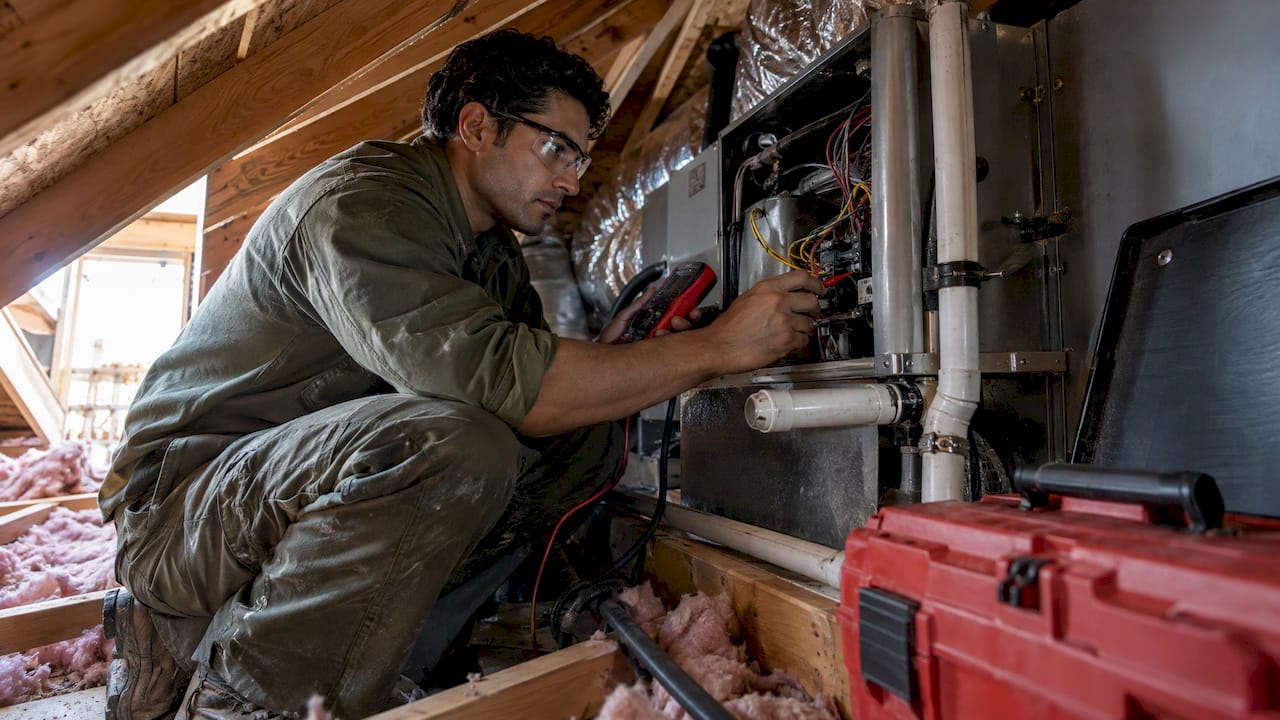
That sounds tidy. The day itself is not. You work in homes, schools, hospitals and other buildings, often in cramped attics or crawl spaces, and sometimes on a roof in bad weather. Most techs work full time, and schedules can include evenings, weekends and emergency calls.
Skills that separate good techs from average ones
The BLS lists customer-service, mechanical, math, problem-solving and technology skills, plus detail orientation, stamina and strength. In our experience, two of those carry the most weight in service work:
- Diagnostics. Anyone can swap a part. The tech who finds the real reason the part failed gets the lead jobs and the raises.
- Talking to customers. You are in someone’s home explaining a repair bill. Clear, honest explanations build the repeat business that keeps a shop (and your paycheck) healthy.
Service, install or something more specialized
Some techs focus on installing, others on repair and maintenance. Some specialize in radiant heating, testing and balancing, or commercial refrigeration in places like grocery stores, hotels and restaurants. Residential techs often sell service contracts that cover periodic maintenance. Service work tends to be the better training ground for diagnostics, which is why so many future service managers start there.
What you need to get started
Education and apprenticeships
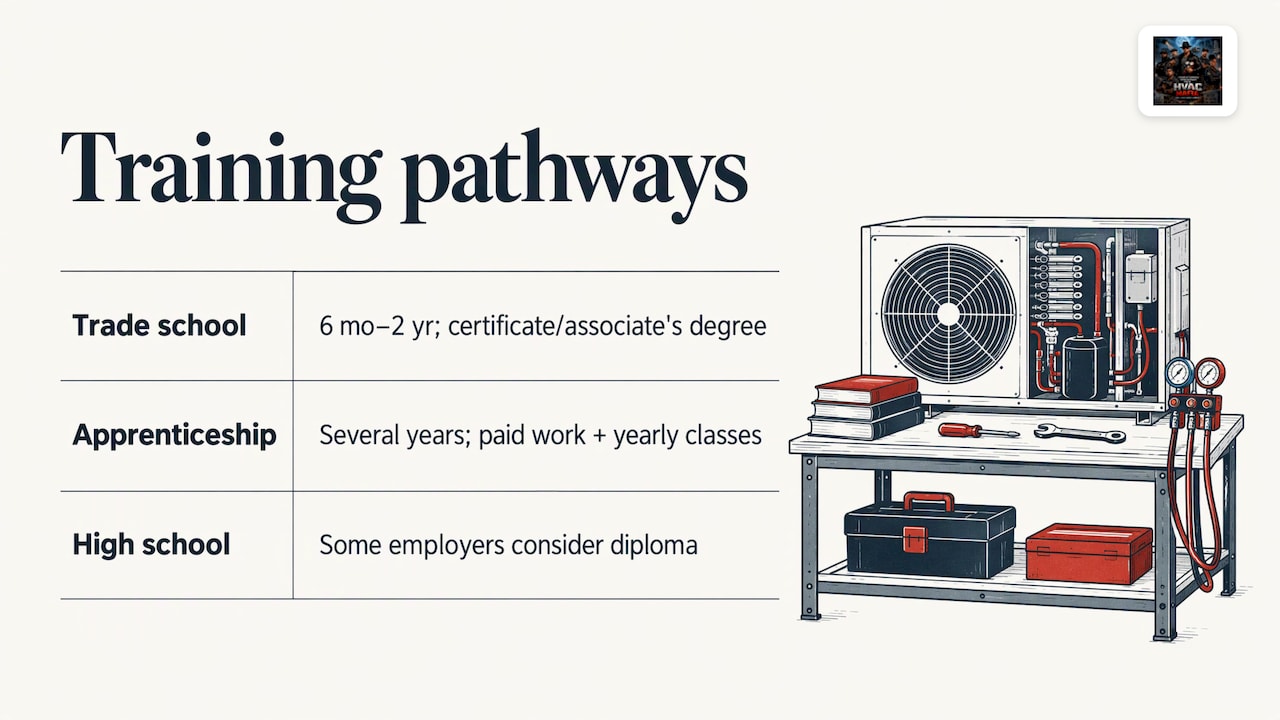
The BLS says most technicians complete postsecondary instruction at a technical or trade school or community college, with programs generally lasting 6 months to 2 years and ending in a certificate or associate’s degree. Some employers will consider a high school diploma. Apprenticeships usually last several years and combine paid on-the-job training with classroom instruction each year. You may also need a driver’s license to reach jobsites.
Newly hired techs typically work alongside experienced ones, starting with basic tasks such as insulating refrigerant lines or cleaning furnaces. In time they move to cutting and soldering pipe and checking electrical circuits. That is how most of us learned.
EPA Section 608 certification
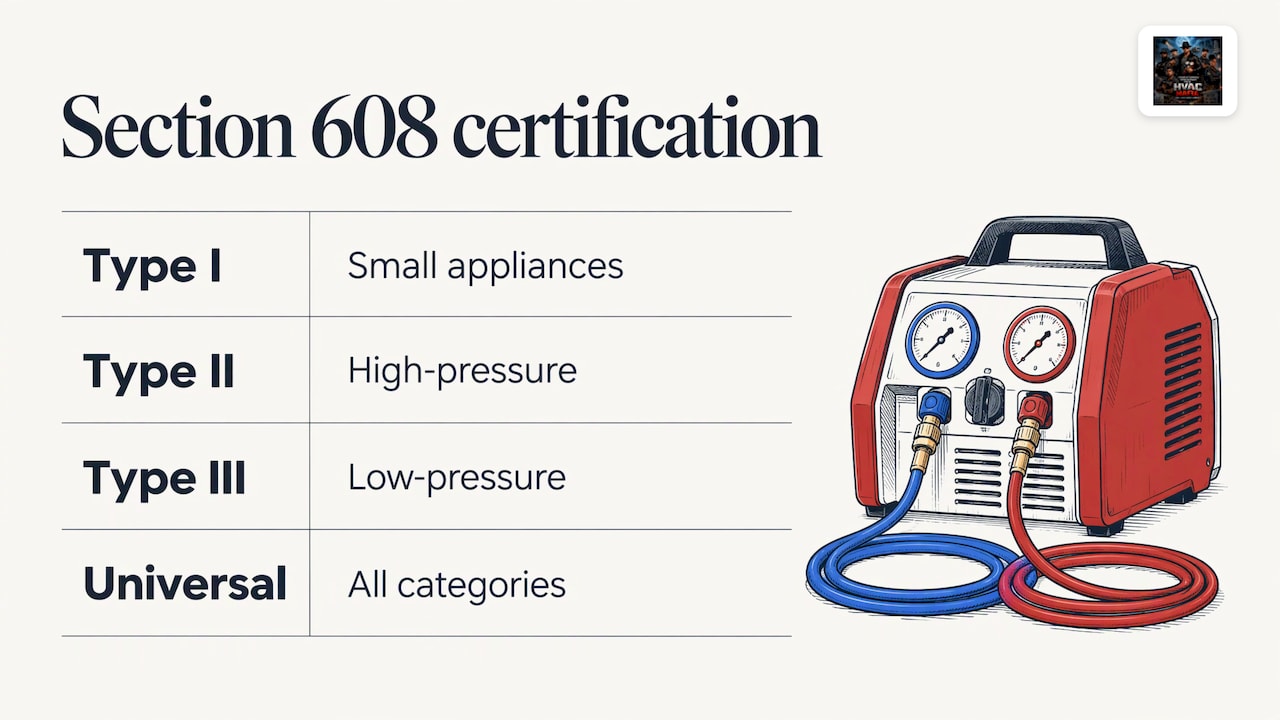
This one is not optional. Under Section 608 of the Clean Air Act, technicians who maintain, service, repair or dispose of equipment that could release refrigerants must be certified. Apprentices are exempt only while they are closely and continually supervised by a certified technician. Certification comes in four types: Type I (small appliances), Type II (high-pressure), Type III (low-pressure) and Universal, which covers all of them. Most service techs aim for Universal, because it keeps every job open to them.
State and local licensing
Rules vary a lot by state. Some states license the individual technician, others license only the contractor, and some leave it to cities. Texas, for example, generally has technicians registered or certified and working under a licensed contractor. Before you move or apply across state lines, check your state licensing board’s page for the current requirements. Our Texas pay breakdown shows how much the local market can change the picture.
NATE and other credentials
NATE certification is voluntary and works as a ladder, from an entry-level Ready-to-Work credential up through professional and senior levels. Whether it pays off depends on the shop. Some employers build a raise into their pay scale for it and others do not, so ask directly what your employer pays for it before you sit the exam. Used well, it is leverage for a raise or for a move to a better-paying company.
What HVAC service technicians earn
The BLS reports a median of $61,010 a year, or $29.33 an hour, in May 2025. The lowest 10% earned less than $40,050, and the highest 10% earned more than $95,210. That spread is the whole story of the career: where you land depends on experience, specialty, location and employer.
| Career stage | Typical years | Rough annual figure |
|---|---|---|
| Helper or installer | 0 to 2 | Around the bottom 10% line, $40,050 |
| Certified service tech | 2 to 5 | Around the median, $61,010 |
| Senior or lead tech | 5 to 10 | Above the median, up toward $77,060 |
| Service manager or owner | 10+ | Around the top 10% line, $95,210 |
The stages and years in the table are a common way to map the ladder, using BLS pay marks for each rung. Treat them as a guide, not a promise. A sharp tech can move faster, and a bad shop can stall you for years.
Location changes the number
A median is a national average. Using BLS May 2025 figures, the District of Columbia, Alaska, Illinois, Massachusetts and Connecticut sit near the top, with median pay in the mid-$70,000s to mid-$80,000s. Cost of living comes along with that, so compare take-home against rent and gas, not just the headline hourly rate.
Look past the hourly rate
Two offers at the same hourly rate can be very different. Take-home depends on overtime rules, on-call pay, whether you get a truck, who buys tools, health insurance, retirement match, and bonuses or commission on sold work. We broke those down in our guide to HVAC employee benefits.
The career path, step by step
Step 1: Helper or apprentice
You carry tools, run lines, clean equipment and watch how a senior tech thinks. Your job here is to learn fast and be reliable. Ask why, not just how. Techs who understand airflow, pressures and electrical basics early are the ones who get a route of their own sooner.
Step 2: Certified service technician
With EPA 608 in hand and a couple of years of field time, you run calls on your own. Your goals now are first-time fixes, clean paperwork and happy customers. This is also the stage to choose a direction: residential service, light commercial, commercial refrigeration, controls or heat pumps.
Step 3: Senior or lead technician
Lead techs troubleshoot the hard calls, mentor newer techs, and handle documentation and safety. A real example from a hiring contractor: a lead commercial service role in Louisville, KY lists $40 to $55 an hour, five years of commercial service experience and EPA Universal certification, with a path on to service manager. That tells you what the next rung usually asks for.
Step 4: Service manager, general manager or owner
Service managers schedule the board, coach techs, protect margins and keep customers from walking. It is a different skill set: people, numbers and systems. Not every great tech wants it, and that is fine. Some of the best careers stay in the field as specialists. If management is your goal, read our guide to HVAC service manager jobs, covering pay, the path and what contractors look for.
Some contractors lay the whole route out in the job post: journeyman, then lead tech, then service manager, then general manager, sometimes with profit sharing tied to company performance. When you see a path written down like that, ask how many techs actually took it.
Why the outlook is strong
The BLS projects employment to grow 11% from 2025 to 2035, with about 40,600 openings a year, many of them from workers retiring or moving to other occupations. Industry observers point to climate extremes, aging buildings, efficiency rules, data centers and heat pump adoption as forces keeping demand high.
For you, that means leverage. Contractors are competing for good techs, which gives you room to ask about pay, training and schedule.
How to judge a job and an employer
This is where careers are made or stalled. Before you accept an offer, get answers to these:
- Training. Is there a real plan, a mentor, paid classes, or help with certifications? Or are you thrown on a truck alone in week two?
- Pay structure. Hourly, flat rate, salary, commission? How is overtime handled? What is the sign-on bonus tied to?
- On-call and hours. How often is the rotation, and what does it pay?
- Equipment. Does the company provide a truck, tools, uniforms, phone and a tablet?
- Advancement. Who in the last two years moved from tech to lead or manager? Can you talk to them?
- Culture. How long have the techs been there? High turnover tells you something.
- Hiring process. Many home service employers run background checks on new hires, so expect it and have your paperwork ready.
General job sites show you a pile of listings with a dollar range and little else. A trade-focused board lets you compare real contractors, read what they offer and ask other techs what they know.
Getting your resume ready
List your certifications first (EPA 608 type, NATE if you have it), then equipment you have worked on, then results: callbacks reduced, service agreements sold, training you delivered. Our guide to the HVAC technician resume walks through what to include.
Our perspective
We have been around this trade a long time. Our founder is a 36-year HVAC veteran and former dealership owner, and he has seen good techs leave for bad reasons and bad shops lose good techs for the same reasons.
Here is what we believe. A career is not the same as a paycheck. The best path is one where you keep learning, get paid fairly for what you know, and work for people who respect you. That takes honest information about pay, certifications and employers, which is hard to find on a general job site.
That is why we built HVAC Mafia as a trade-only space. Techs register free and see openings from real contractors that non-members cannot see. Contractors reach a trade-only audience instead of homeowners and outsiders. Our Company Spotlight profiles let shops show their culture, pay and benefits up front, so you can judge a company before you ever apply. Our Tech Talk forums and the HVAC Underground Podcast give you straight answers from people who do the work.
No corporate fluff. No shortcuts. Just knowledge, loyalty and respect.
the author
Find your next HVAC job with us
If you are a tech, apprentice or trade school student, join HVAC Mafia as a free member to see openings from real contractors, get career advice and talk with other techs. You never pay.

If you are a contractor or service manager struggling to hire, you can put your openings in front of a trade-only audience of nearly 100,000 HVAC followers. Our job posting plans start with Standard at $199 per month per position, Annual at $149 per month per position, and Enterprise from $99 per month per position. Applications go straight to your own hiring system. Company Spotlight has a monthly plan at $149 per month and an annual plan at $1699 per year to show off your culture, pay and benefits.
FAQ
How long does it take to become an HVAC service technician?
Trade school or community college programs generally run 6 months to 2 years. Apprenticeships usually last several years but pay you while you train. Most techs are running their own service calls within a couple of years of starting.
Do I need a license to work as an HVAC technician?
EPA Section 608 certification is required for nearly everyone who handles refrigerant. State and local licensing varies: some states license the technician, others only the contractor. Check your state licensing board before you apply.
Is HVAC a good career for the long term?
The BLS projects 11% employment growth from 2025 to 2035, faster than many occupations, with about 40,600 openings a year on average. Pay climbs with experience, certifications and specialization, and the path leads to lead tech, service manager or ownership.
What is the best way to move up from service tech?
Build diagnostic skills, earn EPA Universal, and pick a specialty such as commercial, refrigeration or controls. Then ask employers directly about advancement. Shops with a written path and people who actually took it are the ones to target.
Sources
- BLS Occupational Outlook Handbook: Heating, Air Conditioning, and Refrigeration Mechanics and Installers
- BLS Occupational Outlook Handbook (print version)
- EPA: Section 608 Technician Certification Requirements
- HVAC technician career guide and pay by stage
- HVAC technician salary by state
- HVAC career opportunities and demand drivers
- Lead Commercial HVAC Service Technician job posting
- Home service hiring articles