
HVAC service manager jobs pay roughly $62,000 to $122,000 in base salary across the U.S., and postings from larger employers run well above that. The role goes to techs who can lead people, run a schedule and understand the numbers. If you’re a tech, this guide shows how to get there. If you’re a contractor trying to fill the seat, it shows what candidates look at before they say yes.
TL;DR
- PayScale puts average HVAC service manager base pay at $88,672, with a $62,000 to $122,000 range. Individual postings go higher in big markets and at large employers.
- Employers want field experience first, then leadership, dispatch software skills and a head for budgets and margins.
- The usual path runs from apprentice to service tech, lead tech, then service manager. EPA 608 is required for refrigerant work, and NATE is a strong plus.
- Contractors who show pay, bonus structure and culture up front get more and better applicants.
- HVAC Mafia is free for techs. Contractors can post to a trade-only audience.
Table of Contents
- What an HVAC service manager actually does
- What employers ask for
- What HVAC service managers earn
- How to get from the truck to the manager’s desk
- How to find and judge openings near you
- Why service manager roles are hard to fill
- How contractors can recruit and keep service managers
- Our perspective
- Reach service managers and techs who know the trade
- FAQ
- Sources
What an HVAC service manager actually does
You run the service department. That means scheduling calls, assigning technicians, reviewing diagnostics, building estimates, handling customer complaints, watching billing and inventory, and keeping everyone safe. One training-school guide describes the job as part technical expert and part team coach, and that matches how most of us see it.
A typical week might include:
- Reviewing tomorrow’s board and moving calls so the right tech lands on the right job
- Riding along with a newer tech who keeps getting callbacks
- Calling a customer whose system failed twice
- Looking at gross margin, average ticket and booked-job numbers
- Sitting in on hiring interviews
It’s a different job from the truck. You stop fixing one system at a time and start fixing the system that produces good work. Some techs love that. Some miss the field. Know which one you are before you chase the title.
Residential, commercial and refrigeration are not the same seat
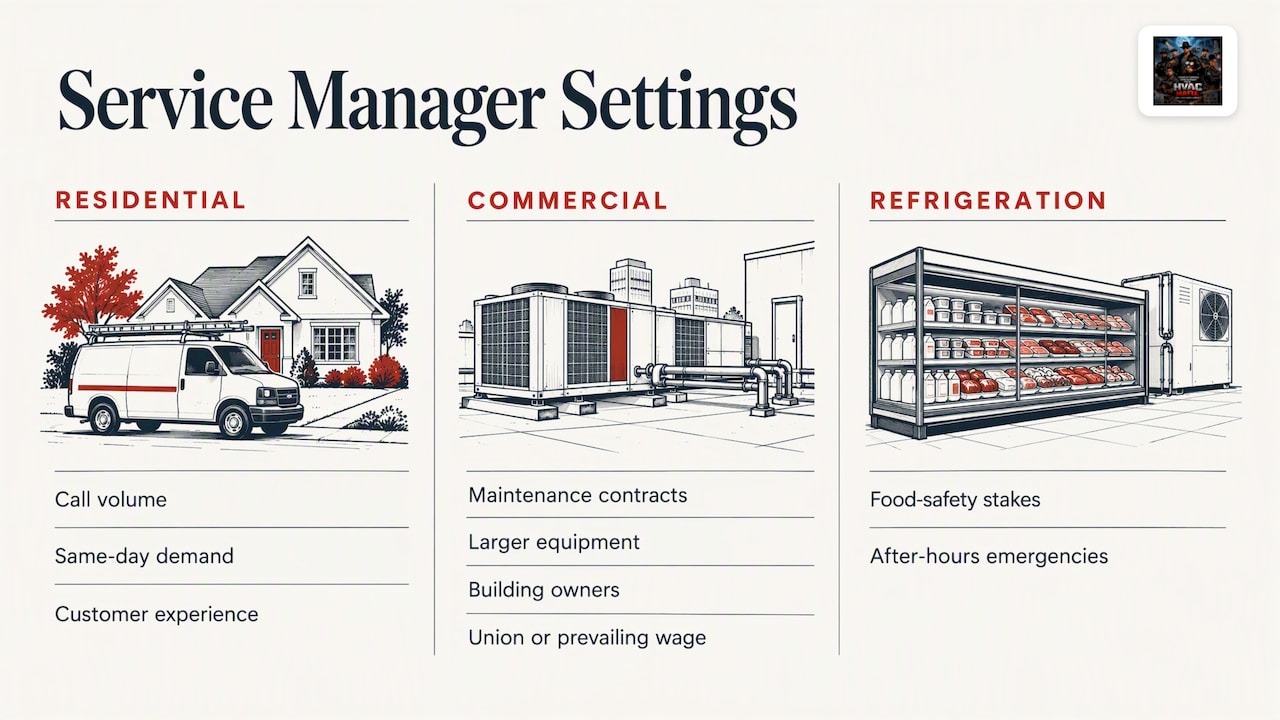
A residential service manager lives in call volume, same-day demand and customer experience. A commercial service manager handles maintenance contracts, larger equipment, building owners and often a union or prevailing wage environment. Refrigeration adds food-safety stakes and after-hours emergencies. When you read a posting, check which one it is. The pay, the hours and the pressure differ.
What employers ask for
Postings vary, but a few requirements show up again and again.
- Field experience. Most employers want years in the trade, not just a degree. You earn credibility by having done the work.
- Leadership experience. Lead tech, crew lead or trainer time counts.
- Technology. Employers expect you to be comfortable with dispatch and field service software. One commercial service manager role at Carrier notes that coursework in accounting, business administration or construction management can open doors to corporate roles.
- Business sense. Margins, labor costs, pricing and forecasting.
- Certifications. Federal rules require technicians who work on equipment that could release refrigerant to be certified, and the EPA’s Section 608 page spells out the requirements. Many employers also like NATE. The Department of Energy says contractors prefer NATE-certified technicians because they tend to stay in the industry longer and have proven knowledge.
State and local rules matter too. There is no national HVAC license, so licensing requirements vary by region, and technicians moving across state lines may need to retest, according to ACHR News. If you’re eyeing a manager job in another state, check that state’s licensing board first.
What HVAC service managers earn
Pay is the first question every tech asks, so let’s put real numbers on the table.
PayScale’s U.S. data reports an average base salary of $88,672 in 2026, with a base range of $62,000 to $122,000. The median sits near $89,000 and the 90th percentile is $122,000. PayScale also reports average total compensation of $68,897 at one to four years of experience and $74,919 at five to nine years.
Those are survey averages. Live postings often look different, especially at larger employers and in expensive metros:
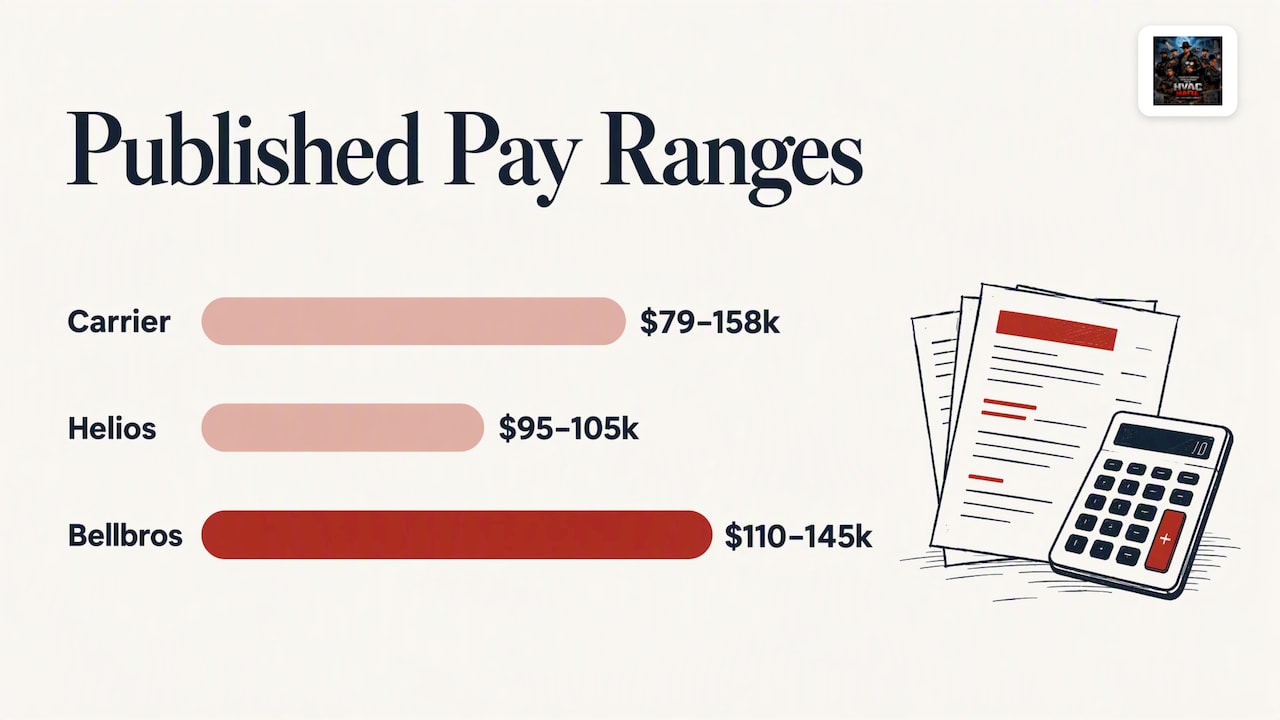
| Employer posting | Location | Published pay |
|---|---|---|
| Carrier, commercial HVAC service manager | Lenexa, Kansas | $79,000 to $158,000 a year |
| Helios Service Partners, commercial HVACR service manager | Posted for 2026 | $95,000 to $105,000 base |
| Bellbros, HVAC service manager | Hayward, California | $110,000 to $145,000 |
Two things stand out. First, the ranges are wide. Carrier says skills, education, experience and other qualifications decide where in the range you land. Helios says pay depends on labor market location, job-related knowledge, skills and experience. Second, the posting with the clearest numbers also lists benefits: the Bellbros listing mentions performance-based bonuses, medical, dental and vision insurance, a 401(k) match, paid time off and professional development.
That last part is how you should read any offer. Base salary is one line. Ask about:
- Bonus formula. What is it tied to: gross margin, customer satisfaction, technician retention? Is it paid monthly, quarterly or yearly?
- Benefits. Health coverage, retirement match, PTO.
- Vehicle and phone. A company truck is real money.
- On-call expectations. Who covers nights and weekends, and is there extra pay?
- Headcount and budget authority. Can you hire, fire and set pay for your techs?
If an employer won’t talk about these, that tells you something about the culture.
How to get from the truck to the manager’s desk
There’s no single route, but the steps are familiar. Most managers come up as an apprentice, then a journeyman or service technician, then a lead technician, and then step into the manager role. Here’s how to speed it up without skipping the parts that matter.
Get the credentials that open doors
Get your EPA 608 certification if you haven’t. Add NATE certification to show proven technical knowledge. Then look at business coursework, such as accounting basics, management or project management. You don’t need a degree for every job, but the Carrier posting above shows that business coursework helps for corporate roles.
Act like a lead before you have the title
Ask to train new hires. Offer to review callbacks and find patterns. Learn the dispatch and field service software, not just the mobile app but the reports behind it. Ask your current manager to walk you through the weekly numbers. Managers promote people who already make their jobs easier.
Tell your boss what you want
This sounds obvious. Many techs skip it. Training-school career guidance suggests asking supervisors about internal leadership opportunities and also searching general job boards and checking whether local cities and towns hire managers to service their buildings. Facilities and public-sector roles are easy to overlook.
Update your resume for a management role
A tech resume lists tools and certifications. A manager resume shows outcomes: callbacks reduced, techs trained, revenue per truck, retention. Our guide on writing an HVAC technician resume covers the basics, and you can add leadership results on top.
How to find and judge openings near you
Start where the jobs are, then filter hard.
- Trade-focused boards. Register free with HVAC Mafia to see openings from real contractors. They’re hidden from non-members, which keeps the noise down.
- Your own network. Ask the lead tech, the supply house counter person and the manufacturer rep who’s hiring. Good manager jobs often fill by word of mouth.
- Big-employer career pages. National and regional service companies post manager roles with pay ranges.
- Local employers. Facilities departments, schools and hospitals need service leadership too.
For a look at what a clear posting looks like, see this HVAC service manager role in Hayward, CA. Then run every opening through the same questions:
- Is the pay range published?
- Is the bonus formula explained?
- How many techs report to you, and what’s turnover been?
- What’s the call volume and the split between maintenance and replacement?
- Who will you report to, and how long have they been there?
- Why is the seat open?
A seat that has opened three times in two years is information.
Why service manager roles are hard to fill
Contractors tell us the same thing every week: finding a good service manager is harder than finding a good tech. The pool is small. The best candidates are usually working for someone and have no reason to scroll a general job site. Many postings sit unanswered because they read like a template.
The broader technician shortage makes it worse. A manager is judged by whether techs stay and perform. Federal energy research points the same direction: a DOE-funded heat pump training project worked to address labor shortages and upskill HVAC workers in newer technologies, and it found that incentives are useful for getting employees engaged in that training. If incentives work for training, they work for growth paths too.
How contractors can recruit and keep service managers
If you own the shop or run operations, here’s what actually moves candidates.
Promote from within, and say so
Your best manager candidate may already be your lead tech. Build a visible path: lead tech, assistant manager, manager. Pay for the business training. Say the path out loud at hire, not at the exit interview.
Publish the pay
A range with a bonus formula beats “competitive compensation” every time. Candidates compare postings side by side, and the ones with numbers get the call. Be specific about what drives the bonus, for example margin, customer satisfaction or retention, and be honest about how it’s measured.
Show your culture before the interview
Techs and managers with options want to know how you treat people. Tell them about training, truck and tool policy, how you handle callbacks, and how often your people leave. A company profile that shows real culture does more than a polished careers page.
Post where the trade looks
General boards bring volume. A trade-only audience brings fit. On HVAC Mafia, contractors reach nearly 100,000 HVAC followers, and applications go straight to your own hiring system.
Retain the manager you hire
Give them authority over scheduling, hiring input and tech development. Set clear targets. Check in weekly in the first 90 days. Most managers who leave say they didn’t have the support or authority to do the job.
Our perspective
I spent 36 years in this trade, and part of that as a dealership owner. I’ve hired service managers who were great and some who weren’t, and the difference was almost never technical skill.
The ones who lasted understood people. They coached before they corrected, and they knew the numbers without making techs feel like numbers. The shops that kept them gave them real authority and paid them fairly, in writing.
That’s why we built HVAC Mafia as a trade-only place. Job listings and community are for verified HVAC professionals, so contractors reach skilled people without homeowner or outsider noise, and techs get straight talk about pay, career paths and which employers are worth working for. We think the best way to fill a manager seat is to be honest about what it pays and what it asks, in front of people who know the work.
If you’re a tech, build a career, not just another paycheck. If you’re a contractor, show techs why your shop is worth joining. We’ll meet you in the middle.
the author
Reach service managers and techs who know the trade
If you’re hiring, post your opening on HVAC Mafia. Published plans are $199 per month per position (Standard), $149 per month per position (Annual) and from $99 per month per position (Enterprise). Want to stand out? Company Spotlight shows your pay, culture and benefits. It’s $149 per month or $1,699 per year.

Need extra visibility for one opening? Spotlight listings run $149 per week per position, $499 per four weeks per position, or $349 per month per position for ongoing. Techs and managers looking for work join free on the membership page.
FAQ
How much does an HVAC service manager make?
PayScale reports an average base salary of $88,672, with a $62,000 to $122,000 range. Live postings vary a lot by location and employer, and some large employers list ranges above $140,000. Bonuses and benefits can add meaningfully to the total.
Do I need a degree to become an HVAC service manager?
Not always. Employers weigh field experience, leadership and technology skills heavily. Business coursework in accounting, administration or construction management can help, especially for corporate roles.
Which certifications help?
EPA 608 is required for technicians who work on equipment that could release refrigerant, and the EPA explains the types on its certification page. NATE certification is a plus that many contractors prefer. Check your state or city for local licensing rules.
How long does it take to move into service management?
It depends on your starting point, the shop and how quickly you take on lead responsibilities. Techs who train others, learn the dispatch system and ask for leadership work tend to get noticed sooner. Tell your manager you want the job.
How do contractors find a good service manager?
Look inside your shop first, then post with the pay range and bonus formula where HVAC professionals actually look. Show your culture and growth path. A clear, honest posting in front of a trade-only audience beats a generic ad.
Sources
- What Is an HVAC Service Manager? (Lincoln Tech)
- How to Become an HVAC Service Manager (Lincoln Tech)
- Commercial HVAC Service Manager, Carrier (Workday)
- HVAC Service Manager Salary, PayScale
- Section 608 Technician Certification Requirements, US EPA
- North American Technician Excellence, Department of Energy
- Cross-State Hiring for HVAC Contractors, ACHR News
- Training the Next Generation of Heat Pump HVAC Technicians, Department of Energy