

A good HVAC benefits package covers health insurance, a retirement plan with a match, paid time off, fair on-call pay and paid training. The best shops add year-round work and a clear path from apprentice to lead tech. Pay gets the attention, but benefits decide whether a job is a career or just a paycheck. This guide covers what employers offer, what the national numbers say, and how to compare two offers side by side.
TL;DR
- Most HVAC employers offer some mix of medical, dental, vision, a 401(k) and paid time off. The details vary a lot by shop size and job type.
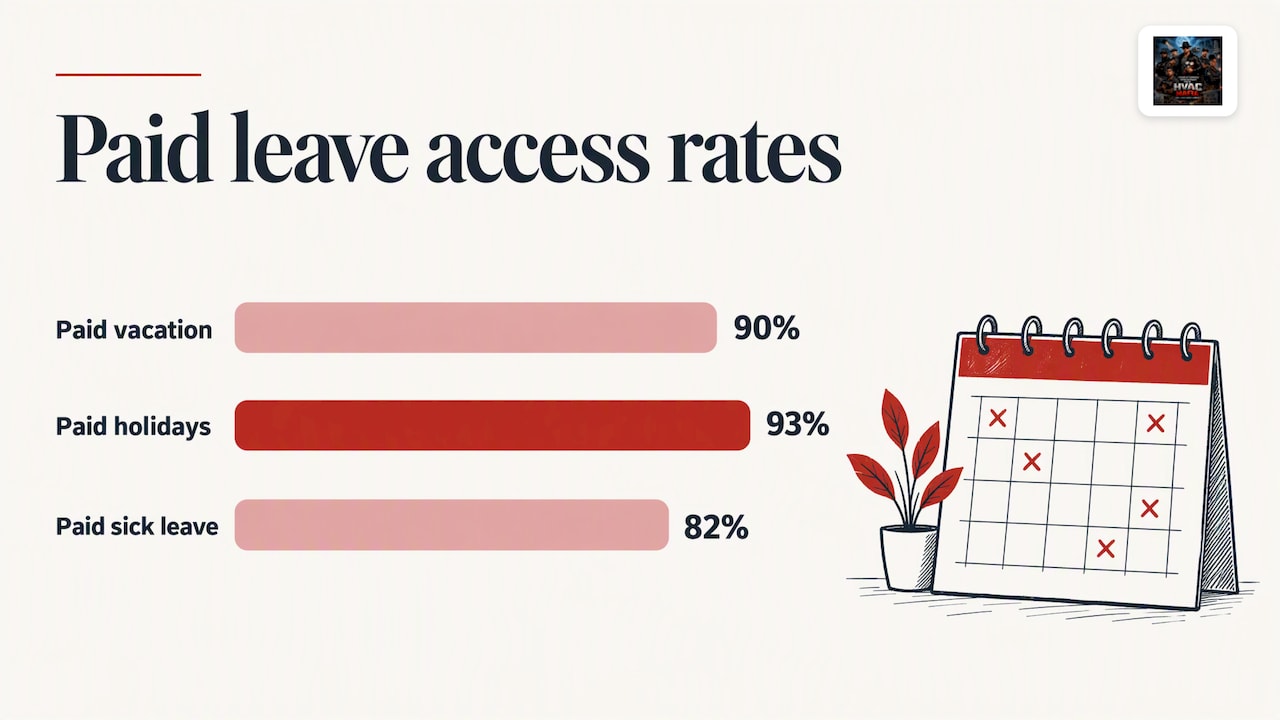
- Federal data shows about 9 in 10 installation, maintenance and repair workers have paid vacation and paid holidays, and 82% have paid sick leave.
- Sign-on bonuses are rare. Paid training, schooling help and extra PTO are more common.
- Ask about on-call pay, overtime rules, tool and vehicle policies, and the employer’s share of premiums before you accept.
- Compare total compensation, not just the hourly rate.
Table of Contents
- What benefits do HVAC technicians actually get?
- Perks that matter in this trade
- How benefits change by employer and job type
- What the pay picture looks like
- How to compare two offers
- For contractors: benefits are your hiring edge
- Our perspective
- Find a job with benefits that fit
- FAQ
- Sources
What benefits do HVAC technicians actually get?
There is no single standard package. Employers in the trade describe a common menu: health plans, HSAs and FSAs, dental and vision, 401(k) plans with an employer match, and supplemental coverage such as life, accident, critical illness and short- or long-term disability. Some shops offer all of it. Smaller shops may offer a few pieces.
Here is how the pieces break down.
| Benefit | What to expect | What to ask |
|---|---|---|
| Medical | Group plan, often with an employer share of the premium | How much comes out of each paycheck for you and your family? What is the deductible? |
| Dental and vision | Often offered as add-ons | Is it included or extra? |
| Retirement | 401(k), sometimes with a match | What is the match, and when do you vest? |
| Paid time off | Vacation, holidays, sick days | When does it start accruing? Does it roll over? |
| Disability and life | Often employer-paid or low-cost | Is short-term disability covered from day one? |
| Training | Paid classes, certifications, schooling help | Who pays for EPA 608 and manufacturer training? |
| Work-life | On-call pay, flexible schedules | How often is the rotation, and how is it paid? |
Health insurance
Under the Affordable Care Act, businesses with 50 or more full-time employees are required to offer health insurance. Smaller contractors are not bound by that rule, but many still reach coverage through group plans or trade association networks. So a 12-person shop can have a solid plan, and a bigger shop can have a thin one. Look at the plan, not the company size.
Retirement
Size matters more here. In March 2025, 86% of private-industry workers in establishments with 100 to 499 workers had access to retirement benefits, and 90% in establishments with 500 or more. If you work for a small shop, a retirement plan is worth asking about directly. If there is a match, treat it as part of your pay. Free money is still money.
Paid time off
The federal numbers are encouraging. According to the Bureau of Labor Statistics, as of March 2025, 90% of private-industry workers in installation, maintenance and repair occupations had access to paid vacation, 93% to paid holidays and 82% to paid sick leave. Access is not the same as generous. Ask how many days you get in year one, because that is where shops differ most.
Perks that matter in this trade
Generic benefit lists miss what makes HVAC different. Our work follows the weather. That shapes the perks worth looking for.
On-call pay and overtime
Summer and winter peaks mean long days and after-hours calls. Some employers do pay for it: technicians may receive on-call pay. If a shop expects you to carry the phone for free, that is a red flag. Ask three things:
- Is there a flat on-call stipend, and how much?
- What is the pay rate once you are dispatched?
- How often are you on rotation?
Some contractors also build in relief. According to an ACCA industry study, flexible arrangements such as four 10-hour days, flex time or guaranteed stop times for overtime are options employers use. If work-life balance matters to you, ask what the shop does in July and January, not what it says in the job post.
Paid training and schooling
This is the perk we would push every apprentice to chase. The same ACCA study found that 72% of contractors do not offer sign-on bonuses. Instead, employers lean on paid training, schooling benefits and added PTO. That is good news for you. A sign-on bonus is spent in a month. A certification or a manufacturer course raises your earning power for the rest of your career.
For apprentices and trade school students, ask:
- Does the company pay for classes, books and exam fees?
- Is time in class paid?
- Is there a ride-along period with a senior tech?
- What does the step from apprentice to service tech look like, and what does the raise look like?
Year-round work
Seasonal slowdowns can hit a paycheck. Shops that keep techs busy in the shoulder seasons, through maintenance agreements, commercial work or installs, give you steadier income. It is a benefit even though it never appears on a benefits sheet. Ask what techs do in the slow months.
Tools, truck and uniforms
In many shops a take-home vehicle, a tool allowance, uniforms and a phone are a real part of the package. They save you money every month. Ask what is provided, what you must buy, and who replaces broken tools.
How benefits change by employer and job type
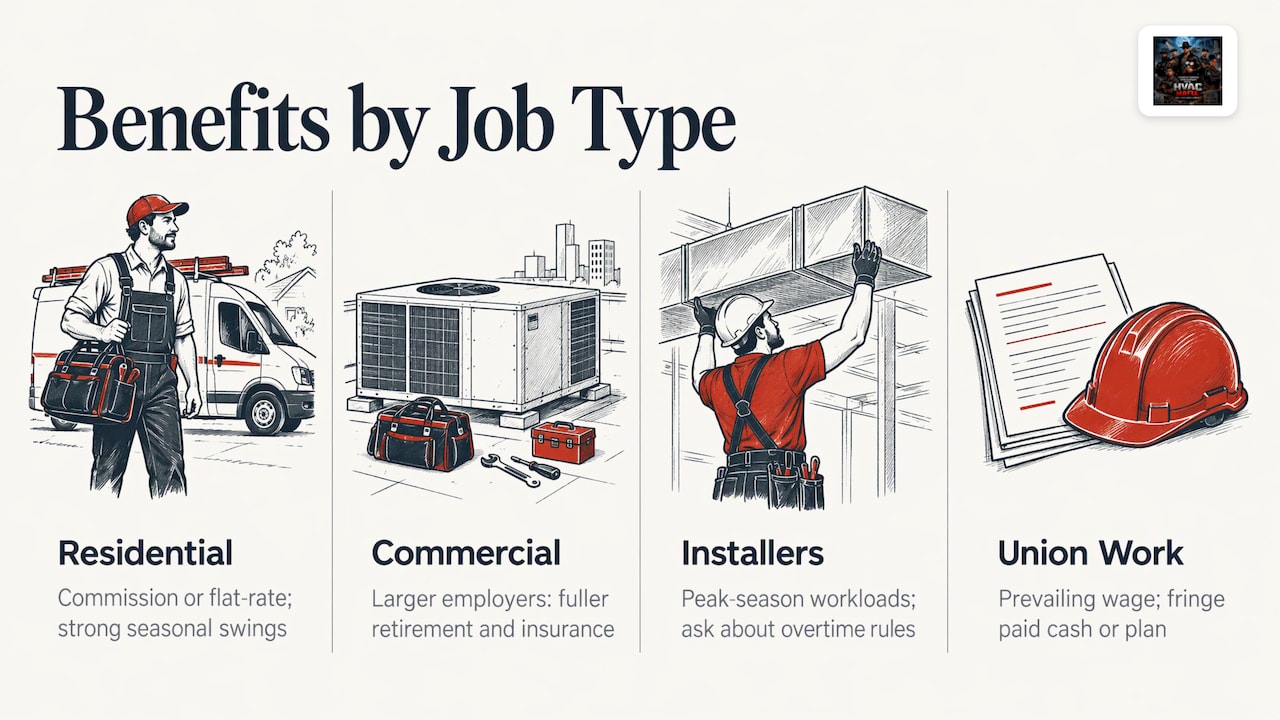
Residential service. Expect commission or flat-rate pay structures at some shops, and strong seasonal swings. Benefits depend heavily on the shop’s size.
Commercial and refrigeration. These jobs often come with steadier hours, planned maintenance schedules and larger employers. Larger employers tend to have fuller retirement and insurance offerings, in line with the BLS size figures above.
Installers. Install crews can see heavy workloads in peak season. Ask about overtime rules and what happens in a slow week.
Union and prevailing-wage work. Some work is covered by union agreements, and some projects carry wage rules. For example, Department of Energy projects funded under the Bipartisan Infrastructure Law and subject to Davis-Bacon have project wage determinations that contractors must meet. If a job posting mentions prevailing wage, ask how the fringe benefit portion is paid, whether as cash or into a plan.
What the pay picture looks like
Benefits sit on top of a base wage, so know the baseline. The Bureau of Labor Statistics reports that heating, air conditioning and refrigeration mechanics and installers had a median pay of $61,010 per year in May 2025, with the top 10% earning more than $95,210. The same page projects 11% job growth from 2025 to 2035, much faster than average. Demand is on your side. That means you have room to ask questions and compare.
How to compare two offers
Here is a simple way to avoid being dazzled by a big hourly number.
- Get the package in writing. Ask for the benefits summary, not a verbal rundown.
- Price the health plan. Add your monthly premium and the deductible. A $2 raise can vanish into a bigger premium.
- Count the match. If one shop matches your 401(k) contributions and the other has no plan, put a dollar figure on the difference.
- Count your days. Add vacation, holidays and sick time for year one.
- Value the extras. Take-home truck, tool allowance, paid training, on-call stipend. Even rough numbers help.
- Ask about waiting periods. Many benefits start after 30 or 90 days. Know the gap, and plan for it.
- Talk to a current tech. Ask how often the rotation really hits, and if the shop keeps its promises.
If you want a feel for what real employers put in postings, browse listings like this service technician role in Reno, this install lead position in Sharonville, OH or this service tech opening in Loveland, CO. Compare how each describes pay and perks, then ask for the rest.
When you are ready to apply, a sharp resume helps you negotiate from strength. Our guide on writing an HVAC technician resume walks through what to include.
For contractors: benefits are your hiring edge
If you run a shop and cannot find or keep techs, your benefits page is part of your recruiting pitch. Techs have choices. Industry commentary points to mental health and financial wellness programs as ways to build loyalty, on top of the basics.
You do not need to match a national company dollar for dollar. You need to be clear and honest. Spell out the 401(k) match, the on-call stipend, the training path and the schedule. Techs read vague postings as bad news. Our guide to HVAC technician recruitment covers how contractors hire and keep techs in more depth.
Our perspective
We have watched this trade for a long time, and the founder of HVAC Mafia is a 36-year HVAC veteran and former dealership owner. Here is what we keep seeing: the shops that keep good techs are not always the ones that pay the highest hourly rate. They are the ones that are straight about the whole package.
Techs deserve to know what a job really offers before they quit the one they have. That is why we built a place where openings come from real contractors, and where the talk is by techs, for techs. No corporate fluff. Just honest answers about pay, benefits and what makes an employer worth working for.
Contractors benefit too. When you show your culture, your pay and your benefits to a trade-only audience, you meet techs who care about exactly those things. Our Company Spotlight profiles are designed to give a shop room to show what it offers, so it stands out to techs who have options.
Build a career, not just another paycheck.
the author
Find a job with benefits that fit
If you are a tech, apprentice or student, join HVAC Mafia free. Members see job openings from real contractors, which are hidden from non-members. You also get straight talk on pay, career paths and spotting good and bad employers, plus the Tech Talk forums and the HVAC Underground Podcast.

Register for a free membership and start comparing real offers. If you are a contractor, our job posting plans put your openings, and your benefits, in front of a trade-only audience.
FAQ
Do HVAC technicians get health insurance?
Often, yes, but it depends on the employer. Businesses with 50 or more full-time employees must offer coverage under the ACA, and smaller shops may offer group plans too. Ask what share of the premium the company pays, since that changes your take-home pay.
Do HVAC techs get paid vacation and sick days?
Most do. BLS data from March 2025 shows 90% of private-industry installation, maintenance and repair workers had access to paid vacation, and 82% had paid sick leave. Ask how many days you earn in your first year and when they start.
Do HVAC employers pay a sign-on bonus?
Usually not. An ACCA study found 72% of contractors do not offer one. Many offer paid training, schooling benefits or more PTO instead, and those can be worth more over time.
Is on-call work paid in HVAC?
It can be. Some employers pay technicians on-call pay, and some arrange schedules around it, such as four 10-hour days or guaranteed stop times. Get the stipend, dispatch rate and rotation in writing before you accept.
What should an apprentice look for in a benefits package?
Put paid training and a clear raise path first, then health coverage and time off. Ask whether the company pays for classes and exam fees and who will mentor you. A shop that invests in your skills is investing in your future with them.
Sources
- ENCON rewards and benefits
- Leavitt Group: Why Employee Benefits Matter in the Trades
- BLS: Employee Benefits in the United States, March 2025
- Enervise: Cincinnati and Columbus employee benefits
- ACCA: 72% of contractors don’t offer sign-on bonuses
- DOE: Davis-Bacon Act compliance Q&A
- BLS Occupational Outlook Handbook: HVAC mechanics and installers