
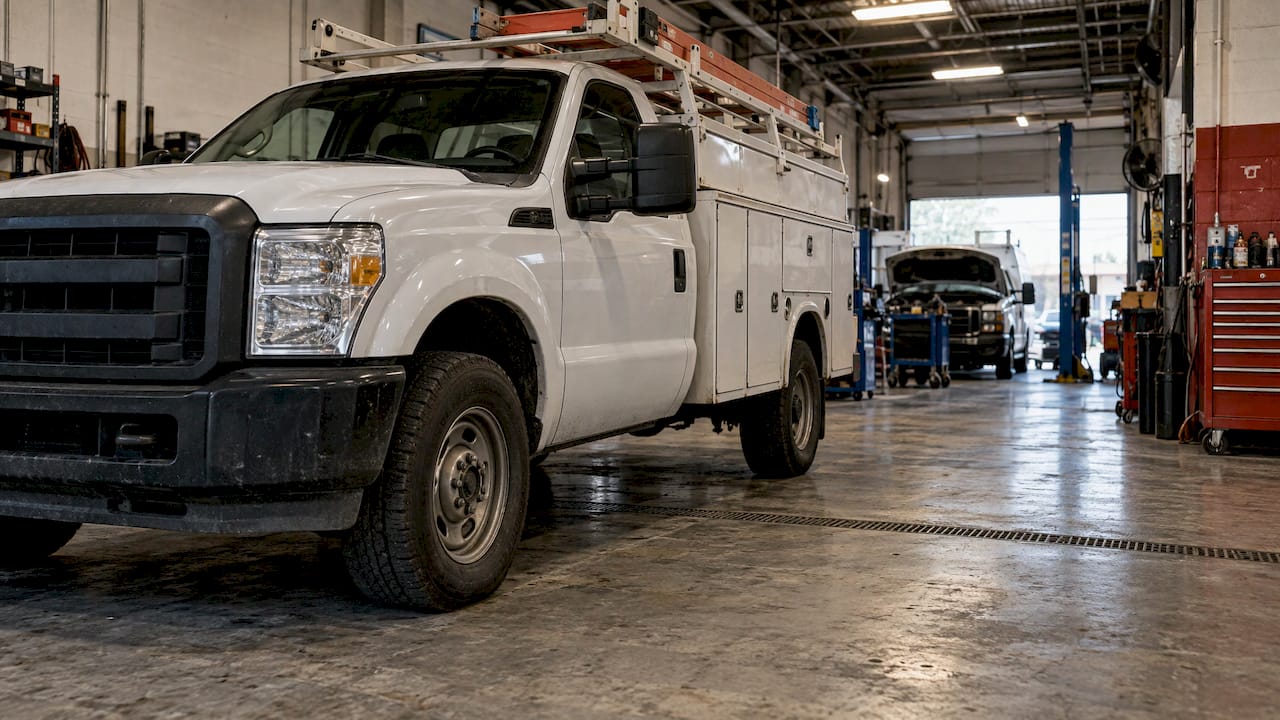
Yes, the HVAC technician shortage is real. Industry estimates put the gap at roughly 110,000 technicians nationwide, and federal data shows demand for the trade growing through 2035. If you run a shop, that means open trucks and slow hiring. If you turn wrenches, it means leverage. Below we break down the numbers, the causes, what an empty seat costs, and what both sides can do about it.
TL;DR
- Industry estimates put the U.S. gap near 110,000 HVAC technicians, with projections of up to 225,000 unfilled positions by 2027.
- The Bureau of Labor Statistics projects 11 percent job growth from 2025 to 2035, about 40,600 openings a year.
- Retirements, the heat pump shift, the HFC phaseout and data center construction are all pulling on the same limited pool of techs.
- An empty service truck can cost a contractor thousands of dollars of potential revenue on a peak-season day, and replacing a journey-level tech runs $15,000 to $25,000.
- Contractors who build their own pipeline and show what it is like to work for them win. Techs with real skills get to choose.
Table of Contents
- How big is the HVAC technician shortage?
- What is causing the shortage?
- What an open seat costs a contractor
- What the shortage means if you’re a technician
- What contractors can do about it
- Training and credentials that help
- Reach the techs you’re missing
- FAQ
- Sources
How big is the HVAC technician shortage?
Two kinds of numbers float around, and they measure different things. Federal data tracks employment and annual openings. Industry estimates try to describe the broader gap between the technicians the market needs and the ones available. Both are useful. Neither tells the whole story alone.
Here is how the main figures line up.
| Measure | Figure | Source |
|---|---|---|
| Estimated U.S. technician gap | About 110,000, possibly 225,000 by 2027 | Industry analysis |
| Technicians leaving the workforce each year | About 25,000 (retirement and career changes) | Industry analysis |
| Projected job growth, 2025 to 2035 | 11 percent, about 48,200 new jobs | Bureau of Labor Statistics |
| Average annual openings | About 40,600 | Bureau of Labor Statistics |
| Energy efficiency employers that hired in 2025 and had trouble filling roles | 74 percent | U.S. Department of Energy |
The BLS openings figure is worth a second look. Many of those 40,600 annual openings come from people who transfer to other occupations or leave the labor force, not just from new jobs being created. That is the churn every contractor feels: you hire, train, and sometimes lose people faster than you can replace them.
The Department of Energy’s 2026 U.S. Energy & Employment Report adds that, among energy efficiency employers who hired in 2025, 74 percent reported difficulty filling positions, and management roles were the hardest to fill. That detail matters for anyone thinking about the path from tech to lead to service manager. The shortage is not only at the entry level.
One more data point from the Skilled Trades Report: HVACR mechanics and installers land between the 73rd and 75th percentiles nationally on its Labor Shortage Index. In plain terms, the pressure is high, though it varies by occupation and by region. A shop in a fast-growing Sun Belt metro will feel it differently than one in a small town.
What is causing the shortage?
There is no single cause. ACHR News points to an aging workforce, the phaseout of HFCs, the move toward heat pumps, and attrition from retirements and new technology. We see the same pieces from the inside.
An aging workforce
A lot of experienced techs are close to the end of their careers, and the people who learned the trade in the field are taking that knowledge with them. Industry estimates put about 25,000 departures a year on retirement and career changes. Replacing them is not a matter of posting one job. A tech who can run a call alone, diagnose a tricky system and talk to a homeowner took years to build.
New equipment and new refrigerants
The HFC phaseout and the push toward heat pumps change what a tech has to know. That is good for people who keep learning. It also means the pool of technicians who are ready for the newest systems is smaller than the pool of people who can do a basic changeout. The Department of Energy has funded work on online curriculum for heat pump installation, design, service and maintenance, with a planned partnership with BPI on a future Heat Pump Certificate of Knowledge, which tells you where the trade is heading.
New demand from heat pumps and data centers
According to industry analysis, rapid growth in heat pump installations and the construction of energy-intensive AI data centers, which need advanced thermal management, are adding demand on top of an already tight supply. For a technician, that opens doors beyond residential service, such as commercial chillers and liquid cooling.
A pipeline that can’t keep up
The old growth model was simple: hire more techs. That model is straining because the sector cannot train and retain enough people at the speed demand requires. Which brings us to the cost.
What an open seat costs a contractor
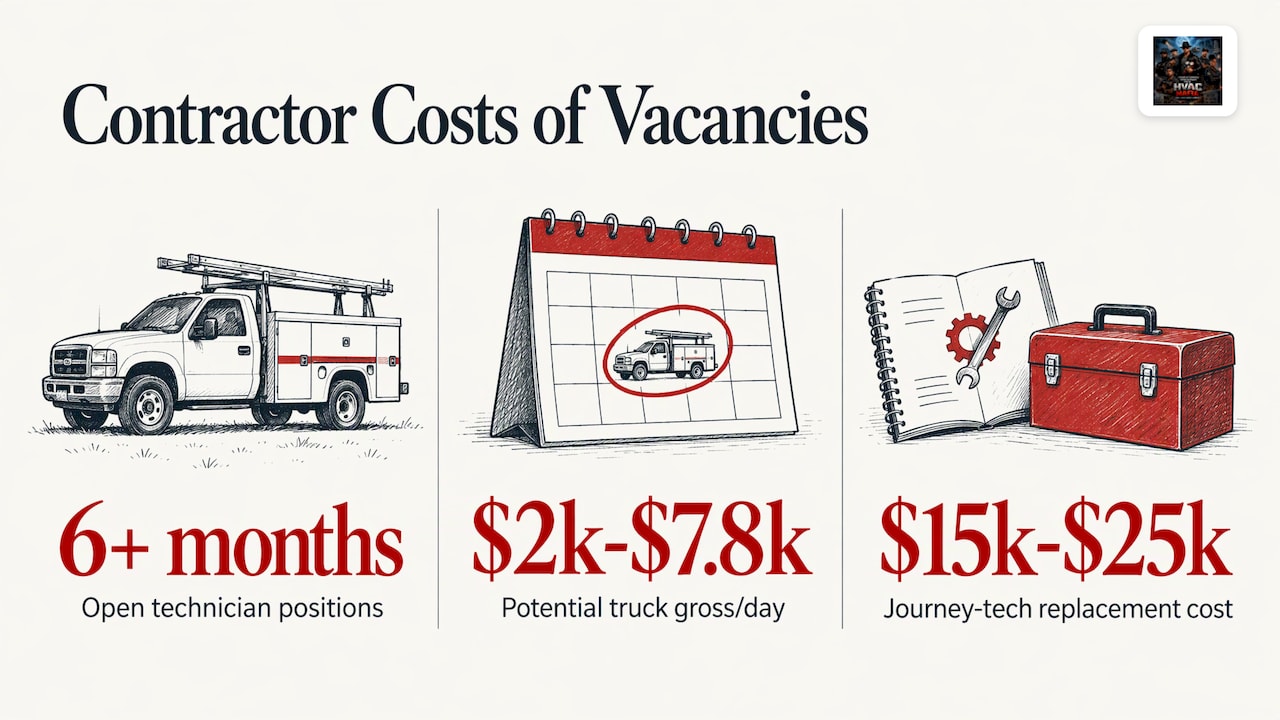
If you own a shop or manage a service department, you already know the pain. Some contractors have technician positions open for six months or longer and cannot get to all of their customers.
The math is rough. TrueStep HR estimates that an unstaffed service truck can represent $2,000 to $7,800 in potential daily gross revenue during peak seasons. The same source puts the cost of replacing a journey-level technician at $15,000 to $25,000 in hiring and training expenses.
Those are estimates, and your numbers will differ by market and by trade mix. But run your own version. Take your average ticket, your average calls per truck, and the number of days a position has been open. Most owners are surprised.
The second cost is quieter: the techs you already have. When a crew is stretched to cover for a missing teammate, overtime climbs, ride-alongs for new hires get skipped, and good people start answering recruiter calls. Shortages feed themselves.
What the shortage means if you’re a technician
Here is the part nobody should hide from you: this market works in your favor.
Strong demand gives new entrants leverage for higher starting wages and employer-sponsored training, according to industry analysis. If you are already in the field, you can ask harder questions of employers. We would encourage you to.
- What does a typical week look like? On-call rotation, overtime expectations, how calls are dispatched.
- Is pay clear? Hourly versus flat rate, spiffs, how commissions are calculated.
- Where does this lead? Is there a real path from service tech to lead tech to service manager, or is it just a title?
- What training do they pay for? Certifications, manufacturer classes, heat pump and commercial work.
- Do people stay? Ask how long the lead techs have been there.
A good employer will answer without flinching. A shop that gets defensive is telling you something.
If you are job hunting, your resume should show the things that make a contractor pick up the phone: system types, certifications, call volume, and any experience with newer equipment. Our guide on writing an HVAC technician resume walks through what to include.
And if you are curious what real openings look like, they are not all in one region. We have listings for roles like a service technician in Spring, TX, a service technician in Loveland, CO and an install lead technician in Sharonville, OH. Members see the full board for free.
What contractors can do about it
Waiting for the market to fix itself is not a plan. Here is what we see working for shops that keep their trucks staffed.
Build your own pipeline
Industry guidance from ACHR News recommends trade-school partnerships and advisory committees, plus apprenticeship programs and training initiatives. Getting in front of students before they graduate means you are the shop they already know. Registered apprenticeships are a major response: the Department of Energy’s report counts 112,000 new apprentices in U.S. construction in 2025, up 9 percent from 2024.
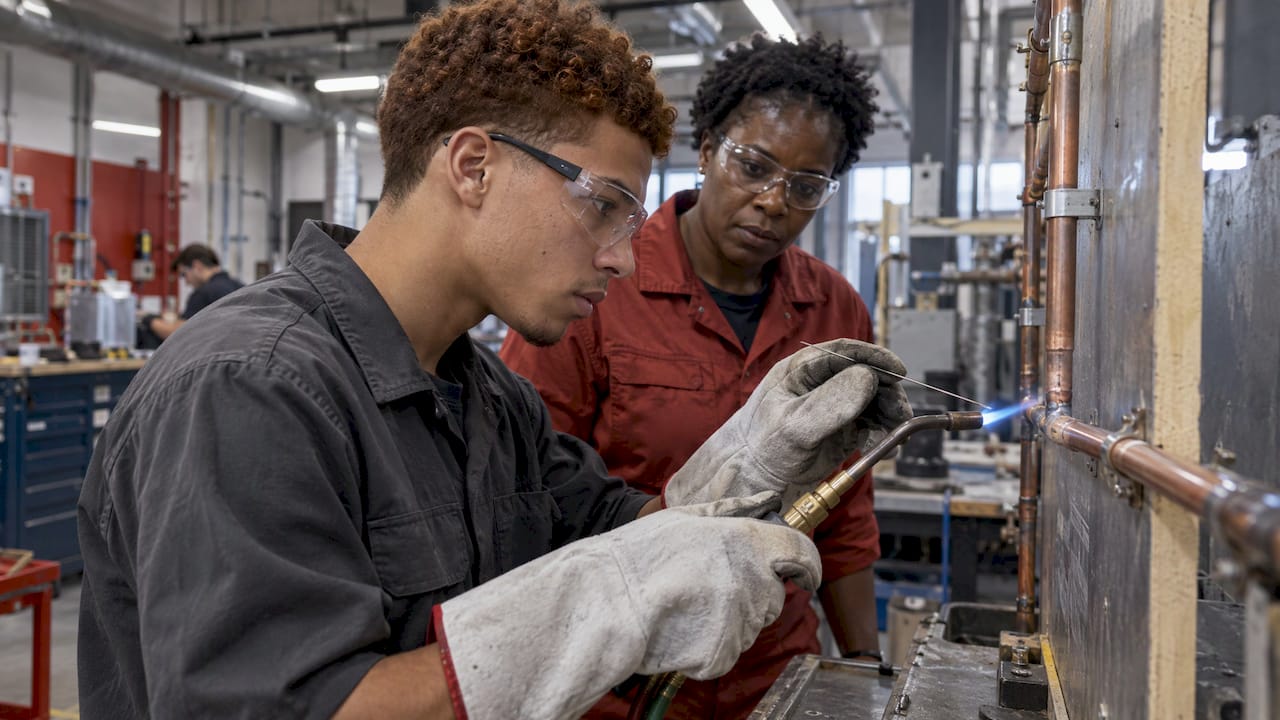
Manufacturers are helping too. Carrier and the TechForce Foundation have launched scholarship, free training access and career path initiatives aimed at the technician pipeline. If you have a relationship with a manufacturer rep, ask what support is available for your apprentices.
Give people a roadmap
Retention is cheaper than recruiting. Industry veterans, including Keith Neff in ACHR News, have argued for treating staff as team members and laying out a clear career roadmap, from maintenance tech up to advanced service. Put the steps on paper. Say what each level pays and what it takes to get there.
Be findable where techs actually look
Posting on a general job site means competing with every retail and warehouse listing in the zip code. Our view, which we lay out in It’s Not a Labor Shortage. It’s a Connection Problem, is that many shops are not short of techs so much as short of ways to reach them. For the nuts and bolts, see our guide to HVAC technician recruitment.
Spell out pay, culture and benefits
Techs have choices, and they compare. Say what you pay. Say what your on-call looks like. Show your people. A vague posting reads like a vague employer.
Training and credentials that help
For anyone entering the trade or moving up, the useful credentials are the ones employers ask for and pay for. Heat pump skills are the clearest example of where the field is moving, thanks to the DOE-backed curriculum mentioned above. Beyond that, think in terms of:
- Trade school or an apprenticeship to start, ideally with an employer who pays for training.
- Certifications that match the work you want: residential service, commercial, or refrigeration.
- Ongoing manufacturer training on the equipment lines your shop installs.
Check pay and program details on official sources and with the employers you are talking to, because both vary by state and by company.
Perspective: We don’t think it’s a shortage of people. It’s a shortage of connection.
We started HVAC Mafia because a 36-year HVAC veteran and former dealership owner kept watching the same story play out. Good contractors couldn’t find techs. Good techs couldn’t find contractors worth working for. Both sides were out there, scrolling past each other on sites built for everything except this trade.
The numbers say the shortage is real, and we’re not arguing with them. What we’ve seen on the ground is that how you hire matters as much as how many people exist. A trade-only audience, openings from real contractors, and honest talk about pay and culture change the conversation. Techs can see who is hiring and what the shop is like. Contractors can reach skilled people without the noise.
That is why job listings on our board are hidden from non-members and why membership is free for technicians. And it is why we built Company Spotlight profiles, so a shop can show its culture, pay and benefits to techs who have options. If you want to build a career, not just collect another paycheck, you belong in this community. If you want to keep good people, show them why they should stay.
the author
Reach the techs you’re missing
If you are a contractor with open positions, we built HVAC Mafia for you. Your job reaches a trade-only audience of nearly 100,000 HVAC followers, and applications go straight to your own hiring system. Our posting plans are priced per position: Standard is $199 per month, Annual is $149 per month, and Enterprise starts from $99 per month. See the details on our job posting plans.

Want to stand out to techs who are comparing offers? A Company Spotlight profile is $149 per month or $1,699 per year. And if you are a technician, join as a member to see the openings.
FAQ
How many HVAC technicians are we short?
Industry estimates put the gap at about 110,000 technicians, with projections reaching 225,000 by 2027. Federal data measures something different: the BLS projects about 48,200 net new jobs from 2025 to 2035 and an average of 40,600 openings a year. Treat the estimates as a signal of pressure, not an exact count.
Is the HVAC labor shortage going away?
Not soon. The BLS projects 11 percent growth from 2025 to 2035, and retirements, heat pump adoption and data center construction keep adding demand. The shops that do best are the ones building their own pipelines through trade schools and apprenticeships.
Is this a good time to start an HVAC career?
Demand is strong, which gives new entrants leverage for better starting wages and employer-sponsored training. Look for employers that pay for training and show a clear path from apprentice to lead tech. Ask about pay and advancement before you accept an offer.
How does the shortage affect customers?
Contractors with positions open for six months or longer can’t service every customer, which can mean longer waits. Some shops shift preventive and non-urgent work to slower months to keep capacity for emergency calls during peak periods.
What can a contractor do first?
Start by pricing your open seats using your own numbers. Then publish clear pay and career steps, partner with a local trade school, and post where techs look. Our recruitment guide covers the steps.
Sources
- Best HVAC Schools in the US (2026): Top 10 Ranked Programs
- Heating, Air Conditioning, and Refrigeration Mechanics and Installers, Bureau of Labor Statistics
- 2026 United States Energy & Employment Report, U.S. Department of Energy
- The State of America’s Skilled Trades
- How Contractors Can Help the UA Recruit 30,000 Technicians, ACHR News
- Scaling Service in a Technician Shortage, ACHR News
- What an open HVAC technician position costs, TrueStep HR
- Talking IoT in HVAC, ACHR News
- Training the Next Generation of Heat Pump HVAC Technicians, U.S. Department of Energy
- Carrier Partners with TechForce to Address HVAC Technician Shortage