The best HVAC referral recruiting programs do four things: pay a real bonus, pay it in stages after the hire proves out, make submitting a referral take a minute, and give employees a job post they can share with confidence. Referrals open the door. A visible, trade-only job listing is what keeps that door from being the only one you have. If you are a contractor or service manager short on techs, here is how to set it up, with real bonus numbers from shops that publish them.
TL;DR
- Published HVAC referral bonuses run from $200 for entry-level hires up to $2,500 for experienced techs, usually paid in two installments.
- Pay in stages (30, 90 or 180 days) so the bonus rewards a hire who stays, not just one who starts.
- Use one short form that goes straight to whoever owns hiring, and write the rules down: who is eligible, what counts, when it pays.
- Referrals only reach your employees’ circles. Pair them with a job post that technicians can find and forward.
- Techs and apprentices: register free to see openings from real contractors, then pass the good ones to your crew.
Table of Contents
- Why referrals matter more in a shortage
- What HVAC shops actually pay for a referral
- How to set up the program, step by step
- Make referrals produce hires who stay
- Referrals for apprentices and early-career techs
- Where referrals end and a job post begins
- Our view: referrals and a trade-only audience work together
- Put your open roles in front of techs
- FAQ
- Sources
Why referrals matter more in a shortage
A referral works because a tech vouches for another tech. They know who shows up, who can run a service call alone and who will fit the crew. That is hard to learn from a résumé.
The shortage makes this more valuable. ACHR News reported in June 2026 that the industry is short more than 100,000 technicians and could see a gap of 225,000 within five years. A separate study covered by ACHR News in March 2026 projected that 192,365 HVAC technician jobs will be unfilled by 2030. Enrollment is rising: two-year HVACR programs grew nearly 30% in 2025 and another 16.7% in 2026, according to National Student Clearinghouse data cited by ACHR News. But industry leaders in the same report say retirements still outpace new entrants in many markets.
When good techs are scarce, the ones you already employ are your best recruiters. For the wider picture, see our guide to how contractors hire and keep techs and the real numbers behind the shortage.
What HVAC shops actually pay for a referral
You do not have to guess at a number. Several contractors publish their terms.
| Shop | Bonus | Payout timing |
|---|---|---|
| Advance Industrial Mechanical | $1,000 when a Field HVAC Technician referral is hired, plus $1,000 more | Second $1,000 after 90 consecutive days |
| Polk Mechanical | $2,000 for service role hires | 50% at 90 days, 50% at 180 days |
| Appolo Heating | $200 (no HVAC experience) up to $2,500 (5+ years) | Two installments, at 30 and 90 days |
| McWilliams & Son (Texas) | Up to $1,000 per hire, plus $2,000 each hire anniversary, as reported in October 2025 | Recurring on the anniversary of the hire date |
| Leap Partners | Bonus plus a raffle entry for a $5,000 family vacation check, per ACHR News in March 2023 | 90-day and six-month anniversaries |
Three patterns stand out.
Bonuses scale with experience. Appolo’s tiers run from $200 to $2,500 depending on the hire’s HVAC background. Leap Partners also raises bonuses for more experienced hires. A lead installer is worth more to you than a helper, and the payout should say so.
Payouts are staged. Every program above holds some or all of the money until the hire has stayed 30, 90 or 180 days. That protects you from paying for someone who walks in month two, and it gives the referrer a reason to help the new hire succeed.
Some programs reward loyalty over years. McWilliams & Son’s annual anniversary bonus turns a referral into a long-term stake in the hire staying.
Pick a number you can sustain. If your cost to fill a service tech seat through ads and downtime is high, a $1,000 to $2,000 bonus split across 90 and 180 days is in line with what these shops publish.
How to set up the program, step by step
1. Decide who and what is eligible
Write down which roles qualify (service techs, installers, apprentices, commercial and refrigeration techs, service managers). Decide who can refer: all employees, or everyone except the hiring manager and owner’s family.
Advance Industrial Mechanical’s terms add a useful rule: the candidate must not have applied within the prior 6 months. Without a rule like that, you will argue over whether a referral was really new.
2. Set the bonus tiers and the payout clock
Use the table above as a starting range. Tie the amount to role and experience, then pick your clock: 30/90 days for fast feedback, 90/180 days for stronger retention protection. Say plainly that the bonus is paid on the referrer’s next regular payroll after the milestone, if the referrer is still employed.
3. Handle ties and caps before they happen
Polk Mechanical states that there is no cap on the number of referrals an employee can make, and that if several employees refer the same candidate, the first referrer receives the reward. Both are simple and fair. Copy the logic, not the wording.
Appolo requires the referral to be submitted before the candidate’s first interview. That one line prevents most after-the-fact claims.
4. Make submitting a referral effortless
If a referral takes ten minutes and several logins, you will get fewer of them. A widely used best practice is a single web form that captures the referrer, the candidate’s name and contact information, the role and a short note, and routes it straight into the recruiting system.
For a shop with 10 to 50 people, that can be as plain as:
- Referrer name
- Candidate name, phone and email
- Role and rough experience
- One sentence on how they know the candidate
- Whether the candidate has applied before
Put the link on the shop’s group chat, the dispatch board and the break room wall. Techs are in trucks, not at desks, so it has to work from a phone.
5. Track every referral to the end
The same source recommends documenting eligibility, qualification windows and the timeline from referral to bonus payment so employees can find them easily. In practice, keep a simple sheet or your hiring system’s source field with these columns:
- Date referred and referrer
- Role
- Interview date (and whether it came after the referral)
- Hire date
- 30, 90 and 180-day check dates
- Bonus paid or not, and when
Every month, look at three numbers: referrals received, referrals hired, and referrals still employed at 90 days. Those tell you if the bonus is too low, the form is too hard, or you are hiring people who do not last.
6. Tell the person who referred, every time
A referrer who hears nothing stops referring. Tell them when their person interviews, when an offer goes out, and when the 90-day mark passes. Thank them in front of the crew. It costs nothing, and it is where a lot of programs quietly fail.
Make referrals produce hires who stay
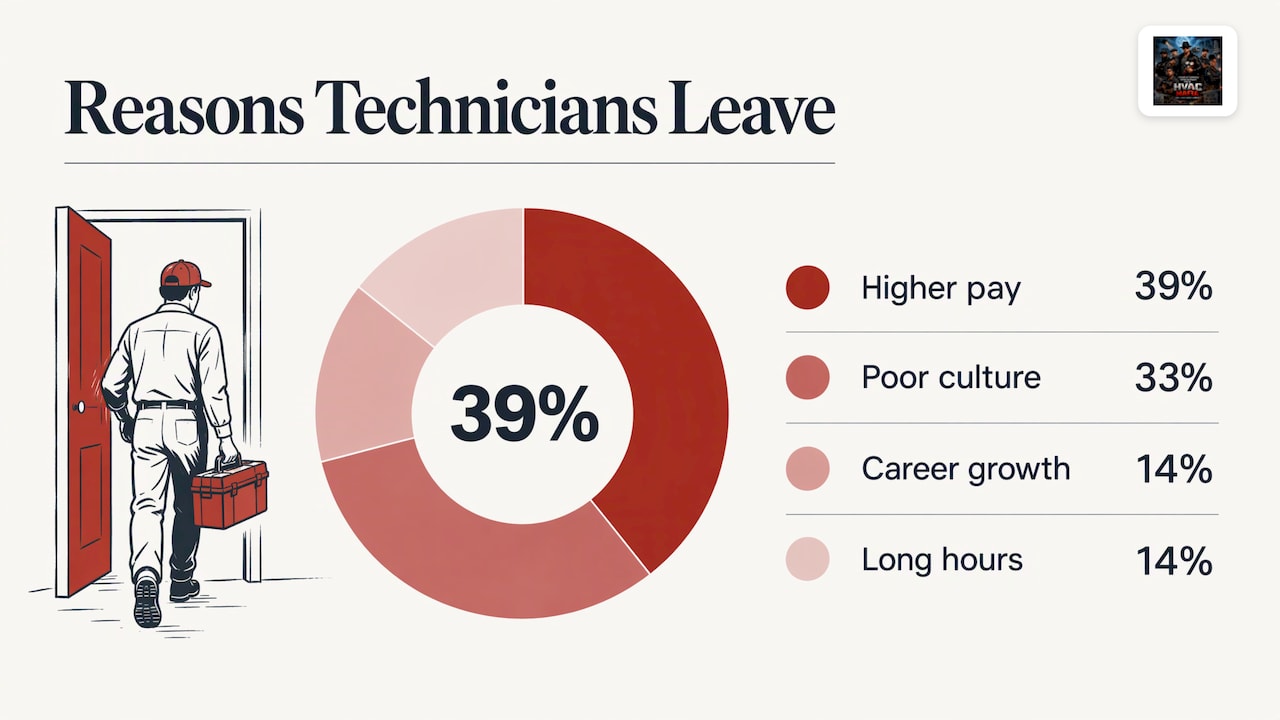
A referral program should fix turnover, not feed it. A Contracting Business survey of 272 respondents found that 39% of technicians leave for higher pay, 33% cite poor culture or management, 14% cite limited career growth and 14% cite long hours.
What that means for your referral program:
- Referrals only work if people would recommend you. A tech who dreads Monday will not bring in a friend. Pay, culture and a clear path from apprentice to lead tech come first.
- Show the ladder. Contracting Business notes that a career development ladder with clear expectations helps technicians see a path forward and cuts the temptation to leave.
- Pick for fit, not just skill. Cardinal’s program, as covered in HVAC Today, pairs financial incentives with employees recommending peers they believe fit the culture. The reported results are faster onboarding, stronger team cohesion and higher retention.
- Keep hiring fair. Apply the same interview standards to referred candidates as everyone else, and write job requirements down. A referral gets someone an interview, not an automatic offer. If your whole crew refers people from the same circle, also post openings publicly so qualified outsiders get a fair look.
John Cerasuolo of Leap Partners told ACHR News that the most effective recruiting and retention strategies are about engaging and leveraging the workforce rather than spending heavily on traditional fixes, and that retention feeds recruitment.
Referrals for apprentices and early-career techs
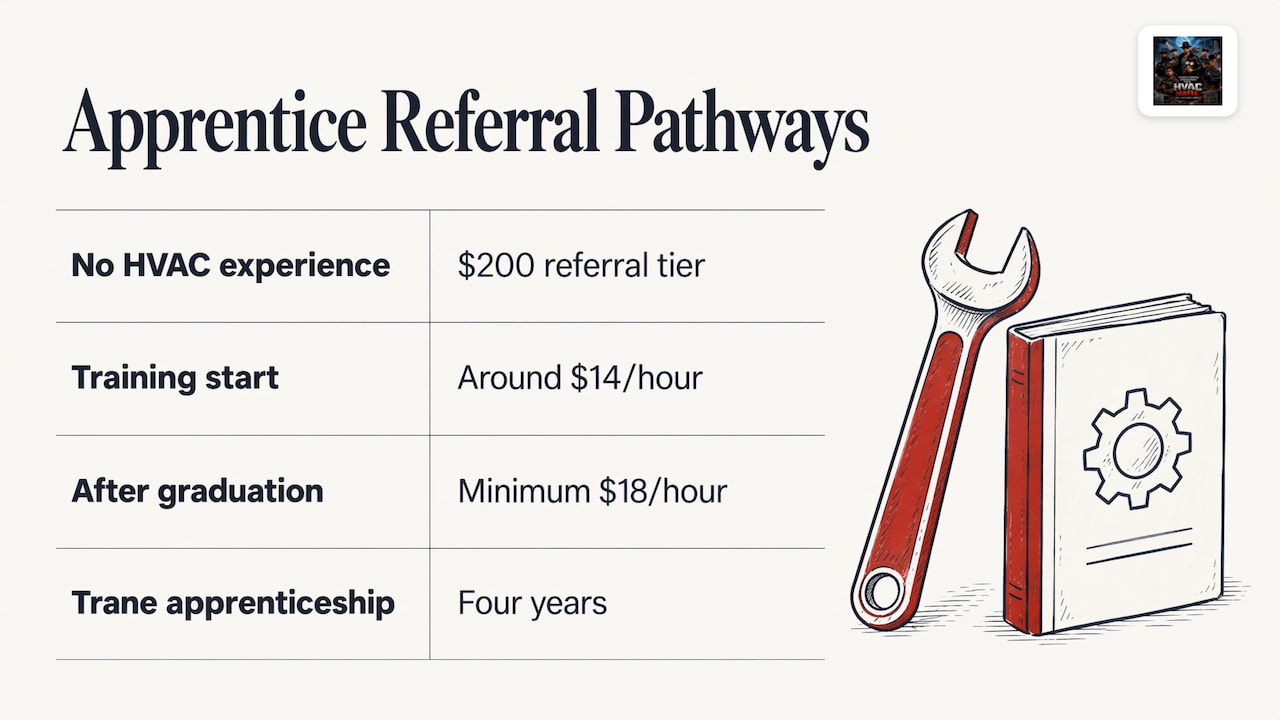
Referrals are not only for experienced hires. Your techs know a nephew finishing trade school, a neighbor leaving retail, a classmate from a community college program. Give those referrals a tiered bonus, like Appolo’s $200 level for candidates with no HVAC experience.
Then back the hire with a real training plan. Stanfield Air Systems starts high school students at around $14 an hour in a training program and brings them in at a minimum of $18 an hour after graduation, treating it as a training investment, as ACHR News reported in November 2025. The same report says apprenticeships build loyalty, reduce turnover and create a steady pipeline.
Formal programs exist too. Trane’s four-year commercial technician apprenticeship is nationally registered and accredited by the U.S. Department of Labor, and ACHR News has written about how contractors can partner with local schools and UA apprenticeship programs to build their own pipeline. If you hire installers, our guide to HVAC installer recruitment covers that path in more detail.
Where referrals end and a job post begins
A referral program reaches the people your employees know. That is powerful, and it is also a fixed circle. Once your techs have named everyone they can think of, the pipeline slows. This is where the open job has to be visible to techs who have never heard of you.
Two things help. First, a clear, honest posting: pay range, benefits, what a normal week looks like. Our look at what techs should expect from HVAC employee benefits shows what candidates compare you against. Second, a place where only the trade is looking. On HVAC Mafia, job listings and community are restricted to verified HVAC trade professionals, so your opening is not buried under homeowner or outsider noise.
It also gives your referral program something to point at. Your tech can forward a real listing to a friend instead of saying “we’re hiring, I think.” If you recruit for larger jobs, read how commercial HVAC hiring works from both sides of the desk.
Our view: referrals and a trade-only audience work together
I spent 36 years in this trade and ran a dealership. I know what it costs when a van sits in the lot because there is no one to drive it.
Here is what I learned. The best hires I ever made came from my own people. A tech who tells a buddy “come work here” is putting his name on the line. That is worth more than any ad.
But I also learned that referrals alone run dry. Your crew only knows so many people. So we built HVAC Mafia as a place where contractors reach a trade-only audience of nearly 100,000 HVAC followers, and where applications go straight into your own hiring system. Your referral program and your job post feed each other: the post gives referrers something to share, and the referrals give the post credibility.
For techs, it is free. Register, see the openings from real contractors, and read straight talk on pay, certifications and spotting good and bad employers. If you are a shop that treats people right, a Company Spotlight profile lets techs see your culture, pay and benefits before they ever call.
No corporate fluff. No shortcuts. Just knowledge, loyalty and respect.
the author
Put your open roles in front of techs
If you are a contractor with seats to fill, post the role where technicians are already looking. Job posting plans are $199 per month per position on Standard, $149 per month per position on Annual, and from $99 per month per position on Enterprise. You can see them on the job posting plans page. To show off your pay, benefits and culture, there is a Company Spotlight at $149 per month or $1,699 per year.

Techs and apprentices can join free as a member to see the openings, then share the good ones with the crew.
FAQ
How much should an HVAC employee referral bonus be?
Published programs range from $200 for hires with no HVAC experience up to $2,500 for 5+ years of experience at Appolo Heating. Polk Mechanical pays $2,000 for service role hires. Scale the amount with the role and what a vacant seat costs you.
When should the referral bonus be paid?
Most shops pay in stages after the hire stays. Appolo pays at 30 and 90 days, Advance Industrial Mechanical at hire and 90 days, and Polk at 90 and 180 days. Staged payouts reward retention, not just the start date.
How should employees submit a referral?
Give them one short form that works on a phone and sends the candidate’s name, contact details, role and a note on how they know them to whoever runs hiring. Ask for it before the candidate’s first interview so credit is never in doubt.
Is there a shortage of HVAC workers?
Yes. ACHR News reported in June 2026 that the industry is short more than 100,000 technicians. Enrollment in two-year HVACR programs is growing, but retirements continue to outpace new entrants in many markets, so keeping the techs you have matters as much as finding new ones.
Sources
- Scaling Service in a Technician Shortage, ACHR News
- Big Red Flag: Trades Looking at Seismic Labor Shortage by 2030, ACHR News
- HVAC Enrollment Is Outperforming Broader Vocational Education, ACHR News
- Employee Referral Program Terms and Conditions, Advance Industrial Mechanical
- Referral Bonus, Polk Mechanical
- Referral Bonus Reward Plan, Appolo Heating
- Top HVAC Recruiting Strategies: 9 Best Practices in 2026
- Leveraging Your Workforce in Recruitment and Retention Strategies, ACHR News
- Employee Referral Programs: Benefits, Best Practices, and How to Build One
- Stop the Revolving Door: Smart Retention Tactics for HVACR Contractors, Contracting Business
- Cardinal University: Building Talent From the Inside Out, HVAC Today
- From Retirement Cliff to Renewal: How One HVAC Firm Got Younger, ACHR News
- Trane Technologies Unveils the World’s Largest HVAC Training Center, ACHR News
- How Contractors Can Help the UA Recruit 30,000 Technicians, ACHR News