
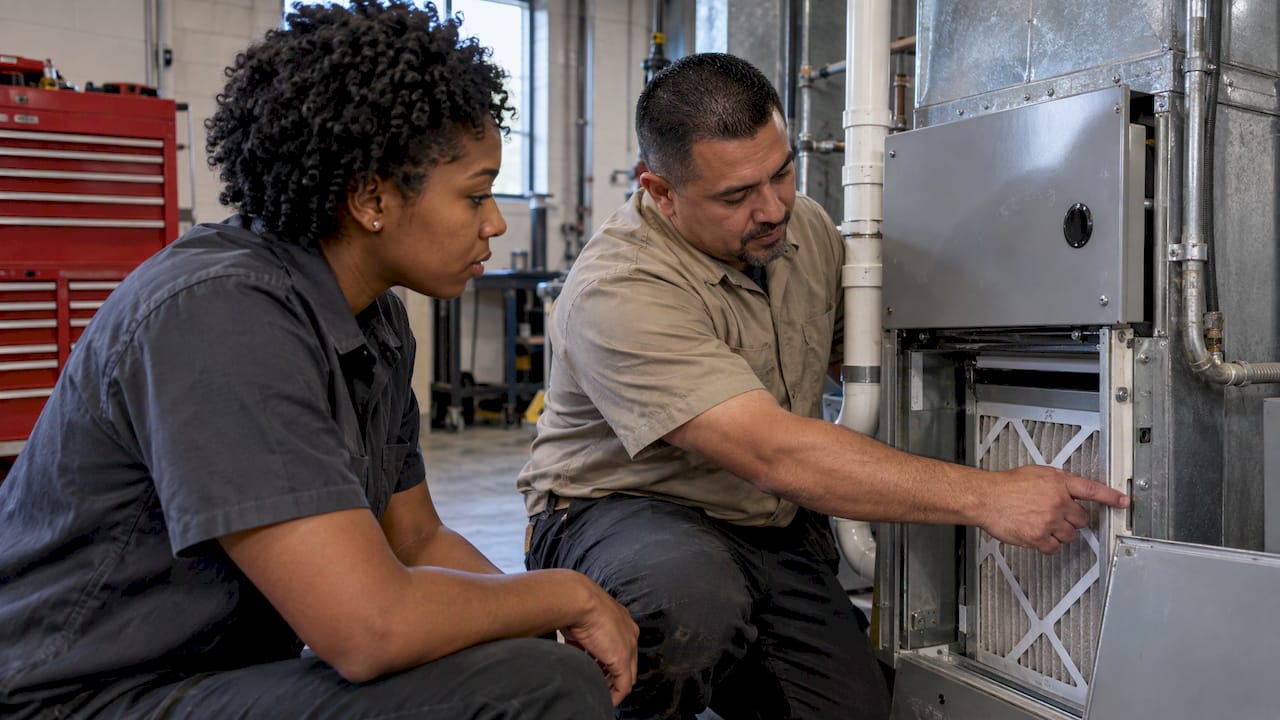
You can start in HVAC without experience and get paid while you learn. Employers hire trainees, helpers and apprentices to work beside experienced technicians, and some run structured programs of 10 weeks to four years. The hard part is telling a real training job from a warehouse job with a nice title. This guide shows what these jobs pay, what they ask for, and how to pick one that builds a career, not just another paycheck.
TL;DR
- Three routes lead into a paid HVAC start: an employer trainee program, a registered apprenticeship, or a short trade school course followed by an entry-level job.
- Listings we reviewed start around $16 to $20 an hour for trainees. Experienced technicians earned a median of $61,010 a year in May 2025.
- Most entry roles need no HVAC experience, but expect age, diploma and driver’s license requirements.
- Ask every employer what the training covers, how long it lasts and what your raise looks like when it ends.
- Technicians register free with us and see openings from real contractors that non-members can’t see.
Table of Contents
- Three ways to get paid training in HVAC
- What the jobs look like day to day
- What HVAC training jobs pay
- What you need to apply
- Certifications you will hear about
- How to tell a real training job from a bad one
- How to land the job, step by step
- Our perspective
- Find your training job on HVAC Mafia
- For contractors: why a trainee program pulls in applicants
- FAQ
- Sources
Three ways to get paid training in HVAC
The U.S. Bureau of Labor Statistics (BLS) says HVAC technicians typically need a postsecondary nondegree award, such as a certificate, though some enter with less education. New hires typically get long-term on-the-job training, and no related work experience is required. A four-year degree is not part of the picture. Here is how the routes break down.
Employer trainee programs
These are short, paid programs, often 10 weeks, that teach one job: maintenance, installation help or service support. A HELP HVAC Maintenance Trainee listing requires no previous HVAC experience and offers a 10-week paid program. It covers residential inspection, cleaning, maintenance, tools, furnaces, air conditioners, condensers, customer communication and safe work. A Timos trainee listing also offers 10 weeks of paid training at $16.90 an hour. Its duties include diagnostics, routine checks, filter replacement and documentation.
Registered apprenticeships
An apprenticeship is the long road, and often the strongest one. BLS says apprenticeships usually last several years and combine paid on-the-job training with technical instruction. One Trane HVAC Service Apprentice listing describes a four-year registered apprenticeship. It includes paid instruction, mentors, pay increases and a nationally recognized credential at the end. The same listing says no industry experience or formal HVAC training is required.
Trade school first, job second
BLS says HVAC programs generally take six months to two years and lead to a certificate or associate degree. Some are shorter and tied to employers. Delaware’s state job portal lists a 12-week, 420-hour HVAC and refrigeration program split equally between classroom and lab. Massachusetts’ Greenfield Community College runs a four-month entry-level program that includes help finding a paid internship or job, plus a year of follow-up support.
School costs money and time before you earn. An employer program pays you from day one. Many people mix the two: start as a helper, then add classes while working.
What the jobs look like day to day
Titles vary, so read the duties. The federal O*NET database lists common titles for the occupation, including HVAC mechanic, HVAC installer, HVAC service technician and refrigeration technician. It defines the work as installing or repairing heating, central air, HVAC or refrigeration systems.
At the entry level, expect this:
| Role type | What you do | Example listing pay |
|---|---|---|
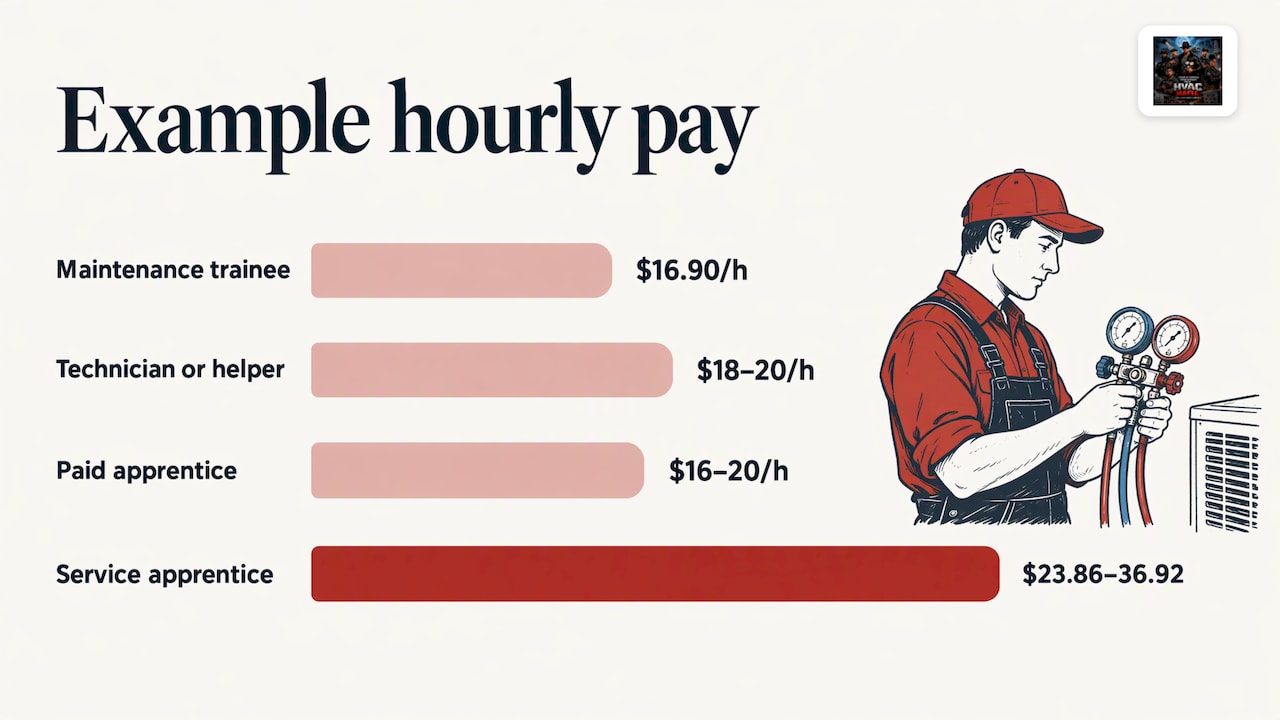
| Maintenance trainee | Inspections, filter changes, cleaning, tool use, customer contact | $16.90 an hour, 10 weeks of paid training |
| Entry-level technician or helper | Assist field techs, learn parts, tools and inventory, sometimes starting in a warehouse | $18 to $20 an hour |
| Paid apprentice | Ride-alongs, weekly classroom and hands-on training, maintenance, repairs, installs | $16 to $20 an hour |
| Service apprentice | Help install and repair environmental-control systems under experienced techs | $23.86 to $36.92 an hour |
The pay figures come from the Day & Night entry-level listing, the Cheeky Tech Academy listing and the Trane and Timos listings above. Listings change, so treat them as examples of the pattern. The Day & Night listing shows how real this can be: hires start in a warehouse learning equipment, parts, tools and inventory while assisting field technicians. That is useful time if the employer moves you to the truck on a schedule. It is a dead end if nobody can tell you when.
AAON’s Field Service Technician I listing shows another level. It is an entry role in installation, startup, maintenance, troubleshooting, inspections, documentation and commissioning, under general supervision. Commercial and manufacturer work often looks like this. If you lean that way, read our look at commercial HVAC salaries.
What HVAC training jobs pay
Start low, grow fast. That is the honest summary.
BLS reports that heating, air-conditioning and refrigeration mechanics and installers had a median pay of $61,010 a year, or $29.33 an hour, in May 2025. The lowest 10% earned less than $40,050 and the highest 10% more than $95,210. BLS’s wage table puts the 25th percentile at $48,360 and the 75th at $77,060. These figures cover all experience levels, and BLS updates them annually.
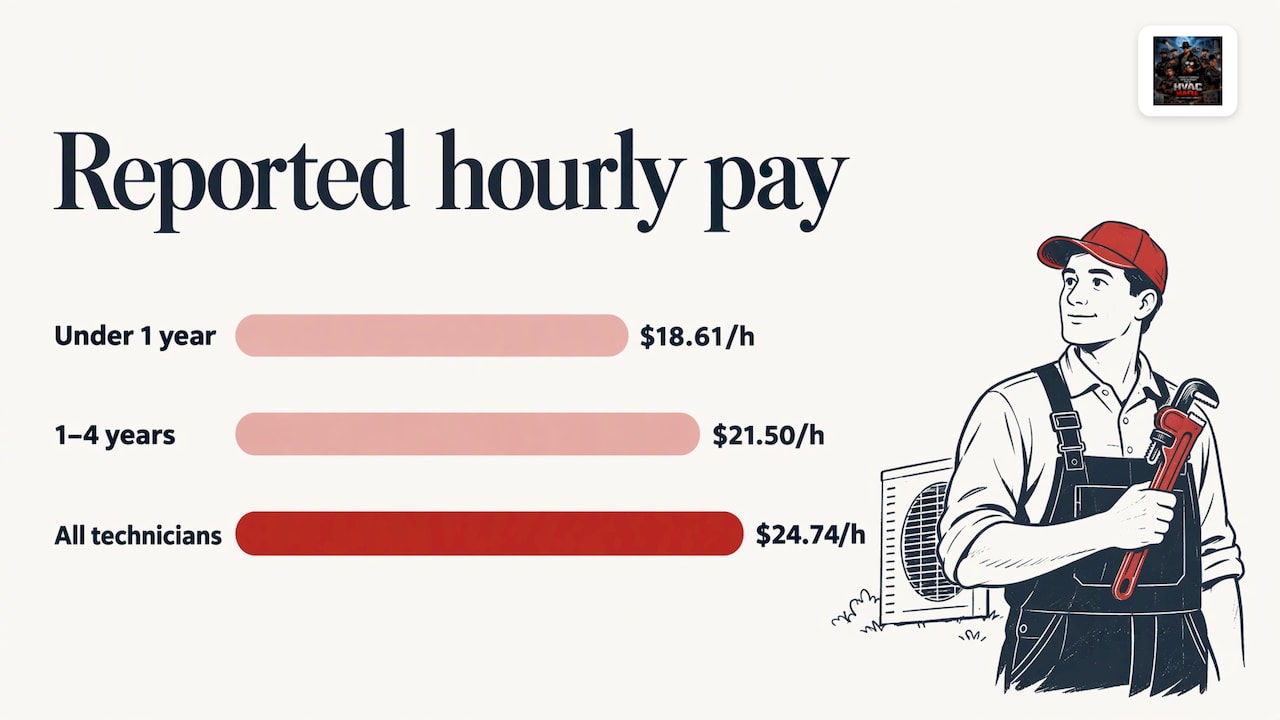
PayScale, which collects self-reported salaries, shows the early-career picture. Its page, updated October 2026, reports average total pay of $18.61 an hour for technicians with under a year of experience and $21.50 for one to four years, including tips, bonuses and overtime. Its median across all technicians is $24.74 an hour, based on 1,201 profiles.
So a trainee at $16 to $20 an hour is not stuck there. The Cheeky listing gives a sample ladder: $18 to $24 an hour for maintenance technicians, $20 to $40-plus for service technicians, $26 to $30 for senior technicians and $36 to $40 for master technicians. That is one employer’s example, not a promise from every shop. Still, it shows what to ask for: a written path with steps and numbers.
Pay also depends on your state and your specialty. For regional detail, see what techs earn in Texas and Florida. For the full ladder from helper to lead, read our guide to the HVAC service technician career.
The demand behind those jobs is steady. BLS counted 440,900 jobs in 2025 and projects 11% growth from 2025 to 2035, about 48,200 additional jobs. Shops need people, which is why they train.
What you need to apply
Most entry-level training jobs ask for the basics, not experience:
- Age: 18 or older. Both the Trane listing and the Delaware program say so.
- Education: a high-school diploma or GED. BLS notes that employers sometimes consider applicants whose highest education is a high-school diploma, and that vocational classes, math and physics help.
- Driver’s license: Trane asks for one held at least 12 months, without major or frequent violations in the prior three years. You will drive a work vehicle to customer homes, so this matters.
- Physical ability: the Massachusetts program lists lifting over 20 pounds.
- Screening: the Delaware program lists reading and math testing, a background check and drug testing.
- Work authorization: the Massachusetts program requires U.S. work authorization.
Program rules differ by state and employer, so read each posting closely. If your resume is thin, lead with anything hands-on: auto shop, construction, electrical, military, even a school vocational class. Our guide to the HVAC technician resume shows how to write it.
Certifications you will hear about
BLS says nearly all HVAC technicians need certification in proper refrigerant handling, earned by passing an exam that is typically included in a postsecondary HVACR program. State or local licenses may also apply. Manufacturer and industry certifications are often optional, but some employers prefer or require specific ones.
The good training jobs build credentials into the program. Delaware’s course lists NCCER Core, NCCER HVAC Level 1, EPA Section 608, first-year apprenticeship certification and OSHA-10 among completion credentials. The Massachusetts program prepares participants for EPA 608 Universal, NORA Bronze, a state oil-burner credential, OSHA-10, NATE Ready-to-Work and credentials for newer refrigerants. Those credentials follow you to your next employer.
A useful question in any interview: who pays for the exam, and do I get paid time to study?
How to tell a real training job from a bad one
A “training” label costs an employer nothing. Ask these before you accept:
- How long is the paid training, and what is my pay during it? Ten weeks, one year and four years are all real answers. “We’ll see” is not.
- Who trains me? A named senior tech or mentor beats “you’ll ride with whoever’s free.”
- How much is classroom and how much is field work? Look for both, such as weekly classroom and hands-on sessions.
- What credentials will I leave with? EPA 608, OSHA-10 and others should be named.
- What happens when training ends? Ask for the next title and the pay range in writing.
- What do techs get besides wages? Tools, truck, health coverage, overtime and PTO. Our guide to HVAC employee benefits lists what to expect.
- Is it residential, commercial or refrigeration? Pick the track you want to grow in.
Also ask how long the people on the crew have been there. Turnover tells you a lot about how a shop treats its techs.
How to land the job, step by step
- Pick your track. Residential service, installation, commercial or refrigeration. Installation is often the quickest door in, and service usually pays more as you grow.
- Get the basics in order. Check your license record, your diploma or GED and your ability to pass a background check.
- Write a one-page resume. Hands-on work, reliability and a clean license go first.
- Look where contractors post. Register free with us and browse openings placed by real contractors. We built the board for HVAC people, so you see trade jobs and not general noise.
- Apply to several, fast. Applications on our board go straight to the employer’s own hiring system, so your answer comes from the shop and not from a middleman.
- Interview with your list of questions. Use the seven above.
- Plan the first year. Aim for EPA 608 and OSHA-10, learn from your lead and ask for a review at the end of training.
Our perspective
I spent 36 years in this trade, and I owned a dealership. I have hired techs, lost techs and trained a lot of them. A new tech’s first year decides whether they stay. If the first ninety days feel like being thrown away, they leave. If they feel like being taught, they build a career.
The shortage is real. Shops need you more than the posting makes it sound. That means you get to ask hard questions: what does training cover, who teaches it, what does the raise look like? A good contractor will answer without flinching.
That is why we built HVAC Mafia as a trade-only job board and community. Technicians register free and see openings from real contractors. They get straight talk on pay, certifications and spotting good and bad employers. They can also trade stories in Tech Talk forums and on the HVAC Underground Podcast. We think you deserve more than a link to a faceless posting. You deserve a community that has been where you are.
No corporate fluff. No shortcuts. Just knowledge, loyalty and respect.
the author
Find your training job on HVAC Mafia
Registering as a technician, apprentice or trade school student is free, and it unlocks the openings that are hidden from non-members. You will see jobs posted by contractors who are looking for people in this trade, plus career guidance on pay, certifications and what makes an employer worth working for. Join free as a member and start browsing.

If you are on the hiring side, you can post a job in front of a trade-only audience of nearly 100,000 HVAC followers. Our job posting plans run $199 a month per position on Standard and $149 a month per position on Annual. Enterprise starts from $99 a month per position. Company Spotlight profiles ($149 a month, or $1,699 a year) show techs your culture, pay and benefits.
For contractors: why a trainee program pulls in applicants
Trainee listings that rank well share a pattern: they say what the job pays, how long paid training lasts and what the tech can earn afterward. Those same details answer the questions careful applicants ask. If you are struggling to hire, spell out the ladder, name your mentors and show your benefits. Our piece on HVAC installer recruitment covers how to hire and get hired, and our guide to whether HVAC is a good career shows what candidates are weighing before they apply.
FAQ
Do I need experience to get an HVAC job with training?
No. Many listings state no previous HVAC experience is needed, including the HELP trainee program and the Trane apprenticeship. BLS also says no related work experience is required for this occupation. Prior training can help with starting pay.
Is a degree necessary to start in HVAC?
No. BLS says technicians typically need a postsecondary nondegree award, like a certificate, though some enter with less. Apprenticeships combine paid on-the-job training with classroom instruction, so you can earn while you learn.
What is the fastest way to get HVAC certified?
The refrigerant handling certification, EPA 608, is the one nearly all technicians need, according to BLS. The exam is typically part of a postsecondary HVACR program. Short programs, like the 12-week Delaware course, include it among their credentials.
How much does an HVAC technician make in the U.S.?
BLS reported a median of $61,010 a year, or $29.33 an hour, for May 2025. Entry-level trainees start lower, often $16 to $20 an hour in the listings above, and pay rises with certifications and experience.
What are common HVAC job titles?
O*NET lists HVAC mechanic, HVAC installer, HVAC service technician, HVAC control technician and refrigeration technician, among others. Read the duties in each posting, because titles differ between shops.
Sources
- BLS Occupational Outlook Handbook: Heating, Air Conditioning, and Refrigeration Mechanics and Installers
- BLS Occupational Employment and Wage Statistics profile
- O*NET OnLine: 49-9021.00
- Trane Technologies HVAC Service Apprentice listing
- HELP HVAC Maintenance Trainee listing
- Day & Night entry-level HVAC technician listing
- Cheeky Tech Academy paid apprentice listing
- AAON Field Service Technician I listing
- Delaware JobLink HVAC & Refrigeration Training Program
- Greenfield Community College Entry-level HVAC Training Program
- PayScale HVAC Technician Hourly Pay