
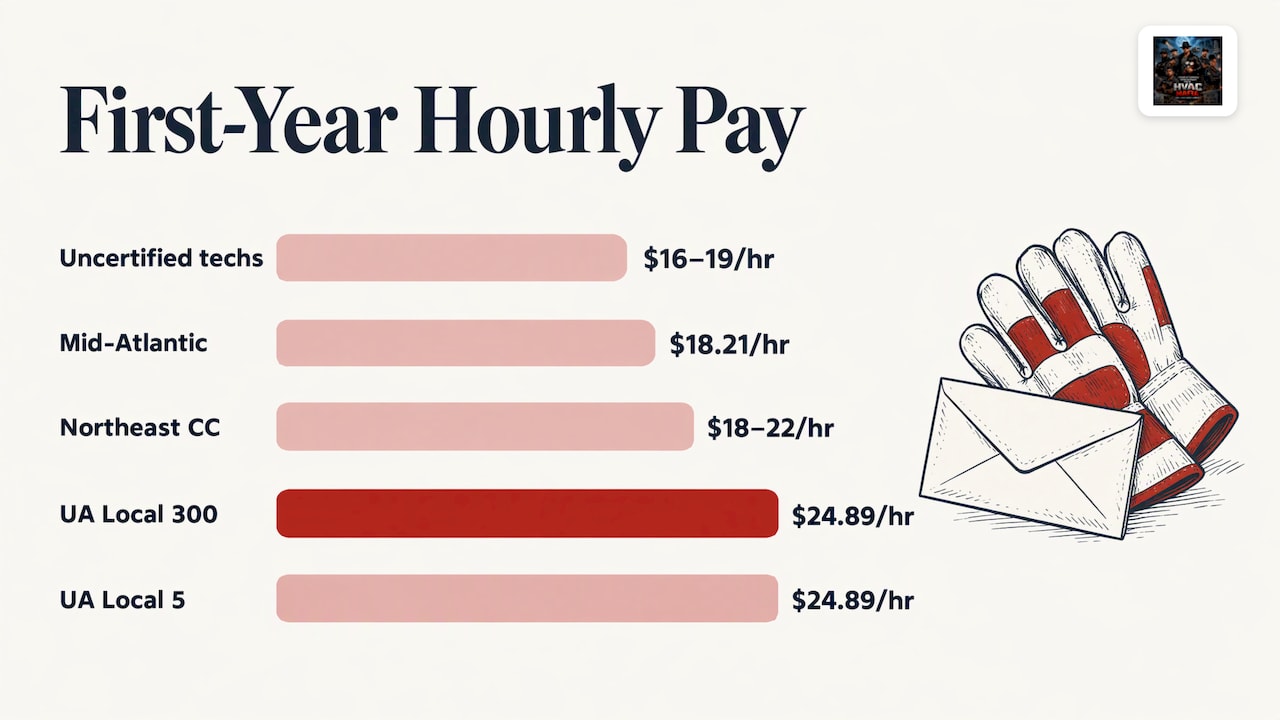
Most HVAC apprentices start between roughly $18 and $22 an hour in open-shop and school-sponsored programs, and the number climbs every year on a written schedule. Union programs start higher on base pay and add benefits on top. The exact figure depends on who sponsors your apprenticeship, where you live and what percentage of a journeyman’s rate your program uses. No national government table sets one apprentice wage, so the real answer is always in the wage schedule your employer or program hands you.
This guide gives you the numbers from programs that publish them, shows how the raise schedule works, and walks through what to ask before you say yes to an offer.
TL;DR
- Typical starting pay in non-union programs runs about $18 to $22 an hour, based on one community college program’s published range and one contractors association’s first-year rate of $18.21.
- Registered apprentices must be paid on a progressively increasing schedule, usually a percentage of the journeyman rate that rises as you log hours.
- Union locals publish dollar rates and add employer-paid benefits. Those benefits can be a big share of the total package.
- Before you accept, get the wage schedule in writing and find out what triggers each raise: hours, classes, skill checks or all three.
Table of Contents
- What a first-year HVAC apprentice earns
- How the raise schedule works
- Union and open shop: the total package
- What moves your pay up or down
- How long until the pay catches up
- Questions to ask before you accept an apprentice offer
- Find apprentice openings with real contractors
- Our take on apprentice pay
- FAQ
- Sources
What a first-year HVAC apprentice earns
Start with the open-shop and school-sponsored side, because that is where most new techs begin.
Northeast Community College in Nebraska lists an average starting wage of $18.00 to $22.00 an hour for apprentices in its HVAC Technician Apprenticeship. The program pairs 1,582.5 hours of classroom instruction with about four years of on-the-job learning. That is a real program in a mid-cost region, not a national average, and it is a useful anchor.
The Mid-Atlantic Mechanical Contractors Association says first-year pay in its HVACR apprenticeship begins at $18.21 an hour and rises every year. It adds that journeymen typically earn more than $35.00 an hour after finishing the five-year program.
Put that first-year rate in annual terms. At a full-time year of about 2,000 hours, $18.21 an hour comes to roughly $36,420 before overtime. That is simple multiplication, not a published salary, but it shows what the hourly figure means for your budget.
Now the union side. United Association Local 300 lists its schedule effective August 2026 through June 2027. A first-year apprentice there is at 55% of the journeyman rate, which works out to $24.89 an hour base pay plus $9.19 an hour in fringe benefits. UA Local 5’s training center publishes a different table. Its first year is 45% of the journeyperson rate, also $24.89 an hour on the straight-time column. Two locals, two percentages, one similar starting dollar figure. That is why you should look at the dollars, not just the percent.
You will also see lower numbers online, from $16 to $19 an hour for entry-level techs with no EPA certification. Those usually come from salary aggregators. They are fine as a rough sense of the floor, but a posted wage schedule from a real employer beats any average.
How the raise schedule works
If your apprenticeship is registered with the U.S. Department of Labor or a state apprenticeship agency, it comes with standards. Those standards call for apprentices to be paid a progressively increasing schedule of wages, based on a percentage of the current journeyworker rate or as set by a local collective bargaining agreement. A collective bargaining agreement is the contract between a union and the contractors who employ its members.
In plain terms: you start at a fraction of what a fully trained tech makes, and every block of hours moves you up a step. The Department of Labor’s HVAC/R technician standards show a five-year term with 8,500 to 10,000 hours of on-the-job learning. Pay starts at 45% of the journeyworker’s rate for the first 1,000 hours and rises to 90% in the final period.
Here is how that plays out in two published union schedules. These are base wages and leave out fringe benefits:
| Apprenticeship year | UA Local 300 (Aug 2026 to Jun 2027) | UA Local 5 JATC (Aug 2026) |
|---|---|---|
| 1st year | 55%, $24.89/hr | 45%, $24.89/hr |
| 2nd year | 60%, $28.65/hr | 55%, $30.42/hr |
| 3rd year | 70%, $33.18/hr | 65%, $35.95/hr |
| 4th year | 80%, $37.70/hr | 70%, $38.71/hr |
| 5th year | 90%, $42.23/hr | 80%, $44.24/hr |
Sources: UA Local 300 and UA Local 5 JATC. Check each page for the current effective dates, because these tables are updated when the contract changes.
The pattern holds even where the numbers differ: your pay rises every year, and your fifth-year wage is close to a full journeyman’s. Open-shop employers often use the same percentage idea with a lower journeyman rate, or they set flat dollar raises at hour or skill milestones.
A worked example
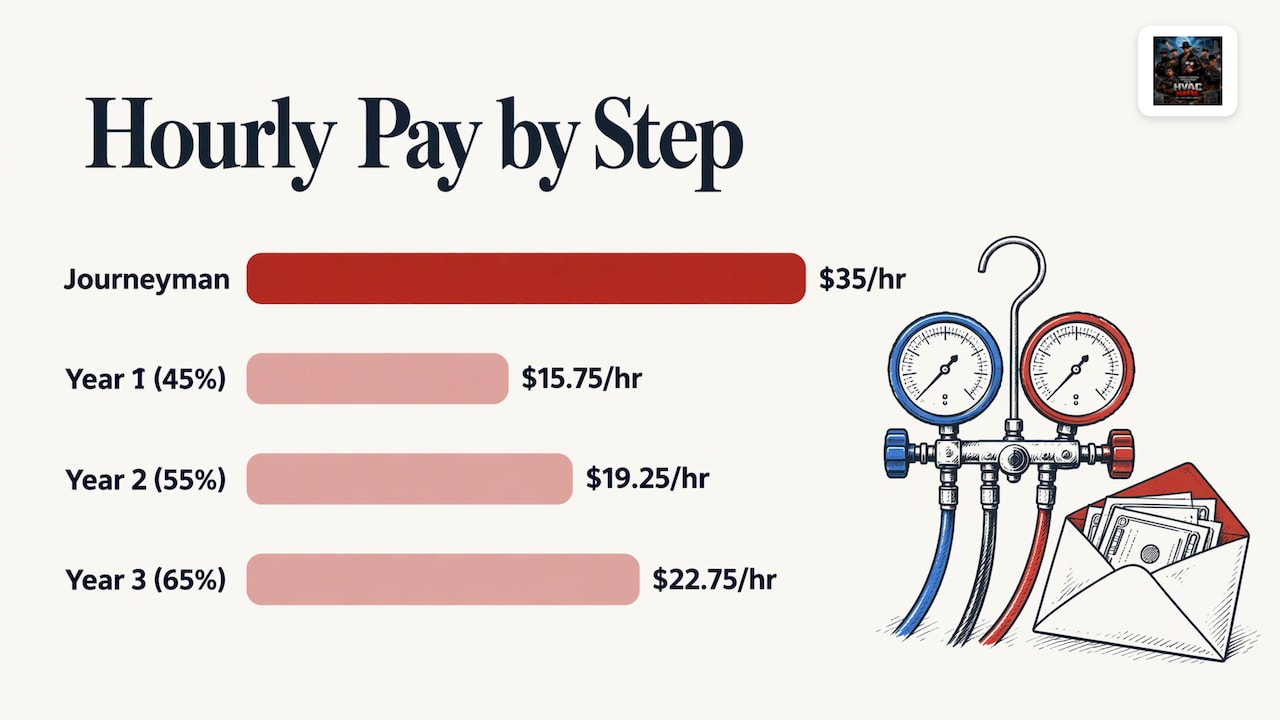
Say a shop’s journeyman rate is $35 an hour and its schedule starts apprentices at 45%. Year one is $15.75 an hour. At 55% in year two you are at $19.25. At 65% in year three you are at $22.75. These are illustrative numbers, not a quote from any employer. The point is the method: take the journeyman rate, multiply by the step, and compare the result with what you were offered. If the shop’s journeyman rate is lower than the market, every step on your schedule is lower too.
Union and open shop: the total package
Hourly wage is only part of what you earn. Union locals show this clearly because they list the benefit contributions separately.
- UA Local 300’s first-year apprentice gets $24.89 base plus $9.19 an hour in fringe. By year two the fringe on that schedule is $20.65 an hour.
- UA Local 5 says apprentice wages exclude the fringe package, while benefits such as medical coverage and a pension plan are provided.
- UA Local 44 lists journeyman gross wages of $53.39 an hour plus $23.38 an hour in employer-paid benefits and contractual contributions, a $76.77 package. It notes apprentices start lower and follow a progression as they meet requirements.
Benefits contributions in the union world go to health coverage, pension and training funds. In the open-shop world, you see them as a health plan, a retirement match, paid time off, a truck and tool allowance. Our guide to HVAC employee benefits lists what techs should expect, and it is worth reading before you compare two offers that look similar on hourly pay.
Two more things change your take-home:
- Classroom time. Related instruction is a required part of a registered apprenticeship. The Department of Labor’s template says apprentices may or may not be paid for instruction hours outside regular working hours. Ask which applies to you. A program with evening classes, like the New Mexico program that runs two nights a week for four years, may not pay for those hours.
- Prevailing wage jobs. On state public works projects, apprentice rates can be set by rule. One contractors association’s notice shows a minimum $1.10 an hour training contribution and an insurance premium of $9.08 an hour worked for California public works as of June 2026. That kind of work can change what the employer must pay on a given job.
What moves your pay up or down
Where you live. Pay follows the local labor market and cost of living. Our look at HVAC salary in Texas shows how much one state can differ from the national picture.
Who sponsors the program. Union joint committees, contractor associations, community colleges and individual employers each write their own schedule. Starting pay and wage steps vary by sponsor, region, bargaining agreement and local market.
Residential or commercial. Commercial work usually opens a higher ceiling, especially in controls and larger systems. We cover that in commercial HVAC salaries and how techs get in the door in commercial HVAC hiring.
Certifications. Credentials such as EPA 608 are the standard way to prove you can legally handle refrigerants, and many shops tie a raise to earning one. How long that takes is covered in how long it takes to get HVAC certified.
What triggers your raises. Some programs raise you on hours worked. Others tie raises to classroom progress or competency checks, or a mix. Trade-school guidance says to ask whether a program uses percentages of the journeyworker rate or fixed dollar amounts, and whether steps come at hour or skill milestones. A shop that moves you up only when it feels like it is not running a schedule at all.
How long until the pay catches up
The Department of Labor’s HVAC/R standards use a five-year term with 8,500 to 10,000 on-the-job hours. Individual programs differ. The New Mexico program mentioned above requires at least 576 hours of related instruction and 8,000 hours of on-the-job training, with a normal 40-hour week that can shift with weather. The community college program in Nebraska runs about four years.
So plan on four to five years from first day to journeyman wages. The first year is the leanest. By the end, you have a trade that pays a living wage in most of the country, and the Mid-Atlantic program’s own figure for finished journeymen, more than $35 an hour, shows where the road leads in that region.
If you are still weighing the trade itself, is HVAC a good career lays out pay, outlook and the hard parts honestly.
Questions to ask before you accept an apprentice offer
You are a paid employee from day one, so treat the offer like any other job. Ask:
- What is my starting hourly rate, and can I have the full wage schedule in writing?
- Is each raise tied to hours, classes, skill checks or a mix?
- Is the program registered with the Department of Labor or a state apprenticeship agency?
- Do I get paid for classroom time, and who pays for books and tuition?
- What benefits start when, and what do they cost me per paycheck?
- Is there a truck, tool allowance or boot stipend?
- What does the shop’s journeyman earn? That number sets every step of your schedule.
- Who will I ride with, and how many techs have moved from apprentice to lead here?
A good employer answers all of these without hesitation. Their answers tell you how they treat people, which matters as much as the first-year rate. Our HVAC technician resume guide helps you get to the interview stage with a clean, honest résumé even when you have no field experience yet.
Find apprentice openings with real contractors
HVAC Mafia is a job board and community built by the trade, for the trade. Techs, apprentices and trade school students join free and see openings from real contractors, openings that are hidden from non-members. Job listings and community are restricted to verified HVAC trade professionals, so you are not wading through noise from outside the trade. You also get straight talk on pay, career paths and spotting good and bad employers, plus Tech Talk forums and the HVAC Underground Podcast.
If you are ready to start looking, join as a free member and see what contractors near you are posting.

If you are a contractor reading this because your apprentices keep leaving, the same board puts your opening in front of a trade-only audience of nearly 100,000 HVAC followers, and applications go straight to your own hiring system. Standard listings are $199 per month per position, with lower per-position rates on the Annual plan at $149 per month and Enterprise plans from $99 per month. See the job posting plans.
Our take on apprentice pay
I have spent 36 years in this trade, and I owned a dealership. I have been the guy writing the offer and the guy hoping it was fair. Here is what I know.
The hourly rate gets all the attention, but the schedule is what builds a career. An apprentice who knows exactly when the next raise comes, and what earns it, stays and works hard. An apprentice who gets a vague promise leaves for another dollar an hour. Shops that publish their steps keep their people.
To techs: do not be embarrassed to ask about money. Ask for the wage schedule, the benefits and the path. Good contractors respect the question, and the ones who dodge it just answered it. We built HVAC Mafia so you can see real openings from real contractors, hear from other techs about who is worth working for, and build a career, not just another paycheck.
To contractors: pay transparency is a recruiting tool. A Company Spotlight profile lets you show your culture, pay and benefits to techs who have choices. The shortage is real, and the shops that show their work are the ones that fill seats.
Loyalty and respect run both ways in this trade. It starts on the first day of the apprenticeship.
the author
FAQ
How much does a first-year HVAC apprentice earn?
In published open-shop and school programs, first-year pay runs from about $18 to $22 an hour, and one contractors association starts at $18.21. Union locals publish higher base rates, such as $24.89 an hour plus fringe benefits at UA Local 300 in 2026 and 2027. Your own number depends on your employer, program and region.
How long is an HVAC apprenticeship?
The Department of Labor’s HVAC/R technician standards use a five-year term with 8,500 to 10,000 hours of on-the-job learning, plus classroom instruction. Some programs are a bit shorter, with one college program running about four years. Expect to reach journeyman pay in four to five years.
Do HVAC apprentices get paid during classroom training?
It depends on the program. Apprentices are employees and are paid for on-the-job hours. The Department of Labor’s template says apprentices may or may not be paid for related instruction outside regular working hours. Ask before you sign.
Do union apprentices make more than open-shop apprentices?
Published union schedules show higher base wages and separate fringe benefit contributions, such as the fringe rates on UA Local 300’s schedule. Open-shop pay varies widely by employer. Compare total packages, meaning wages plus benefits, not just the hourly rate.
What should I ask for before accepting an apprentice job?
Ask for the written wage schedule, what triggers each raise, whether classroom time is paid, and what benefits start when. Trade-school guidance recommends getting the current schedule in writing before you accept.
Sources
- Northeast Community College: HVAC Technician Apprenticeship
- Mid-Atlantic MCA: Apprenticeship Opportunities
- U.S. Department of Labor: apprenticeship standards bulletin
- United Association Local 300: Apprentices
- UA Local 5 JATC: Apprentice Wages
- United Association Local 44
- ABC New Mexico: HVAC Program
- ABC Southern California: Notice of Understanding, Apprentice Wage Rates
- Trade Schools Net: HVAC Apprenticeship Guide