

HVAC contractor hiring comes down to three things: being found by working techs, showing them real pay and a real path, and then giving them a reason to stay. Posting on a general site that thousands of other shops also use gets you resumes from people who have never held a gauge set. Posting where techs actually spend their time gets you the people you want. That is why we built HVAC Mafia as a trade-only job board and community: your opening goes in front of nearly 100,000 HVAC followers, and applications go straight to your own hiring system.
If you are a tech or an apprentice reading this, stay with us. The second half explains what a good employer should show you, so you can tell a shop worth joining from one that is just filling a truck.
TL;DR
- Hire for the role you actually have: helper, installer, maintenance tech, service tech or lead. Each one needs a different person and a different pay range.
- Publish a pay range and a career path. Techs compare offers, and a vague posting loses to a clear one.
- Ask for the EPA refrigerant certification, treat NATE as a bonus, and weigh attitude and aptitude for entry-level roles.
- Post where techs already are, and give them a hiring page that answers pay, schedule, vehicle, training and on-call questions.
- Retention starts on day one: training, a visible next step and a culture people can see before they apply.
Table of Contents
- Why hiring techs is hard right now
- Start with the role, not the ad
- Put real numbers on the table
- Know the credentials you are asking for
- Where to post so techs actually see it
- What your hiring page should say
- Run an interview that respects the candidate
- Keep the people you hire
- Our perspective
- Ready to post your opening
- If you are a tech looking for a shop
- FAQ
- Sources
Why hiring techs is hard right now
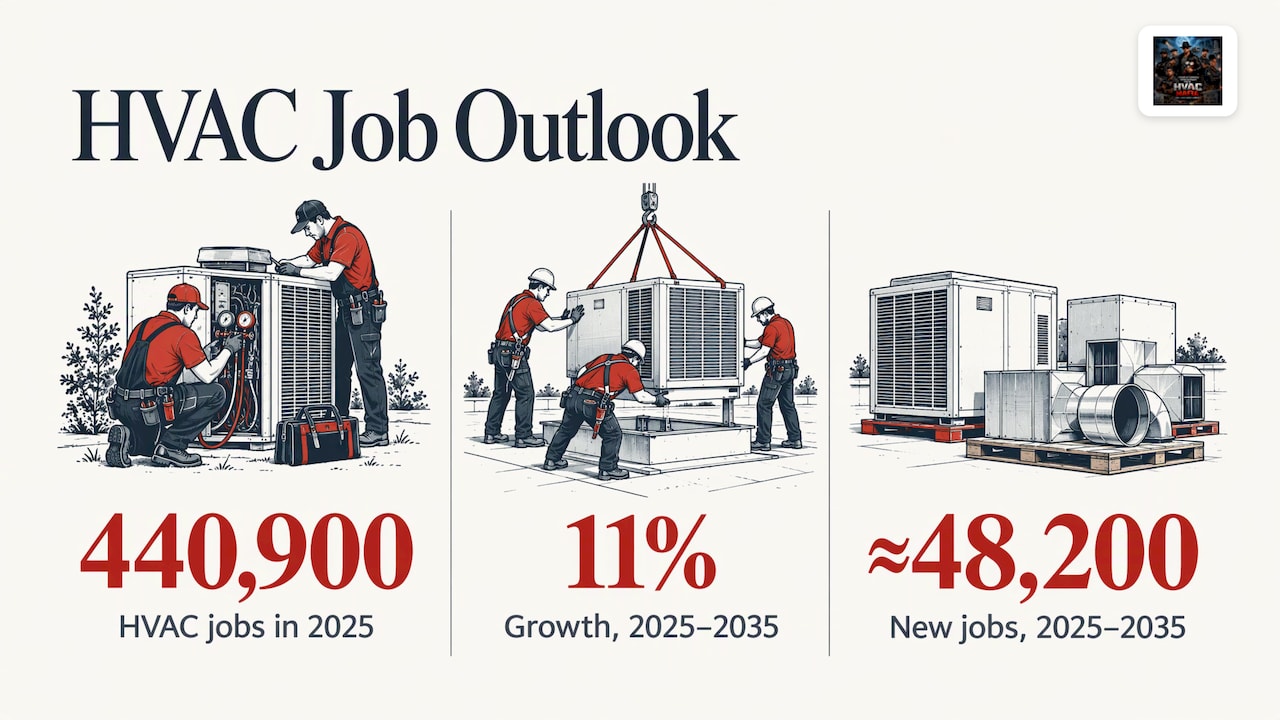
The numbers explain the squeeze. The Bureau of Labor Statistics counts 440,900 heating, air conditioning and refrigeration mechanics and installer jobs in 2025 and projects 11% growth from 2025 to 2035, about 48,200 new jobs. That is much faster than the average for all occupations. More work and not enough trained hands means every decent tech has options.
So your posting is not competing with nothing. It is competing with the posting the tech saw this morning, the text from a buddy at another shop and the recruiter call they ignored. Treat hiring like a sales process: know who you want, show them why you are the better offer, and make it easy to say yes.
Start with the role, not the ad
Most weak postings say “HVAC technician needed” and stop. That covers five very different jobs. Before you write anything, decide which rung you are hiring for. A career-path flyer from a manufacturer-affiliated training group lays out the ladder clearly:
- Helper: stages inventory, assists installers, and does physical work in attics and basements.
- Installer: installs and replaces equipment, runs gas piping and wiring, and performs final commissioning tests.
- Maintenance technician: runs periodic checks and sells maintenance agreements.
- Service technician: diagnoses and repairs systems in residential, commercial and industrial settings.
- Lead technician: mentors others, estimates remodels and builds maintenance programs.
The federal occupational database O*NET lists the many titles shops use for the same family of work, including HVAC Installer, HVAC Service Tech and Refrigeration Technician. Use the title techs search for, then spell out the duties underneath. If the job is mostly new-construction installs, say so. If it is service with on-call rotation, say so. Honest scope filters in the right people and filters out the wrong ones before they waste your time.
Specialty matters too. Commercial refrigeration, for example, means reach-in and walk-in coolers, freezers and ice machines, a different skill set from residential heating and air conditioning. If you need that background, put it in the first lines. For more on filling those two lanes, see our guides to installer recruitment and commercial HVAC hiring.
Put real numbers on the table
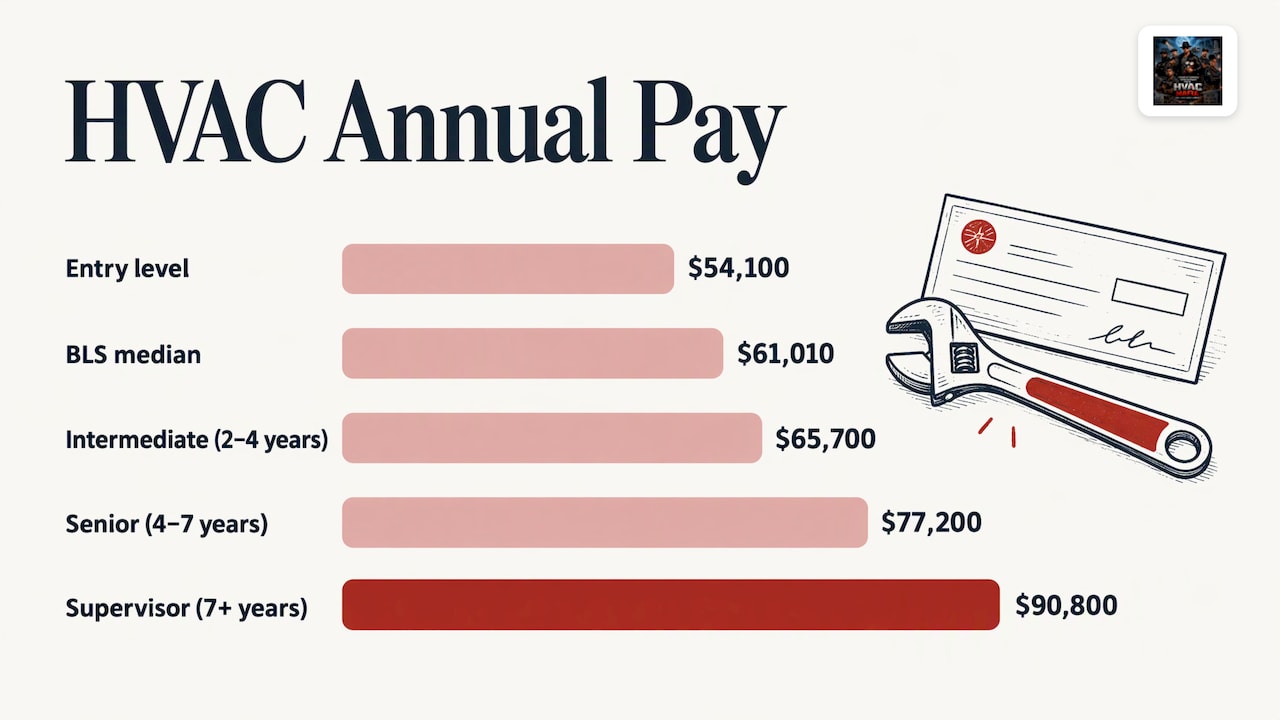
Techs talk about pay constantly. If your posting hides it, they assume it is low. Give a range, tie it to experience and certifications, and say what is in the package.
Here is the market context to anchor your range:
| Level | Typical annual pay | Hourly |
|---|---|---|
| Entry level | $54,100 | $26.01 |
| Intermediate (2 to 4 years) | $65,700 | $31.59 |
| Senior (4 to 7 years) | $77,200 | $37.12 |
| Supervisor (7+ years) | $90,800 | $43.65 |
Those figures are Payscale’s 2025 data as reported by ACHR News. For the broader picture, the BLS puts 2025 median pay at $61,010 a year, or $29.33 an hour, and notes that earnings vary with experience, responsibility, performance, tenure and geographic area. Your own market may sit well above or below these. Texas, for example, has its own pay picture, which we break down in HVAC salary in Texas.
A contractor quoted in that same ACHR piece recommends publishing earning ranges and career paths based on training, certifications and performance. She also says to weigh attitude and aptitude more than experience. That is sound advice for helpers and apprentices: you can teach a motivated person the trade, and you cannot teach showing up.
Beyond the base rate, list the rest of the offer plainly:
- Vehicle, or gas reimbursement
- Tool allowance
- Health insurance, PTO and retirement contributions
- Reimbursement for EPA and NATE exams and study time
- Overtime and on-call rules, in writing
- Bonuses and how they are earned
Know the credentials you are asking for
The BLS says most HVAC techs have postsecondary training from a trade school or community college, with programs running from six months to two years. It also says the EPA requires nearly all HVAC technicians to be certified in proper refrigerant handling, and some states and localities require licenses as well. Check your state’s licensing rules before you write the requirements section, so your posting does not ask for something the law does not or miss something it does.
A useful way to set your bar is the Department of Energy-backed HVAC Career Map, which sorts 40 representative jobs into three levels:
- Entry level: a high school diploma, with no HVAC/R education or experience required.
- Mid level: one to four years of experience, with postsecondary training preferred.
- Advanced: five or more years of experience, journey-level training or a bachelor’s-level education.
Match your requirements to the level. Asking for five years of experience at entry-level pay is the fastest way to get no applicants. If you hire at entry level and train, say that in the first paragraph. Apprentices and trade school students are looking for exactly that line.
Where to post so techs actually see it
General job sites put you in a feed with every retail, warehouse and delivery job in town. Trade-only boards put you in front of people who already do this work. A good mix usually includes:
- A trade-specific board and community where techs already read about pay, careers and employers
- Local trade schools and community college programs, and the government’s Apprenticeship Job Finder if you run a registered program
- Your own employees, through a structured referral program
- Your own website and social pages
On HVAC Mafia, techs register free and see openings from real contractors. Openings are hidden from non-members, so the people looking at your listing are signed-in members of the trade, not casual browsers. Applications go to your own hiring system, so you keep your process and your data. For a fuller playbook on the whole funnel, read HVAC technician recruitment.
What your hiring page should say
Your hiring page is where a tech decides whether to apply or keep scrolling. Think of it as a sales page for the job. Answer the questions a tech will ask before they ask them:
1. What is the job, exactly? The title, the work mix (service, install, maintenance, commercial, refrigeration), the equipment brands and the typical day.
2. What does it pay? A range, how raises work, and what moves someone from one step to the next.
3. What is the schedule? Hours, overtime, on-call rotation, weekends and the busy-season reality. Techs respect a shop that is upfront about the hard parts.
4. What do I drive and carry? Take-home vehicle or not, tools provided or allowance, phone, uniforms.
5. How will I grow? Name the path: helper to installer to service tech to lead to service manager. Say what training and certification support you pay for. If you are hiring a manager, our guide to HVAC service manager jobs shows what that next rung looks like.
6. Who will I work with? Photos of your real crew and trucks, a line from a tech, and how long people stay. A Company Spotlight profile on HVAC Mafia is built to show a shop’s culture, pay and benefits to techs who have choices.
7. How do I apply, and what happens next? One short form, a named person, and a promise on response time. Then keep it.
Keep the page short enough to read on a phone in a truck cab. Techs apply from the job site, not from a desk.
Run an interview that respects the candidate
A slow or disorganized interview loses good techs to the shop that called back the same day. Decide in advance what you are testing: technical diagnosis, safety habits, customer manner and fit with your crew. Use the same core questions for every candidate so you can compare fairly. Resources on interview question design can help you structure questions you can defend and score consistently, and our own list of HVAC interview questions shows what techs expect to be asked.
Expect the candidate to interview you back. NATE’s job-search guide tells techs to ask about continuing education, certification support, career path, on-call and overtime, and mentorship. Have clean answers ready. A shop that can explain its training plan in two sentences is a shop techs trust.
Keep the people you hire
Hiring is only half the job. Every tech who leaves takes training dollars, customer relationships and crew morale with them. What keeps people:
- A clear next step. Show each tech the rung above them and what it takes to climb it.
- Paid training and certification. Cover exam fees and study time.
- Pay that moves. Review it on a schedule, not only when someone threatens to quit.
- Respect on the job. Real dispatch, working trucks, tools that function, and a manager who answers the phone.
- Mentorship. Pair new hires with a lead tech from week one.
None of this is flashy. It is the difference between a shop techs recommend and a shop they warn each other about.
Our perspective
We started HVAC Mafia because the people who built this trade deserved a place of their own. Our founder is a 36-year HVAC veteran and a former dealership owner, so we have seen the hiring problem from both sides of the counter.
Here is what we believe. The shortage is real, but most shops make it worse with vague postings, hidden pay and a hiring process that treats techs like numbers. The contractors who win are the ones who tell the truth about the job, show their culture and pay people fairly.
That is why our listings and community are restricted to verified HVAC trade professionals. You reach skilled techs without homeowner or outsider noise. Techs get straight talk on pay, careers, certifications and spotting good and bad employers, with no corporate filter. When a contractor tells a good story and a tech who has choices reads it, both sides win.
No corporate fluff. No shortcuts. Just knowledge, loyalty and respect.
the author
Ready to post your opening
Our job posting plans are priced per position: Standard is $199 per month, Annual is $149 per month, and Enterprise starts from $99 per month, all on the job posting plans page. If you want your shop’s story told alongside the job, the Company Spotlight is $149 per month or $1,699 per year. For a boost on a single hard-to-fill role, Spotlight pricing runs $149 for one week, $499 for four weeks, or $349 per month for ongoing placement.
If you are a tech looking for a shop
Everything above is also your checklist. A good employer posts a pay range, names the career path, explains the schedule and tells you what training they pay for. If a listing hides all of that, ask in the interview. The same NATE guide suggests asking about exam fees, study materials, time off for training and the types of systems you will work on.
Credentials help you stand out. EPA refrigerant certification is the legal baseline for handling refrigerants. Experience with newer low-GWP refrigerants such as R-454B and R-32 is increasingly a hiring advantage, according to one resume guide, and NATE is the most widely recognized voluntary credential. If you want to see where a service tech career can go, read HVAC service technician career: pay, path and next steps.
Registering with HVAC Mafia is free for techs, apprentices and trade school students. Join as a member to see openings from real contractors, join the Tech Talk forums and listen to the HVAC Underground Podcast.
FAQ
How do I find HVAC technicians when no one is applying?
Post where techs already are, and make the ad specific: pay range, schedule, vehicle, training and career path. A trade-only board puts your opening in front of people who work in the field. Add a Company Spotlight profile so candidates can see your culture before they apply.
What should an HVAC company hiring page include?
The role and work mix, a pay range, the schedule and on-call rules, vehicle and tool details, training and certification support, a visible career path, photos of your crew and a short application. Keep it readable on a phone.
What certifications should I require?
The EPA requires nearly all HVAC technicians to be certified in refrigerant handling, and some states and localities also require licenses, so check your state’s rules. NATE is a voluntary credential you can list as preferred, especially for senior and lead roles. For entry-level hires, consider training them and paying for their exams.
How much should I pay a new HVAC tech?
BLS reports a 2025 median of $61,010 per year for the occupation, and Payscale data reported by ACHR News puts entry-level techs at $54,100. Your local market sets the real number, so research nearby shops and publish a range.
How much does it cost to post an HVAC job on HVAC Mafia?
Plans are per position: Standard is $199 per month, Annual is $149 per month and Enterprise starts from $99 per month. Company Spotlight and Spotlight placements are priced separately, and the details are on our pricing pages.
Sources
- BLS Occupational Outlook Handbook: Heating, Air Conditioning, and Refrigeration Mechanics and Installers
- BLS Occupational Outlook Handbook: How to become an HVAC technician
- O*NET OnLine: 49-9021.00 Heating, Air Conditioning, and Refrigeration Mechanics and Installers
- Technician Career Path and Training Flyer
- College of Lake County: What Does an HVAC Technician Do?
- ACHR News: From $54K to $90K, What HVAC Techs Are Really Making in 2025
- HVAC Career Map
- Apprenticeship.gov: How do I find open apprenticeship job opportunities?
- NATE: How to Look for a Job as an HVAC Technician
- Resume Optimizer Pro: HVAC Technician Resume Examples