HVAC Mafia

Commercial HVAC Salaries: What Techs Really Earn in 2026

Most commercial HVAC techs land somewhere between $40,000 and $95,000 a year, with a national median around $61,000. Commercial work, refrigeration and controls skills, overtime and your zip code push you up or down inside that range. Below is what the numbers say, where they come from, and how to read them like a tech, not a salary website.

Thehvacmafia
Find Commercial HVAC Jobs
HVAC Mafia connects technicians with real contractor openings and offers straight talk on pay, career paths, certifications, and employers.

Explore HVAC Mafia

TL;DR

  • The federal median for HVAC and refrigeration mechanics and installers is $61,010 a year, or $29.33 an hour, with the bottom 10% under $40,050 and the top 10% over $95,210.
  • Commercial work is commonly reported to pay $10,000 to $20,000 more a year than residential, and specialties like refrigeration can pay more again.
  • Location is the biggest swing. The same job pays about $28,000 more in Massachusetts than in Mississippi.
  • Overtime, certifications and employer type all move the number. Compare total compensation, not just the hourly rate.
  • Registering with HVAC Mafia is free for techs, and you can see real openings from real contractors.

Table of Contents

What the national numbers say

Start with the most reliable source: the Bureau of Labor Statistics. For May 2025, the median annual wage for heating, air conditioning and refrigeration mechanics and installers was $61,010, which works out to $29.33 an hour. The lowest 10% earned less than $40,050. The highest 10% earned more than $95,210.
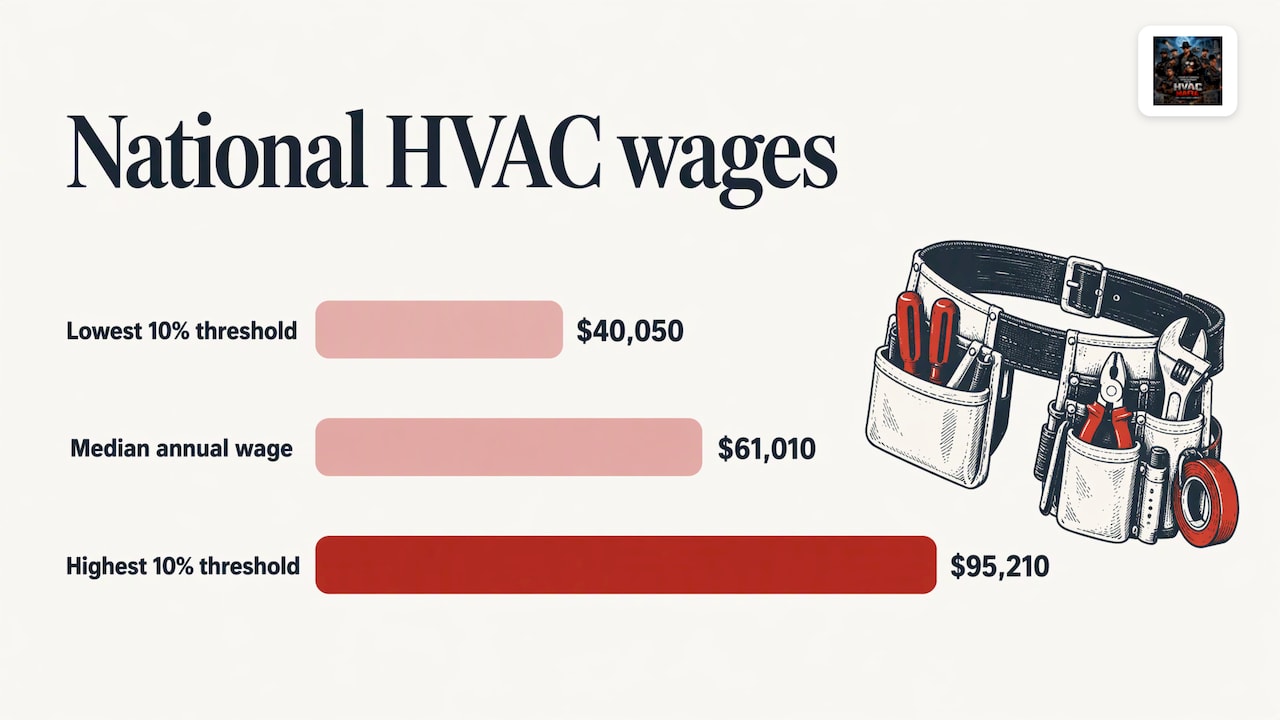
National HVAC wages from lower threshold to upper threshold

One honest note: BLS groups residential, commercial and refrigeration techs into one occupation. It does not publish a separate “commercial HVAC tech” number. So when you see a site quoting one exact commercial salary, it is blending BLS data with its own estimates or user-submitted pay.

Those estimates tend to land close to the federal figure. One industry blog projects the average commercial HVAC technician at about $60,000 to $65,000 in 2026, with entry-level near $40,000 and experienced techs in high-demand markets above $90,000 once overtime and bonuses are counted.

The occupation is also growing. BLS counted 440,900 jobs in 2025 and projects 11% growth from 2025 to 2035. More demand for techs means more leverage for you when you negotiate.

Commercial vs. residential pay

Why does commercial usually pay more? The work is more complex. You are on rooftop units, chillers, boilers, building automation and big refrigeration systems. Customers are businesses that lose money when equipment is down, and that urgency tends to show up in wages.
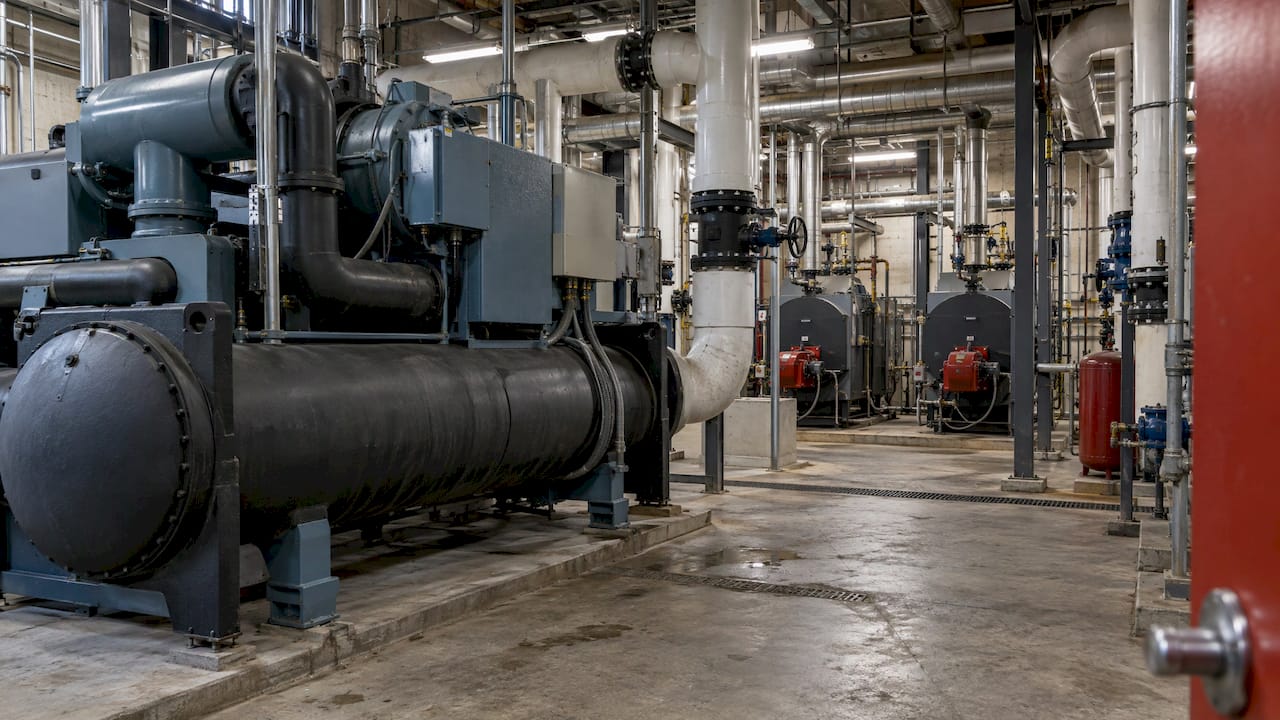
Commercial chillers and boilers in a mechanical plant

One contractor-software company reports that commercial HVAC pays $10,000 to $20,000 more per year on average than residential work. Treat that as a general pattern, not a promise. A strong residential service tech in a busy market can out-earn a weak commercial offer.

Employer type matters too. In May 2025, BLS puts the median for HVAC mechanics and installers in wholesale trade at $71,190, against $60,030 in plumbing, heating and air-conditioning contractors. Those wholesale jobs are often in equipment sales and support, so they are not a direct swap for a field role. They still show that who signs your check changes the number.

If you are weighing a move, our guide on how techs land commercial jobs and how shops hire them walks through what commercial employers look for.

Commercial HVAC salary by state

Location moves pay more than almost anything else. One analysis points out that moving from Mississippi, at a $48,680 median, to Massachusetts, at $77,300, is a $28,620 difference for doing the same work.

Here are BLS May 2025 state medians for HVAC mechanics and installers, as compiled by a trade-pay calculator that reports the official figures:

Rank State Median annual wage
1 District of Columbia $84,390
2 Alaska $77,430
3 Illinois $77,410
4 Massachusetts $77,300
5 Connecticut $76,610
6 Minnesota $76,350
7 Washington $75,660
8 North Dakota $74,490
9 New Jersey $74,450
10 New York $74,430

At the other end, the lowest medians are Arkansas at $48,110, Alabama at $48,370 and Mississippi at $48,680.

Different sites rank the states a little differently because they use different data years. An industry magazine’s 2025 roundup put California, New Jersey, Washington, Massachusetts and New York in the top five, with West Virginia, Mississippi, Wyoming, Arkansas and South Dakota at the bottom. Both lists tell the same story: the coasts, big northern states and Alaska pay the most, and the lower-cost South pays the least.

Beware of numbers that look too good. One team that tracks this data warns that some high-traffic salary pages publish figures well above BLS, such as $112,300 for Hawaii where the federal median is $65,450. If a number looks wild, find the BLS series behind it.

Working in Texas? We broke that market down in our Texas HVAC salary guide.

Pay by metro area

City matters inside a state, too. An analysis of BLS May 2025 data for the 30 largest metros found median hourly wages ranging from $38.51 in Seattle to $24.30 in Tampa, against a national median of $29.33. Nineteen of the 30 metros paid above the national median.

Higher pay usually comes with higher rent. Before you chase a big-city wage, compare it against what housing, insurance and fuel cost where you would live. A $28 an hour job in a cheaper town can leave you with more in your pocket than $36 an hour in an expensive one.

What moves a commercial tech’s paycheck

Specialization

After experience, specialty is one of the biggest levers. One industry company says commercial and industrial refrigeration techs who work cold storage, supermarket racks and large chillers routinely earn $85,000 to $120,000 with overtime. The same source flags building controls (BACnet, BMS, IoT) and heat pumps as growing niches.

The pattern is simple. Skills that fewer techs have, on equipment that costs a customer a lot when it fails, earn more.

Overtime and on-call

Peak season changes the math. One estimate says 50 to 60 hour weeks can add $7,000 to $15,000 or more per year. Another puts overtime and on-call work at $5,000 to $15,000 in annual take-home.

Ask how overtime is calculated, how on-call is paid, and how often you can expect it. A good hourly rate with no overtime can pay less than a modest rate with steady hours.

Certifications

Certifications help you get hired and give you something to point to in a pay conversation. One contractor-software source estimates NATE certification adds about $15,000 a year in earning power. Take that as an estimate, not a guarantee. What it does tell you is that shops pay for proven skill, so ask any employer whether they cover exam fees and reward certifications with a raise.

Productivity and value

Techs are paid in proportion to the value they create. A tech who diagnoses fast, runs more calls a day, spots legitimate repair opportunities and keeps callbacks low is worth more to a shop. One industry writer notes that owners often pay a premium to keep high-productivity techs because turnover is expensive. Track your own numbers. They are your best negotiating tool.

Can you make $200,000 in commercial HVAC?

As a salaried tech, rarely. One salary aggregator puts typical HVAC tech pay between $54,132 and $71,510, with a median near $61,841, and says reaching $200K is uncommon without extensive experience or additional roles.

The people who get there usually have a different job title. Here are the common routes:

  1. Service manager or operations roles. You trade the tools for people, scheduling and numbers. See our guide to HVAC service manager jobs, pay and path.
  2. Niche specialist. Refrigeration, controls or large chiller work, plus plenty of overtime, can push the top of the tech range well past the median.
  3. Owning the business. Owner income depends on revenue, overhead and how many trucks you run. It carries real risk and long hours, so it is a different path, not a raise.

For most techs, a realistic plan is to climb the ladder: apprentice, service tech, lead tech, specialist or manager. Each rung adds both pay and leverage.

Why pay can feel low, and how to compare offers

HVAC is physical, seasonal work in attics, rooftops and mechanical rooms. It is fair to ask whether the paycheck matches the effort. The answer often depends on what you count.

An hourly rate is only one piece. When you compare two offers, put these side by side:

  • Base hourly rate or salary, and how raises are decided
  • Overtime rules and typical hours in peak season
  • On-call pay and rotation
  • Health insurance, and what you pay in premiums
  • Retirement match
  • Paid time off
  • Take-home truck, tools, uniforms and boot allowances
  • Paid training and certification support
  • A clear path from where you are to lead tech or manager

A lower hourly rate with a take-home truck, a retirement match and paid training can beat a higher rate with none of it. We cover what to expect in our guide to HVAC employee benefits.

Also ask what pay looks like in the slow season. Some shops keep techs busy year-round with maintenance and project work. Others cut hours. That answer changes your annual number more than a dollar-an-hour difference.

Our take: pay transparency is the trade’s biggest fix

We have spent a long time in this trade, and we have seen the same story over and over. Good techs leave because they never knew what they were worth, or because a shop would not talk about pay until the offer letter.

That is why we built HVAC Mafia as a place by and for the trade. Our job listings and community are restricted to verified HVAC trade professionals, so the conversation stays about the work, the money and the career. No homeowner noise. No corporate polish.

Here is our advice. Learn your market, because a number from another state tells you little. Learn the specialty that pays, whether that is refrigeration, controls or heat pumps. Ask the benefits questions before you sign. And pick a contractor who shows you their culture, pay and benefits up front, because a shop proud of how it treats techs has nothing to hide.

Build a career, not just another paycheck. That is what we are here for.

the author

Find a commercial HVAC job that pays what you are worth

If you are a tech, registering with us is free. You see openings from real contractors that non-members cannot, and you get straight talk on pay, certifications and spotting good and bad employers. Join HVAC Mafia as a free member and start comparing offers with real numbers.

HVAC Trucker Hat — Structured Mesh-Back Cap | HVAC Mafia

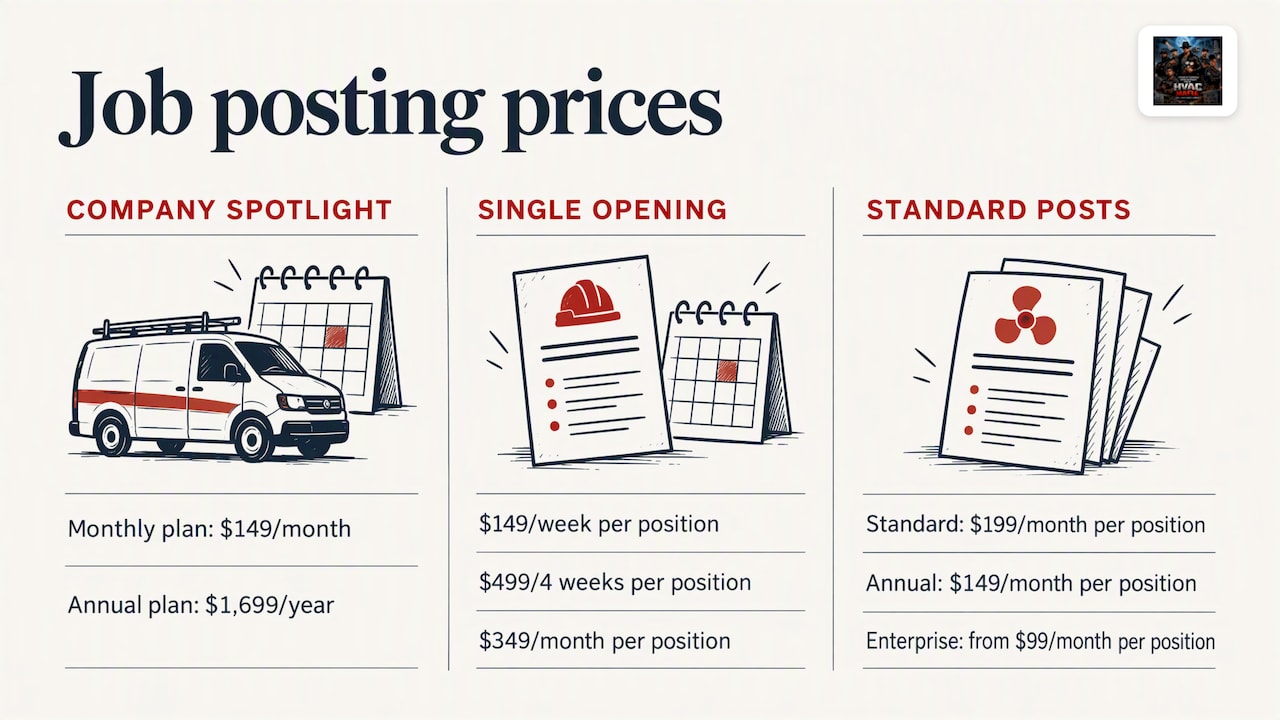
If you are a contractor losing techs to better offers, publish your pay and benefits where techs are looking. Our job posting plans run from $199 per month per position on the Standard plan, $149 on the Annual plan, and from $99 on Enterprise. Postings reach a trade-only audience of nearly 100,000 HVAC followers, and applications go straight to your own hiring system. Our guide to how contractors hire and keep techs covers what works after the posting goes live.

FAQ

How much does a commercial HVAC technician make per hour?

The federal median for HVAC and refrigeration mechanics and installers is $29.33 an hour. Commercial roles often land at or above that, depending on your state, specialty and overtime. Metro medians run from about $24 an hour in Tampa to about $38 in Seattle.

Which states pay HVAC techs the most?

In BLS May 2025 data, the District of Columbia leads at $84,390, followed by Alaska, Illinois, Massachusetts and Connecticut. Rankings shift a little between data years, but the Northeast, the West Coast and Alaska show up near the top.

Does commercial HVAC pay more than residential?

Usually, yes. One industry source reports a gap of $10,000 to $20,000 a year on average. Your own result depends on the employer, the market and how much overtime you work.

Can you make $200K a year in HVAC?

It is uncommon for a salaried tech. One aggregator says it generally takes extensive experience or additional roles. Moving into management, a high-demand specialty, or business ownership are the usual routes.

How do I find a commercial HVAC job near me?

Register free with HVAC Mafia to see openings from real contractors, then use our commercial HVAC hiring guide and resume guide to prepare. Ask about pay, overtime and benefits in the first conversation.

Sources

HVAC Interview Questions: What Techs Get Asked and How to Answer

Expect four kinds of questions in an HVAC interview: technical, behavioral, situational and culture fit. FieldEdge sorts them the same way. The ones that decide the job are rarely trivia. They are the questions where you explain how you think: how you diagnose a no-cool call, how you stay safe, and how you talk to a customer who is hot, tired and worried about the bill. This guide covers the questions service techs, installers and apprentices actually face, and the answer shape that works for each.

I’ve spent 36 years in this trade, and I’ve sat on both sides of that table. The techs who got hired were not always the ones with the most certifications. They were the ones who could say why they did something.

Thehvacmafia
Find a Shop Worth Interviewing With
Explore HVAC job openings and get straight talk on pay, career paths, and spotting good and bad employers.

Explore HVAC opportunities

TL;DR

  • Interviews mix technical, behavioral, situational and culture-fit questions. Prepare a short story for each type.
  • For any diagnostic question, answer in order: what you check first and why, what each result tells you, and what you do next.
  • Safety answers need specifics: name the hazard, name the procedure, and say when you would stop the job.
  • Installers should be ready for questions on brazing, line sets, airflow, load basics and the newer A2L refrigerants.
  • Always ask your own questions about pay, training, truck, on-call and how the shop treats its techs.

Table of Contents

How an HVAC interview is usually built

Most shops run it in stages. A short phone screen checks your credentials and years of experience. Then comes a sit-down with a service manager or owner. Many shops add a hands-on piece, a scenario in the shop or the field, because talking and doing are different skills.

The questions fall into the four groups FieldEdge describes. Technical questions test your knowledge of systems, tools and safety. Behavioral questions start with ‘Tell me about a time when…’ and look for problem solving and teamwork. Situational questions drop you into a made-up job. Culture-fit questions ask whether you share the shop’s values and work ethic.

Know which one you are answering. A behavioral question wants a real story from your past. A situational question wants your plan. Mixing them up is the most common way good techs sound vague.

The opening questions

Tell me about yourself

This one sounds soft and it matters. Keep it under 90 seconds and cover three things: how you got into HVAC, the work you have done, and what you want now. Smart Service makes the point that the interviewer already has your resume, so the question is mostly about how you communicate.

A solid version for a mid-level service tech: ‘I started as a helper on residential installs, moved to service after three years, and now run my own calls on split systems and heat pumps. I like diagnostics and I like customers who are glad to see me. I’m looking for a shop that trains on newer equipment and has a path to lead tech.’

If you are just starting, say that plainly. Talk about trade school, the lab work you liked, and the reason you picked this trade. Our guide to the HVAC technician resume helps you line up the same story on paper.

Why HVAC, and why us?

They want a real reason, not a speech. Maybe you like fixing things, working with your hands, or the fact that no two calls are the same. For ‘why us,’ do your homework: know the service area, whether they do residential, commercial or both, and what techs say about working there. A shop’s company profile often tells you about culture, pay and benefits before you walk in.

Where do you see yourself in five years?

Pick a direction and be honest. Lead tech, install crew lead, commercial service, controls, service manager. If you want to grow into management, say so. Shops hiring for the long term like to hear it. If you are curious about that path, see what we wrote on HVAC service manager jobs.

Technical questions you should be ready for

You will not get every question below. You should be able to talk through all of them without freezing.

  • What are BTU, CAV and AHU, and where do you run into each?
  • What is heating or cooling load, and how is it calculated?
  • How does heat move by conduction, convection and radiation?
  • What is the difference between a heat pump, a furnace and a refrigeration system?
  • Walk me through the refrigeration cycle.
  • What refrigerants have you worked with, and what changed recently?
  • How do you read a wiring diagram?

These topics line up with what the trade itself treats as core knowledge. NCCER’s assessment specifications describe a journey-level technician as someone who can install residential, commercial and industrial systems, use trade math, read mechanical drawings, solder and braze, troubleshoot heating, cooling and heat pump systems, and handle refrigerant leak detection, evacuation, recovery and charging. If you can speak to each of those from your own jobs, you are in good shape.

Refrigerants: the question that dates your knowledge

Refrigerant questions show whether you keep learning. The American Innovation and Manufacturing Act phased out R-410A for new equipment effective January 1, 2025. New residential and light commercial split systems and heat pumps use R-32 or R-454B. Both are A2L refrigerants with a lower global warming potential.

A strong answer goes past the names. Mention the practical side: A2L training, A2L-rated tools, spark-free brazing precautions and ventilation at the install site. If you have not worked on A2L equipment yet, say so, then say what you have done to get ready. That reads as honest and coachable.

The older questions still come up too. AANM’s sample questions ask about common refrigerants and their environmental impact, naming R-22, R-32, R-134a and R-410A, and note that R-22 is being phased out because of its high ozone depletion potential. Know the history as well as the current picture.

How to answer any diagnostic question

This is where interviews are won. The question might be ‘The AC is running but the house won’t cool. What do you do?’ or ‘A heat pump is short cycling. Walk me through it.’ The shape of a strong answer is the same every time:

  1. What you check first, and why that check.
  2. What each result tells you, so you are narrowing the problem rather than guessing.
  3. What you do about it.

Take the no-cool call. Smart Service lays out a simple-to-complex order: confirm thermostat settings, check the breaker, the indoor disconnect and the filter, verify a cooling call at Y, inspect the outdoor components, then check pressures and superheat or subcooling if the system runs but does not cool.

Now say it like a tech in the room: ‘I start at the thermostat because it’s the cheapest thing to rule out. If it’s calling for cooling, I check the breaker and disconnect, because no power means everything downstream is a distraction. Then the filter and airflow, since a restricted coil can look like a refrigerant problem. If the outdoor unit is running, I get on the gauges and look at superheat and subcooling, because they tell me whether I’m dealing with a charge issue or a metering issue.’

Notice what that answer does. Every step has a reason. The reason is the part many candidates skip, and it is the part the manager is listening for.

Don’t be the parts swapper

The highest-probability failure is often a capacitor. Saying ‘I’d change the capacitor’ first still sounds like guessing. Put it inside a sequence instead, after you have confirmed what the unit is doing.

Two more habits help. First, know the sequence of operation. A veteran contributor on ACCA’s HVAC blog says it is the best foundation for diagnosing a malfunctioning system. He also says that if you see immediate damage, like water coming through a ceiling, handle that emergency before you chase the root cause. Second, sort the problem early. ACHR News reported advice that most problems can be divided into mechanical or electrical, and knowing which helps you pick the right tools.

Safety, lockout and refrigerant handling

Safety questions are scored on specifics. ‘I always stay safe’ scores nothing. Name the hazard, name the procedure, and show that you would actually stop work.

Expect questions like these:

  • Which EPA Section 608 certification do you hold?
  • How do you recover refrigerant without venting it?
  • How do you verify a circuit is dead?
  • What PPE do you use, and for what jobs?
  • Tell me about a time you stopped a job because it wasn’t safe.
  • What do you do if you smell gas on a service call?

On lockout/tagout, say that you lock out, tag out and then confirm zero energy with your own meter. Do not trust the disconnect position alone. On gas, the answer is immediate: do not create an ignition source, so no switches and no phone use inside, get everyone out of the building, and leave the investigating to the gas company and the proper authorities.

For the ‘time you stopped a job’ question, use a real story. Maybe it was a roof edge with no tie-off, a panel you did not trust, or a customer pressuring you to skip a step. Say what you did, who you told and how it ended. Shops want techs who will halt a job, not just recite a procedure.

Installer interview questions

Installers get a different mix. Less theory about diagnostics, more about craft, speed and quality. Common questions include:

  • What does a clean install look like to you, start to finish?
  • How do you braze line sets, and what do you do to protect the system while you do it?
  • How do you evacuate a system, and how do you know the job is done?
  • How do you check airflow and ductwork on a replacement?
  • What does a load calculation tell you, and why not just match the old unit’s size?
  • How do you work with a crew, and what do you do when you find a problem the sales team missed?
  • Have you worked on A2L systems, and what changes on the job site?

For each one, use the same pattern: what you do, why, and what you do when it goes wrong. For example, on sizing: ‘I don’t assume the old unit was right. A load calculation tells me what the house needs, and I’d flag the duct condition before we set equipment.’ That answer shows judgment, which is what a lead installer is hiring.

Be ready to talk about your pace without bragging about corners cut. A shop wants installs finished on time and without callbacks. If you have a story about a clean startup, a neat line set or catching a mistake before the customer did, tell it.

Expect a hands-on test too. It might be a brazing joint, a wiring exercise or a walk-through of a staged problem. If you want some reps beforehand, practice job-knowledge questions give you a way to check yourself on more than memorized answers.

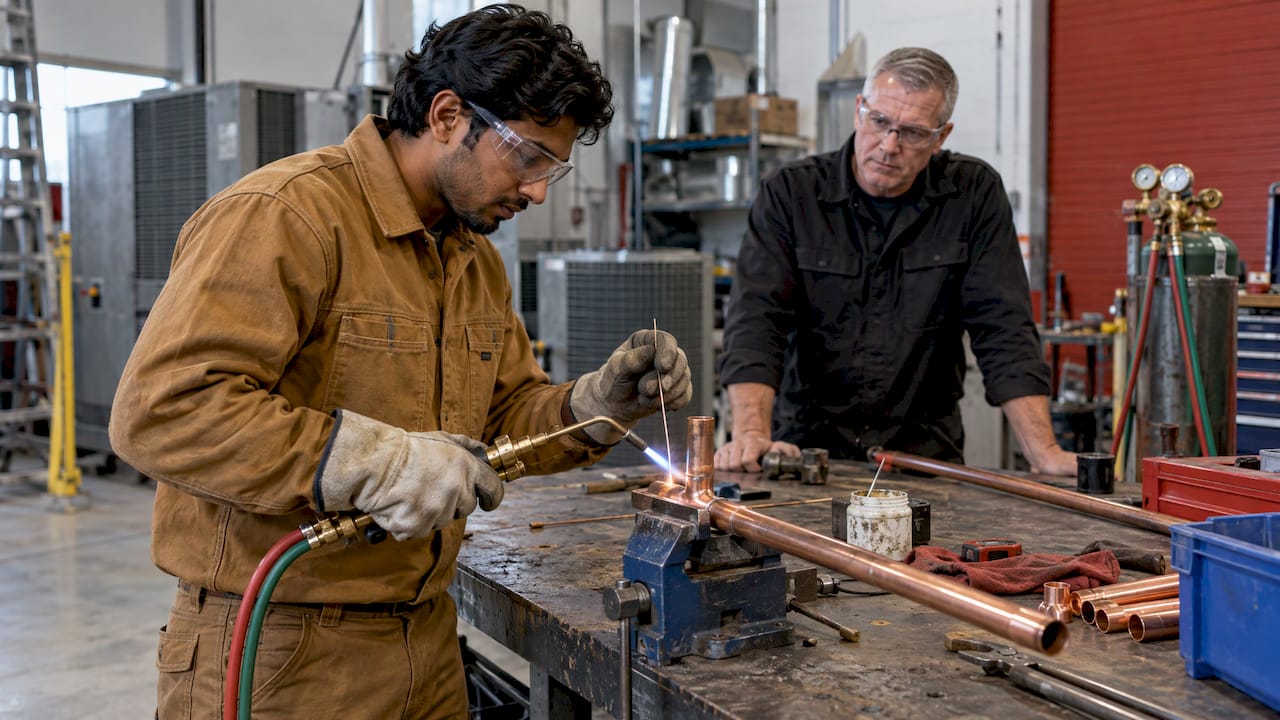
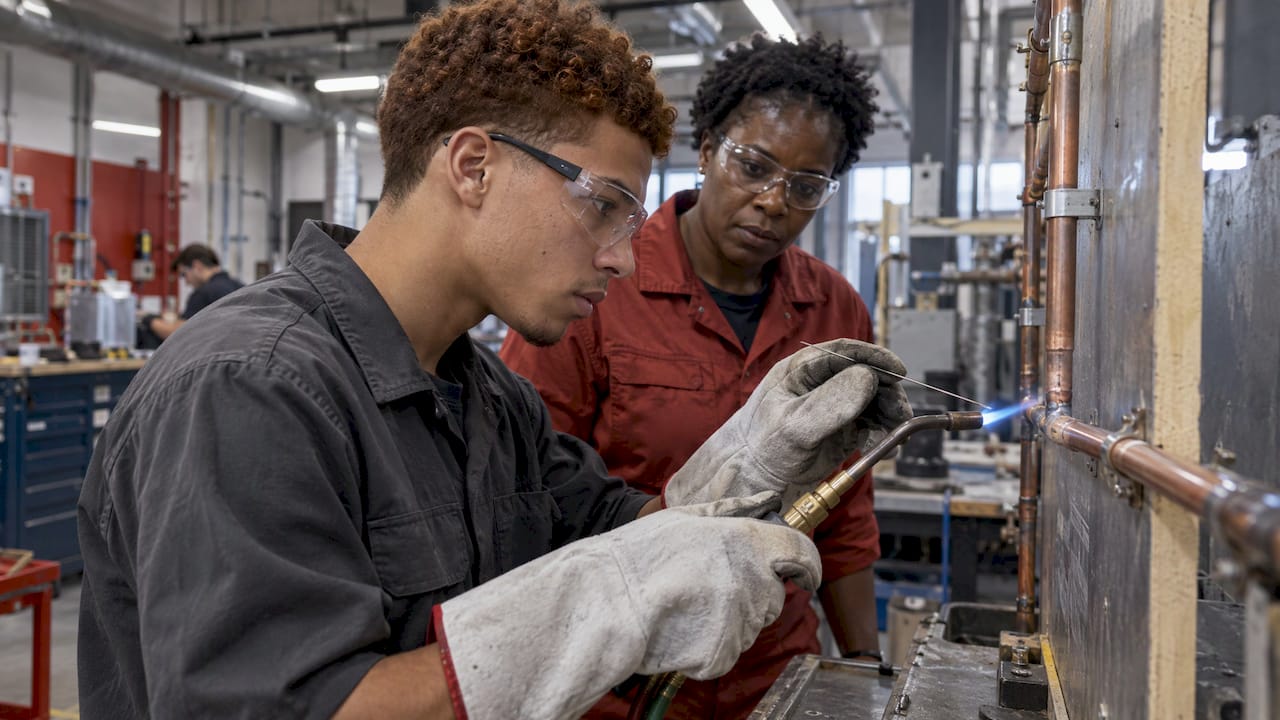
Candidate brazes copper during an HVAC skills test

Behavioral and customer questions

You are the face of the company when you walk into someone’s home. Customers are often uncomfortable and stressed. That is why the soft skills are hard skills in this trade, and why interviewers ask:

  • Tell me about a difficult customer and how you handled it.
  • How do you respond when a customer is unhappy with a diagnosis or a service fee?
  • Tell me about a time you put safety ahead of speed.
  • How would you handle a conflict with a coworker?

Strong answers stay calm, listen first, explain clearly, solve the problem instead of arguing and remain respectful. That is how Jobber describes what hiring managers look for.

Explaining the problem is half of it. RSI advises techs to say what the problem is, why it happened, what repair or replacement options exist and what next steps may cost, in plain language rather than jargon. Practice a one-minute version of that out loud. It works in the interview and on the call.

Use a story format

For behavioral and situational questions, the STAR method keeps you organized. RSI recommends it: Situation, Task, Action, Result. It helps you tell a clear, complete story that shows how you solve problems under pressure.

Here is a quick one: ‘A customer’s system froze up on the first hot weekend (situation). I needed to get cooling back without selling a repair they didn’t need (task). I found a clogged filter and a blower issue, showed them both, and explained the options (action). They approved the blower fix and left us a good review (result).’ Make sure yours is true, and include a number or outcome if you have one.

Questions you should ask them

An interview runs both ways. Techs have choices right now, and the questions you ask show you are serious. Ask:

  • What does training look like for the first 90 days, and for A2L equipment?
  • How is pay structured: hourly, flat rate, commission, or a mix? How are raises decided?
  • What is the on-call rotation, and how is it paid?
  • What does a typical day look like, and how many calls per day?
  • What does the truck stock and tool setup look like?
  • What does the path to lead tech or service manager look like here?
  • What do the benefits look like? Our page on HVAC employee benefits lists what techs should expect.

Listen to how they answer as much as what they say. A shop that is proud of its pay and training will talk about them freely.

Commercial and specialty roles

If you are interviewing for commercial or refrigeration work, expect more on controls, chillers, rooftop units, preventive maintenance and documentation. Bring numbers: how many units you maintained, how you cut downtime, what failure you prevented. We cover how techs land those roles in our guide to commercial HVAC hiring.

Our take on HVAC interviews

After 36 years in this trade, we’ve learned that a good interview is two people finding out if they can trust each other. Techs worry about the questions. Contractors worry about the answers. Both should worry about the fit.

For techs: prepare stories, not scripts. Explain why behind every check, own your safety record and ask hard questions about pay, training and culture. You are not begging for a job. You are choosing a shop.

For contractors: if your interview is just trivia, you will hire good talkers and miss good techs. Ask how they think, put them in a real scenario and be upfront about what you pay and what you offer. Techs have choices, and the shops that are honest win them.

That is why we built HVAC Mafia as a trade-only place where openings come from real contractors and the talk is by techs, for techs. Build a career, not just another paycheck.

the author

Find a shop worth interviewing with

Preparing is half the work. The other half is finding employers worth your time. Registering with HVAC Mafia is free for technicians, apprentices and trade school students, and members can see openings from real contractors that are hidden from non-members. You also get straight talk on pay, career paths and spotting good and bad employers.

HVAC Stickers — Vinyl Decals for Toolboxes  Trucks | HVAC Mafia

Join with a free basic membership and start browsing jobs.

Hiring instead? Contractors can post in front of a trade-only audience of nearly 100,000 HVAC followers, and applications go straight to your own hiring system. Job posting plans are $199 per month per position on Standard, $149 per month per position on Annual, and from $99 per month per position on Enterprise. If you are working on the bigger picture, read our guide to HVAC technician recruitment.

FAQ

What are the most common HVAC technician interview questions?

Expect ‘Tell me about yourself,’ why you chose HVAC, what experience you have with repairs and systems, how you troubleshoot a no-cool call, how you handle a difficult customer and how you keep safe on the job. Salary expectations and whether you hold a valid driver’s license are common too. Prepare one short story for each.

How do I answer a technical HVAC question if I don’t know the answer?

Say what you do know, then explain how you would find out. Interviewers are watching how you reason, not whether you memorized a fact. ‘I haven’t worked on that, but I’d start with the manufacturer’s documentation and a senior tech’ is far better than a guess.

What should an apprentice say with limited experience?

Talk about your training, your lab work and your willingness to learn. Describe one job or project in detail, what you did and what you learned. Ask about mentorship and training, since that is what you are really choosing.

What questions should an HVAC installer expect?

Expect questions on brazing, evacuation, line sets, airflow and duct checks, load basics and how you work on a crew. Newer A2L refrigerants may come up. Be ready for a hands-on test as well as questions.

Sources

Is HVAC a Good Career? Pay, Outlook and the Hard Parts

Yes, HVAC is a good career for people who like hands-on work, want to get paid while they learn and are willing to put up with some hard days in attics and on rooftops. The government numbers back it up: solid median pay, faster-than-average job growth and an entry path that does not require a four-year degree. But “good” depends on the shop you land in as much as the trade itself. Here is the full picture, from a community that has been around this trade for a long time.

Thehvacmafia
Find Your Next HVAC Job
Explore openings from real contractors, with straight talk on pay, career paths, certifications, and what makes an employer worth working for.

Explore HVAC jobs

TL;DR

  • The median HVAC pay in the U.S. was $61,010 a year in May 2025, with the top 10% earning more than $95,210.
  • BLS projects 11% job growth from 2025 to 2035, much faster than average, with about 40,600 openings a year.
  • You can start through a trade school program or a paid apprenticeship. Nearly everyone who handles refrigerant needs EPA certification.
  • The work is physical, and the schedule can include nights, weekends and on-call hours. Pay and culture vary a lot from one contractor to the next.
  • Picking a good employer matters as much as picking the trade.

Table of Contents

What HVAC techs actually do all day

HVAC stands for heating, ventilation and air conditioning, and the trade usually includes refrigeration. According to the Bureau of Labor Statistics, technicians install, maintain and repair these systems. They also install electrical components and wiring, inspect and test equipment, talk with customers about what is going wrong, replace worn parts and keep records of the work.

That sounds tidy. In real life it means a service tech might spend the morning diagnosing a no-cool call in a hot attic, the afternoon doing a tune-up and an hour with a homeowner explaining why their 18-year-old system is not worth another repair.

The trade also splits into lanes:

  • Service and repair: diagnosing problems, running calls, building customer relationships.
  • Installation: swapping systems, running lines and ductwork, working with a crew.
  • Commercial and refrigeration: rooftop units, chillers, grocery store and restaurant refrigeration.
  • Specialties: BLS notes some techs focus on areas such as radiant heating, testing and balancing, or commercial refrigeration.

Residential techs often also sell maintenance agreements. Those typically cover inspecting the system, replacing filters and checking refrigerant levels, according to the same BLS profile. If you like talking to people, that lane can pay well. If you would rather turn wrenches, installation or commercial work may suit you better.

How much does HVAC pay?

The national picture from BLS data for May 2025:

Measure Amount
Median annual wage $61,010
Median hourly wage $29.33
Lowest 10% earn less than $40,050
Highest 10% earn more than $95,210

That spread tells you something. A first-year helper and a ten-year lead tech are not in the same pay world. BLS says earnings vary with experience, responsibility, performance, tenure and where you live.

Location changes the math

State figures show how much geography matters. New York’s clean energy career guide lists HVAC installer wages from $47,510 to $98,530, with a median of $32.05 an hour, and service managers from $51,380 to $136,820. Meanwhile, Oklahoma’s career site reports a median hourly wage of $20.34 for technicians there. Cost of living moves along with those numbers, so compare take-home against local rent and gas, not just the headline.

Pay grows with the title

Most techs do not stay at the bottom of the range. A typical path looks like this:

  1. Helper or apprentice, learning basic tasks under an experienced tech.
  2. Service or install tech, running your own calls.
  3. Senior tech or install lead, mentoring and handling the tough jobs.
  4. Service manager, operations manager or business owner.

BLS says new hires usually work alongside experienced technicians, starting with basics like insulating refrigerant lines or cleaning furnaces, then moving to cutting and soldering pipe and checking electrical circuits. Oklahoma’s career site also points to management roles and to becoming a contractor or starting your own business as ways to advance.

Want to know what the extras look like? Pay is only part of the package. We put together a guide on HVAC employee benefits techs should expect, because a good benefits package can be worth thousands a year.

Job outlook: will there be work?

BLS projects employment growth of 11% from 2025 to 2035, much faster than the average for all occupations. That adds about 48,200 jobs to a base of 440,900, with roughly 40,600 openings projected each year once you count people leaving or retiring.

Numbers like that explain why contractors keep saying they cannot find enough techs. Every building with a furnace, a heat pump, an air conditioner or a walk-in cooler needs somebody to keep it running, and that work happens on-site. You cannot do a compressor swap over the internet.

How HVAC compares with other trades

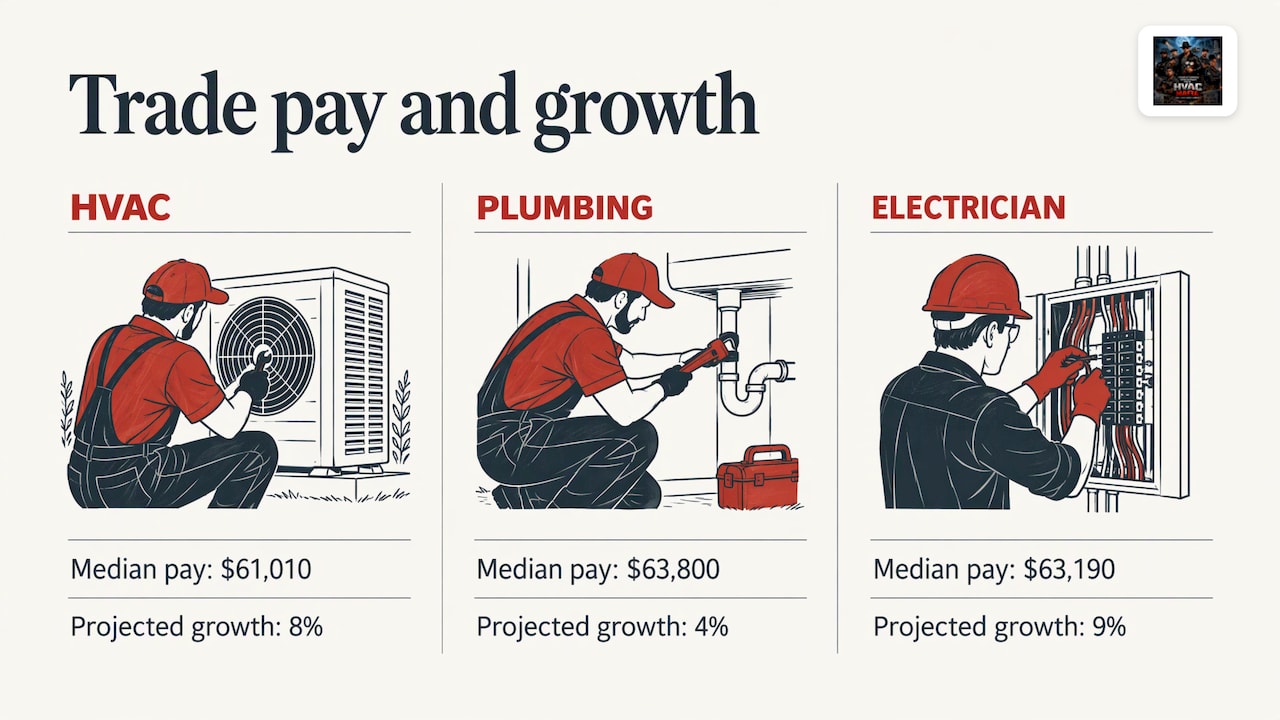
A 2024 to 2034 benchmark from JobStack Research lines up several trades on BLS figures. HVAC shows $61,010 median pay and 8% projected growth. Plumbers are listed at $63,800 and 4%, electricians at $63,190 and 9%. In other words, HVAC pay is in the same neighborhood as its sister trades, with strong demand.

Median pay and projected growth across three trades

Here is the thing nobody tells new people: you can cross-train. Plenty of techs add electrical or plumbing knowledge over time, and that makes you more valuable to a shop.

The hard parts, said plainly

We would not be doing you any favors if we left this out. HVAC is not easy.

It is physical. BLS says HVAC technicians have one of the highest rates of injuries and illnesses of all occupations. Hazards include burns from electrical parts or chemicals and strains or sprains from heavy equipment. Refrigerants are hazardous, so the right safety gear is part of the job. Techs lower their risk with proper lifting technique and protective equipment such as special clothing, goggles or masks.

The schedule can be rough. Most techs work full time, per BLS, but evenings and weekends come up, and some are on call for emergencies. Peak heating and cooling seasons can mean overtime and irregular hours.

Weather is the job. Hot attics in July, cold roofs in January. Some people love being out of an office. Others burn out.

Employers differ. One shop gives you training, a clean truck and a fair on-call rotation. Another hands you a ladder and a quota. Same trade, very different life.

So is being in HVAC hard? Yes, physically and mentally, since you diagnose problems that do not announce themselves. But most techs will tell you the difficulty is part of why the skill pays.

How to get started

Training options

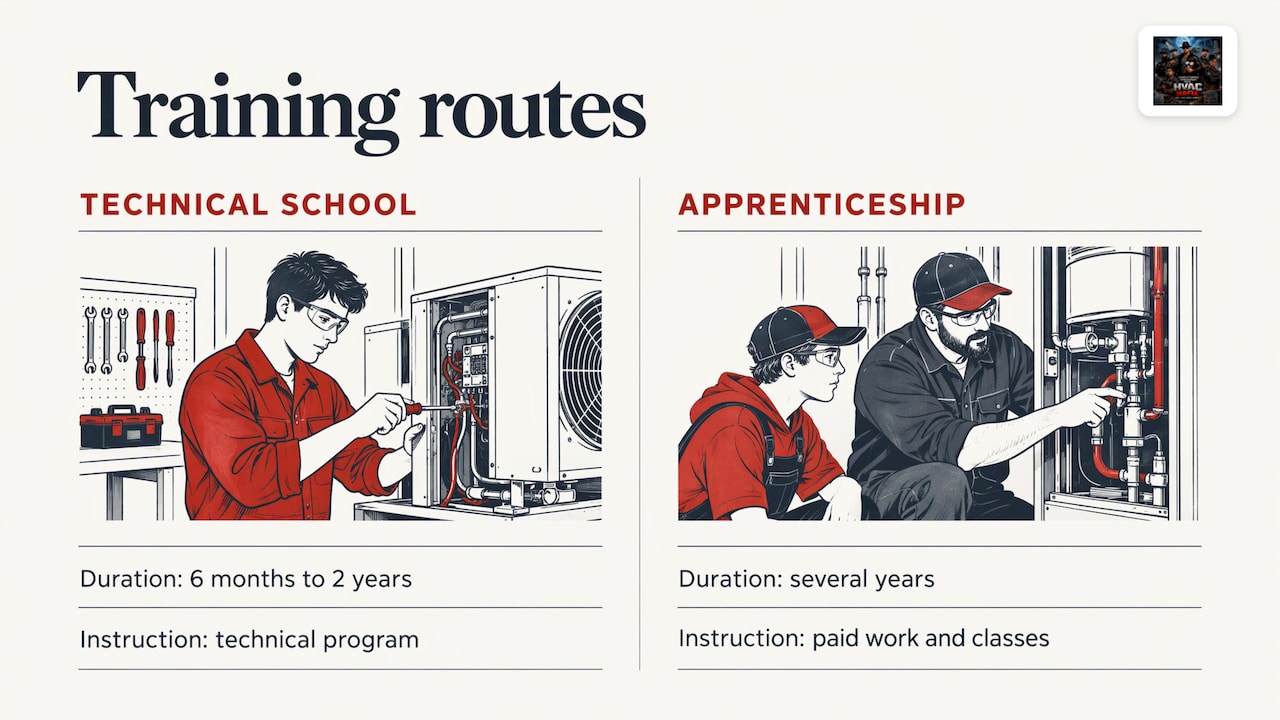
According to BLS, techs typically get postsecondary instruction from technical schools or community colleges, with programs lasting from 6 months to 2 years and ending in a certificate or an associate degree. Some employers will consider high school graduates. Apprenticeships usually run several years and combine paid on-the-job training with technical instruction. That earn-while-you-learn route is a big reason many people pick the trade over a four-year degree.

If you are wondering about timing, our guide on how long it takes to get HVAC certified breaks it down.

Training options

Certifications and licenses

BLS says the EPA requires nearly all HVAC technicians to be certified in proper refrigerant handling. Many other industry certifications are optional, though some employers prefer or require particular ones. State licensing rules differ, so check your own state’s licensing board before you start applying.

Your first job

Your first employer shapes your habits for years. When you are starting out, ask:

  • Will someone senior ride with me and actually teach?
  • Is there a clear path from helper to tech to lead?
  • How is pay structured, hourly, flat rate or commission?
  • What does the on-call rotation look like?
  • What benefits come with the job?

A clean, specific resume helps too. Here is how to write an HVAC technician resume that gets callbacks even with limited experience.

Who HVAC is a good fit for

HVAC tends to work well if you:

  • Would rather learn on the job than sit in a lecture hall for four years.
  • Like solving problems with your hands and your head.
  • Are comfortable talking with customers.
  • Want a skill that is in demand in nearly every town.
  • Are interested in running a team or your own shop down the road.

It may be a tougher fit if you need a predictable desk schedule or cannot handle heat, tight spaces and heights.

Where the trade is headed

Systems are getting more complex. Efficiency standards, refrigerant changes and electrification mean techs need to keep learning. Investment research from BlackRock notes that skilled trades like HVAC are largely resistant to offshoring and AI replacement, and that apprenticeships let people earn and learn at the same time. The work is hands-on and varies from one building to the next, so a laptop will not replace the person on the roof.

Our take

We have watched this trade for a long time, and our founder is a 36-year HVAC veteran and former dealership owner. Here is what he and the rest of us keep seeing.

HVAC is a good career. It can be a great one if you land with the right contractor. The techs who stay and grow are the ones who found a shop that pays fairly, trains them and treats them with respect. The ones who leave usually do not leave the trade. They leave a bad employer.

That is why we built HVAC Mafia. Techs register free and see openings from real contractors, with straight talk on pay, certifications and how to spot good and bad employers. Contractors get a trade-only audience of nearly 100,000 HVAC followers. No outsiders, no homeowner noise, no corporate fluff.

Build a career, not just another paycheck. That is the goal.

the author

Ready to look for HVAC work?

If you are a tech, apprentice or trade school student, membership on HVAC Mafia is free. Register as a member to see openings from real contractors, which are hidden from non-members, and join the Tech Talk forums and the HVAC Underground Podcast.

Make HVAC Great Again™ Front  HVAC Mafia Back T-Shirt

Contractors who are struggling to hire can reach a trade-only audience through our job posting plans. Plans are listed at $199 per month per position for Standard and $149 per month per position for Annual, with Enterprise starting from $99 per month per position. You can also see what real listings look like, such as an HVAC service technician role in Spring, TX or an install lead position in Sharonville, OH.

FAQ

What do HVAC technicians do?

They install, maintain and repair heating, cooling and refrigeration systems. Day to day that includes testing equipment, replacing worn parts, working on electrical components and explaining problems to customers. Some focus on installs, others on service or commercial refrigeration.

How much do HVAC technicians earn?

BLS reports a median of $61,010 a year in May 2025. The lowest 10% earned under $40,050 and the highest 10% earned more than $95,210. Experience, specialty and location move you around that range.

Is being in HVAC hard?

It can be. The work is physical, the weather is part of the job and schedules can include nights, weekends and on-call time. It is also skilled work, and many techs find that learning to diagnose tough problems is what makes the career rewarding and well paid.

Do I need a degree to start?

Not a four-year one. BLS says techs typically complete a technical school or community college program lasting 6 months to 2 years, or learn through a multi-year paid apprenticeship. Nearly all techs also need EPA refrigerant handling certification.

Sources

HVAC Contractor Forum: Where Owners and Service Managers Compare Notes

An HVAC contractor forum is any place where people who run or manage HVAC businesses trade real answers with each other. That can be a live event, a small peer group that meets twice a year, or an online community that stays open all week. The best one for you depends on whether you need a room full of owners, a handful of non-competing peers, or a daily conversation with the techs who actually do the work. Below we walk through each option, what it costs you in time and money, and how to tell a good one from a dead one.

Thehvacmafia
Trade Notes With HVAC Peers
HVAC Mafia connects contractors, service managers, and technicians through a trade-built community focused on the issues shops face every day.

Visit the HVAC Mafia community

TL;DR

  • “HVAC Contractor Forum” is also the name of a new live event from ACHR News for residential contractors, held for the first time in Frisco, Texas, in November 2026.
  • ACCA MIX Groups are small, non-competing peer groups for ACCA contractor members, and you get invited in rather than assigned.
  • Online trade communities cover the daily stuff: hiring, pay, tech retention, and what a good employer looks like.
  • Judge any forum by who is allowed in, how recent the conversations are, and whether people share numbers instead of slogans.
  • Service managers get the most from a mix: one peer group for strategy, one tech-focused community for the shop floor.

Table of Contents

What people mean by “HVAC contractor forum”

The phrase covers three different things, and mixing them up wastes time.

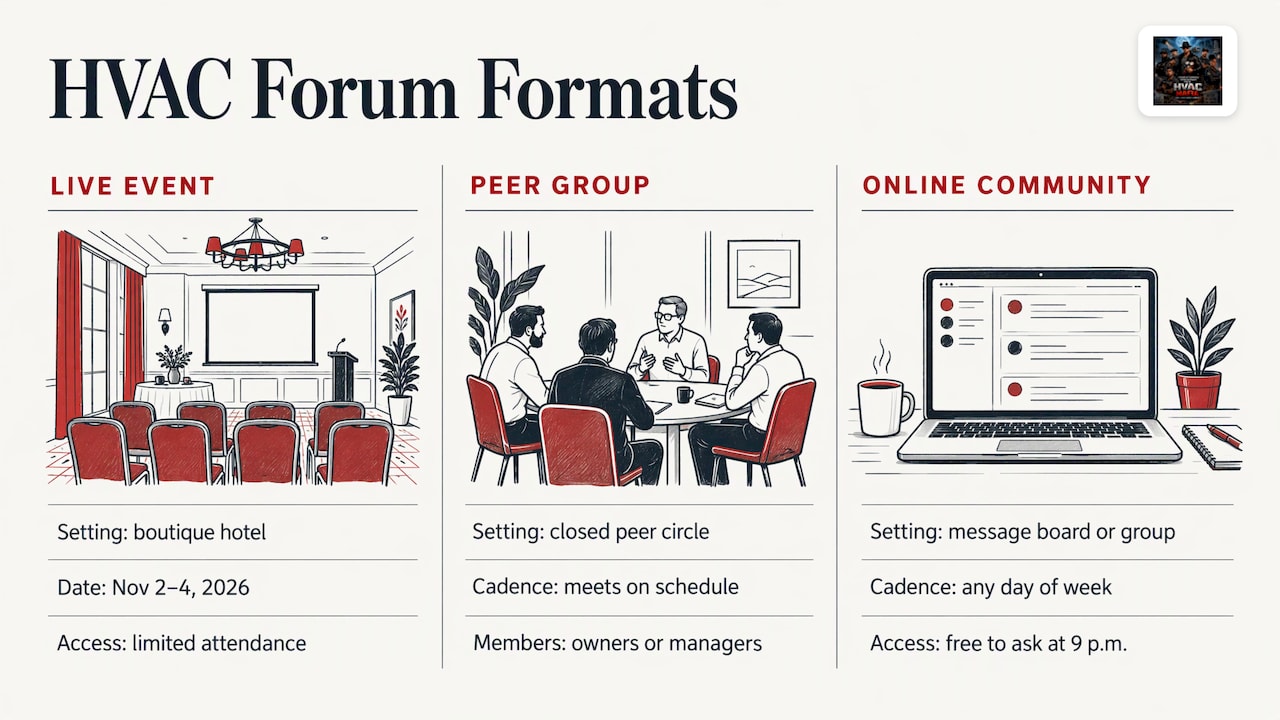
A live event. The HVAC Contractor Forum is a peer-to-peer event hosted by ACHR News for residential contractors. Its first edition ran November 2 to 4, 2026, at the Omni Frisco Star in Frisco, Texas, alongside ACCA’s Smart Tech Summit. It is not a big convention: attendance is limited, and the boutique hotel setting is meant to leave room for focused conversation.

A peer group. A small, closed circle of owners or managers who meet on a schedule and review each other’s businesses. The best-known version in our trade is the ACCA MIX Group.

An online community. A message board, a private group or a members-only site where people post questions and answers any day of the week. This is where most service managers and techs spend their time, because it costs nothing to ask a question at 9 p.m. after a rough day.

None of these replaces the others. They answer different questions, so let’s take them one at a time.

Comparison of three HVAC contractor forum formats

The live event: HVAC Contractor Forum in Frisco

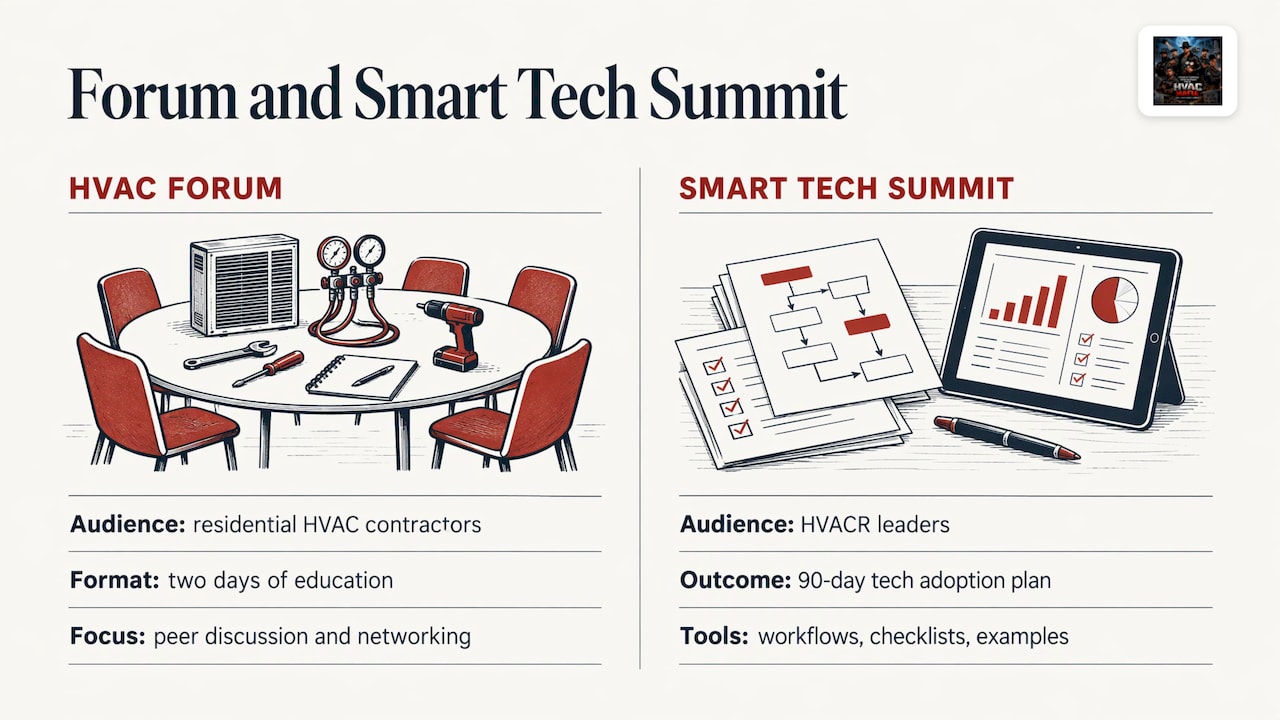
The event was designed exclusively for residential HVAC contractors, bringing together business owners, service managers and operations managers for two days of education, peer discussion and networking. That matters if you manage a service department. You were named as an intended attendee, not an afterthought.

The published agenda mixes keynotes, interactive panels and networking, with topics including marketing strategies, legislative updates, heat pump trends and the repair-or-replace question. The organizers describe the format as intimate, built to encourage open dialogue about common challenges and successes.

The Smart Tech Summit that ran alongside it is aimed at HVACR leaders, including business owners, general and operations managers and emerging leaders. According to HVAC/P Products, attendees leave with a 90-day tech adoption plan, plus workflows, checklists and examples built around HVACR operations.

The live event: HVAC Contractor Forum in Frisco

How registration worked

The registration page states that registered attendees can cancel up to 30 days before the conference for a full refund. ACCA contractor members reach the Contractor Forum by logging in and going to Member Services.

Because this was a first-year event and dates can change, check the official event site for whether and when the next one runs, and for current pricing. Don’t plan around a date you read in an old post.

Who gets the most from an event like this

  • Owners who want a short, structured stretch away from the phones to think about marketing, pricing and policy.
  • Service managers who are tired of solving the same dispatch and callback problems alone.
  • Operations managers who want to see how other shops handle heat pump demand and the repair-or-replace conversation.

If you are a tech or an apprentice, an event aimed at owners is not your best use of travel money. Keep reading: there is a better fit further down.

Peer groups: ACCA MIX Groups and similar circles

A peer group is the slow, deep option. The ACCA MIX Group program (Management Information Exchange) is built for contractor-to-contractor exchange. Groups are made of non-competing ACCA contractor members, and they typically meet twice a year. Each meeting travels to a participant’s location, where the group reviews sales, operations, policies, advertising, staff, strategy and facilities and offers frank feedback.

A few details worth knowing before you apply:

  • Most groups run 8 to 10 companies, and every participant must be non-competing and an ACCA member in good standing.
  • Some groups are residential only, some commercial only, and some mixed. Most pair companies of about the same annual sales volume.
  • You can start your own group and recruit members of any size and profile.
  • You apply by completing a form. ACCA does not place anyone in a group: you are either invited into an existing one or you start your own.

That last point surprises people. Joining takes some effort, and the group has to want you as much as you want them. If you do get in, you get a standing set of peers who have seen your actual shop.

What a peer group is good at

Peer groups shine on the decisions you only make a few times a year: pricing changes, a new branch, a compensation plan rewrite, when to hire a second service manager. They are not built for the Tuesday-afternoon question about a no-heat call that keeps coming back. For that you want a community with volume.

What service manager forums actually talk about

If you manage a service department, the conversations that move the needle tend to cluster around the same few problems. Here are the ones we see come up again and again in the trade.

  1. Finding techs. Where do you post, what do you offer, and why are good candidates ignoring you?
  2. Keeping techs. Pay structure, ride-along time, training, truck and tool quality, and how you handle a bad week.
  3. Pay transparency. Whether to publish a range, and how techs react when you do.
  4. Career paths. How to move an apprentice into a service tech, a lead tech, and eventually a service manager, so people see a future with you.
  5. Dispatch and callbacks. The daily mechanics of running a schedule without burning out the crew.
  6. Seasonal swings. How to staff for a July heat wave and a slow March.

Notice that most of this is people work. The equipment changes, but the question of why a tech stays or leaves does not. A forum where managers talk about that honestly is worth more than one that only argues about refrigerants.

Online communities: the everyday option

Peer groups and events happen a few times a year. An online community happens every day, which is why it is the first stop for most service managers and techs.

Our own community at HVAC Mafia works this way. It is a job board and trade-only community built for the trade by a 36-year HVAC veteran and former dealership owner. Listings and discussions are restricted to verified HVAC trade professionals, so you are not wading through homeowner questions or outside noise. Technicians register free, see job openings from real contractors, and can join the Tech Talk forums and listen to the HVAC Underground Podcast.

Why does that matter to a contractor or service manager? Because the people in that conversation are the ones you are trying to hire and keep. Reading what techs say about pay, certifications and bad employers is free market research you cannot get from another owner.

Who else gets value from a forum

  • Technicians: straight talk on pay, certifications and how to spot a good or bad employer.
  • Apprentices and trade school students: a look at career paths from apprentice to lead tech to service manager before you commit to a shop.
  • Owners: a read on trends and what your crew is really asking for.
  • Service managers: a way to see your shop the way a candidate sees it.

How to judge whether a forum or peer group is worth your time

Most forums look fine on day one. Here is how to tell what they look like on day ninety.

Check who is allowed in

A trade-only space gets better answers. If anyone can post, you will get confident advice from people who have never run a service call. Ask who verifies members, and whether competitors sit in the same room. A MIX Group, for example, requires non-competing members for exactly this reason: people only speak freely when they are not worried about the guy across town.

Check how recent the conversation is

Open the latest threads. Are the replies from this month? Do the same five people answer everything? A forum with steady, varied answers is alive. One with a year-old last post is a library, not a community.

Check whether people share numbers

Good forums have people who say what they pay a lead tech, what a callback costs them, what their close rate on replacements looks like. Vague motivation is easy to post. Real figures take trust.

Check the tone

You want disagreement that stays respectful. If every thread is either a sales pitch or a pile-on, the useful people have already left.

Check what it asks of you

Some options cost money and travel days, some cost a few minutes a week. Match the commitment to what you can actually give. A group that meets twice a year and visits your shop expects you to show up prepared and open about your numbers.

Which one should you pick?

You are Start with Why
Owner of a residential shop A live event or MIX Group Strategy, marketing, pricing and legislative updates with other owners
Service manager An online trade community plus one peer circle Daily problem solving and a longer-term sounding board
Contractor struggling to hire A trade-only job board and tech community You reach techs and see what they care about
Lead tech thinking about management Tech-focused forums Hear from managers and techs about what the step up looks like
Apprentice or student Free trade community Career paths, pay and employer red flags without the sales pitch

Most service managers end up using two or three. Use the event for a reset, the peer group for the big decisions, and the community for everything in between.

Our perspective

We built HVAC Mafia because the trade needed a place that was honest about the problems we actually live with: the technician shortage, turnover, pay that nobody will talk about, and shops that treat techs like replaceable parts.

Here is what we have learned. Contractors who struggle to hire usually are not short on money. They are short on a reason for a good tech to pick them. A service manager who reads what techs say about pay, culture and growth in a trade-only space learns that faster than any consultant could teach it.

That is why our listings and our conversations are restricted to verified HVAC trade professionals. When a contractor posts a job, it lands in front of a trade-only audience of nearly 100,000 HVAC followers, and applications go straight to the employer’s own hiring system. When a tech joins, they see openings from real contractors that non-members never see, and they get straight talk that is not filtered by corporate messaging.

If you run a shop, we think a Company Spotlight profile is one of the best ways to show techs your culture, pay and benefits, because techs today have choices. Build a place worth working for, then let people see it. That is how you build a career for someone, not just another paycheck.

Loyalty. Respect. No shortcuts.

the author

Put your shop in front of techs

If your biggest forum question is “where do I find people,” the answer may be a posting instead of another conversation. Contractors can post openings on HVAC Mafia through the job posting plans: Standard is $199 per month per position, Annual is $149 per month per position, and Enterprise starts from $99 per month per position.

HVAC Trucker Hat — Structured Mesh-Back Cap | HVAC Mafia

Want to show techs what working for you is like? The Company Spotlight is $149 per month on the monthly plan or $1,699 per year on the annual plan. Short-run Spotlight options include $149 per week per position, $499 per 4 weeks per position, or $349 per month per position for ongoing placement. Technicians never pay: they can join free as members to see the openings.

Seeing what techs see: real postings

One practical way to use a trade community is to read the postings your competition and peers publish. Notice what a good listing leads with: pay clarity, location, the kind of work, and what growth looks like. A few examples from our board show the range of roles:

If you want a broader view of where the trade is heading, our AHR Expo 2026 recap covers the technology side.

Getting more from any forum once you join

Joining is the easy part. These habits separate the people who benefit from those who lurk for a year.

  1. Ask a specific question. “How do you handle a tech who refuses on-call weeks?” gets better answers than “any advice on staffing?”
  2. Share your own number first. If you want others to be open about pay or margins, go first with something you are comfortable sharing.
  3. Answer one question a week. You know more than you think, and teaching sharpens your own process.
  4. Write down what you will change. After a peer meeting or a good thread, pick one action and a date. Otherwise it stays a nice conversation.
  5. Bring your service team into it. Managers who read what techs write about pay and culture tend to fix things sooner.

FAQ

Is the HVAC Contractor Forum an online forum?

No. The HVAC Contractor Forum is a live, in-person event hosted by ACHR News for residential contractors, first held in Frisco, Texas, in November 2026. For online conversation you want a trade community or message board instead. Check the event site for what comes next.

How do I join a contractor peer group?

For an ACCA MIX Group, you complete the application form on the program page as an ACCA contractor member. ACCA does not place you in a group: an existing group has to invite you, or you can start your own with non-competing peers.

Is there a forum for HVAC service managers specifically?

The HVAC Contractor Forum event names service managers among its intended attendees, alongside owners and operations managers. For everyday discussion, a trade-only community where managers and techs both take part gives you the view from both sides of the shop.

Can technicians and apprentices join contractor forums?

Events and peer groups like the ones above are aimed at owners and managers. Technicians, apprentices and trade school students can join HVAC Mafia free, see job openings from real contractors and take part in the Tech Talk forums.

How do I know a forum is trustworthy?

Look at who is allowed in, how recent the latest threads are, and whether people share real numbers. A trade-only space with steady, varied replies and respectful disagreement is a good sign.

Sources

Commercial HVAC Hiring: How Techs Land Jobs and Shops Hire

Commercial HVAC hiring runs on one fact: there are more jobs than qualified techs. If you’re a technician, that gives you leverage, and this guide shows you how to use it. If you run a shop, it means the old “post it and wait” approach isn’t enough anymore. Below, we cover how techs get into commercial work, what it pays, and how contractors can build a hiring process that finds good people and keeps them.

Thehvacmafia
Find Your Place in Commercial HVAC
HVAC Mafia connects technicians with job openings from real contractors and helps shops reach a trade-only audience of nearly 100,000 HVAC followers.

Explore HVAC Mafia

TL;DR

  • Commercial HVAC is a seller’s market for techs. Industry sources put the gap at roughly 41,000 new technicians needed each year against about 26,000 graduates.
  • You can start with a high school diploma and no experience, then move up through apprentice, service tech and lead roles. Many people also start with a trade program of about 6 months to 2 years.
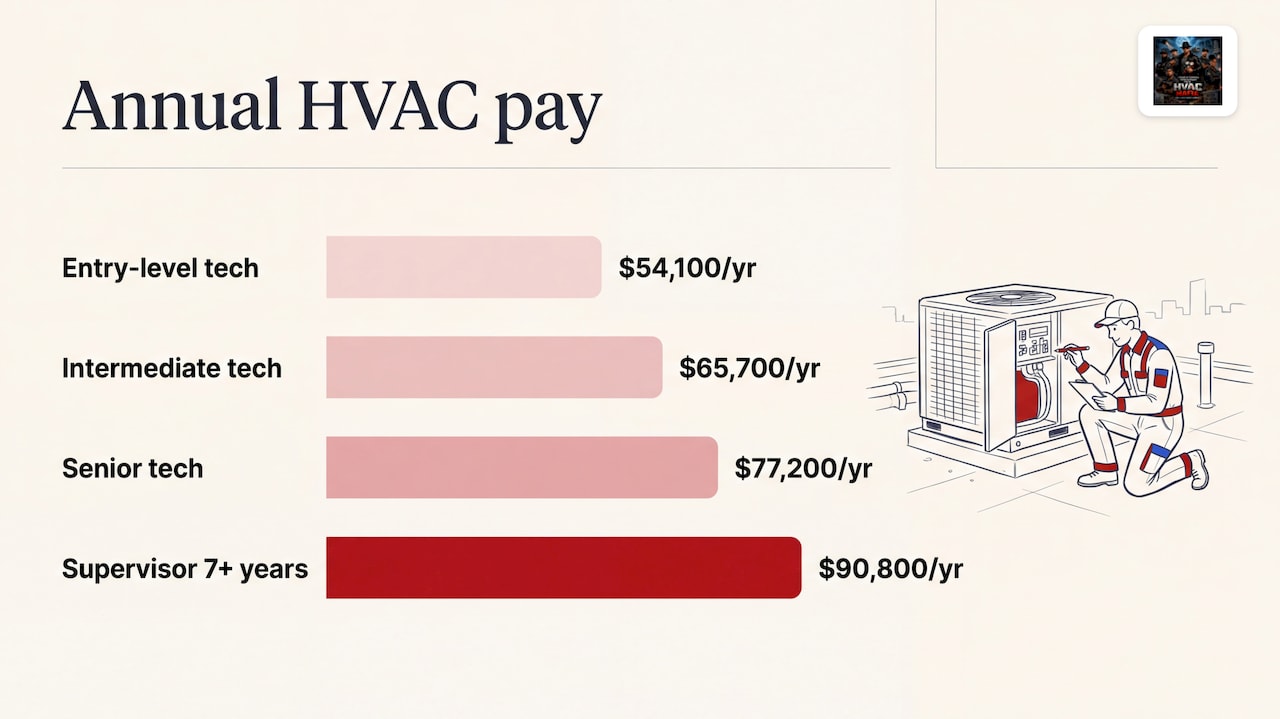
  • National 2025 pay runs from about $54,100 a year at entry level to a $90,800 median for supervisors.
  • Contractors who respond fast, show real pay and culture, and fix day-to-day frustrations keep techs longer.
  • Techs register free on HVAC Mafia to see openings from real contractors. Contractors post jobs to a trade-only audience.

Table of Contents

Why commercial HVAC is hiring so hard right now

Facilities Management Insights reports that the industry needs more than 41,000 new technicians every year while training programs produce about 26,000 graduates. Demand is growing from data centers, healthcare, building modernization and energy-efficiency work. All of those lean on commercial systems.

A bank’s contractor-trends report adds that roughly 42,500 HVAC-related positions have gone unfilled each year for more than a decade. And ACHR News describes even union contractors with strong backlogs as struggling to field enough technicians.

What does that mean for you?

  • If you’re a tech: you can be choosy. Pay, schedule, training and how the office treats you are all fair questions.
  • If you’re a contractor: the pipeline is the problem. The shortage is a mismatch between training output and demand, so waiting for experienced techs to find you is a slow plan.

What commercial HVAC work actually is

Residential techs mostly work in homes. Commercial techs work in office buildings, hospitals, schools, warehouses, restaurants and retail. That usually means larger rooftop units, chillers, boilers, building controls and, in many shops, refrigeration.

The HVAC Career Map describes two common entry points:

  • Commercial service technician: troubleshoots, diagnoses and repairs HVAC/R equipment in commercial buildings.
  • Commercial installer: installs HVAC equipment under a lead installer or supervisor.

The same resource sorts jobs by skill level. Entry level asks for a high school diploma or equivalent and no HVAC/R experience. Mid level asks for 1 to 4 years of experience, with post-secondary training preferred. Advanced roles call for 5 or more years, journey-level training or a bachelor’s level education.

That’s good news if you’re starting out. Plenty of shops hire for attitude and train the rest.

How to get into commercial HVAC

There isn’t one door. There are three common ones.

1. Trade school or community college

The Bureau of Labor Statistics says HVAC technicians typically need a postsecondary nondegree award, with programs running about 6 months to 2 years, followed by lengthy on-the-job training. Classroom time plus hands-on labs gets you to the first day with some vocabulary and a feel for the tools.

If you’re weighing timelines, our breakdown of how long it takes to get HVAC certified walks through what to expect.

2. Apprenticeship

Some people skip the classroom-first route. BLS notes that some techs train through multi-year apprenticeships instead. The HVAC Career Map describes an apprentice as someone in a full-time paid position with on-the-job training from experienced journey-level technicians and structured apprenticeship classes. You earn while you learn, and that matters if you can’t afford to go without a paycheck.

3. Start as a helper or installer

Many techs begin by assisting. BLS says new hires commonly start with basic tasks next to experienced technicians, such as insulating refrigerant lines or cleaning furnaces, before moving on to harder work like cutting and soldering pipe. Installer roles are a common way into commercial because the shop can teach its own methods from day one.

Credentials to plan for

Whichever door you take, expect to need EPA certification to handle refrigerants, and in many states a license. Requirements vary by state, so check with your state licensing board before you apply. The earlier you get your EPA card, the more jobs you can apply for.

What commercial HVAC techs earn

Pay depends on role, region and experience. ACHR News published national 2025 figures that give a useful baseline:

Level Annual pay Hourly
Entry-level tech $54,100 $26.01
Intermediate tech $65,700 $31.59
Senior tech $77,200 $37.12
Supervisor (7+ years), median $90,800 $43.65

Source: ACHR News, 2025 national pay figures.

Those are national numbers. Your city, union status, on-call rules, overtime and bonuses will move them. When you read a posting, look for the hourly range, not just the headline. Listings on our board often show it, like this lead installer role in Westchester, NY that lists $35 to $55 an hour.

The lesson is the same everywhere: the move from entry to senior is worth roughly $23,000 a year at the national level. Training, certifications and a few good years under a strong lead tech are how you get there.

What commercial HVAC techs earn

Career paths: where commercial work can take you

Commercial isn’t a dead end. It’s a ladder with a lot of rungs.

  • Apprentice or helper to journey-level technician.
  • Senior technician or lead installer, running a truck or a crew.
  • Commercial service manager, who the HVAC Career Map describes as supervising HVAC field and office personnel to ensure quality service.
  • Beyond that, project management, estimating, sales and ownership.

The best employers show you the next rung before you ask. In an interview, ask what the path from tech to lead looks like at that company, and who got promoted last year.

How to get hired as a commercial HVAC tech

Write a resume that sounds like the trade. Hiring managers want equipment types, certifications, systems you’ve worked on and results. Our guide on what to include in an HVAC technician resume covers the layout.

Search where the real employers are. On HVAC Mafia, basic membership is free for technicians, and job openings are visible to members only. You’ll see roles from actual contractors, such as a service technician role in West Palm Beach, FL, a lead installer role in New Cumberland, PA or an install lead position in Sharonville, OH.

Ask the questions that tell you who’s good.

  • What does a normal week look like, on-call included?
  • How are techs trained on new equipment?
  • Who do I call when I’m stuck on a job?
  • What’s the plan for the tech who wants to move up?
  • What does the office do when parts aren’t on the truck?

That last one matters more than people think, as the next section shows.

Why contractors struggle to hire and keep techs

Hiring is only half the cost. ServiceTrade estimates that replacing a skilled technician can cost 50 to 200% of that tech’s annual salary.

Its survey of 800+ technicians also points to what drives techs crazy day to day. For mechanical techs, the top productivity obstacles include miscommunication with the office (45%) and poor scheduling or last-minute changes (44%), plus not having the right parts (40%) and missing work order information (32%).

Read that list again. None of it is about a pay raise. Dispatch, scheduling and information are things a shop can fix this month, and techs notice when they get fixed. They also talk, in forums, on job sites and over lunch.

A commercial hiring process that works

The contractors we hear from who hire well do a few things consistently.

Write the job like you’d want to read it

Post the pay range, the schedule, the equipment, the on-call rules and the training. ACCA’s webinar recap lists updating the job description as the first step in an 11-step hiring process that also covers posting on multiple job boards, structured screening, interviews, reference checks, written offers and background and drug screening.

Post where techs are

ServiceTrade’s hiring guide recommends HVAC-focused job boards, employee referrals and networking. A trade-only board keeps your listing in front of people who can actually do the work.

Respond fast

The ACCA recap suggests reaching out to candidates within 24 to 48 hours and keeping in touch through the process. A good tech with three offers won’t wait a week for your call.

Show your culture and benefits

The same recap stresses employer branding: your values, specific benefits and real career advancement. Say what you offer and prove it with details.

Interview for skills and fit

ServiceTrade recommends probing interview questions to judge both skills and cultural fit. Ask a candidate to walk you through the last no-cool call they solved on a rooftop unit. You’ll learn more in five minutes than from a list of job titles.

Keep them

The same guide points to competitive pay, training and development, regular feedback and recognition for high performers as the core of retention. Then fix the office-to-field friction above. For a deeper look, read our guide on HVAC technician recruitment.

Our perspective: build a career, not just another paycheck

We built HVAC Mafia because we’ve seen both sides of this trade. Our founder has 36 years in HVAC and used to own a dealership. He’s hired techs, lost techs, and been the tech on the roof in August.

Here’s what we believe. Most hiring problems are trust problems. Techs don’t trust job ads that hide the pay. Contractors don’t trust job sites that send them résumés from people who’ve never held a gauge set. So we built something different: a board and community for verified HVAC trade professionals, without homeowner or outsider noise.

For techs, that means free membership, openings from real contractors, straight talk on pay and career paths, Tech Talk forums and the HVAC Underground Podcast. For contractors, it means your listing reaches a trade-only audience of nearly 100,000 HVAC followers, and applications go straight into your own hiring system. Company Spotlight profiles let you show your culture, pay and benefits to techs who have choices.

The shortage isn’t going away this year. The shops that win will be the ones that treat techs with respect, grow them, and say so out loud. That’s what we’re here to help with. No corporate fluff. No shortcuts. Just knowledge, loyalty and respect.

the author

Ready to hire or get hired?

Techs: join HVAC Mafia for free and see the openings that non-members can’t. Use the ones that fit your level, location and goals.

Contractors: our job posting plans are priced per position: Standard is $199 per month per position, Annual is $149 per month per position, and Enterprise starts from $99 per month per position. If you want to stand out, a Company Spotlight profile is $149 per month or $1,699 per year.

HVAC Trucker Hat — Structured Mesh-Back Cap | HVAC Mafia

Need a short push on a hard-to-fill role? Spotlight placements run $149 for 1 week per position, $499 for 4 weeks per position, or $349 per month per position on the ongoing plan. Details are on the Spotlight pricing page.

FAQ

How do I get into commercial HVAC work?

Start with a trade program of about 6 months to 2 years, an apprenticeship, or an entry-level helper or installer role. Entry-level jobs often ask only for a high school diploma or equivalent. Plan on EPA certification for refrigerants and check your state’s licensing rules.

Is commercial HVAC in demand?

Yes. Industry reporting says the field needs more than 41,000 new technicians a year while programs graduate about 26,000. Data centers, healthcare and energy-efficiency work are adding demand.

What is the highest paying job in HVAC?

In the national 2025 figures we cited, supervisors with seven or more years of experience had the top median pay, at $90,800 a year. Pay climbs with experience, certifications and responsibility, and it varies by region and employer. Moving from lead tech into service management or sales is a common route to higher earnings.

Can you make $200K as an HVAC technician?

We haven’t found a reliable national figure showing that for technicians, and the national medians run well below it. The path to higher income usually runs through leadership, management, sales or owning a business. Look at the pay range in the listing and ask how bonuses and overtime work.

How fast should contractors respond to applicants?

ACCA’s guidance suggests reaching out within 24 to 48 hours. Strong techs often have several options, so quick, clear communication helps you stay in the running.

Sources

HVAC Salary in Texas: What Techs Really Make in 2026

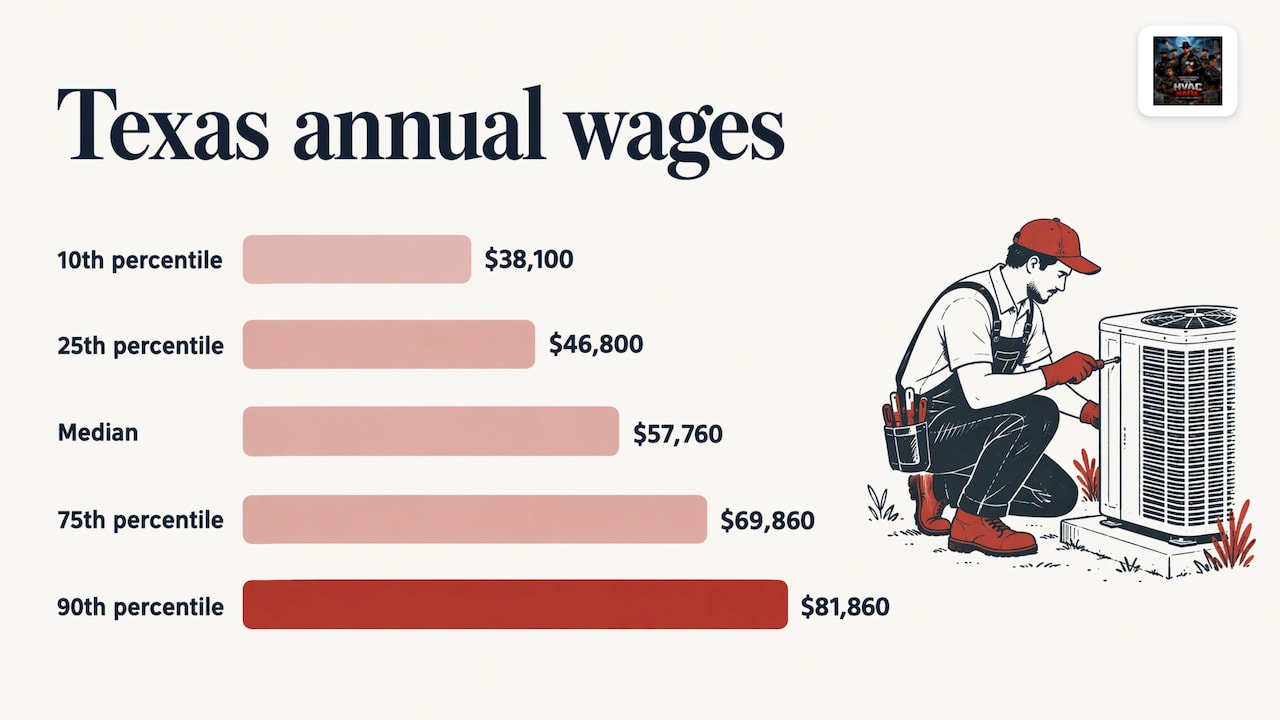
The median HVAC technician in Texas makes $57,760 a year, or $27.77 an hour, based on May 2025 federal wage data. The bottom 10 percent earn about $38,100, and the top 10 percent earn about $81,860 or more. Where you land in that range depends on your experience, your city, your specialty and how your shop pays.

That’s the base-pay picture. Overtime, commission and benefits sit on top of it, and in Texas summers they matter a lot. Let’s walk through the numbers the way we’d explain them to a tech at the shop.

Thehvacmafia
thehvacmafia.com
Find HVAC Jobs That Match Your Worth
Compare real HVAC openings and get straight talk on pay, career paths, certifications, and what makes an employer worth working for.

Explore HVAC job opportunities

TL;DR

  • Texas median for HVAC mechanics and installers: $57,760 a year ($27.77 an hour). The national median is $61,010.
  • The middle half of Texas techs earn between $46,800 and $69,860. The top 10 percent earn $81,860 or more.
  • Austin, Dallas-Fort Worth and Houston pay the most. El Paso pays the least of the metros tracked.
  • Commercial, controls and sales roles, plus licenses and certifications, are the clearest paths to a bigger paycheck.
  • Overtime, commission and benefits aren’t in the base-wage figures, so compare the whole offer, not just the hourly rate.

Table of Contents

What HVAC techs make in Texas: the wage data

The most reliable numbers come from the Bureau of Labor Statistics survey, which O*NET republishes by state. For Texas heating, air conditioning and refrigeration mechanics and installers, the May 2025 wage breakdown looks like this:

Percentile Hourly Annual
10th $18.32 $38,100
25th $22.50 $46,800
Median $27.77 $57,760
75th $33.59 $69,860
90th $39.36 $81,860

Read it this way. One in ten Texas techs is at or near the bottom of that table, usually new to the trade. Half make more than $57,760. One in ten clears $81,860. The spread between the bottom and top is more than $43,000, and almost all of it is explained by what you know, what you’re licensed for and who you work for.

The trade is also big in this state. One compiled breakdown of the same federal data counts 34,730 HVAC technicians employed in Texas. That’s a lot of shops competing for people who can run a call and run it right.

What HVAC techs make in Texas: the wage data

Texas vs. the national average

Texas pays a little under the national figure. The BLS Occupational Outlook Handbook puts the national median at $61,010 a year, or $29.33 an hour, with the top 10 percent above $95,210. So the Texas median sits about $3,250 under the national median.

Don’t read that as a knock on Texas. Two things to keep in mind:

  • Texas has no state income tax, so a gross dollar here goes further in your pocket than the same dollar in many states.
  • The same BLS page projects 11 percent job growth from 2025 to 2035, much faster than average. Demand is the best leverage a tech has when negotiating.

The mean (average) wage in Texas is a bit higher than the median. One 2026 guide reports a Texas mean of $59,130 against a national mean of $64,780, from the same May 2025 data. When you see different “average” figures across salary sites, that’s usually why: some report the median, some the mean, and some mix in self-reported or posted wages.

Pay by experience level

Experience is where most of the movement happens. Using the federal percentiles, one wage breakdown maps career stages roughly like this:

  • Apprentice and entry level: $18.32 to $22.50 an hour, or $38,100 to $46,800 a year.
  • Journeyman: $22.50 to $33.59 an hour, or $46,800 to $69,860 a year.
  • Master, foreman or specialist: $33.59 to $39.36 an hour, or $69,860 to $81,860 a year, and above for the best.

Those are percentile bands, not job-title guarantees. Still, they match what we see in the trade: the first two years are about learning fast, and the jump comes when you can run calls on your own.

A look at how the State of Texas pays its own techs

The Texas State Auditor’s Office publishes pay ranges for state-employed HVAC mechanics, and it’s a clean example of how responsibility drives pay. Its job description for HVAC Mechanic lists four levels:

Level Salary range
HVAC Mechanic I $40,918 to $61,130
HVAC Mechanic II $45,521 to $71,055
HVAC Mechanic III $51,158 to $81,351
HVAC Mechanic IV $57,614 to $93,138

The levels are based on independence, complexity of work, scope of responsibility, and related experience, education and certifications. Level I works under close supervision. Level II can handle the full range of work independently and help others. Level III coordinates installation, repairs and overhauls with limited supervision. Level IV plans and oversees system replacement and renovation projects with minimal supervision.

That’s a good map for any tech. The more you can run without someone looking over your shoulder, the more you’re worth to the next employer.

Rough pay by years in the trade

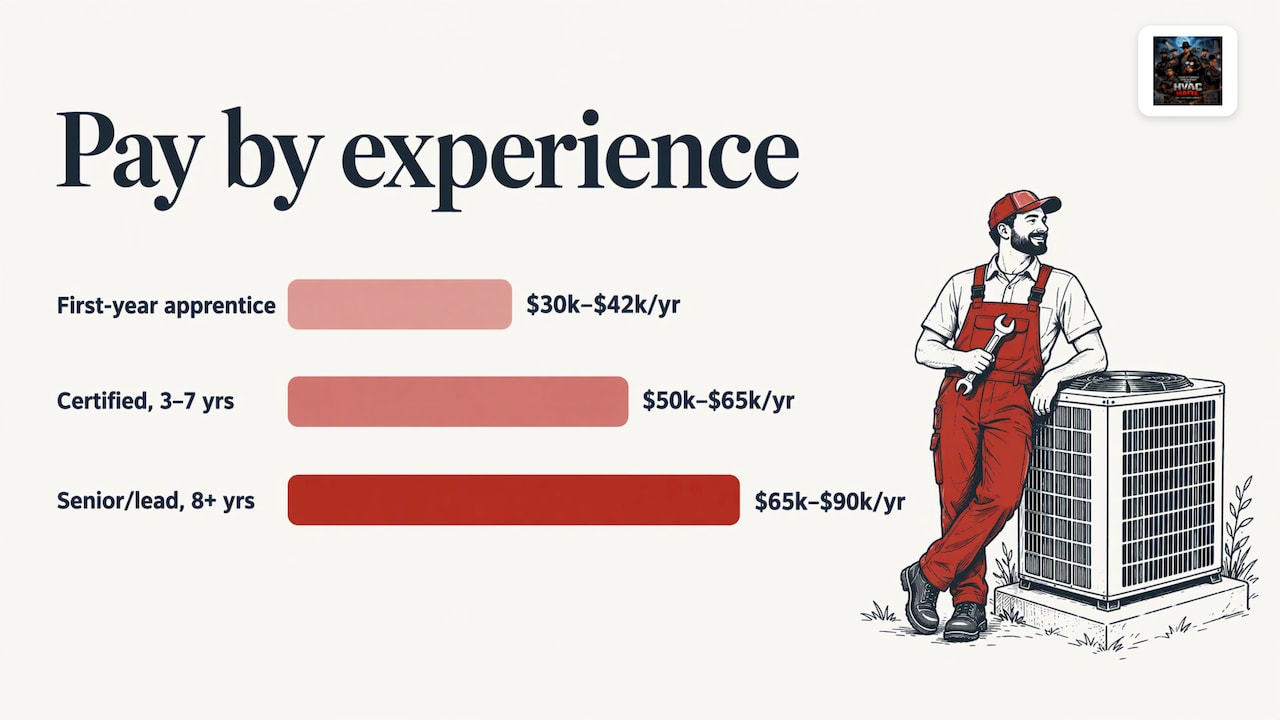
One Texas-focused 2026 guide breaks it down by years on the job: apprentices in their first year around $30,000 to $42,000, mid-career certified techs with 3 to 7 years around $50,000 to $65,000, and senior or lead techs with 8 or more years around $65,000 to $90,000. Treat those as ballpark ranges from one publisher, not a rate card. The federal percentiles above are the anchor.

Estimated Texas HVAC pay ranges by experience

Where in Texas pays the most

Location shifts the number, but less than people expect inside Texas. CareerOneStop’s Texas metro table shows these medians:

Metro area Median hourly Median annual
Austin-Round Rock-San Marcos $29.24 $60,820
Dallas-Fort Worth-Arlington $28.63 $59,560
Houston-Pasadena-The Woodlands $28.34 $58,940
El Paso $22.73 $47,270

The three big metros are within about $1,900 of each other, so don’t move across the state for a few cents an hour. El Paso is the outlier at the low end. Costs of living differ too, so a lower wage in a smaller market can stretch further than the table suggests.

If you’re in the Houston area and want to see what real contractors are advertising, here’s an HVAC service technician opening in Houston and another in Spring, TX. Reading actual postings beats guessing.

What pushes a Texas HVAC paycheck higher

Base wage is only part of it. Here’s what moves the needle.

Specialty

Residential service is the baseline for most techs. One 2026 Texas guide estimates commercial HVAC at roughly 15 to 25 percent above residential, controls and building automation at 40 to 60 percent above, and data center cooling at 30 to 50 percent above. Those are estimates from a single publisher, but they point the same direction as what we hear from techs: the harder it is to replace you, the more you earn.

Commercial and refrigeration techs have a clear lane here. Skills in chillers, rooftop units, VRF and controls open doors that residential-only experience doesn’t.

Licenses and certifications

In Texas, the state licenses air conditioning and refrigeration work through the Texas Department of Licensing and Regulation. To get a contractor license, you generally need at least 48 months of practical experience under a licensed contractor, or 36 months plus a year as a certified technician, with exceptions for relevant degrees, diplomas and military training. Licenses are valid for one year and renewed.

The same Texas guide says NATE certification adds about $3 to $6 an hour and the Class A license opens commercial and industrial roles that pay 15 to 25 percent more. Whatever the exact premium at your shop, credentials give you something to point to at review time. If you’re still mapping out how to get there, our guide on how long it takes to get HVAC certified lays out the timeline.

Compensation structure

Hourly, salary, flat rate, commission: they all produce different paychecks from the same skills. Sales and comfort-advisor roles are commission-based, and one Texas guide puts the range at $60,000 to $120,000 or more, the highest individual ceiling in the trade, with the risk that comes with variable pay.

Employer

Two techs with the same résumé can differ by thousands depending on the shop. Culture, training, truck and tool support, and benefits all matter. Our breakdown of what techs should expect in HVAC employee benefits is worth reading before you compare offers.

Can you make $100,000 as an HVAC tech in Texas?

It’s possible, but not typical for base wages. The federal 90th percentile in Texas is $81,860, and that figure is straight-time pay. The federal wage survey excludes self-employed workers and owners of unincorporated businesses and leaves out overtime premiums, employer-paid benefits and some bonuses. So the survey understates what some people take home.

Here’s how techs and tradespeople get to six figures:

  1. Overtime in the cooling season. One Texas guide says mandatory overtime is common for service techs from May through September, averaging roughly $6,750 a year. Your numbers will depend on your shop.
  2. Commission and spiffs on replacement sales. Those are left out of base-wage models but can be a large share of real earnings for a strong selling tech.
  3. Moving into controls, commercial or data-center work. Specialties with fewer qualified people.
  4. Lead, install manager or service manager roles. Pay follows responsibility.
  5. Owning the business. Ownership isn’t in the wage survey, and the risk and workload are very different.

Honest answer: most techs reach $100,000 by stacking two or three of these, not by waiting for a raise.

How HVAC compares with other trades

People ask whether HVAC or plumbing pays more. On federal data they’re close, and the difference is at the top end. One 2026 comparison using the same BLS data puts HVAC’s national 90th percentile at 1.56 times the median, compared with 1.70 for plumbers and 1.72 for electricians. In plain words, HVAC starts strong and has a lower ceiling on pure wages, which is why specialty, sales and ownership matter so much in this trade.

How to read a Texas HVAC offer

Don’t stop at the hourly rate. Ask these questions before you say yes:

  • Is the pay hourly, flat rate, salary or a mix? What’s the guaranteed minimum?
  • How is overtime paid during summer, and is it expected?
  • Is there commission or a spiff on replacements, and who sets the pricing?
  • Is a company truck, phone, tools or uniform included?
  • What do health insurance, retirement match and PTO look like?
  • Does the company pay for training, exam fees and certifications?
  • What does the path from tech to lead to manager look like here?

A shop that answers those clearly usually treats its people well. A shop that dodges them is telling you something too. If you’re building your pitch, our guide to writing an HVAC technician resume helps you put licenses, certifications and equipment experience where a hiring manager looks first.

Our perspective

We’ve been in this trade a long time, and the founder of HVAC Mafia is a 36-year HVAC veteran and former dealership owner. Here’s what we know: salary pages tell you the middle of the road. They don’t tell you what a good shop pays, and they don’t tell you which shops are worth your years.

That’s why we built a place where techs can see openings from real contractors, talk straight about pay in the Tech Talk forums and listen to the HVAC Underground Podcast. Openings are visible to registered members, and joining is free for technicians. Contractors, meanwhile, reach a trade-only audience instead of the general public.

Our advice to a Texas tech: build a career, not just another paycheck. Get your licenses. Learn a second specialty. Ask about the whole package. And when a contractor shows you their culture, pay and benefits up front, pay attention. Those are the ones who plan to keep you.

the author

Find a Texas HVAC job that pays what you’re worth

HVAC Mafia is a job board and community built by the trade, for the trade. Techs, apprentices and trade school students register free to see openings from real contractors, plus pay talk, career advice and the podcast.

HVAC Travel Mug — 25 oz Stainless Steel | HVAC Mafia

Ready to compare real offers? Join HVAC Mafia for free and see what Texas contractors are hiring for. If you’re a contractor having trouble filling trucks, our guide on HVAC technician recruitment covers how to hire and keep techs, and you can see our job posting plans, which start with Standard at $199 per month per position.

FAQ

How much do HVAC techs make in Texas?

The median is $57,760 a year, or $27.77 an hour, according to May 2025 federal wage data. Most techs fall between about $46,800 and $69,860, and the top 10 percent earn $81,860 or more. Overtime and commission can add to those base figures.

Which Texas city pays HVAC techs the most?

Among the metros in CareerOneStop’s table, Austin-Round Rock-San Marcos leads at a median of $60,820 a year, followed by Dallas-Fort Worth-Arlington at $59,560 and Houston at $58,940. El Paso is the lowest at $47,270. The three big metros are close enough that employer and specialty usually matter more than the city.

Is Texas HVAC pay lower than the national average?

Slightly. The Texas median of $57,760 is about $3,250 below the national median of $61,010. Texas has no state income tax, and demand for techs is strong, so take-home and negotiating power can be better than the gap suggests.

Can an HVAC tech make six figures in Texas?

Yes, but it usually takes more than base wages. Techs get there through overtime in the cooling season, commission on replacement sales, commercial or controls specialties, lead and management roles, or owning a shop. Base-wage surveys don’t capture most of that.

How do I get a higher HVAC salary in Texas?

Get your Texas licenses and certifications, learn a higher-demand specialty like commercial or controls, and move toward working independently on complex jobs. Then compare the full package, including overtime, benefits and training, when you look at new employers.

Sources

HVAC Technician Shortage: The Real Numbers and What to Do

Yes, the HVAC technician shortage is real. Industry estimates put the gap at roughly 110,000 technicians nationwide, and federal data shows demand for the trade growing through 2035. If you run a shop, that means open trucks and slow hiring. If you turn wrenches, it means leverage. Below we break down the numbers, the causes, what an empty seat costs, and what both sides can do about it.

Thehvacmafia
Find Your Place in HVAC
Explore HVAC Mafia’s job board and trade community for job openings, straight talk on pay, and insights from fellow technicians.

Explore the HVAC community

TL;DR

  • Industry estimates put the U.S. gap near 110,000 HVAC technicians, with projections of up to 225,000 unfilled positions by 2027.
  • The Bureau of Labor Statistics projects 11 percent job growth from 2025 to 2035, about 40,600 openings a year.
  • Retirements, the heat pump shift, the HFC phaseout and data center construction are all pulling on the same limited pool of techs.
  • An empty service truck can cost a contractor thousands of dollars of potential revenue on a peak-season day, and replacing a journey-level tech runs $15,000 to $25,000.
  • Contractors who build their own pipeline and show what it is like to work for them win. Techs with real skills get to choose.

Table of Contents

How big is the HVAC technician shortage?

Two kinds of numbers float around, and they measure different things. Federal data tracks employment and annual openings. Industry estimates try to describe the broader gap between the technicians the market needs and the ones available. Both are useful. Neither tells the whole story alone.

Here is how the main figures line up.

Measure Figure Source
Estimated U.S. technician gap About 110,000, possibly 225,000 by 2027 Industry analysis
Technicians leaving the workforce each year About 25,000 (retirement and career changes) Industry analysis
Projected job growth, 2025 to 2035 11 percent, about 48,200 new jobs Bureau of Labor Statistics
Average annual openings About 40,600 Bureau of Labor Statistics
Energy efficiency employers that hired in 2025 and had trouble filling roles 74 percent U.S. Department of Energy

The BLS openings figure is worth a second look. Many of those 40,600 annual openings come from people who transfer to other occupations or leave the labor force, not just from new jobs being created. That is the churn every contractor feels: you hire, train, and sometimes lose people faster than you can replace them.

The Department of Energy’s 2026 U.S. Energy & Employment Report adds that, among energy efficiency employers who hired in 2025, 74 percent reported difficulty filling positions, and management roles were the hardest to fill. That detail matters for anyone thinking about the path from tech to lead to service manager. The shortage is not only at the entry level.

One more data point from the Skilled Trades Report: HVACR mechanics and installers land between the 73rd and 75th percentiles nationally on its Labor Shortage Index. In plain terms, the pressure is high, though it varies by occupation and by region. A shop in a fast-growing Sun Belt metro will feel it differently than one in a small town.

What is causing the shortage?

There is no single cause. ACHR News points to an aging workforce, the phaseout of HFCs, the move toward heat pumps, and attrition from retirements and new technology. We see the same pieces from the inside.

An aging workforce

A lot of experienced techs are close to the end of their careers, and the people who learned the trade in the field are taking that knowledge with them. Industry estimates put about 25,000 departures a year on retirement and career changes. Replacing them is not a matter of posting one job. A tech who can run a call alone, diagnose a tricky system and talk to a homeowner took years to build.

New equipment and new refrigerants

The HFC phaseout and the push toward heat pumps change what a tech has to know. That is good for people who keep learning. It also means the pool of technicians who are ready for the newest systems is smaller than the pool of people who can do a basic changeout. The Department of Energy has funded work on online curriculum for heat pump installation, design, service and maintenance, with a planned partnership with BPI on a future Heat Pump Certificate of Knowledge, which tells you where the trade is heading.

New demand from heat pumps and data centers

According to industry analysis, rapid growth in heat pump installations and the construction of energy-intensive AI data centers, which need advanced thermal management, are adding demand on top of an already tight supply. For a technician, that opens doors beyond residential service, such as commercial chillers and liquid cooling.

A pipeline that can’t keep up

The old growth model was simple: hire more techs. That model is straining because the sector cannot train and retain enough people at the speed demand requires. Which brings us to the cost.

What an open seat costs a contractor

If you own a shop or manage a service department, you already know the pain. Some contractors have technician positions open for six months or longer and cannot get to all of their customers.

The math is rough. TrueStep HR estimates that an unstaffed service truck can represent $2,000 to $7,800 in potential daily gross revenue during peak seasons. The same source puts the cost of replacing a journey-level technician at $15,000 to $25,000 in hiring and training expenses.

Those are estimates, and your numbers will differ by market and by trade mix. But run your own version. Take your average ticket, your average calls per truck, and the number of days a position has been open. Most owners are surprised.

The second cost is quieter: the techs you already have. When a crew is stretched to cover for a missing teammate, overtime climbs, ride-alongs for new hires get skipped, and good people start answering recruiter calls. Shortages feed themselves.

What an open seat costs a contractor

What the shortage means if you’re a technician

Here is the part nobody should hide from you: this market works in your favor.

Strong demand gives new entrants leverage for higher starting wages and employer-sponsored training, according to industry analysis. If you are already in the field, you can ask harder questions of employers. We would encourage you to.

  • What does a typical week look like? On-call rotation, overtime expectations, how calls are dispatched.
  • Is pay clear? Hourly versus flat rate, spiffs, how commissions are calculated.
  • Where does this lead? Is there a real path from service tech to lead tech to service manager, or is it just a title?
  • What training do they pay for? Certifications, manufacturer classes, heat pump and commercial work.
  • Do people stay? Ask how long the lead techs have been there.

A good employer will answer without flinching. A shop that gets defensive is telling you something.

If you are job hunting, your resume should show the things that make a contractor pick up the phone: system types, certifications, call volume, and any experience with newer equipment. Our guide on writing an HVAC technician resume walks through what to include.

And if you are curious what real openings look like, they are not all in one region. We have listings for roles like a service technician in Spring, TX, a service technician in Loveland, CO and an install lead technician in Sharonville, OH. Members see the full board for free.

What contractors can do about it

Waiting for the market to fix itself is not a plan. Here is what we see working for shops that keep their trucks staffed.

Build your own pipeline

Industry guidance from ACHR News recommends trade-school partnerships and advisory committees, plus apprenticeship programs and training initiatives. Getting in front of students before they graduate means you are the shop they already know. Registered apprenticeships are a major response: the Department of Energy’s report counts 112,000 new apprentices in U.S. construction in 2025, up 9 percent from 2024.

HVAC apprentice brazes copper under instructor supervision

Manufacturers are helping too. Carrier and the TechForce Foundation have launched scholarship, free training access and career path initiatives aimed at the technician pipeline. If you have a relationship with a manufacturer rep, ask what support is available for your apprentices.

Give people a roadmap

Retention is cheaper than recruiting. Industry veterans, including Keith Neff in ACHR News, have argued for treating staff as team members and laying out a clear career roadmap, from maintenance tech up to advanced service. Put the steps on paper. Say what each level pays and what it takes to get there.

Be findable where techs actually look

Posting on a general job site means competing with every retail and warehouse listing in the zip code. Our view, which we lay out in It’s Not a Labor Shortage. It’s a Connection Problem, is that many shops are not short of techs so much as short of ways to reach them. For the nuts and bolts, see our guide to HVAC technician recruitment.

Spell out pay, culture and benefits

Techs have choices, and they compare. Say what you pay. Say what your on-call looks like. Show your people. A vague posting reads like a vague employer.

Training and credentials that help

For anyone entering the trade or moving up, the useful credentials are the ones employers ask for and pay for. Heat pump skills are the clearest example of where the field is moving, thanks to the DOE-backed curriculum mentioned above. Beyond that, think in terms of:

  • Trade school or an apprenticeship to start, ideally with an employer who pays for training.
  • Certifications that match the work you want: residential service, commercial, or refrigeration.
  • Ongoing manufacturer training on the equipment lines your shop installs.

Check pay and program details on official sources and with the employers you are talking to, because both vary by state and by company.

Perspective: We don’t think it’s a shortage of people. It’s a shortage of connection.

We started HVAC Mafia because a 36-year HVAC veteran and former dealership owner kept watching the same story play out. Good contractors couldn’t find techs. Good techs couldn’t find contractors worth working for. Both sides were out there, scrolling past each other on sites built for everything except this trade.

The numbers say the shortage is real, and we’re not arguing with them. What we’ve seen on the ground is that how you hire matters as much as how many people exist. A trade-only audience, openings from real contractors, and honest talk about pay and culture change the conversation. Techs can see who is hiring and what the shop is like. Contractors can reach skilled people without the noise.

That is why job listings on our board are hidden from non-members and why membership is free for technicians. And it is why we built Company Spotlight profiles, so a shop can show its culture, pay and benefits to techs who have options. If you want to build a career, not just collect another paycheck, you belong in this community. If you want to keep good people, show them why they should stay.

the author

Reach the techs you’re missing

If you are a contractor with open positions, we built HVAC Mafia for you. Your job reaches a trade-only audience of nearly 100,000 HVAC followers, and applications go straight to your own hiring system. Our posting plans are priced per position: Standard is $199 per month, Annual is $149 per month, and Enterprise starts from $99 per month. See the details on our job posting plans.

HVAC Mafia  Beanie

Want to stand out to techs who are comparing offers? A Company Spotlight profile is $149 per month or $1,699 per year. And if you are a technician, join as a member to see the openings.

FAQ

How many HVAC technicians are we short?

Industry estimates put the gap at about 110,000 technicians, with projections reaching 225,000 by 2027. Federal data measures something different: the BLS projects about 48,200 net new jobs from 2025 to 2035 and an average of 40,600 openings a year. Treat the estimates as a signal of pressure, not an exact count.

Is the HVAC labor shortage going away?

Not soon. The BLS projects 11 percent growth from 2025 to 2035, and retirements, heat pump adoption and data center construction keep adding demand. The shops that do best are the ones building their own pipelines through trade schools and apprenticeships.

Is this a good time to start an HVAC career?

Demand is strong, which gives new entrants leverage for better starting wages and employer-sponsored training. Look for employers that pay for training and show a clear path from apprentice to lead tech. Ask about pay and advancement before you accept an offer.

How does the shortage affect customers?

Contractors with positions open for six months or longer can’t service every customer, which can mean longer waits. Some shops shift preventive and non-urgent work to slower months to keep capacity for emergency calls during peak periods.

What can a contractor do first?

Start by pricing your open seats using your own numbers. Then publish clear pay and career steps, partner with a local trade school, and post where techs look. Our recruitment guide covers the steps.

Sources

HVAC Service Manager Jobs: Pay, Path and How to Hire

HVAC service manager jobs pay roughly $62,000 to $122,000 in base salary across the U.S., and postings from larger employers run well above that. The role goes to techs who can lead people, run a schedule and understand the numbers. If you’re a tech, this guide shows how to get there. If you’re a contractor trying to fill the seat, it shows what candidates look at before they say yes.

Thehvacmafia
Find Your Next HVAC Career Move
Explore HVAC job openings and trade advice on pay, career paths, and what makes a contractor worth working for.

Explore HVAC Mafia

TL;DR

  • PayScale puts average HVAC service manager base pay at $88,672, with a $62,000 to $122,000 range. Individual postings go higher in big markets and at large employers.
  • Employers want field experience first, then leadership, dispatch software skills and a head for budgets and margins.
  • The usual path runs from apprentice to service tech, lead tech, then service manager. EPA 608 is required for refrigerant work, and NATE is a strong plus.
  • Contractors who show pay, bonus structure and culture up front get more and better applicants.
  • HVAC Mafia is free for techs. Contractors can post to a trade-only audience.

Table of Contents

What an HVAC service manager actually does

You run the service department. That means scheduling calls, assigning technicians, reviewing diagnostics, building estimates, handling customer complaints, watching billing and inventory, and keeping everyone safe. One training-school guide describes the job as part technical expert and part team coach, and that matches how most of us see it.

A typical week might include:

  • Reviewing tomorrow’s board and moving calls so the right tech lands on the right job
  • Riding along with a newer tech who keeps getting callbacks
  • Calling a customer whose system failed twice
  • Looking at gross margin, average ticket and booked-job numbers
  • Sitting in on hiring interviews

It’s a different job from the truck. You stop fixing one system at a time and start fixing the system that produces good work. Some techs love that. Some miss the field. Know which one you are before you chase the title.

Residential, commercial and refrigeration are not the same seat

A residential service manager lives in call volume, same-day demand and customer experience. A commercial service manager handles maintenance contracts, larger equipment, building owners and often a union or prevailing wage environment. Refrigeration adds food-safety stakes and after-hours emergencies. When you read a posting, check which one it is. The pay, the hours and the pressure differ.

Residential, commercial and refrigeration are not the same seat

What employers ask for

Postings vary, but a few requirements show up again and again.

  • Field experience. Most employers want years in the trade, not just a degree. You earn credibility by having done the work.
  • Leadership experience. Lead tech, crew lead or trainer time counts.
  • Technology. Employers expect you to be comfortable with dispatch and field service software. One commercial service manager role at Carrier notes that coursework in accounting, business administration or construction management can open doors to corporate roles.
  • Business sense. Margins, labor costs, pricing and forecasting.
  • Certifications. Federal rules require technicians who work on equipment that could release refrigerant to be certified, and the EPA’s Section 608 page spells out the requirements. Many employers also like NATE. The Department of Energy says contractors prefer NATE-certified technicians because they tend to stay in the industry longer and have proven knowledge.

State and local rules matter too. There is no national HVAC license, so licensing requirements vary by region, and technicians moving across state lines may need to retest, according to ACHR News. If you’re eyeing a manager job in another state, check that state’s licensing board first.

What HVAC service managers earn

Pay is the first question every tech asks, so let’s put real numbers on the table.

What HVAC service managers earn

PayScale’s U.S. data reports an average base salary of $88,672 in 2026, with a base range of $62,000 to $122,000. The median sits near $89,000 and the 90th percentile is $122,000. PayScale also reports average total compensation of $68,897 at one to four years of experience and $74,919 at five to nine years.

Those are survey averages. Live postings often look different, especially at larger employers and in expensive metros:

Employer posting Location Published pay
Carrier, commercial HVAC service manager Lenexa, Kansas $79,000 to $158,000 a year
Helios Service Partners, commercial HVACR service manager Posted for 2026 $95,000 to $105,000 base
Bellbros, HVAC service manager Hayward, California $110,000 to $145,000

Two things stand out. First, the ranges are wide. Carrier says skills, education, experience and other qualifications decide where in the range you land. Helios says pay depends on labor market location, job-related knowledge, skills and experience. Second, the posting with the clearest numbers also lists benefits: the Bellbros listing mentions performance-based bonuses, medical, dental and vision insurance, a 401(k) match, paid time off and professional development.

That last part is how you should read any offer. Base salary is one line. Ask about:

  1. Bonus formula. What is it tied to: gross margin, customer satisfaction, technician retention? Is it paid monthly, quarterly or yearly?
  2. Benefits. Health coverage, retirement match, PTO.
  3. Vehicle and phone. A company truck is real money.
  4. On-call expectations. Who covers nights and weekends, and is there extra pay?
  5. Headcount and budget authority. Can you hire, fire and set pay for your techs?

If an employer won’t talk about these, that tells you something about the culture.

How to get from the truck to the manager’s desk

There’s no single route, but the steps are familiar. Most managers come up as an apprentice, then a journeyman or service technician, then a lead technician, and then step into the manager role. Here’s how to speed it up without skipping the parts that matter.

Get the credentials that open doors

Get your EPA 608 certification if you haven’t. Add NATE certification to show proven technical knowledge. Then look at business coursework, such as accounting basics, management or project management. You don’t need a degree for every job, but the Carrier posting above shows that business coursework helps for corporate roles.

Act like a lead before you have the title

Ask to train new hires. Offer to review callbacks and find patterns. Learn the dispatch and field service software, not just the mobile app but the reports behind it. Ask your current manager to walk you through the weekly numbers. Managers promote people who already make their jobs easier.

Tell your boss what you want

This sounds obvious. Many techs skip it. Training-school career guidance suggests asking supervisors about internal leadership opportunities and also searching general job boards and checking whether local cities and towns hire managers to service their buildings. Facilities and public-sector roles are easy to overlook.

Update your resume for a management role

A tech resume lists tools and certifications. A manager resume shows outcomes: callbacks reduced, techs trained, revenue per truck, retention. Our guide on writing an HVAC technician resume covers the basics, and you can add leadership results on top.

How to find and judge openings near you

Start where the jobs are, then filter hard.

  • Trade-focused boards. Register free with HVAC Mafia to see openings from real contractors. They’re hidden from non-members, which keeps the noise down.
  • Your own network. Ask the lead tech, the supply house counter person and the manufacturer rep who’s hiring. Good manager jobs often fill by word of mouth.
  • Big-employer career pages. National and regional service companies post manager roles with pay ranges.
  • Local employers. Facilities departments, schools and hospitals need service leadership too.

For a look at what a clear posting looks like, see this HVAC service manager role in Hayward, CA. Then run every opening through the same questions:

  • Is the pay range published?
  • Is the bonus formula explained?
  • How many techs report to you, and what’s turnover been?
  • What’s the call volume and the split between maintenance and replacement?
  • Who will you report to, and how long have they been there?
  • Why is the seat open?

A seat that has opened three times in two years is information.

Why service manager roles are hard to fill

Contractors tell us the same thing every week: finding a good service manager is harder than finding a good tech. The pool is small. The best candidates are usually working for someone and have no reason to scroll a general job site. Many postings sit unanswered because they read like a template.

The broader technician shortage makes it worse. A manager is judged by whether techs stay and perform. Federal energy research points the same direction: a DOE-funded heat pump training project worked to address labor shortages and upskill HVAC workers in newer technologies, and it found that incentives are useful for getting employees engaged in that training. If incentives work for training, they work for growth paths too.

How contractors can recruit and keep service managers

If you own the shop or run operations, here’s what actually moves candidates.

Promote from within, and say so

Your best manager candidate may already be your lead tech. Build a visible path: lead tech, assistant manager, manager. Pay for the business training. Say the path out loud at hire, not at the exit interview.

Publish the pay

A range with a bonus formula beats “competitive compensation” every time. Candidates compare postings side by side, and the ones with numbers get the call. Be specific about what drives the bonus, for example margin, customer satisfaction or retention, and be honest about how it’s measured.

Show your culture before the interview

Techs and managers with options want to know how you treat people. Tell them about training, truck and tool policy, how you handle callbacks, and how often your people leave. A company profile that shows real culture does more than a polished careers page.

Post where the trade looks

General boards bring volume. A trade-only audience brings fit. On HVAC Mafia, contractors reach nearly 100,000 HVAC followers, and applications go straight to your own hiring system.

Retain the manager you hire

Give them authority over scheduling, hiring input and tech development. Set clear targets. Check in weekly in the first 90 days. Most managers who leave say they didn’t have the support or authority to do the job.

Our perspective

I spent 36 years in this trade, and part of that as a dealership owner. I’ve hired service managers who were great and some who weren’t, and the difference was almost never technical skill.

The ones who lasted understood people. They coached before they corrected, and they knew the numbers without making techs feel like numbers. The shops that kept them gave them real authority and paid them fairly, in writing.

That’s why we built HVAC Mafia as a trade-only place. Job listings and community are for verified HVAC professionals, so contractors reach skilled people without homeowner or outsider noise, and techs get straight talk about pay, career paths and which employers are worth working for. We think the best way to fill a manager seat is to be honest about what it pays and what it asks, in front of people who know the work.

If you’re a tech, build a career, not just another paycheck. If you’re a contractor, show techs why your shop is worth joining. We’ll meet you in the middle.

the author

Reach service managers and techs who know the trade

If you’re hiring, post your opening on HVAC Mafia. Published plans are $199 per month per position (Standard), $149 per month per position (Annual) and from $99 per month per position (Enterprise). Want to stand out? Company Spotlight shows your pay, culture and benefits. It’s $149 per month or $1,699 per year.

Make HVAC Great Again™ Front  HVAC Mafia Back T-Shirt

Need extra visibility for one opening? Spotlight listings run $149 per week per position, $499 per four weeks per position, or $349 per month per position for ongoing. Techs and managers looking for work join free on the membership page.

FAQ

How much does an HVAC service manager make?

PayScale reports an average base salary of $88,672, with a $62,000 to $122,000 range. Live postings vary a lot by location and employer, and some large employers list ranges above $140,000. Bonuses and benefits can add meaningfully to the total.

Do I need a degree to become an HVAC service manager?

Not always. Employers weigh field experience, leadership and technology skills heavily. Business coursework in accounting, administration or construction management can help, especially for corporate roles.

Which certifications help?

EPA 608 is required for technicians who work on equipment that could release refrigerant, and the EPA explains the types on its certification page. NATE certification is a plus that many contractors prefer. Check your state or city for local licensing rules.

How long does it take to move into service management?

It depends on your starting point, the shop and how quickly you take on lead responsibilities. Techs who train others, learn the dispatch system and ask for leadership work tend to get noticed sooner. Tell your manager you want the job.

How do contractors find a good service manager?

Look inside your shop first, then post with the pay range and bonus formula where HVAC professionals actually look. Show your culture and growth path. A clear, honest posting in front of a trade-only audience beats a generic ad.

Sources

HVAC Employee Benefits: What Techs Should Expect in 2026

A good HVAC benefits package covers health insurance, a retirement plan with a match, paid time off, fair on-call pay and paid training. The best shops add year-round work and a clear path from apprentice to lead tech. Pay gets the attention, but benefits decide whether a job is a career or just a paycheck. This guide covers what employers offer, what the national numbers say, and how to compare two offers side by side.

Thehvacmafia
Find HVAC Jobs With Benefits
Explore HVAC Mafia for job openings and straight talk on pay, career paths, and spotting good and bad employers.

Explore HVAC opportunities

TL;DR

  • Most HVAC employers offer some mix of medical, dental, vision, a 401(k) and paid time off. The details vary a lot by shop size and job type.
  • Federal data shows about 9 in 10 installation, maintenance and repair workers have paid vacation and paid holidays, and 82% have paid sick leave.
  • Sign-on bonuses are rare. Paid training, schooling help and extra PTO are more common.
  • Ask about on-call pay, overtime rules, tool and vehicle policies, and the employer’s share of premiums before you accept.
  • Compare total compensation, not just the hourly rate.

Table of Contents

What benefits do HVAC technicians actually get?

There is no single standard package. Employers in the trade describe a common menu: health plans, HSAs and FSAs, dental and vision, 401(k) plans with an employer match, and supplemental coverage such as life, accident, critical illness and short- or long-term disability. Some shops offer all of it. Smaller shops may offer a few pieces.

Here is how the pieces break down.

Benefit What to expect What to ask
Medical Group plan, often with an employer share of the premium How much comes out of each paycheck for you and your family? What is the deductible?
Dental and vision Often offered as add-ons Is it included or extra?
Retirement 401(k), sometimes with a match What is the match, and when do you vest?
Paid time off Vacation, holidays, sick days When does it start accruing? Does it roll over?
Disability and life Often employer-paid or low-cost Is short-term disability covered from day one?
Training Paid classes, certifications, schooling help Who pays for EPA 608 and manufacturer training?
Work-life On-call pay, flexible schedules How often is the rotation, and how is it paid?

Health insurance

Under the Affordable Care Act, businesses with 50 or more full-time employees are required to offer health insurance. Smaller contractors are not bound by that rule, but many still reach coverage through group plans or trade association networks. So a 12-person shop can have a solid plan, and a bigger shop can have a thin one. Look at the plan, not the company size.

Retirement

Size matters more here. In March 2025, 86% of private-industry workers in establishments with 100 to 499 workers had access to retirement benefits, and 90% in establishments with 500 or more. If you work for a small shop, a retirement plan is worth asking about directly. If there is a match, treat it as part of your pay. Free money is still money.

The federal numbers are encouraging. According to the Bureau of Labor Statistics, as of March 2025, 90% of private-industry workers in installation, maintenance and repair occupations had access to paid vacation, 93% to paid holidays and 82% to paid sick leave. Access is not the same as generous. Ask how many days you get in year one, because that is where shops differ most.

Access rates for vacation, holidays and sick leave

Perks that matter in this trade

Generic benefit lists miss what makes HVAC different. Our work follows the weather. That shapes the perks worth looking for.

On-call pay and overtime

Summer and winter peaks mean long days and after-hours calls. Some employers do pay for it: technicians may receive on-call pay. If a shop expects you to carry the phone for free, that is a red flag. Ask three things:

  1. Is there a flat on-call stipend, and how much?
  2. What is the pay rate once you are dispatched?
  3. How often are you on rotation?

Some contractors also build in relief. According to an ACCA industry study, flexible arrangements such as four 10-hour days, flex time or guaranteed stop times for overtime are options employers use. If work-life balance matters to you, ask what the shop does in July and January, not what it says in the job post.

This is the perk we would push every apprentice to chase. The same ACCA study found that 72% of contractors do not offer sign-on bonuses. Instead, employers lean on paid training, schooling benefits and added PTO. That is good news for you. A sign-on bonus is spent in a month. A certification or a manufacturer course raises your earning power for the rest of your career.

For apprentices and trade school students, ask:

  • Does the company pay for classes, books and exam fees?
  • Is time in class paid?
  • Is there a ride-along period with a senior tech?
  • What does the step from apprentice to service tech look like, and what does the raise look like?

Year-round work

Seasonal slowdowns can hit a paycheck. Shops that keep techs busy in the shoulder seasons, through maintenance agreements, commercial work or installs, give you steadier income. It is a benefit even though it never appears on a benefits sheet. Ask what techs do in the slow months.

Tools, truck and uniforms

In many shops a take-home vehicle, a tool allowance, uniforms and a phone are a real part of the package. They save you money every month. Ask what is provided, what you must buy, and who replaces broken tools.

How benefits change by employer and job type

Residential service. Expect commission or flat-rate pay structures at some shops, and strong seasonal swings. Benefits depend heavily on the shop’s size.

Commercial and refrigeration. These jobs often come with steadier hours, planned maintenance schedules and larger employers. Larger employers tend to have fuller retirement and insurance offerings, in line with the BLS size figures above.

Installers. Install crews can see heavy workloads in peak season. Ask about overtime rules and what happens in a slow week.

Union and prevailing-wage work. Some work is covered by union agreements, and some projects carry wage rules. For example, Department of Energy projects funded under the Bipartisan Infrastructure Law and subject to Davis-Bacon have project wage determinations that contractors must meet. If a job posting mentions prevailing wage, ask how the fringe benefit portion is paid, whether as cash or into a plan.

How benefits change by employer and job type

What the pay picture looks like

Benefits sit on top of a base wage, so know the baseline. The Bureau of Labor Statistics reports that heating, air conditioning and refrigeration mechanics and installers had a median pay of $61,010 per year in May 2025, with the top 10% earning more than $95,210. The same page projects 11% job growth from 2025 to 2035, much faster than average. Demand is on your side. That means you have room to ask questions and compare.

How to compare two offers

Here is a simple way to avoid being dazzled by a big hourly number.

  1. Get the package in writing. Ask for the benefits summary, not a verbal rundown.
  2. Price the health plan. Add your monthly premium and the deductible. A $2 raise can vanish into a bigger premium.
  3. Count the match. If one shop matches your 401(k) contributions and the other has no plan, put a dollar figure on the difference.
  4. Count your days. Add vacation, holidays and sick time for year one.
  5. Value the extras. Take-home truck, tool allowance, paid training, on-call stipend. Even rough numbers help.
  6. Ask about waiting periods. Many benefits start after 30 or 90 days. Know the gap, and plan for it.
  7. Talk to a current tech. Ask how often the rotation really hits, and if the shop keeps its promises.

If you want a feel for what real employers put in postings, browse listings like this service technician role in Reno, this install lead position in Sharonville, OH or this service tech opening in Loveland, CO. Compare how each describes pay and perks, then ask for the rest.

When you are ready to apply, a sharp resume helps you negotiate from strength. Our guide on writing an HVAC technician resume walks through what to include.

For contractors: benefits are your hiring edge

If you run a shop and cannot find or keep techs, your benefits page is part of your recruiting pitch. Techs have choices. Industry commentary points to mental health and financial wellness programs as ways to build loyalty, on top of the basics.

You do not need to match a national company dollar for dollar. You need to be clear and honest. Spell out the 401(k) match, the on-call stipend, the training path and the schedule. Techs read vague postings as bad news. Our guide to HVAC technician recruitment covers how contractors hire and keep techs in more depth.

Our perspective

We have watched this trade for a long time, and the founder of HVAC Mafia is a 36-year HVAC veteran and former dealership owner. Here is what we keep seeing: the shops that keep good techs are not always the ones that pay the highest hourly rate. They are the ones that are straight about the whole package.

Techs deserve to know what a job really offers before they quit the one they have. That is why we built a place where openings come from real contractors, and where the talk is by techs, for techs. No corporate fluff. Just honest answers about pay, benefits and what makes an employer worth working for.

Contractors benefit too. When you show your culture, your pay and your benefits to a trade-only audience, you meet techs who care about exactly those things. Our Company Spotlight profiles are designed to give a shop room to show what it offers, so it stands out to techs who have options.

Build a career, not just another paycheck.

the author

Find a job with benefits that fit

If you are a tech, apprentice or student, join HVAC Mafia free. Members see job openings from real contractors, which are hidden from non-members. You also get straight talk on pay, career paths and spotting good and bad employers, plus the Tech Talk forums and the HVAC Underground Podcast.

HVAC Mafia  Beanie

Register for a free membership and start comparing real offers. If you are a contractor, our job posting plans put your openings, and your benefits, in front of a trade-only audience.

FAQ

Do HVAC technicians get health insurance?

Often, yes, but it depends on the employer. Businesses with 50 or more full-time employees must offer coverage under the ACA, and smaller shops may offer group plans too. Ask what share of the premium the company pays, since that changes your take-home pay.

Do HVAC techs get paid vacation and sick days?

Most do. BLS data from March 2025 shows 90% of private-industry installation, maintenance and repair workers had access to paid vacation, and 82% had paid sick leave. Ask how many days you earn in your first year and when they start.

Do HVAC employers pay a sign-on bonus?

Usually not. An ACCA study found 72% of contractors do not offer one. Many offer paid training, schooling benefits or more PTO instead, and those can be worth more over time.

Is on-call work paid in HVAC?

It can be. Some employers pay technicians on-call pay, and some arrange schedules around it, such as four 10-hour days or guaranteed stop times. Get the stipend, dispatch rate and rotation in writing before you accept.

What should an apprentice look for in a benefits package?

Put paid training and a clear raise path first, then health coverage and time off. Ask whether the company pays for classes and exam fees and who will mentor you. A shop that invests in your skills is investing in your future with them.

Sources

HVAC Company Profiles: What to Include and How Techs Read Them

An HVAC company profile is the page where a contractor says who it is, what work it does, and what it is like to work there. A good one serves two readers at once. Homeowners and commercial customers want to know if they can trust you. Technicians want to know if they should quit their current shop and join yours. This guide covers both, with a focus on the second reader, because that is where most contractors are losing ground right now.

Thehvacmafia
thehvacmafia.com
Show Techs What Sets Your Shop Apart
HVAC Mafia Company Spotlight profiles put your shop’s culture, pay, and benefits in front of a trade-only audience.

Visit HVAC Mafia

TL;DR

  • A solid profile covers the basics (name, location, founding year, services, licenses, service area) and the human side (people, values, training, pay, schedule).
  • Technicians read profiles for proof: real photos, named training programs, clear career paths and honest talk about pay and on-call time.
  • Generic marketing language is the fastest way to lose a tech’s trust. Specific, checkable details win.
  • Hiring is hard across the industry, so a profile that answers a tech’s questions up front gives you an edge.
  • If you want a profile in front of a trade-only audience, we offer Company Spotlight profiles at HVAC Mafia.

Table of Contents

What an HVAC company profile actually is

People use the phrase for a few different things. A directory listing is a profile. So is the About Us page on your website, a one-page company overview for a bid package, or a spotlight on a job board. They share a job: to introduce a business quickly and credibly.

ACHR News describes the About Us page as the place to communicate the brand story, experience, certifications, awards and values. That is a fair baseline. The problem is that most profiles stop there, and most are written for customers only. If you are trying to hire, you need a second layer written for the person who will actually turn the wrenches.

The basics every profile needs

Start with the facts anyone would look for. A January 2026 profile guide lists the usual elements: company name, logo, location, founding year, history, mission, service areas, detailed services, licenses, certifications, awards and contact details. Business data providers track similar attributes, such as employee count, number of trucks, residential or commercial focus, and manufacturer relationships.

Here is a practical checklist:

  • Who you are: legal name, year founded, who owns it, how big the team is.
  • Where you work: cities, counties or states you serve, and whether you are residential, light commercial, commercial or refrigeration.
  • What you do: installs, service, maintenance agreements, new construction, controls. Name the equipment you work on.
  • Proof: license numbers where appropriate, NATE or other certifications, manufacturer programs, awards.
  • How to reach you: phone, email, address, and a clear way to apply for a job.

Keep it plain. If a stranger can’t tell in ten seconds what you do and where, rewrite it.

What technicians look for that customers don’t

A customer asks, “Will this company show up and fix my system?” A tech asks a different set of questions:

  • What will I make, and how does it grow?
  • Will I get real training, or a ride-along and a good luck?
  • How often am I on call?
  • Who will I work for? Is the owner involved, or is it a revolving door of managers?
  • Is there a path from apprentice to lead tech to service manager?
  • Does the company run like the profile says it does?

You don’t have to answer every one in a paragraph. You do have to answer them somewhere. The best profiles treat the tech as a customer, because that is what a hire is: a person choosing between offers.

Pay and benefits

Pay transparency matters in this trade. Techs talk to each other constantly, and they know what the going rate is. The Bureau of Labor Statistics reported a median annual wage of $61,010 for heating, air conditioning and refrigeration mechanics and installers in May 2025. That is a national median, and your market may sit well above or below it. Use it as context, then show where you land and why.

You don’t have to publish every salary band. But a range, a description of how raises work, and a list of benefits (health coverage, retirement match, tools, truck policy, paid time off) tells a tech you aren’t hiding anything. Job posts that show a range get noticed. Look at how one Nevada listing leads with its pay range for a service technician in Reno. That is the kind of clarity techs respond to.

Training and career path

Training is where profiles can be the most specific, and the most convincing. A few examples from ACHR News coverage of contractors recognized as good places to work:

Notice what these have in common: a named program, a concrete detail, a reason a tech would care. “We invest in our people” says nothing. “New hires spend their first 90 days with a mentor and a written skills checklist” says something, if it is true for you.

Training also connects to where the work is heading. The Department of Energy backs workforce efforts such as an initiative to train HVAC technicians in heat pump installation, design and maintenance. If you train on heat pumps or other newer equipment, say so.

Schedule and work-life balance

Burnout drives techs out of the trade and out of shops. One Washington contractor addressed it with a four 10-hour day schedule that limits on-call to about two days a month, according to ACHR News in 2012. You don’t need to copy that. You do need to say what your schedule is and how on-call works. Silence on the subject reads as bad news.

Showing culture without sounding like an ad

“Family-owned, customer-focused, committed to excellence.” Every tech has read that sentence a hundred times, and none believe it. A profile that shows culture has to be specific.

Research on web usability backs this up: Nielsen Norman Group reports that people expect About Us content to be clear, authentic and transparent, especially about purpose and values. Gallup adds that values become credible when leaders model them, stories are shared on an ongoing basis, and recognition and accountability reinforce them.

Translate that into your profile:

  1. Use real people. Real team photos, real trucks, real shop. An HVAC marketing firm recommends real photos of team members, technicians at work, vehicles and training over stock images. Show safety gear on, too. A photography guide for trades suggests wide and close-up shots of technicians doing representative work, with PPE visible.
  2. Tell the founding story honestly. Who started the company, why, and what changed over the years. Short and plain beats polished and vague. Testimonials that build real trust do the same thing for customers: they sound like actual people, not copy.
  3. Describe how you hire. One Washington contractor hires for character first and trains for technical performance once the candidate is a cultural fit. Another owner meets applicants personally before offering an introductory period. Details like that tell a candidate how they will be treated.
  4. Share ownership and structure. Arizona’s HACI Mechanical became employee-owned in August 2025, affecting 350 employees. If you have profit sharing, an ownership path or a promote-from-within record, that belongs in the profile.
  5. Let your techs talk. HVAC marketing specialists suggest voluntary, employee-led content, employee spotlights, work-anniversary recognition and team events, with customer permission and a simple approval process. Behind-the-scenes footage of technician prep, equipment organization and training works as well.

HVACR Business makes a related point: explain the people behind the work and what training and certifications mean for the customer, instead of just listing credentials. The same goes for techs. “NATE-certified” is a badge. “We pay for your NATE exams and a raise follows” is a reason to apply, if that is your policy.

Why the profile matters more in a tight labor market

Techs have choices. The Department of Energy’s 2026 U.S. Energy & Employment Report found that 70% or more of establishments in the Energy Efficiency sector reported difficulty finding workers in 2025, and that construction establishments in that sector reported a 78% hiring difficulty rate. When most employers are struggling to hire, a candidate who sees ten similar job posts will click through to the company that explains itself best.

Credentials help too. The DOE worked with Google so that contractors with Energy Skilled-recognized credentials can display a label on Google Business Profiles. The same announcement says more than 20,000 people have earned a credential from a recognized training program, and that states may use the recognition as a criterion for federal workforce funding. If your techs hold such credentials, say it in your profile.

How techs can read a profile like a pro

If you are a tech, apprentice or trade school student, here is how to size up a company from what it publishes:

  • Look for specifics. Named training programs, schedules, pay ranges and benefits beat slogans.
  • Check the photos. Are they real people in real shops and trucks, or stock images?
  • Find the career path. Does the profile mention apprenticeships, mentoring, lead tech or management tracks?
  • Notice what’s missing. No mention of pay, schedule or on-call may mean those aren’t selling points.
  • Ask for proof in the interview. Ask to meet the team you’d work with and ask how long the average tech has stayed.
  • Talk to other techs. Forums and podcasts are good for the straight story on how a shop treats its people.

When you find a shop you like, make your own side of the paper strong. Our guide on what to include in an HVAC technician resume walks through it. And when you browse openings, the listing itself tells you a lot. Compare a service technician opening in Spring, TX with an install lead role in Sharonville, OH and see which details each employer chose to share.

A simple template for your own profile

Use this outline and fill each part with specifics:

  1. Opening paragraph: who you are, where you work, and the kind of tech you want to hire.
  2. Our story: founding year, founder, how you grew.
  3. What we do: services, equipment, residential or commercial mix.
  4. How we treat techs: pay structure, benefits, schedule, on-call, tools and truck.
  5. How you grow here: training, certifications paid for, mentoring, promotion examples.
  6. Meet the team: photos and a line about each person, with their permission.
  7. How to apply: one clear link, one clear contact.

Keep every claim something a current employee would confirm. Techs will check.

Spotlight profiles at HVAC Mafia

Spotlight profiles at HVAC Mafia

If you want your profile in front of the people you are trying to hire, our Company Spotlight is built for that. It lets a shop show its culture, pay and benefits to a trade-only audience, so it stands out to techs who have options. HVAC Mafia was founded by a 36-year HVAC veteran and former dealership owner, and our listings and community are limited to verified HVAC trade professionals.

Company Spotlight is $149 per month on the monthly plan or $1,699 per year on the annual plan. If you’d rather promote a single opening, Spotlight pricing runs $149 per week per position, $499 per four weeks per position, or $349 per month per position for ongoing placement. Standard job posts are listed on our job posting plans page: $199 per month per position on Standard, $149 per month per position on Annual, and Enterprise from $99 per month per position.

Make HVAC Great Again™ Front  HVAC Mafia Back T-Shirt

Techs register free, and openings are visible to members. If you are a tech, join as a member and see who is hiring.

Perspective

We have spent decades in this trade, and we have seen both sides of the hiring table. Most contractors don’t have a hiring problem so much as a visibility problem. They run a good shop, pay fairly, and train their people, but the tech scrolling job listings never finds that out.

That is why we think a company profile is a recruiting tool first and a marketing piece second. A tech wants to know what you pay, how you train, who they’d work for and whether people stick around. If your profile answers that honestly, you won’t need big promises.

We built HVAC Mafia as a place where those answers can be shared with the people who care, and only those people: verified trade professionals, not homeowners or outsiders. Our Company Spotlight is designed to put your culture, pay and benefits in front of them. Build a career, not just another paycheck. That works for the tech and for the shop.

the author

FAQ

What should an HVAC contractor company profile include?

Start with the business name, location, founding year, services, service area, licenses and certifications. Then add the human side: your team, values, training, pay approach and how to apply. Real photos and honest detail matter more than polished slogans.

How do I showcase HVAC company culture?

Use specifics instead of adjectives. Show real team photos, describe how you hire and train, explain your schedule and on-call approach, and let your techs share their own stories. Anything you claim should be something a current employee would confirm.

Should I list pay in my company profile?

A range or a clear explanation of how pay and raises work builds trust with technicians, who compare offers constantly. For context, the BLS median for HVAC mechanics and installers was $61,010 in May 2025, but your local market may differ. Be clear about benefits, tools and truck policy too.

How can a technician judge an employer from its profile?

Look for named training programs, a described career path, real photos, clear schedule details and pay information. Missing details are a signal. Confirm what you read by asking to meet the team and by talking with other techs.

What is a Company Spotlight at HVAC Mafia?

It is a profile that shows a shop’s culture, pay and benefits to our trade-only audience of HVAC professionals. It is sold as a monthly plan at $149 per month or an annual plan at $1,699 per year. You can see the options on the Company Spotlight page.

Sources

Enable Notifications OK No thanks