
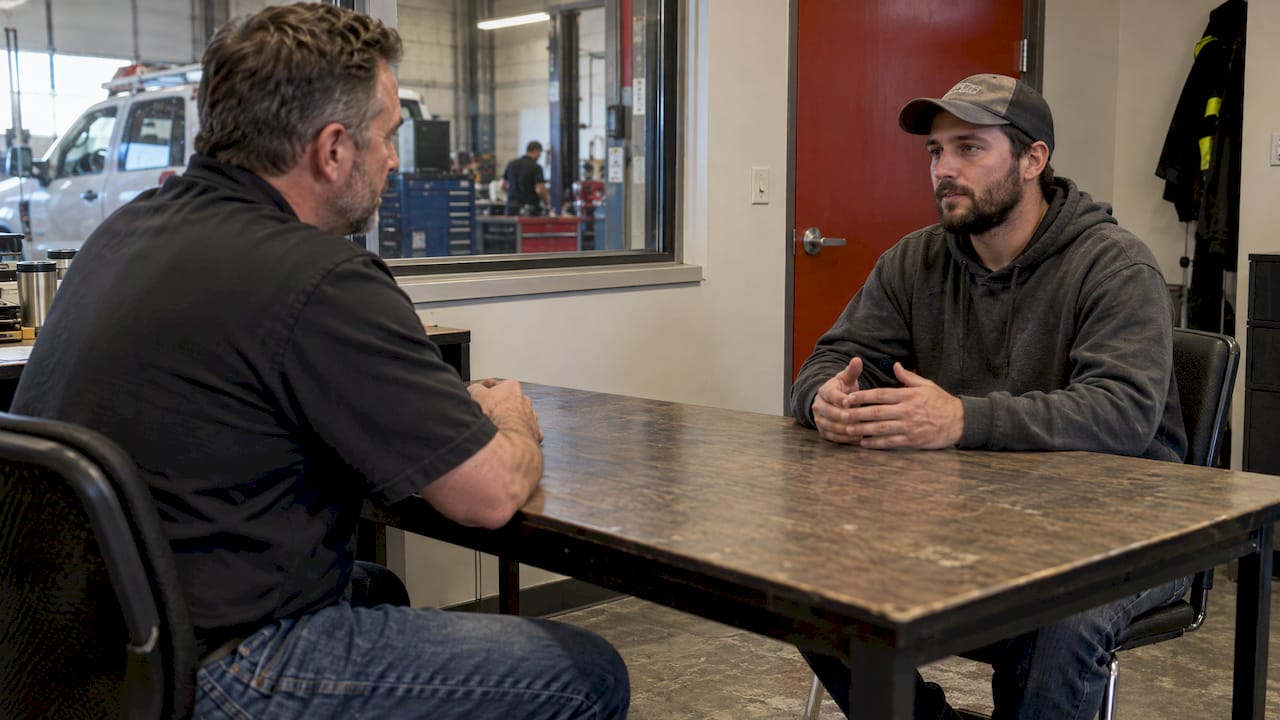
Expect four kinds of questions in an HVAC interview: technical, behavioral, situational and culture fit. FieldEdge sorts them the same way. The ones that decide the job are rarely trivia. They are the questions where you explain how you think: how you diagnose a no-cool call, how you stay safe, and how you talk to a customer who is hot, tired and worried about the bill. This guide covers the questions service techs, installers and apprentices actually face, and the answer shape that works for each.
I’ve spent 36 years in this trade, and I’ve sat on both sides of that table. The techs who got hired were not always the ones with the most certifications. They were the ones who could say why they did something.
TL;DR
- Interviews mix technical, behavioral, situational and culture-fit questions. Prepare a short story for each type.
- For any diagnostic question, answer in order: what you check first and why, what each result tells you, and what you do next.
- Safety answers need specifics: name the hazard, name the procedure, and say when you would stop the job.
- Installers should be ready for questions on brazing, line sets, airflow, load basics and the newer A2L refrigerants.
- Always ask your own questions about pay, training, truck, on-call and how the shop treats its techs.
Table of Contents
- How an HVAC interview is usually built
- The opening questions
- Technical questions you should be ready for
- How to answer any diagnostic question
- Safety, lockout and refrigerant handling
- Installer interview questions
- Behavioral and customer questions
- Questions you should ask them
- Commercial and specialty roles
- Find a shop worth interviewing with
- FAQ
- Sources
How an HVAC interview is usually built
Most shops run it in stages. A short phone screen checks your credentials and years of experience. Then comes a sit-down with a service manager or owner. Many shops add a hands-on piece, a scenario in the shop or the field, because talking and doing are different skills.
The questions fall into the four groups FieldEdge describes. Technical questions test your knowledge of systems, tools and safety. Behavioral questions start with ‘Tell me about a time when…’ and look for problem solving and teamwork. Situational questions drop you into a made-up job. Culture-fit questions ask whether you share the shop’s values and work ethic.
Know which one you are answering. A behavioral question wants a real story from your past. A situational question wants your plan. Mixing them up is the most common way good techs sound vague.
The opening questions
Tell me about yourself
This one sounds soft and it matters. Keep it under 90 seconds and cover three things: how you got into HVAC, the work you have done, and what you want now. Smart Service makes the point that the interviewer already has your resume, so the question is mostly about how you communicate.
A solid version for a mid-level service tech: ‘I started as a helper on residential installs, moved to service after three years, and now run my own calls on split systems and heat pumps. I like diagnostics and I like customers who are glad to see me. I’m looking for a shop that trains on newer equipment and has a path to lead tech.’
If you are just starting, say that plainly. Talk about trade school, the lab work you liked, and the reason you picked this trade. Our guide to the HVAC technician resume helps you line up the same story on paper.
Why HVAC, and why us?
They want a real reason, not a speech. Maybe you like fixing things, working with your hands, or the fact that no two calls are the same. For ‘why us,’ do your homework: know the service area, whether they do residential, commercial or both, and what techs say about working there. A shop’s company profile often tells you about culture, pay and benefits before you walk in.
Where do you see yourself in five years?
Pick a direction and be honest. Lead tech, install crew lead, commercial service, controls, service manager. If you want to grow into management, say so. Shops hiring for the long term like to hear it. If you are curious about that path, see what we wrote on HVAC service manager jobs.
Technical questions you should be ready for
You will not get every question below. You should be able to talk through all of them without freezing.
- What are BTU, CAV and AHU, and where do you run into each?
- What is heating or cooling load, and how is it calculated?
- How does heat move by conduction, convection and radiation?
- What is the difference between a heat pump, a furnace and a refrigeration system?
- Walk me through the refrigeration cycle.
- What refrigerants have you worked with, and what changed recently?
- How do you read a wiring diagram?
These topics line up with what the trade itself treats as core knowledge. NCCER’s assessment specifications describe a journey-level technician as someone who can install residential, commercial and industrial systems, use trade math, read mechanical drawings, solder and braze, troubleshoot heating, cooling and heat pump systems, and handle refrigerant leak detection, evacuation, recovery and charging. If you can speak to each of those from your own jobs, you are in good shape.
Refrigerants: the question that dates your knowledge
Refrigerant questions show whether you keep learning. The American Innovation and Manufacturing Act phased out R-410A for new equipment effective January 1, 2025. New residential and light commercial split systems and heat pumps use R-32 or R-454B. Both are A2L refrigerants with a lower global warming potential.
A strong answer goes past the names. Mention the practical side: A2L training, A2L-rated tools, spark-free brazing precautions and ventilation at the install site. If you have not worked on A2L equipment yet, say so, then say what you have done to get ready. That reads as honest and coachable.
The older questions still come up too. AANM’s sample questions ask about common refrigerants and their environmental impact, naming R-22, R-32, R-134a and R-410A, and note that R-22 is being phased out because of its high ozone depletion potential. Know the history as well as the current picture.
How to answer any diagnostic question
This is where interviews are won. The question might be ‘The AC is running but the house won’t cool. What do you do?’ or ‘A heat pump is short cycling. Walk me through it.’ The shape of a strong answer is the same every time:
- What you check first, and why that check.
- What each result tells you, so you are narrowing the problem rather than guessing.
- What you do about it.
Take the no-cool call. Smart Service lays out a simple-to-complex order: confirm thermostat settings, check the breaker, the indoor disconnect and the filter, verify a cooling call at Y, inspect the outdoor components, then check pressures and superheat or subcooling if the system runs but does not cool.
Now say it like a tech in the room: ‘I start at the thermostat because it’s the cheapest thing to rule out. If it’s calling for cooling, I check the breaker and disconnect, because no power means everything downstream is a distraction. Then the filter and airflow, since a restricted coil can look like a refrigerant problem. If the outdoor unit is running, I get on the gauges and look at superheat and subcooling, because they tell me whether I’m dealing with a charge issue or a metering issue.’
Notice what that answer does. Every step has a reason. The reason is the part many candidates skip, and it is the part the manager is listening for.
Don’t be the parts swapper
The highest-probability failure is often a capacitor. Saying ‘I’d change the capacitor’ first still sounds like guessing. Put it inside a sequence instead, after you have confirmed what the unit is doing.
Two more habits help. First, know the sequence of operation. A veteran contributor on ACCA’s HVAC blog says it is the best foundation for diagnosing a malfunctioning system. He also says that if you see immediate damage, like water coming through a ceiling, handle that emergency before you chase the root cause. Second, sort the problem early. ACHR News reported advice that most problems can be divided into mechanical or electrical, and knowing which helps you pick the right tools.
Safety, lockout and refrigerant handling
Safety questions are scored on specifics. ‘I always stay safe’ scores nothing. Name the hazard, name the procedure, and show that you would actually stop work.
Expect questions like these:
- Which EPA Section 608 certification do you hold?
- How do you recover refrigerant without venting it?
- How do you verify a circuit is dead?
- What PPE do you use, and for what jobs?
- Tell me about a time you stopped a job because it wasn’t safe.
- What do you do if you smell gas on a service call?
On lockout/tagout, say that you lock out, tag out and then confirm zero energy with your own meter. Do not trust the disconnect position alone. On gas, the answer is immediate: do not create an ignition source, so no switches and no phone use inside, get everyone out of the building, and leave the investigating to the gas company and the proper authorities.
For the ‘time you stopped a job’ question, use a real story. Maybe it was a roof edge with no tie-off, a panel you did not trust, or a customer pressuring you to skip a step. Say what you did, who you told and how it ended. Shops want techs who will halt a job, not just recite a procedure.
Installer interview questions
Installers get a different mix. Less theory about diagnostics, more about craft, speed and quality. Common questions include:
- What does a clean install look like to you, start to finish?
- How do you braze line sets, and what do you do to protect the system while you do it?
- How do you evacuate a system, and how do you know the job is done?
- How do you check airflow and ductwork on a replacement?
- What does a load calculation tell you, and why not just match the old unit’s size?
- How do you work with a crew, and what do you do when you find a problem the sales team missed?
- Have you worked on A2L systems, and what changes on the job site?
For each one, use the same pattern: what you do, why, and what you do when it goes wrong. For example, on sizing: ‘I don’t assume the old unit was right. A load calculation tells me what the house needs, and I’d flag the duct condition before we set equipment.’ That answer shows judgment, which is what a lead installer is hiring.
Be ready to talk about your pace without bragging about corners cut. A shop wants installs finished on time and without callbacks. If you have a story about a clean startup, a neat line set or catching a mistake before the customer did, tell it.
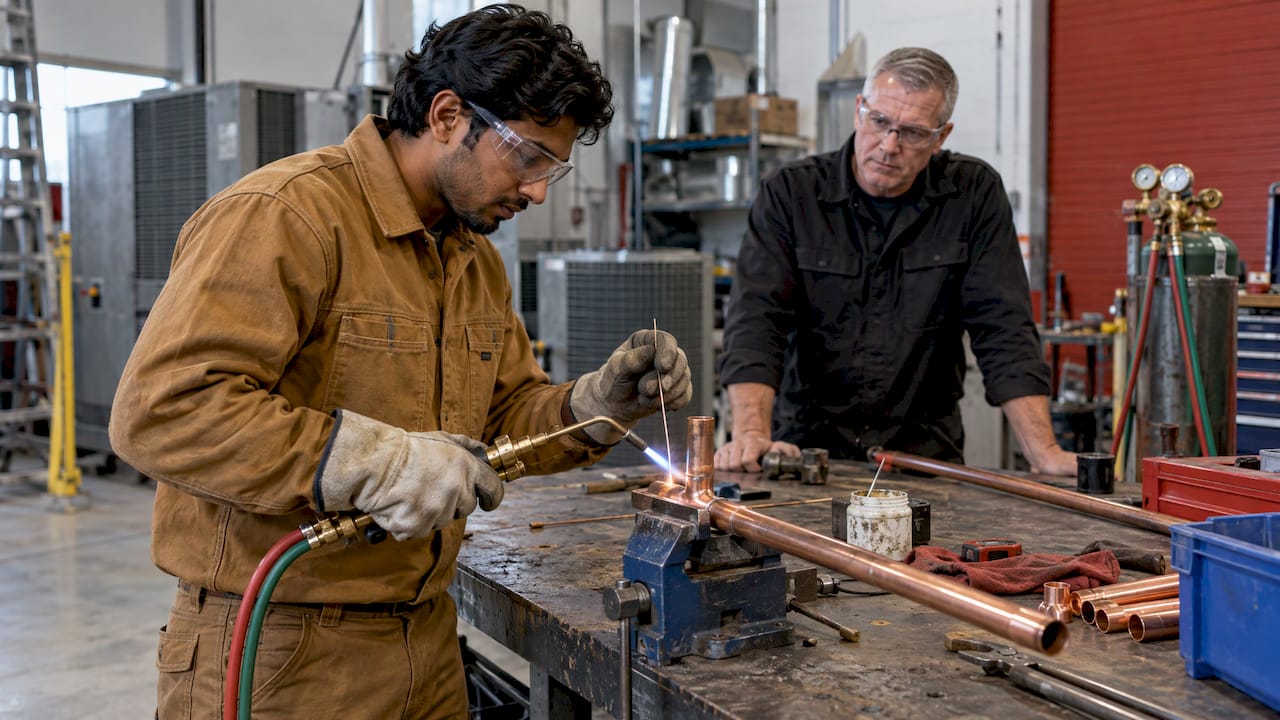
Expect a hands-on test too. It might be a brazing joint, a wiring exercise or a walk-through of a staged problem. If you want some reps beforehand, practice job-knowledge questions give you a way to check yourself on more than memorized answers.
Behavioral and customer questions
You are the face of the company when you walk into someone’s home. Customers are often uncomfortable and stressed. That is why the soft skills are hard skills in this trade, and why interviewers ask:
- Tell me about a difficult customer and how you handled it.
- How do you respond when a customer is unhappy with a diagnosis or a service fee?
- Tell me about a time you put safety ahead of speed.
- How would you handle a conflict with a coworker?
Strong answers stay calm, listen first, explain clearly, solve the problem instead of arguing and remain respectful. That is how Jobber describes what hiring managers look for.
Explaining the problem is half of it. RSI advises techs to say what the problem is, why it happened, what repair or replacement options exist and what next steps may cost, in plain language rather than jargon. Practice a one-minute version of that out loud. It works in the interview and on the call.
Use a story format
For behavioral and situational questions, the STAR method keeps you organized. RSI recommends it: Situation, Task, Action, Result. It helps you tell a clear, complete story that shows how you solve problems under pressure.
Here is a quick one: ‘A customer’s system froze up on the first hot weekend (situation). I needed to get cooling back without selling a repair they didn’t need (task). I found a clogged filter and a blower issue, showed them both, and explained the options (action). They approved the blower fix and left us a good review (result).’ Make sure yours is true, and include a number or outcome if you have one.
Questions you should ask them
An interview runs both ways. Techs have choices right now, and the questions you ask show you are serious. Ask:
- What does training look like for the first 90 days, and for A2L equipment?
- How is pay structured: hourly, flat rate, commission, or a mix? How are raises decided?
- What is the on-call rotation, and how is it paid?
- What does a typical day look like, and how many calls per day?
- What does the truck stock and tool setup look like?
- What does the path to lead tech or service manager look like here?
- What do the benefits look like? Our page on HVAC employee benefits lists what techs should expect.
Listen to how they answer as much as what they say. A shop that is proud of its pay and training will talk about them freely.
Commercial and specialty roles
If you are interviewing for commercial or refrigeration work, expect more on controls, chillers, rooftop units, preventive maintenance and documentation. Bring numbers: how many units you maintained, how you cut downtime, what failure you prevented. We cover how techs land those roles in our guide to commercial HVAC hiring.
Our take on HVAC interviews
After 36 years in this trade, we’ve learned that a good interview is two people finding out if they can trust each other. Techs worry about the questions. Contractors worry about the answers. Both should worry about the fit.
For techs: prepare stories, not scripts. Explain why behind every check, own your safety record and ask hard questions about pay, training and culture. You are not begging for a job. You are choosing a shop.
For contractors: if your interview is just trivia, you will hire good talkers and miss good techs. Ask how they think, put them in a real scenario and be upfront about what you pay and what you offer. Techs have choices, and the shops that are honest win them.
That is why we built HVAC Mafia as a trade-only place where openings come from real contractors and the talk is by techs, for techs. Build a career, not just another paycheck.
the author
Find a shop worth interviewing with
Preparing is half the work. The other half is finding employers worth your time. Registering with HVAC Mafia is free for technicians, apprentices and trade school students, and members can see openings from real contractors that are hidden from non-members. You also get straight talk on pay, career paths and spotting good and bad employers.

Join with a free basic membership and start browsing jobs.
Hiring instead? Contractors can post in front of a trade-only audience of nearly 100,000 HVAC followers, and applications go straight to your own hiring system. Job posting plans are $199 per month per position on Standard, $149 per month per position on Annual, and from $99 per month per position on Enterprise. If you are working on the bigger picture, read our guide to HVAC technician recruitment.
FAQ
What are the most common HVAC technician interview questions?
Expect ‘Tell me about yourself,’ why you chose HVAC, what experience you have with repairs and systems, how you troubleshoot a no-cool call, how you handle a difficult customer and how you keep safe on the job. Salary expectations and whether you hold a valid driver’s license are common too. Prepare one short story for each.
How do I answer a technical HVAC question if I don’t know the answer?
Say what you do know, then explain how you would find out. Interviewers are watching how you reason, not whether you memorized a fact. ‘I haven’t worked on that, but I’d start with the manufacturer’s documentation and a senior tech’ is far better than a guess.
What should an apprentice say with limited experience?
Talk about your training, your lab work and your willingness to learn. Describe one job or project in detail, what you did and what you learned. Ask about mentorship and training, since that is what you are really choosing.
What questions should an HVAC installer expect?
Expect questions on brazing, evacuation, line sets, airflow and duct checks, load basics and how you work on a crew. Newer A2L refrigerants may come up. Be ready for a hands-on test as well as questions.
Sources
- FieldEdge: HVAC interview question types
- Smart Service: HVAC technician interview questions and answers
- NCCER: HVAC technician assessment specifications
- AANM: A/C tech interview questions
- ACCA HVAC Blog: diagnosing a malfunctioning system
- ACHR News: troubleshooting and diagnostic tips
- Jobber: HVAC interview questions
- RSI: communicating HVAC problems to customers
- RSI: interview questions HVAC managers may ask new techs