
Commercial HVAC hiring runs on one fact: there are more jobs than qualified techs. If you’re a technician, that gives you leverage, and this guide shows you how to use it. If you run a shop, it means the old “post it and wait” approach isn’t enough anymore. Below, we cover how techs get into commercial work, what it pays, and how contractors can build a hiring process that finds good people and keeps them.
TL;DR
- Commercial HVAC is a seller’s market for techs. Industry sources put the gap at roughly 41,000 new technicians needed each year against about 26,000 graduates.
- You can start with a high school diploma and no experience, then move up through apprentice, service tech and lead roles. Many people also start with a trade program of about 6 months to 2 years.
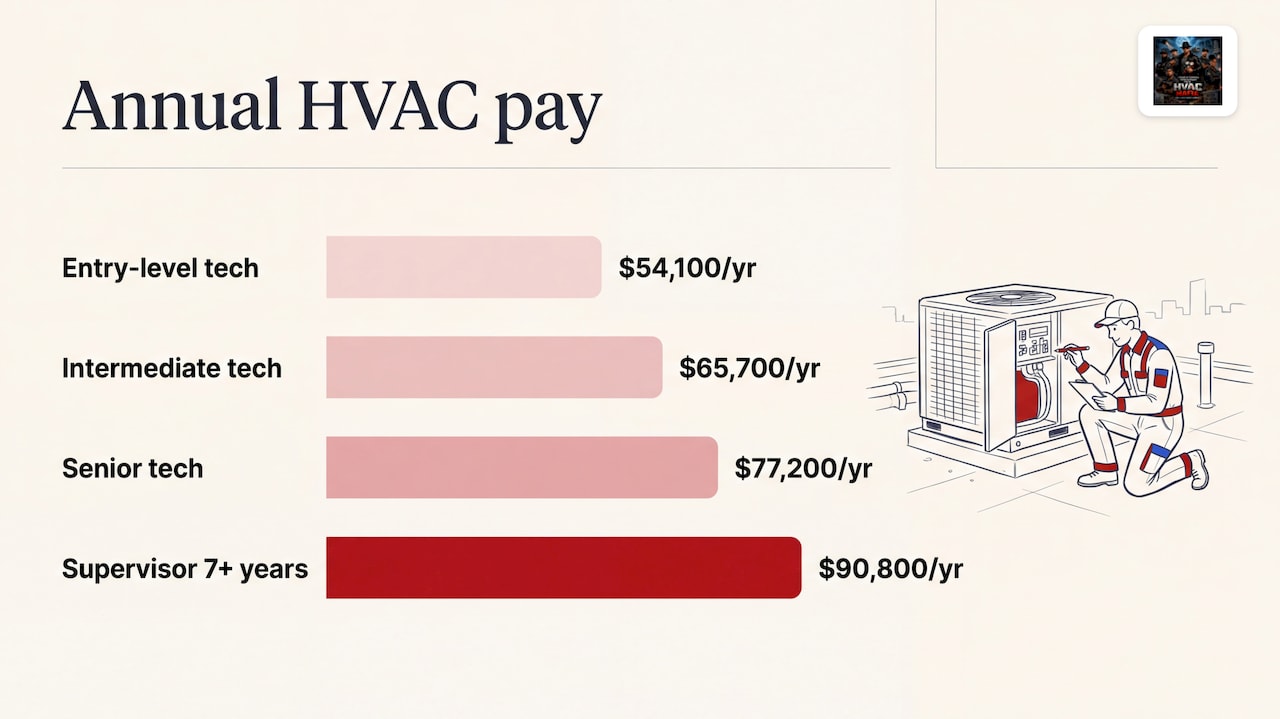
- National 2025 pay runs from about $54,100 a year at entry level to a $90,800 median for supervisors.
- Contractors who respond fast, show real pay and culture, and fix day-to-day frustrations keep techs longer.
- Techs register free on HVAC Mafia to see openings from real contractors. Contractors post jobs to a trade-only audience.
Table of Contents
- Why commercial HVAC is hiring so hard right now
- What commercial HVAC work actually is
- How to get into commercial HVAC
- What commercial HVAC techs earn
- Career paths: where commercial work can take you
- How to get hired as a commercial HVAC tech
- Why contractors struggle to hire and keep techs
- A commercial hiring process that works
- Our perspective: build a career, not just another paycheck
- Ready to hire or get hired?
- FAQ
- Sources
Why commercial HVAC is hiring so hard right now
Facilities Management Insights reports that the industry needs more than 41,000 new technicians every year while training programs produce about 26,000 graduates. Demand is growing from data centers, healthcare, building modernization and energy-efficiency work. All of those lean on commercial systems.
A bank’s contractor-trends report adds that roughly 42,500 HVAC-related positions have gone unfilled each year for more than a decade. And ACHR News describes even union contractors with strong backlogs as struggling to field enough technicians.
What does that mean for you?
- If you’re a tech: you can be choosy. Pay, schedule, training and how the office treats you are all fair questions.
- If you’re a contractor: the pipeline is the problem. The shortage is a mismatch between training output and demand, so waiting for experienced techs to find you is a slow plan.
What commercial HVAC work actually is
Residential techs mostly work in homes. Commercial techs work in office buildings, hospitals, schools, warehouses, restaurants and retail. That usually means larger rooftop units, chillers, boilers, building controls and, in many shops, refrigeration.
The HVAC Career Map describes two common entry points:
- Commercial service technician: troubleshoots, diagnoses and repairs HVAC/R equipment in commercial buildings.
- Commercial installer: installs HVAC equipment under a lead installer or supervisor.
The same resource sorts jobs by skill level. Entry level asks for a high school diploma or equivalent and no HVAC/R experience. Mid level asks for 1 to 4 years of experience, with post-secondary training preferred. Advanced roles call for 5 or more years, journey-level training or a bachelor’s level education.
That’s good news if you’re starting out. Plenty of shops hire for attitude and train the rest.
How to get into commercial HVAC
There isn’t one door. There are three common ones.
1. Trade school or community college
The Bureau of Labor Statistics says HVAC technicians typically need a postsecondary nondegree award, with programs running about 6 months to 2 years, followed by lengthy on-the-job training. Classroom time plus hands-on labs gets you to the first day with some vocabulary and a feel for the tools.
If you’re weighing timelines, our breakdown of how long it takes to get HVAC certified walks through what to expect.
2. Apprenticeship
Some people skip the classroom-first route. BLS notes that some techs train through multi-year apprenticeships instead. The HVAC Career Map describes an apprentice as someone in a full-time paid position with on-the-job training from experienced journey-level technicians and structured apprenticeship classes. You earn while you learn, and that matters if you can’t afford to go without a paycheck.
3. Start as a helper or installer
Many techs begin by assisting. BLS says new hires commonly start with basic tasks next to experienced technicians, such as insulating refrigerant lines or cleaning furnaces, before moving on to harder work like cutting and soldering pipe. Installer roles are a common way into commercial because the shop can teach its own methods from day one.
Credentials to plan for
Whichever door you take, expect to need EPA certification to handle refrigerants, and in many states a license. Requirements vary by state, so check with your state licensing board before you apply. The earlier you get your EPA card, the more jobs you can apply for.
What commercial HVAC techs earn
Pay depends on role, region and experience. ACHR News published national 2025 figures that give a useful baseline:
| Level | Annual pay | Hourly |
|---|---|---|
| Entry-level tech | $54,100 | $26.01 |
| Intermediate tech | $65,700 | $31.59 |
| Senior tech | $77,200 | $37.12 |
| Supervisor (7+ years), median | $90,800 | $43.65 |
Source: ACHR News, 2025 national pay figures.
Those are national numbers. Your city, union status, on-call rules, overtime and bonuses will move them. When you read a posting, look for the hourly range, not just the headline. Listings on our board often show it, like this lead installer role in Westchester, NY that lists $35 to $55 an hour.
The lesson is the same everywhere: the move from entry to senior is worth roughly $23,000 a year at the national level. Training, certifications and a few good years under a strong lead tech are how you get there.
Career paths: where commercial work can take you
Commercial isn’t a dead end. It’s a ladder with a lot of rungs.
- Apprentice or helper to journey-level technician.
- Senior technician or lead installer, running a truck or a crew.
- Commercial service manager, who the HVAC Career Map describes as supervising HVAC field and office personnel to ensure quality service.
- Beyond that, project management, estimating, sales and ownership.
The best employers show you the next rung before you ask. In an interview, ask what the path from tech to lead looks like at that company, and who got promoted last year.
How to get hired as a commercial HVAC tech
Write a resume that sounds like the trade. Hiring managers want equipment types, certifications, systems you’ve worked on and results. Our guide on what to include in an HVAC technician resume covers the layout.
Search where the real employers are. On HVAC Mafia, basic membership is free for technicians, and job openings are visible to members only. You’ll see roles from actual contractors, such as a service technician role in West Palm Beach, FL, a lead installer role in New Cumberland, PA or an install lead position in Sharonville, OH.
Ask the questions that tell you who’s good.
- What does a normal week look like, on-call included?
- How are techs trained on new equipment?
- Who do I call when I’m stuck on a job?
- What’s the plan for the tech who wants to move up?
- What does the office do when parts aren’t on the truck?
That last one matters more than people think, as the next section shows.
Why contractors struggle to hire and keep techs
Hiring is only half the cost. ServiceTrade estimates that replacing a skilled technician can cost 50 to 200% of that tech’s annual salary.
Its survey of 800+ technicians also points to what drives techs crazy day to day. For mechanical techs, the top productivity obstacles include miscommunication with the office (45%) and poor scheduling or last-minute changes (44%), plus not having the right parts (40%) and missing work order information (32%).
Read that list again. None of it is about a pay raise. Dispatch, scheduling and information are things a shop can fix this month, and techs notice when they get fixed. They also talk, in forums, on job sites and over lunch.
A commercial hiring process that works
The contractors we hear from who hire well do a few things consistently.
Write the job like you’d want to read it
Post the pay range, the schedule, the equipment, the on-call rules and the training. ACCA’s webinar recap lists updating the job description as the first step in an 11-step hiring process that also covers posting on multiple job boards, structured screening, interviews, reference checks, written offers and background and drug screening.
Post where techs are
ServiceTrade’s hiring guide recommends HVAC-focused job boards, employee referrals and networking. A trade-only board keeps your listing in front of people who can actually do the work.
Respond fast
The ACCA recap suggests reaching out to candidates within 24 to 48 hours and keeping in touch through the process. A good tech with three offers won’t wait a week for your call.
Show your culture and benefits
The same recap stresses employer branding: your values, specific benefits and real career advancement. Say what you offer and prove it with details.
Interview for skills and fit
ServiceTrade recommends probing interview questions to judge both skills and cultural fit. Ask a candidate to walk you through the last no-cool call they solved on a rooftop unit. You’ll learn more in five minutes than from a list of job titles.
Keep them
The same guide points to competitive pay, training and development, regular feedback and recognition for high performers as the core of retention. Then fix the office-to-field friction above. For a deeper look, read our guide on HVAC technician recruitment.
Our perspective: build a career, not just another paycheck
We built HVAC Mafia because we’ve seen both sides of this trade. Our founder has 36 years in HVAC and used to own a dealership. He’s hired techs, lost techs, and been the tech on the roof in August.
Here’s what we believe. Most hiring problems are trust problems. Techs don’t trust job ads that hide the pay. Contractors don’t trust job sites that send them résumés from people who’ve never held a gauge set. So we built something different: a board and community for verified HVAC trade professionals, without homeowner or outsider noise.
For techs, that means free membership, openings from real contractors, straight talk on pay and career paths, Tech Talk forums and the HVAC Underground Podcast. For contractors, it means your listing reaches a trade-only audience of nearly 100,000 HVAC followers, and applications go straight into your own hiring system. Company Spotlight profiles let you show your culture, pay and benefits to techs who have choices.
The shortage isn’t going away this year. The shops that win will be the ones that treat techs with respect, grow them, and say so out loud. That’s what we’re here to help with. No corporate fluff. No shortcuts. Just knowledge, loyalty and respect.
the author
Ready to hire or get hired?
Techs: join HVAC Mafia for free and see the openings that non-members can’t. Use the ones that fit your level, location and goals.
Contractors: our job posting plans are priced per position: Standard is $199 per month per position, Annual is $149 per month per position, and Enterprise starts from $99 per month per position. If you want to stand out, a Company Spotlight profile is $149 per month or $1,699 per year.

Need a short push on a hard-to-fill role? Spotlight placements run $149 for 1 week per position, $499 for 4 weeks per position, or $349 per month per position on the ongoing plan. Details are on the Spotlight pricing page.
FAQ
How do I get into commercial HVAC work?
Start with a trade program of about 6 months to 2 years, an apprenticeship, or an entry-level helper or installer role. Entry-level jobs often ask only for a high school diploma or equivalent. Plan on EPA certification for refrigerants and check your state’s licensing rules.
Is commercial HVAC in demand?
Yes. Industry reporting says the field needs more than 41,000 new technicians a year while programs graduate about 26,000. Data centers, healthcare and energy-efficiency work are adding demand.
What is the highest paying job in HVAC?
In the national 2025 figures we cited, supervisors with seven or more years of experience had the top median pay, at $90,800 a year. Pay climbs with experience, certifications and responsibility, and it varies by region and employer. Moving from lead tech into service management or sales is a common route to higher earnings.
Can you make $200K as an HVAC technician?
We haven’t found a reliable national figure showing that for technicians, and the national medians run well below it. The path to higher income usually runs through leadership, management, sales or owning a business. Look at the pay range in the listing and ask how bonuses and overtime work.
How fast should contractors respond to applicants?
ACCA’s guidance suggests reaching out within 24 to 48 hours. Strong techs often have several options, so quick, clear communication helps you stay in the running.
Sources
- Facilities Management Insights: How to Prepare and Employ Future HVAC Technicians
- FNBO: Mechanical Contractor Trends for 2026
- ACHR News: Cautious Confidence, Contractors Staring Down Price Pressures, Workforce Shortages and AI Escalation in 2026
- HVAC Career Map
- Bureau of Labor Statistics: Heating, Air Conditioning, and Refrigeration Mechanics and Installers
- ACHR News: From $54K to $90K, What HVAC Techs Are Really Making in 2025
- ServiceTrade: Mechanical Contractor Technician Retention survey
- ACCA: Webinar recap on fixing broken hiring processes
- ServiceTrade: How to Excel at Hiring and Retaining the Best HVAC Technicians