HVAC Mafia

HVAC Employee Benefits: What Techs Should Expect in 2026

A good HVAC benefits package covers health insurance, a retirement plan with a match, paid time off, fair on-call pay and paid training. The best shops add year-round work and a clear path from apprentice to lead tech. Pay gets the attention, but benefits decide whether a job is a career or just a paycheck. This guide covers what employers offer, what the national numbers say, and how to compare two offers side by side.

Thehvacmafia
Find HVAC Jobs With Benefits
Explore HVAC Mafia for job openings and straight talk on pay, career paths, and spotting good and bad employers.

Explore HVAC opportunities

TL;DR

  • Most HVAC employers offer some mix of medical, dental, vision, a 401(k) and paid time off. The details vary a lot by shop size and job type.
  • Federal data shows about 9 in 10 installation, maintenance and repair workers have paid vacation and paid holidays, and 82% have paid sick leave.
  • Sign-on bonuses are rare. Paid training, schooling help and extra PTO are more common.
  • Ask about on-call pay, overtime rules, tool and vehicle policies, and the employer’s share of premiums before you accept.
  • Compare total compensation, not just the hourly rate.

Table of Contents

What benefits do HVAC technicians actually get?

There is no single standard package. Employers in the trade describe a common menu: health plans, HSAs and FSAs, dental and vision, 401(k) plans with an employer match, and supplemental coverage such as life, accident, critical illness and short- or long-term disability. Some shops offer all of it. Smaller shops may offer a few pieces.

Here is how the pieces break down.

Benefit What to expect What to ask
Medical Group plan, often with an employer share of the premium How much comes out of each paycheck for you and your family? What is the deductible?
Dental and vision Often offered as add-ons Is it included or extra?
Retirement 401(k), sometimes with a match What is the match, and when do you vest?
Paid time off Vacation, holidays, sick days When does it start accruing? Does it roll over?
Disability and life Often employer-paid or low-cost Is short-term disability covered from day one?
Training Paid classes, certifications, schooling help Who pays for EPA 608 and manufacturer training?
Work-life On-call pay, flexible schedules How often is the rotation, and how is it paid?

Health insurance

Under the Affordable Care Act, businesses with 50 or more full-time employees are required to offer health insurance. Smaller contractors are not bound by that rule, but many still reach coverage through group plans or trade association networks. So a 12-person shop can have a solid plan, and a bigger shop can have a thin one. Look at the plan, not the company size.

Retirement

Size matters more here. In March 2025, 86% of private-industry workers in establishments with 100 to 499 workers had access to retirement benefits, and 90% in establishments with 500 or more. If you work for a small shop, a retirement plan is worth asking about directly. If there is a match, treat it as part of your pay. Free money is still money.

The federal numbers are encouraging. According to the Bureau of Labor Statistics, as of March 2025, 90% of private-industry workers in installation, maintenance and repair occupations had access to paid vacation, 93% to paid holidays and 82% to paid sick leave. Access is not the same as generous. Ask how many days you get in year one, because that is where shops differ most.
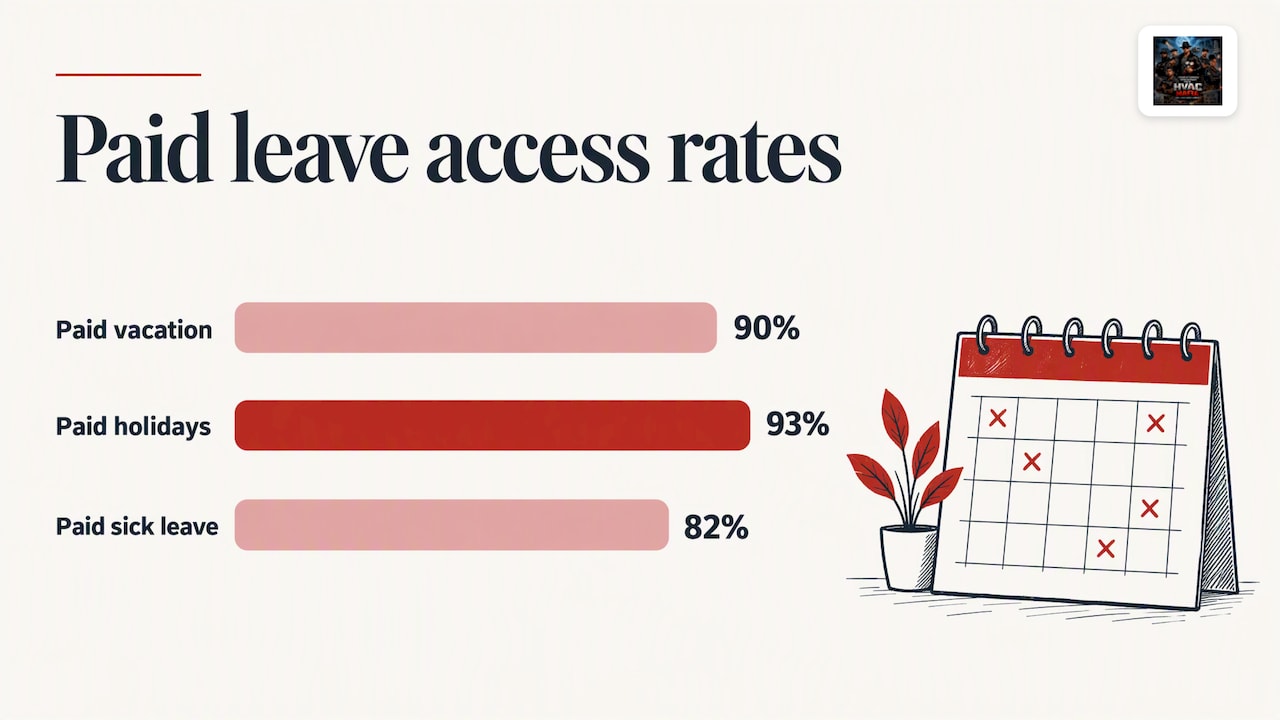
Access rates for vacation, holidays and sick leave

Perks that matter in this trade

Generic benefit lists miss what makes HVAC different. Our work follows the weather. That shapes the perks worth looking for.

On-call pay and overtime

Summer and winter peaks mean long days and after-hours calls. Some employers do pay for it: technicians may receive on-call pay. If a shop expects you to carry the phone for free, that is a red flag. Ask three things:

  1. Is there a flat on-call stipend, and how much?
  2. What is the pay rate once you are dispatched?
  3. How often are you on rotation?

Some contractors also build in relief. According to an ACCA industry study, flexible arrangements such as four 10-hour days, flex time or guaranteed stop times for overtime are options employers use. If work-life balance matters to you, ask what the shop does in July and January, not what it says in the job post.

This is the perk we would push every apprentice to chase. The same ACCA study found that 72% of contractors do not offer sign-on bonuses. Instead, employers lean on paid training, schooling benefits and added PTO. That is good news for you. A sign-on bonus is spent in a month. A certification or a manufacturer course raises your earning power for the rest of your career.

For apprentices and trade school students, ask:

  • Does the company pay for classes, books and exam fees?
  • Is time in class paid?
  • Is there a ride-along period with a senior tech?
  • What does the step from apprentice to service tech look like, and what does the raise look like?

Year-round work

Seasonal slowdowns can hit a paycheck. Shops that keep techs busy in the shoulder seasons, through maintenance agreements, commercial work or installs, give you steadier income. It is a benefit even though it never appears on a benefits sheet. Ask what techs do in the slow months.

Tools, truck and uniforms

In many shops a take-home vehicle, a tool allowance, uniforms and a phone are a real part of the package. They save you money every month. Ask what is provided, what you must buy, and who replaces broken tools.

How benefits change by employer and job type

Residential service. Expect commission or flat-rate pay structures at some shops, and strong seasonal swings. Benefits depend heavily on the shop’s size.

Commercial and refrigeration. These jobs often come with steadier hours, planned maintenance schedules and larger employers. Larger employers tend to have fuller retirement and insurance offerings, in line with the BLS size figures above.

Installers. Install crews can see heavy workloads in peak season. Ask about overtime rules and what happens in a slow week.

Union and prevailing-wage work. Some work is covered by union agreements, and some projects carry wage rules. For example, Department of Energy projects funded under the Bipartisan Infrastructure Law and subject to Davis-Bacon have project wage determinations that contractors must meet. If a job posting mentions prevailing wage, ask how the fringe benefit portion is paid, whether as cash or into a plan.
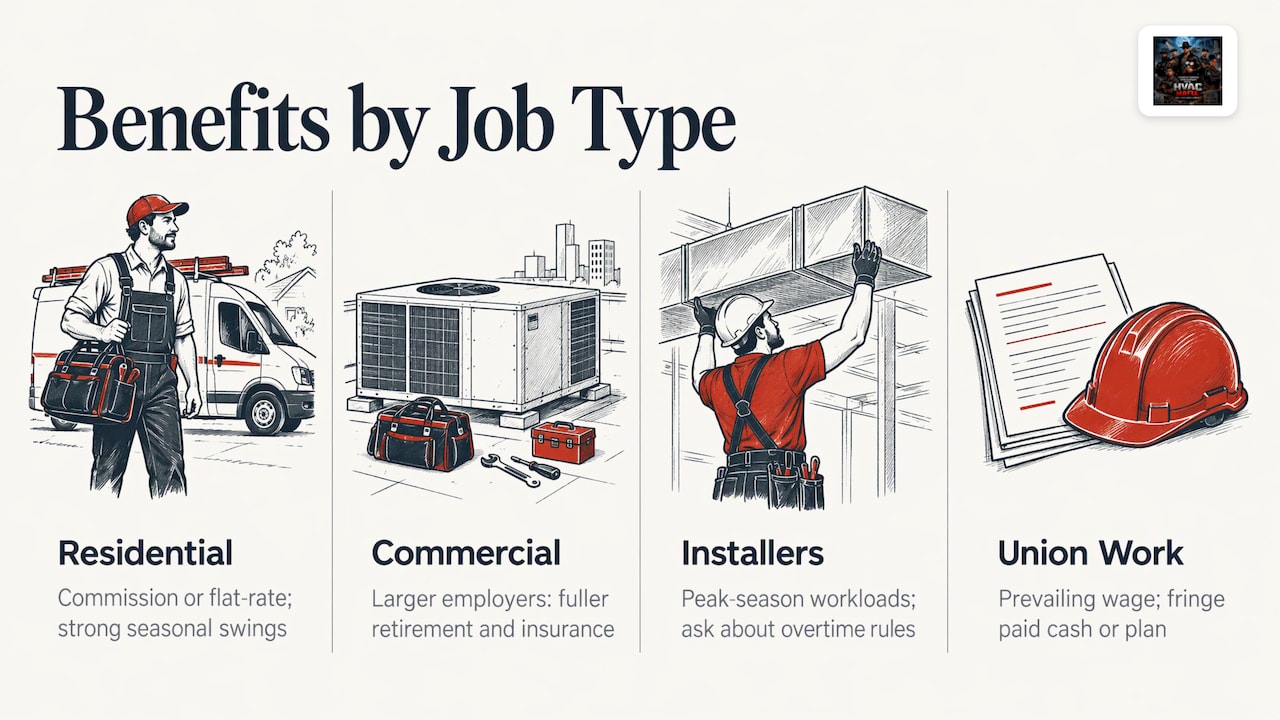
How benefits change by employer and job type

What the pay picture looks like

Benefits sit on top of a base wage, so know the baseline. The Bureau of Labor Statistics reports that heating, air conditioning and refrigeration mechanics and installers had a median pay of $61,010 per year in May 2025, with the top 10% earning more than $95,210. The same page projects 11% job growth from 2025 to 2035, much faster than average. Demand is on your side. That means you have room to ask questions and compare.

How to compare two offers

Here is a simple way to avoid being dazzled by a big hourly number.

  1. Get the package in writing. Ask for the benefits summary, not a verbal rundown.
  2. Price the health plan. Add your monthly premium and the deductible. A $2 raise can vanish into a bigger premium.
  3. Count the match. If one shop matches your 401(k) contributions and the other has no plan, put a dollar figure on the difference.
  4. Count your days. Add vacation, holidays and sick time for year one.
  5. Value the extras. Take-home truck, tool allowance, paid training, on-call stipend. Even rough numbers help.
  6. Ask about waiting periods. Many benefits start after 30 or 90 days. Know the gap, and plan for it.
  7. Talk to a current tech. Ask how often the rotation really hits, and if the shop keeps its promises.

If you want a feel for what real employers put in postings, browse listings like this service technician role in Reno, this install lead position in Sharonville, OH or this service tech opening in Loveland, CO. Compare how each describes pay and perks, then ask for the rest.

When you are ready to apply, a sharp resume helps you negotiate from strength. Our guide on writing an HVAC technician resume walks through what to include.

For contractors: benefits are your hiring edge

If you run a shop and cannot find or keep techs, your benefits page is part of your recruiting pitch. Techs have choices. Industry commentary points to mental health and financial wellness programs as ways to build loyalty, on top of the basics.

You do not need to match a national company dollar for dollar. You need to be clear and honest. Spell out the 401(k) match, the on-call stipend, the training path and the schedule. Techs read vague postings as bad news. Our guide to HVAC technician recruitment covers how contractors hire and keep techs in more depth.

Our perspective

We have watched this trade for a long time, and the founder of HVAC Mafia is a 36-year HVAC veteran and former dealership owner. Here is what we keep seeing: the shops that keep good techs are not always the ones that pay the highest hourly rate. They are the ones that are straight about the whole package.

Techs deserve to know what a job really offers before they quit the one they have. That is why we built a place where openings come from real contractors, and where the talk is by techs, for techs. No corporate fluff. Just honest answers about pay, benefits and what makes an employer worth working for.

Contractors benefit too. When you show your culture, your pay and your benefits to a trade-only audience, you meet techs who care about exactly those things. Our Company Spotlight profiles are designed to give a shop room to show what it offers, so it stands out to techs who have options.

Build a career, not just another paycheck.

the author

Find a job with benefits that fit

If you are a tech, apprentice or student, join HVAC Mafia free. Members see job openings from real contractors, which are hidden from non-members. You also get straight talk on pay, career paths and spotting good and bad employers, plus the Tech Talk forums and the HVAC Underground Podcast.

HVAC Mafia  Beanie

Register for a free membership and start comparing real offers. If you are a contractor, our job posting plans put your openings, and your benefits, in front of a trade-only audience.

FAQ

Do HVAC technicians get health insurance?

Often, yes, but it depends on the employer. Businesses with 50 or more full-time employees must offer coverage under the ACA, and smaller shops may offer group plans too. Ask what share of the premium the company pays, since that changes your take-home pay.

Do HVAC techs get paid vacation and sick days?

Most do. BLS data from March 2025 shows 90% of private-industry installation, maintenance and repair workers had access to paid vacation, and 82% had paid sick leave. Ask how many days you earn in your first year and when they start.

Do HVAC employers pay a sign-on bonus?

Usually not. An ACCA study found 72% of contractors do not offer one. Many offer paid training, schooling benefits or more PTO instead, and those can be worth more over time.

Is on-call work paid in HVAC?

It can be. Some employers pay technicians on-call pay, and some arrange schedules around it, such as four 10-hour days or guaranteed stop times. Get the stipend, dispatch rate and rotation in writing before you accept.

What should an apprentice look for in a benefits package?

Put paid training and a clear raise path first, then health coverage and time off. Ask whether the company pays for classes and exam fees and who will mentor you. A shop that invests in your skills is investing in your future with them.

Sources

HVAC Company Profiles: What to Include and How Techs Read Them

An HVAC company profile is the page where a contractor says who it is, what work it does, and what it is like to work there. A good one serves two readers at once. Homeowners and commercial customers want to know if they can trust you. Technicians want to know if they should quit their current shop and join yours. This guide covers both, with a focus on the second reader, because that is where most contractors are losing ground right now.

Thehvacmafia
thehvacmafia.com
Show Techs What Sets Your Shop Apart
HVAC Mafia Company Spotlight profiles put your shop’s culture, pay, and benefits in front of a trade-only audience.

Visit HVAC Mafia

TL;DR

  • A solid profile covers the basics (name, location, founding year, services, licenses, service area) and the human side (people, values, training, pay, schedule).
  • Technicians read profiles for proof: real photos, named training programs, clear career paths and honest talk about pay and on-call time.
  • Generic marketing language is the fastest way to lose a tech’s trust. Specific, checkable details win.
  • Hiring is hard across the industry, so a profile that answers a tech’s questions up front gives you an edge.
  • If you want a profile in front of a trade-only audience, we offer Company Spotlight profiles at HVAC Mafia.

Table of Contents

What an HVAC company profile actually is

People use the phrase for a few different things. A directory listing is a profile. So is the About Us page on your website, a one-page company overview for a bid package, or a spotlight on a job board. They share a job: to introduce a business quickly and credibly.

ACHR News describes the About Us page as the place to communicate the brand story, experience, certifications, awards and values. That is a fair baseline. The problem is that most profiles stop there, and most are written for customers only. If you are trying to hire, you need a second layer written for the person who will actually turn the wrenches.

The basics every profile needs

Start with the facts anyone would look for. A January 2026 profile guide lists the usual elements: company name, logo, location, founding year, history, mission, service areas, detailed services, licenses, certifications, awards and contact details. Business data providers track similar attributes, such as employee count, number of trucks, residential or commercial focus, and manufacturer relationships.

Here is a practical checklist:

  • Who you are: legal name, year founded, who owns it, how big the team is.
  • Where you work: cities, counties or states you serve, and whether you are residential, light commercial, commercial or refrigeration.
  • What you do: installs, service, maintenance agreements, new construction, controls. Name the equipment you work on.
  • Proof: license numbers where appropriate, NATE or other certifications, manufacturer programs, awards.
  • How to reach you: phone, email, address, and a clear way to apply for a job.

Keep it plain. If a stranger can’t tell in ten seconds what you do and where, rewrite it.

What technicians look for that customers don’t

A customer asks, “Will this company show up and fix my system?” A tech asks a different set of questions:

  • What will I make, and how does it grow?
  • Will I get real training, or a ride-along and a good luck?
  • How often am I on call?
  • Who will I work for? Is the owner involved, or is it a revolving door of managers?
  • Is there a path from apprentice to lead tech to service manager?
  • Does the company run like the profile says it does?

You don’t have to answer every one in a paragraph. You do have to answer them somewhere. The best profiles treat the tech as a customer, because that is what a hire is: a person choosing between offers.

Pay and benefits

Pay transparency matters in this trade. Techs talk to each other constantly, and they know what the going rate is. The Bureau of Labor Statistics reported a median annual wage of $61,010 for heating, air conditioning and refrigeration mechanics and installers in May 2025. That is a national median, and your market may sit well above or below it. Use it as context, then show where you land and why.

You don’t have to publish every salary band. But a range, a description of how raises work, and a list of benefits (health coverage, retirement match, tools, truck policy, paid time off) tells a tech you aren’t hiding anything. Job posts that show a range get noticed. Look at how one Nevada listing leads with its pay range for a service technician in Reno. That is the kind of clarity techs respond to.

Training and career path

Training is where profiles can be the most specific, and the most convincing. A few examples from ACHR News coverage of contractors recognized as good places to work:

Notice what these have in common: a named program, a concrete detail, a reason a tech would care. “We invest in our people” says nothing. “New hires spend their first 90 days with a mentor and a written skills checklist” says something, if it is true for you.

Training also connects to where the work is heading. The Department of Energy backs workforce efforts such as an initiative to train HVAC technicians in heat pump installation, design and maintenance. If you train on heat pumps or other newer equipment, say so.

Schedule and work-life balance

Burnout drives techs out of the trade and out of shops. One Washington contractor addressed it with a four 10-hour day schedule that limits on-call to about two days a month, according to ACHR News in 2012. You don’t need to copy that. You do need to say what your schedule is and how on-call works. Silence on the subject reads as bad news.

Showing culture without sounding like an ad

“Family-owned, customer-focused, committed to excellence.” Every tech has read that sentence a hundred times, and none believe it. A profile that shows culture has to be specific.

Research on web usability backs this up: Nielsen Norman Group reports that people expect About Us content to be clear, authentic and transparent, especially about purpose and values. Gallup adds that values become credible when leaders model them, stories are shared on an ongoing basis, and recognition and accountability reinforce them.

Translate that into your profile:

  1. Use real people. Real team photos, real trucks, real shop. An HVAC marketing firm recommends real photos of team members, technicians at work, vehicles and training over stock images. Show safety gear on, too. A photography guide for trades suggests wide and close-up shots of technicians doing representative work, with PPE visible.
  2. Tell the founding story honestly. Who started the company, why, and what changed over the years. Short and plain beats polished and vague. Testimonials that build real trust do the same thing for customers: they sound like actual people, not copy.
  3. Describe how you hire. One Washington contractor hires for character first and trains for technical performance once the candidate is a cultural fit. Another owner meets applicants personally before offering an introductory period. Details like that tell a candidate how they will be treated.
  4. Share ownership and structure. Arizona’s HACI Mechanical became employee-owned in August 2025, affecting 350 employees. If you have profit sharing, an ownership path or a promote-from-within record, that belongs in the profile.
  5. Let your techs talk. HVAC marketing specialists suggest voluntary, employee-led content, employee spotlights, work-anniversary recognition and team events, with customer permission and a simple approval process. Behind-the-scenes footage of technician prep, equipment organization and training works as well.

HVACR Business makes a related point: explain the people behind the work and what training and certifications mean for the customer, instead of just listing credentials. The same goes for techs. “NATE-certified” is a badge. “We pay for your NATE exams and a raise follows” is a reason to apply, if that is your policy.

Why the profile matters more in a tight labor market

Techs have choices. The Department of Energy’s 2026 U.S. Energy & Employment Report found that 70% or more of establishments in the Energy Efficiency sector reported difficulty finding workers in 2025, and that construction establishments in that sector reported a 78% hiring difficulty rate. When most employers are struggling to hire, a candidate who sees ten similar job posts will click through to the company that explains itself best.

Credentials help too. The DOE worked with Google so that contractors with Energy Skilled-recognized credentials can display a label on Google Business Profiles. The same announcement says more than 20,000 people have earned a credential from a recognized training program, and that states may use the recognition as a criterion for federal workforce funding. If your techs hold such credentials, say it in your profile.

How techs can read a profile like a pro

If you are a tech, apprentice or trade school student, here is how to size up a company from what it publishes:

  • Look for specifics. Named training programs, schedules, pay ranges and benefits beat slogans.
  • Check the photos. Are they real people in real shops and trucks, or stock images?
  • Find the career path. Does the profile mention apprenticeships, mentoring, lead tech or management tracks?
  • Notice what’s missing. No mention of pay, schedule or on-call may mean those aren’t selling points.
  • Ask for proof in the interview. Ask to meet the team you’d work with and ask how long the average tech has stayed.
  • Talk to other techs. Forums and podcasts are good for the straight story on how a shop treats its people.

When you find a shop you like, make your own side of the paper strong. Our guide on what to include in an HVAC technician resume walks through it. And when you browse openings, the listing itself tells you a lot. Compare a service technician opening in Spring, TX with an install lead role in Sharonville, OH and see which details each employer chose to share.

A simple template for your own profile

Use this outline and fill each part with specifics:

  1. Opening paragraph: who you are, where you work, and the kind of tech you want to hire.
  2. Our story: founding year, founder, how you grew.
  3. What we do: services, equipment, residential or commercial mix.
  4. How we treat techs: pay structure, benefits, schedule, on-call, tools and truck.
  5. How you grow here: training, certifications paid for, mentoring, promotion examples.
  6. Meet the team: photos and a line about each person, with their permission.
  7. How to apply: one clear link, one clear contact.

Keep every claim something a current employee would confirm. Techs will check.

Spotlight profiles at HVAC Mafia

Spotlight profiles at HVAC Mafia

If you want your profile in front of the people you are trying to hire, our Company Spotlight is built for that. It lets a shop show its culture, pay and benefits to a trade-only audience, so it stands out to techs who have options. HVAC Mafia was founded by a 36-year HVAC veteran and former dealership owner, and our listings and community are limited to verified HVAC trade professionals.

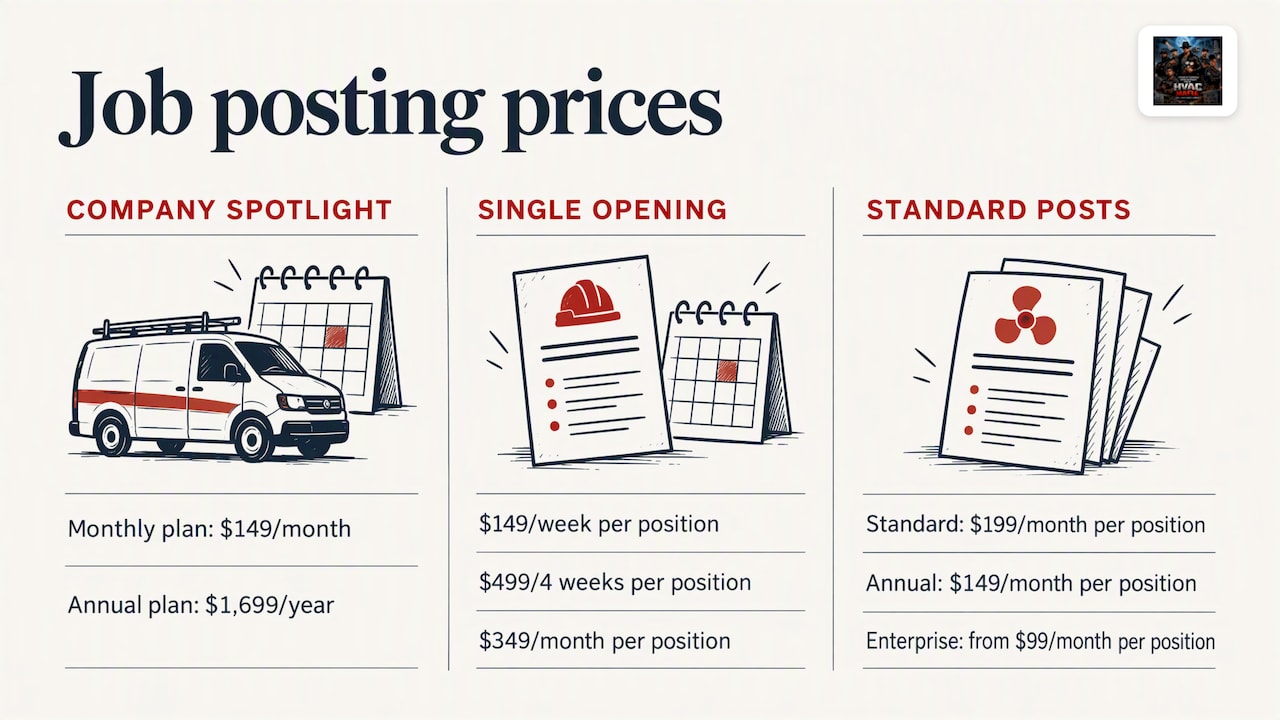
Company Spotlight is $149 per month on the monthly plan or $1,699 per year on the annual plan. If you’d rather promote a single opening, Spotlight pricing runs $149 per week per position, $499 per four weeks per position, or $349 per month per position for ongoing placement. Standard job posts are listed on our job posting plans page: $199 per month per position on Standard, $149 per month per position on Annual, and Enterprise from $99 per month per position.

Make HVAC Great Again™ Front  HVAC Mafia Back T-Shirt

Techs register free, and openings are visible to members. If you are a tech, join as a member and see who is hiring.

Perspective

We have spent decades in this trade, and we have seen both sides of the hiring table. Most contractors don’t have a hiring problem so much as a visibility problem. They run a good shop, pay fairly, and train their people, but the tech scrolling job listings never finds that out.

That is why we think a company profile is a recruiting tool first and a marketing piece second. A tech wants to know what you pay, how you train, who they’d work for and whether people stick around. If your profile answers that honestly, you won’t need big promises.

We built HVAC Mafia as a place where those answers can be shared with the people who care, and only those people: verified trade professionals, not homeowners or outsiders. Our Company Spotlight is designed to put your culture, pay and benefits in front of them. Build a career, not just another paycheck. That works for the tech and for the shop.

the author

FAQ

What should an HVAC contractor company profile include?

Start with the business name, location, founding year, services, service area, licenses and certifications. Then add the human side: your team, values, training, pay approach and how to apply. Real photos and honest detail matter more than polished slogans.

How do I showcase HVAC company culture?

Use specifics instead of adjectives. Show real team photos, describe how you hire and train, explain your schedule and on-call approach, and let your techs share their own stories. Anything you claim should be something a current employee would confirm.

Should I list pay in my company profile?

A range or a clear explanation of how pay and raises work builds trust with technicians, who compare offers constantly. For context, the BLS median for HVAC mechanics and installers was $61,010 in May 2025, but your local market may differ. Be clear about benefits, tools and truck policy too.

How can a technician judge an employer from its profile?

Look for named training programs, a described career path, real photos, clear schedule details and pay information. Missing details are a signal. Confirm what you read by asking to meet the team and by talking with other techs.

What is a Company Spotlight at HVAC Mafia?

It is a profile that shows a shop’s culture, pay and benefits to our trade-only audience of HVAC professionals. It is sold as a monthly plan at $149 per month or an annual plan at $1,699 per year. You can see the options on the Company Spotlight page.

Sources

HVAC Technician Resume: What to Include and How to Write It

A strong HVAC technician resume fits on one page, leads with your certifications, and shows what you actually fixed, installed or maintained, with numbers. Hiring managers in this trade skim. They want to know three things in ten seconds: are you certified, what equipment have you worked on, and can you run a call on your own. Build the page around those answers and you are most of the way there.

We built HVAC Mafia for techs, and we see what makes a contractor pick up the phone. This guide walks you through the layout, the wording, and two full examples you can adapt to your own background.

Thehvacmafia
Put Your HVAC Resume to Work
HVAC Mafia helps technicians find job openings and get straight talk on pay, career paths, certifications, and employers.

TL;DR

  • Keep it to one page. Two pages only make sense for senior commercial roles.
  • Put EPA 608 (with your type), NATE, OSHA and license level where a hiring manager sees them first.
  • Write bullets about results, not duties: first-visit fixes, installs per year, tonnage serviced.
  • Mirror the equipment and controls named in the job posting, and be honest about dates and seasonal work.
  • Entry-level? Lead with trade school hours, EPA 608 and hands-on lab or helper work.

Table of Contents

What belongs on an HVAC technician resume

The NAHB trades resume guide recommends a clean format with clear headings such as Education, Certifications and Professional Experience. It also says to list positions in reverse chronological order, use concise bullets with strong action verbs, quantify results, and put the most impressive item first under each job. A short profile at the top is optional but useful.

Here is the order that works for most techs:

  1. Contact block: name, phone, professional-sounding email, city and state. You do not need a full street address.
  2. Summary: two or three sentences. Who you are, how many years, what you work on, what you are certified in.
  3. Certifications and licenses: right under the summary for most techs. This is the first filter.
  4. Technical skills: six to ten items that match the job.
  5. Experience: newest job first.
  6. Education and training: trade school, apprenticeship hours, manufacturer classes.

If your certifications are your strongest card, they go high. If you have ten years of solid service work and a license, your experience can come first and certifications can sit in a tight line below the summary. Either way, nobody should have to hunt for them.

One page, with one exception

One page is the standard. A free HVAC resume template guide notes that two pages are acceptable for senior commercial roles. If you are a lead tech, a controls specialist or a service manager with a long list of large projects, a second page can earn its place. If you are an installer with four years in, it cannot.

Pick a structure that fits your story

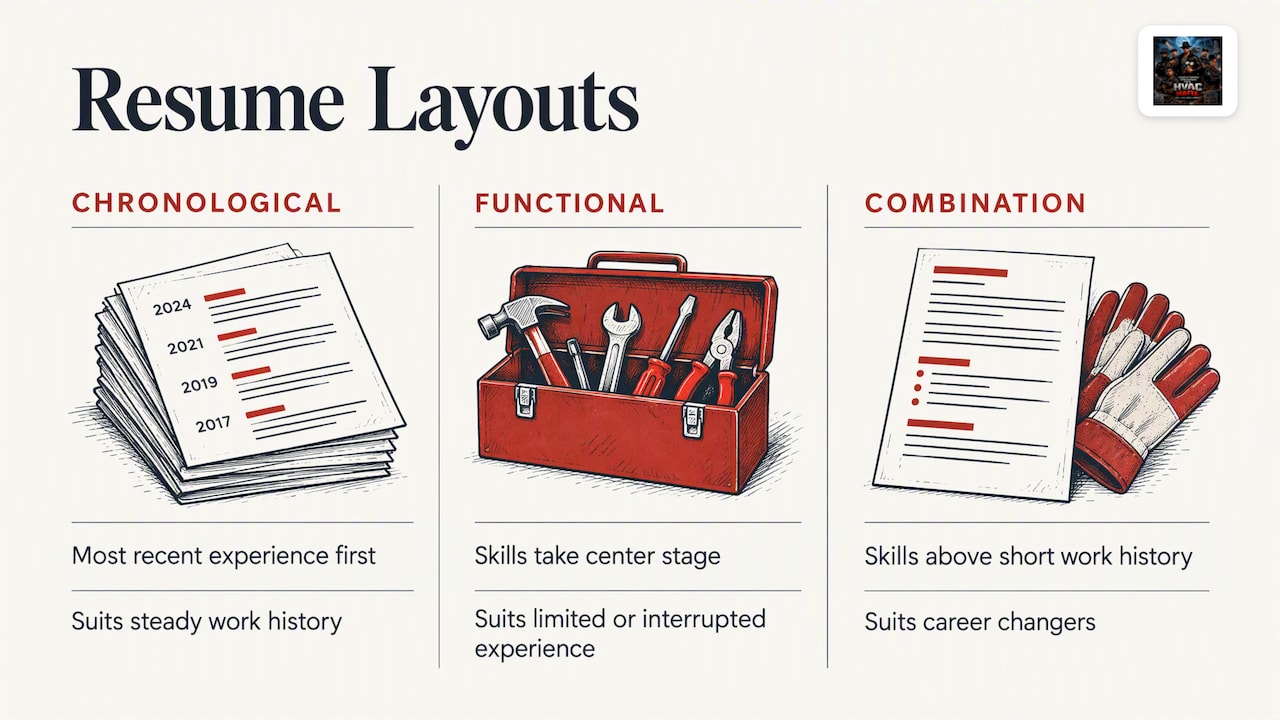
There are three common layouts: chronological, functional and combination. Chronological puts your most recent experience first and suits almost everyone with steady work. Functional leans on skills and suits people with limited or interrupted experience. Combination blends both. A career changer coming out of the military or a different trade can use a combination layout, with skills up top and a short work history below. A tech with a clean work record should use chronological and not overthink it.

Three resume structures and their best-fit candidates

Certifications, licenses and training: list them the way employers read them

This is where most HVAC resumes win or lose. The Bureau of Labor Statistics says the EPA requires nearly all HVAC technicians to be certified in refrigerant handling, and that certification requires passing an exam. So an employer is looking for it before anything else.

How to write each credential:

  • EPA 608: state the type. “EPA 608 Universal” tells a hiring manager more than “EPA certified.” If you hold Type I, II or III only, list exactly that.
  • NATE: list the specialty (for example, air conditioning service or gas heating) if you hold one.
  • OSHA 10 or 30: include the hour count. It matters to commercial and industrial employers.
  • State or local license: name the level and the state.
  • Driver’s license: a clean license is a real requirement for any tech who drives a service truck. Say so.
  • Manufacturer training: list brand-specific classes if you have them, such as controls or variable-speed equipment.

For each, add the issuing body and the year. For a diploma or trade school certificate, name the school, the program and the date you finished.

How much schooling is typical? The BLS says technicians typically need postsecondary instruction from technical or trade schools or community colleges, with programs generally running from 6 months to 2 years, and that employers sometimes consider candidates whose highest education is a high school diploma. If you are still working out your own timeline, our guide on how long it takes to get HVAC certified lays it out.

Technical skills that earn interviews

Keep the skills section short and specific. The same template guide lists examples such as refrigerant recovery and charging, brazing, electrical diagnostics, VFDs, BAS and thermostat controls, and Manual J load calculations. Pick the ones you can do and defend in an interview.

A few rules:

  • Match the posting. If the job lists heat pumps, mini-splits and communicating thermostats, those words belong on your page, as long as they are true.
  • Name equipment, not traits. “Hard worker” tells nobody anything. “Diagnosed and repaired residential split systems and packaged rooftop units up to 20 tons” does.
  • Group them. Residential service, light commercial, refrigeration, controls and tools can each get a short line.
  • Do not pad. If you have never touched a chiller, leave it off. Someone will ask you about it.

How to write your experience bullets

The NAHB guide says to describe accomplishments or skills gained instead of tasks, and to put numbers on results. That is the single biggest upgrade most tech resumes need. “Responsible for service calls” is a duty. “Ran 6 to 8 residential service calls a day with a high first-visit fix rate” is a result.

Each job entry needs a title, employer and location, dates in month and year, and bullets. For length, one HVAC service technician guide suggests five to eight bullets for your most recent role and three to five for older ones, with a summary of two to three sentences. Apprenticeships, hands-on training and work placements count as experience if you are early in your career.

Numbers a tech can actually use

Field work is easy to measure when you know where to look. The template guide points to metrics like first-visit fix rate, calls per week, installs per year and tonnage serviced. Others that carry weight:

  • Callback rate or number of repeat visits
  • Maintenance agreements you sold or renewed
  • Install crew size you worked on or led
  • Number of apprentices you trained
  • Equipment tonnage or number of units on a commercial route
  • Average ticket or revenue per call, if your company shares it

If you do not know an exact figure, estimate honestly and keep it modest, or ask your service manager. Do not invent numbers. Hiring managers in this trade talk to each other.

Before and after

Weak bullet Stronger bullet
Did maintenance on HVAC systems Performed seasonal tune-ups on 12 to 15 residential systems per week, cleaning coils and checking charge and airflow
Installed furnaces and AC units Installed 150+ split systems per year as part of a three-person crew, from line set to startup
Good with customers Explained repairs and options on site, helping convert repair calls into maintenance agreements
Worked on commercial equipment Serviced rooftop units and chillers across 40 light-commercial accounts, 5 to 50 tons

Every number above is a placeholder showing the shape. Swap in your own.

Example: experienced service technician

Here is a sample you can model. Replace every detail with your real information.

Jordan Reyes | Tampa, FL | 555-555-0142 | jordan.reyes@email.com

Summary: Residential and light commercial HVAC service technician with 9 years of field experience, EPA 608 Universal and NATE certified. Strong diagnostics on heat pumps, split systems and rooftop units. Comfortable running calls solo and on-call rotation.

Certifications: EPA 608 Universal (2017) | NATE Air Conditioning Service (2019) | OSHA 10 (2021) | Florida Class B license (2022) | Valid driver’s license, clean record

Technical skills: Refrigerant recovery and charging | Brazing | Electrical and compressor diagnostics | Variable-speed and communicating systems | Smart thermostat setup | Airflow and static pressure testing

Experience

Service Technician, Coastal Comfort Heating & Air, Tampa, FL (03/2019 to Present)

  • Run 6 to 8 service calls a day across residential and light commercial accounts, with a first-visit fix rate above 85% (confirmed with dispatch).
  • Diagnose and repair heat pumps, split systems and packaged rooftop units up to 15 tons.
  • Sell and renew maintenance agreements, adding roughly 60 members in 2025.
  • Mentor two apprentices on brazing, gauge reading and customer communication.
  • Reduce callbacks by documenting readings and photos on every ticket.

Installer, Bayshore Air Systems, Tampa, FL (06/2016 to 02/2019)

  • Installed 120+ residential systems per year with a three-person crew.
  • Handled line sets, pressure testing, evacuation and startup.
  • Passed all inspections on first visit across my final 18 months.

Education: Hillsborough Community College, HVAC Certificate (2016)

Notice what this does. Credentials are in one scannable line. Bullets name equipment and results. Dates are month and year. There is no fluff.

Example: entry-level tech or apprentice

If you do not have years of field work, do not apologize for it. Danfoss, in its HVACR resume guide for students, advises entry-level candidates to lead with EPA 608 and trade school training, including lab hours and coursework, then frame helper or maintenance work in terms of results. It also suggests featuring tools you can use and OSHA 10.

Here is how that looks in practice:

  • Summary: Recent HVAC program graduate with EPA 608 Universal certification and 600 hours of hands-on lab training. Reliable, punctual and eager to learn residential service and installation.
  • Certifications: EPA 608 Universal | OSHA 10 | Valid driver’s license
  • Training: Program name, school, graduation date, and a line on lab work, such as refrigerant recovery, brazing, and electrical troubleshooting on training units.
  • Experience: Helper, warehouse, maintenance, or any trade job. Show what you did with numbers: “Loaded and organized truck stock for a 6-van fleet daily, cutting missing-part delays.”
  • Tools: Gauges, multimeter, recovery machine, torch, tubing tools, whatever you can use confidently.

For an apprenticeship application specifically, pull keywords from the job description, add quantified achievements where you can, keep the layout neat, and proofread before sending. A typo on a trades resume tells a manager how you will fill out a work order.

Tailor it to the job: service, install, commercial and refrigeration

One generic resume sent to fifty shops does worse than three targeted versions sent to ten. Keep a master document with everything, then trim.

  • Service technician: lead with diagnostics, first-visit fix rate, customer communication, maintenance agreements. Service managers want someone who can run a ticket from arrival to payment. See a few real examples of what contractors post in listings like this service technician opening in Spring, TX or this service technician role in Loveland, CO.
  • Installer or lead installer: lead with installs per year, crew size, system types, permitting and inspection pass rate. Compare against a posting such as this install lead technician opening in Sharonville, OH to see which skills employers name.
  • Commercial and refrigeration: name the equipment (rooftops, chillers, walk-ins, reach-ins), tonnage, controls platforms, and safety training like OSHA 30.
  • Apprentice: training hours, EPA 608, attendance, and willingness to learn.

Also reflect the realities of the job. CareerOneStop notes that technicians must follow government regulations on handling and disposing of fluids and pressurized gases and on refrigerant recycling. If you have a clean record on refrigerant logs and compliance paperwork, say so. The same source describes work in cramped spaces, in high heat or deep cold, where heavy equipment can cause injuries. A line about your safety training, such as OSHA 10 or a clean safety record, speaks to that directly.

Make it ATS-friendly and avoid common mistakes

Many mid-size and large contractors use applicant tracking software to sort resumes before a human sees them. You do not need tricks. You need clarity.

  • Mirror the posting. If it says “BAS controls” or “mini-split installation,” use those words if they apply to you. The template guide recommends mirroring the equipment and controls language in the posting.
  • State the EPA 608 type rather than just “EPA certified.”
  • Use real numbers. Round, honest figures beat fake precision.
  • Format dates consistently. Month and year throughout. A HVAC resume guide from Rezoom lists consistent dates and honesty about seasonal work among the expectations in this trade. If you were laid off in the slow season or worked winters elsewhere, say it plainly.
  • Use a simple layout. Standard fonts, clear headings, no text boxes, no photos, no graphics. Save as PDF unless the application asks for Word.
  • Skip the objective statement. “Seeking a challenging position” says nothing. Use the summary instead.
  • Proofread out loud. Then have someone else read it.

A practical example resume also puts credentials and equipment scope near the top, then names systems and tonnage, refrigerants and tools, and measurable outcomes like first-time-fix or callback rate. Add field qualities such as customer communication and comfort working independently or on call.

Our perspective: a resume is half the story

We have been in this trade a long time, and we have sat on both sides of the hiring table. Our founder spent 36 years as an HVAC veteran and a dealership owner. Here is what we know: a good resume gets you a conversation, but the right employer keeps you.

Too many techs send out resumes blind and take the first offer. Then they find out the pay was vague, the truck was a wreck, and nobody invested in training. We think you deserve better. You should be able to compare real openings from real contractors, ask other techs what a shop is like, and pick a place where you can build a career, not just another paycheck.

That is why HVAC Mafia is a trade-only community with job openings visible to registered members, a Tech Talk forum where techs talk straight about pay and employers, and Company Spotlight profiles where shops show their culture, pay and benefits. Our listings and discussions are restricted to verified HVAC trade professionals, so there is no homeowner or outsider noise. Use your resume to show what you can do. Use the community to find out where it will be respected.

the author

Put your resume to work

A finished resume does nothing sitting in a folder. Register as a member of HVAC Mafia and you can see openings from real contractors, including service, install, commercial and refrigeration roles. Membership is free for technicians, apprentices and trade school students.

Make HVAC Great Again™ Front  HVAC Mafia Back T-Shirt

Ready to use it? Join HVAC Mafia as a member, then match your resume to the openings that fit. Compare how employers word their postings, and tailor each version. For example, here is how a contractor describes a service technician role near Jupiter, FL.

A final checklist before you hit send

  • Is it one page (or two only for a senior commercial role)?
  • Are EPA 608 type, NATE, OSHA and license level easy to spot?
  • Does every job have month and year dates?
  • Does each recent bullet show a result or number?
  • Did you use the equipment and controls words from the posting?
  • Is your email professional and your voicemail set up?
  • Did someone else proofread it?
  • Can you talk through every line in an interview?

That last one matters most. Everything you list is something a service manager can ask about on a ride-along.

FAQ

How long should an HVAC technician resume be?

One page is the standard for almost every tech. Two pages can work for senior commercial roles with a long list of projects and certifications. If you have to cut, drop older, unrelated jobs before you drop recent results.

What certifications should I list first?

Start with EPA 608 and state the type, since the BLS says nearly all HVAC technicians need refrigerant-handling certification. Then add NATE, OSHA 10 or 30, and your state or local license level. Put them in a short block near the top so they are easy to find.

What if I have no HVAC experience?

Lead with your trade school training, lab hours and EPA 608 if you have it. Then show results from any helper, maintenance, warehouse or other hands-on work. Add the tools you can use and OSHA 10 if you hold it.

Should I use a resume template?

A simple template is fine if it is clean, one column and easy to read. Avoid graphics, photos and text boxes that confuse applicant tracking systems. Fill it with your own specific numbers and equipment, because the content is what gets you the call.

Sources

Made with BabyLoveGrowth, an AI SEO writer

How Long Does It Take to Get HVAC Certified?

It depends on which certification you mean. The EPA refrigerant exam you need to start working can be done in a few weeks. A school program usually runs 6 months to 2 years. A full apprenticeship usually takes several years. Most techs end up doing more than one of these, and they overlap more than people expect.

We built HVAC Mafia for techs who want straight answers, so here’s the breakdown by path, with real timelines and what each one gets you.

Thehvacmafia
Find Your Next HVAC Opportunity
Explore HVAC job openings and get straight talk on career paths, certifications, pay, and what to look for in an employer.

Explore HVAC jobs

TL;DR

  • EPA 608 is the federal certification you need to handle refrigerants. It’s a test, not a course, so it can take as little as a few weeks of studying.
  • Trade school or a certificate program generally takes 6 months to 2 years, depending on the school and whether you go full time.
  • Apprenticeships usually last several years, but you’re paid while you learn.
  • NATE and state licenses come later. NATE expects experience first, and licensing rules depend on your state or city.

Table of Contents

First, what “HVAC certification” actually means

People use the phrase for four different things, and that’s why the answers online look so inconsistent.

  1. A school certificate or diploma. This is proof you finished a training program. It’s not a license and no law requires it.
  2. EPA Section 608 certification. This one is federal. It covers handling refrigerants.
  3. Industry certifications like NATE. These are voluntary, and some employers prefer them.
  4. A state or local license. Some places require one to do HVAC work or to run your own shop.

When a school says “you’ll be certified in 9 months,” it’s usually talking about the first item, maybe with an EPA exam bundled in. Keep the four separate in your head and the timelines make sense.

The timeline at a glance

Path Typical time What you get Required by law?
EPA Section 608 exam Weeks of study, then one test Lifetime refrigerant credential Yes, to handle refrigerants
Certificate or associate program 6 months to 2 years Classroom and lab training No
Registered apprenticeship Several years (average 4.2 in construction) Paid training, mentoring, a recognized credential No
NATE certification Usually after 6 months to 2 years in the field Industry-recognized credential No
State or local license Varies by place Legal authority to work or contract In some states and localities

The sections below explain each row.

EPA 608: the fastest certification, and the one you can’t skip

If you will maintain, service, repair or dispose of equipment that could release refrigerants, the EPA says you must pass an approved Section 608 test given by an EPA-approved certifying organization. There’s no required class and no required number of hours in a classroom. It’s an exam.

That’s why the time varies so much. A tech who already works around refrigerant every day might study a couple of weeks. Someone coming in cold may need longer to get comfortable with the regulations, recovery rules and leak-repair requirements.

A few things worth knowing:

  • It doesn’t expire. According to the EPA, credentials do not expire, so you only do this once.
  • Universal is the one most techs want. It covers all equipment types, and the EPA says Universal certification requires a proctored Core test.
  • Online testing exists. The EPA keeps a list of approved certifying programs, and some of them offer remote or online testing. The EPA does not approve study materials, so check that the organization giving the test is on that list.

Can you work before you’re certified?

Yes, in the right setup. The EPA exempts apprentices from Section 608 certification while they’re closely and continually supervised by a certified technician. That is how many people start: hired as a helper, working alongside a certified tech, taking the exam when ready.

Don’t treat that as a reason to put the exam off for a year, though. Showing up to an interview already holding your 608 puts you ahead of other entry-level applicants.

HVAC school and certificate programs: 6 months to 2 years

The Bureau of Labor Statistics says HVAC programs at technical schools and community colleges generally last 6 months to 2 years. It also lists a postsecondary nondegree award as the usual entry-level education for the occupation.

Where you land in that range depends on a few things.

Certificate versus associate degree

A certificate or diploma focuses on the trade itself: electrical basics, refrigeration cycle, airflow, heating systems, controls. It sits at the short end of the range. An associate degree adds general education courses and takes closer to two years. For most techs headed to the field, the certificate is enough. The degree makes more sense if you’re thinking about management, estimating or controls work down the road.

Full time or part time

Full-time students can finish a certificate in under a year. Evening or weekend programs for people who already have a job stretch it out, sometimes to 18 months or more. Neither is better. The right one is the one you’ll actually finish.

Start dates and seasonal classes

Some schools start a new class every month. Others only start in fall and spring. If you miss a start date, you could wait months before you even begin, so ask about the next cohort when you call.

What the school gets you, and what it doesn’t

School gives you the fundamentals and lab time on real equipment. It does not give you years of troubleshooting experience. BLS notes that new technicians typically work alongside experienced technicians and go through a lengthy period of on-the-job training after they’re hired. Plan on learning the real trade on the truck, whatever school you pick.

Apprenticeships: longer, but you get paid

If you can’t afford to sit in a classroom full time, an apprenticeship may be the better route. The U.S. Department of Labor describes registered apprenticeship as paid employment that combines classroom instruction with on-the-job learning.

The time commitment is longer. In the Department of Labor’s American Apprenticeship Initiative data, the average time from start to end was 2.7 years overall and 4.2 years in construction. The Department also says program length varies with the employer, the complexity of the occupation, the industry and the program type, so ask any program for its exact hours.

What you get for that time, according to the Department of Labor:

  • Paid work from day one
  • Progressive wage increases
  • Structured mentoring
  • Classroom education
  • A portable, nationally recognized credential

The real question isn’t “which is faster.” School is faster to finish. An apprenticeship gets you earning sooner and usually leaves you with less debt. Many techs do a bit of both: a short certificate program, then a job that trains them up on the truck.

NATE certification: it’s about experience, not just studying

NATE is the best-known industry certification, and it’s voluntary. Because it tests real-world knowledge, NATE itself recommends experience before you sit for its exams: 6 months to 1 year for the HVAC Support Technician certificate, and 2 years for the CHP-5 or traditional certification exams.

There are two main pathways. The traditional one requires a Core exam plus a Specialty exam. The CHP-5 pathway is five exams covering HVAC fundamentals, electrical and controls, comfort and airflow, installation, and service.

If you’re newer than that, NATE also offers Ready-to-Work and HVAC Support Technician credentials for technicians with less than 2 years of experience. So realistically, NATE is something you plan for in your first two years on the job, not something you finish before you apply.

BLS says many manufacturer and industry certifications are optional, although some employers prefer or require specific types. Before you pay for one, check the postings of the companies you’d like to work for and see what they ask for.

State and local licensing: the wild card

This is the part that can change your timeline the most. BLS says some states and localities require HVAC technicians to be licensed and tells applicants to check with their state and local authorities.

Licenses often hinge on documented experience, not a course. Wisconsin is one example. Its code says applicants for the HVAC qualifier exam need at least 1,000 hours per year for at least 4 years of qualifying experience, 4 years of qualifying school attendance, or a combination of the two. Other states set different numbers, and some have no statewide license at all.

Before you plan anything, call your state licensing board or look at its website. Ask two questions: what do I need to work as a technician, and what do I need to contract on my own?

A realistic timeline for someone starting from zero

Here are three common ways it plays out. These are illustrations of how the pieces fit together, not promises.

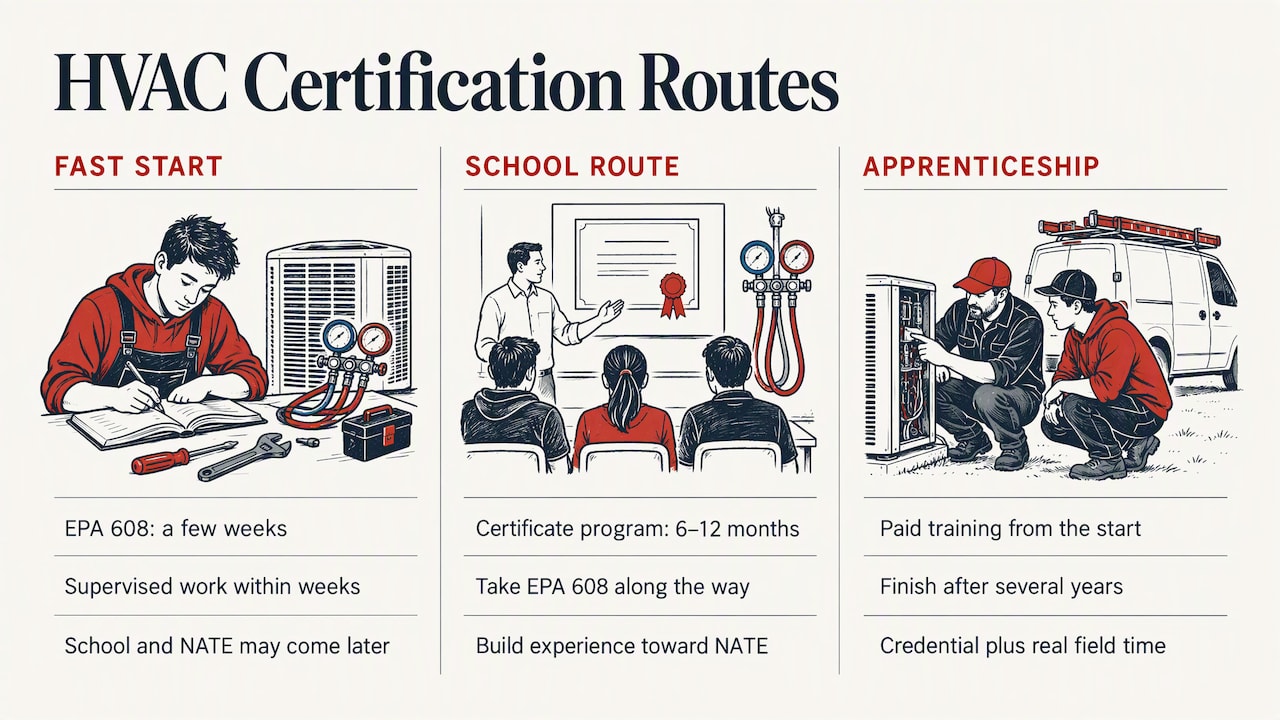
Three HVAC training routes and timelines

The fast start. You study for and pass the EPA 608 in a few weeks, then apply for helper or apprentice jobs. You’re working under a certified tech within weeks. School and NATE come later, if at all.

The school route. You enroll in a certificate program that runs 6 to 12 months. Along the way you take the 608. You graduate with a certificate and the EPA credential, then start as an entry-level tech and spend the next couple of years building the experience that makes NATE realistic.

The apprenticeship route. You join a registered apprenticeship. You’re paid from the start, take classes along the way, and finish after several years with a credential and real field time. The EPA exemption for supervised apprentices applies during the early stretch, but you still want the 608 in hand early.

In all three, most of what makes you valuable comes from time in the field. Certifications open the door. Experience is what gets you paid like a pro.

Is HVAC certification worth it?

Short answer: the EPA 608 is a must-have, and the rest depends on your goals.

Here are the facts. BLS reports 2025 median pay of $61,010 for heating, air-conditioning and refrigeration mechanics and installers. A year earlier, BLS reported a median of $59,810. That’s a median, so half of techs earn more and half earn less, and where you fall depends on your market, your specialty and your employer.

The 608 is worth it because the work is off-limits without it, and the exam is a small investment of time. School is worth it if you want structure and don’t have a mentor lined up. An apprenticeship is worth it if you need income while you learn. NATE is worth it when your employer values it or you want to prove skill in a specialty. Ask around first, because some shops reward it and others don’t care.

Where certification fits in the job hunt

If you’re searching for work, certification affects which jobs you can apply for and how much you start at. Many shops list the EPA 608 as a minimum. Some list NATE as a plus. Others will train the right person with no credentials.

On HVAC Mafia, you can see what real contractors are asking for. Look at a posting like this HVAC service technician role in Charleston, SC or a lead installer opening in Westchester, NY and compare the requirements with what you have. It’s a quick reality check on how much of the certification stack you actually need for the job you want.

What we think, from the trade

We’ve seen this question from both sides of the table. A lot of people ask how fast they can get certified, when the better question is what they want to be doing in five years.

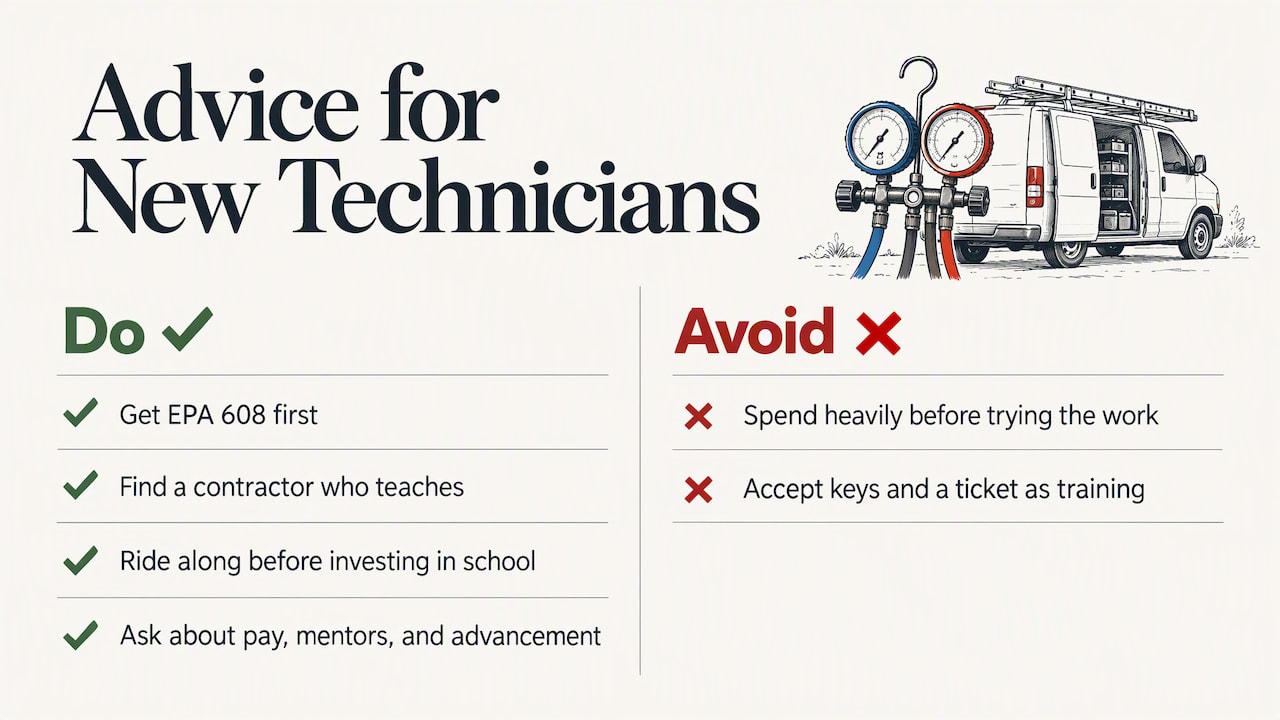
Here’s what we’d tell a new tech sitting at our kitchen table. Get your EPA 608 first. It’s quick, it’s required, and it’s yours for good. Then find a contractor who’ll teach you, because the shop you land in matters more than the paper on the wall. A good employer pays you to learn, puts you with a patient lead tech and talks openly about where you can go. A bad one hands you keys and a ticket and calls it training.

What we think, from the trade — overview diagram

School is a fine start, and so is an apprenticeship. We just don’t think anyone should spend two years and a pile of money before they’ve ridden along on a single service call. Try the work, then decide how much more paper you need.

And don’t ignore what you’re walking into. Ask about pay, about who your mentor will be and about what the path from apprentice to lead tech looks like. That’s why we built this community: so techs can talk straight to each other about what’s real. Build a career, not just another paycheck.

— the author

Find your first HVAC job with us

Once you’ve got your 608, or you’re close, the next step is finding a contractor worth working for. Registering with HVAC Mafia is free for technicians, and job openings from real contractors are visible to members. You’ll also get straight talk on pay and career paths, plus the Tech Talk forums.

HVAC Travel Mug — 25 oz Stainless Steel | HVAC Mafia

Join as a member and see who’s hiring near you. If you’re a contractor trying to hire techs, our job posting plans put your openings in front of a trade-only audience.

FAQ

Can I get HVAC certified in a few weeks?

You can get the EPA Section 608 certification in a few weeks, because it’s an exam and not a course. Other credentials take longer. School programs generally run 6 months to 2 years, and apprenticeships usually take several years.

Do I need a certificate from school to get hired?

Not always. BLS says employers sometimes consider candidates whose highest education is a high school diploma, and new hires typically work alongside experienced techs. Having your EPA 608 and some training will make you a stronger applicant.

Does the EPA 608 certification expire?

No. The EPA says Section 608 credentials do not expire. You only need to pass the test once, and Universal certification requires a proctored Core test.

Do I need a state license too?

It depends on where you work. BLS says some states and localities require licenses, so check with your state and local authorities before you plan your timeline.

How long should I work before going for NATE?

NATE recommends 6 months to 1 year of experience for its HVAC Support Technician certificate and 2 years for CHP-5 or traditional certification exams. If you have less than 2 years, it also offers Ready-to-Work and HVAC Support Technician credentials.

Sources

Made with BabyLoveGrowth to build domain authority

HVAC Technician Recruitment: How Contractors Hire and Keep Techs

Good HVAC technician recruitment starts with a simple fact: the techs you want already have jobs, and they will only look at yours if it is easy to find, honest about pay, and posted where techs actually spend time. Post a vague ad on a general job site and you get a pile of résumés from people who have never touched a manifold gauge. Post a clear, specific opening in front of the trade and you get calls from people who can run the work. This guide covers how to do it, whether you are hiring service techs, installers, apprentices or refrigeration techs.

Thehvacmafia
Put Your Opening in Front of HVAC Techs
HVAC Mafia connects contractors with a trade-only audience, so your job opening can reach technicians looking for their next opportunity.

Visit HVAC Mafia

TL;DR

  • Techs compare total compensation, schedule, training and culture, so your posting needs real numbers and real details, not slogans.
  • Know the certification baseline: EPA Section 608 is required for nearly everyone touching refrigerants, and NATE is a strong signal of skill.
  • Apprentices are your pipeline. A structured path with supervision and rising wages keeps them.
  • Retention is recruiting. The best hire is the one who never leaves, so fix scheduling, on-call and growth paths first.
  • Post where the trade is. A trade-only audience beats a general board full of outside noise.

Table of Contents

Why hiring techs feels so hard right now

We hear the same complaint from contractors every week: “There are no techs out there.” We have a different read. We wrote about it in HVAC hiring is not a labor shortage, it is a connection problem. Plenty of skilled people work in this trade. Many are happy enough where they are, and many are quietly looking. They just are not seeing your opening, or they see it and can’t tell whether you are worth the move.

Demand is real, though. The Bureau of Labor Statistics reports that the median annual wage for heating, air conditioning and refrigeration mechanics and installers was $61,010 as of May 2025, with the lowest 10 percent earning under $40,050 and the highest 10 percent earning over $95,210. That spread is your opportunity. Techs at the top of it are not sitting on job boards waiting for a $20 an hour offer.

Know who you are actually hiring

“HVAC tech” covers a lot of ground. Before you write anything, decide which seat you are filling.

  • Residential service tech: diagnoses and repairs in homes, talks to customers, often runs calls alone.
  • Installer or lead installer: changeouts and new systems, heavy on electrical, brazing, ductwork and crew leadership.
  • Commercial tech: rooftop units, chillers, controls, larger systems and more complex troubleshooting.
  • Refrigeration tech: walk-ins, reach-ins, racks and supermarket or food-service systems.
  • Apprentice or helper: learning the trade, needs structure and a person to learn from.

The BLS describes the work as installing, maintaining and repairing heating, cooling and refrigeration systems in homes, schools, hospitals and other buildings. Your posting should say which part of that you mean. A refrigeration tech reading “HVAC technician wanted” will often scroll past. A commercial refrigeration tech reading “service tech for walk-ins and racks, no residential calls” will stop.

The certifications that matter when you screen

EPA Section 608

This one is not optional. The EPA says technicians who maintain, service, repair or dispose of equipment that could release refrigerants must pass an EPA-approved test for Section 608 certification. Apprentices are exempt only when they are closely and continually supervised by a certified technician. The agency also says anyone servicing, installing or disposing of stationary appliances, except disposal of small appliances, must be certified.

Practical takeaway: ask for the certification card at the interview, and plan to get your apprentices tested early. It protects you and speeds up how fast they can run calls alone.

NATE

NATE is not a legal requirement, but it is a useful signal. The Department of Energy says NATE has certified over 35,000 technicians and maintains over 5,500 registered contractors. It also notes that contractors prefer NATE-certified techs because they tend to be more productive, have proven knowledge and stay in the industry longer. If you pay for NATE testing and tell candidates so, you stand out.

State and local licenses

The BLS notes that some states and localities require a license. Rules differ widely, so say in the posting whether you need a license on day one or will help the hire get one. That one line saves you a lot of unqualified applications.

What techs want to see in a job posting

Most postings read the same: “competitive pay, great benefits, fun team.” Techs have learned to ignore all of it. The ones that get attention name specifics. Here is how one real employer posting reads: it lists overtime eligibility, uniforms, a boot voucher, a company vehicle and tools, optional weekly training, insurance, an HSA, a 401(k) with a 4% company match, paid time off and holidays, a referral bonus and disability coverage. You can disagree with any single item, but a tech can picture the job from that list.

NATE’s own advice to job seekers lines up with that. It tells techs to ask about continuing education, certification support, career paths, equipment, on-call work, overtime and scheduling, mentorship and hands-on training. If your posting answers those questions before they are asked, you are ahead of most of the shops you compete with.

A checklist for every posting

  1. A pay range, in dollars. Hourly, salary or commission, plus what is realistic with spiffs and overtime.
  2. The schedule. Hours, weekends, how on-call rotates and how it is paid.
  3. The equipment. Truck, tools, tablet, diagnostic gear. Is the truck take-home?
  4. The training. Who mentors, how often, and who pays for certifications.
  5. The path. Where does a tech go in two years: lead tech, trainer, service manager?
  6. The type of work. Replacement-heavy, service-heavy, new construction, commercial, refrigeration.
  7. The location. City and service area, not just “Southeast.”

Notice what is not on the list: mission statements and buzzwords. Techs want to know what a Tuesday looks like.

Apprentices are your pipeline

If you only hire fully trained techs, you are fishing in the smallest pond and competing on price. Growing your own is slower but it is how shops build loyal crews.

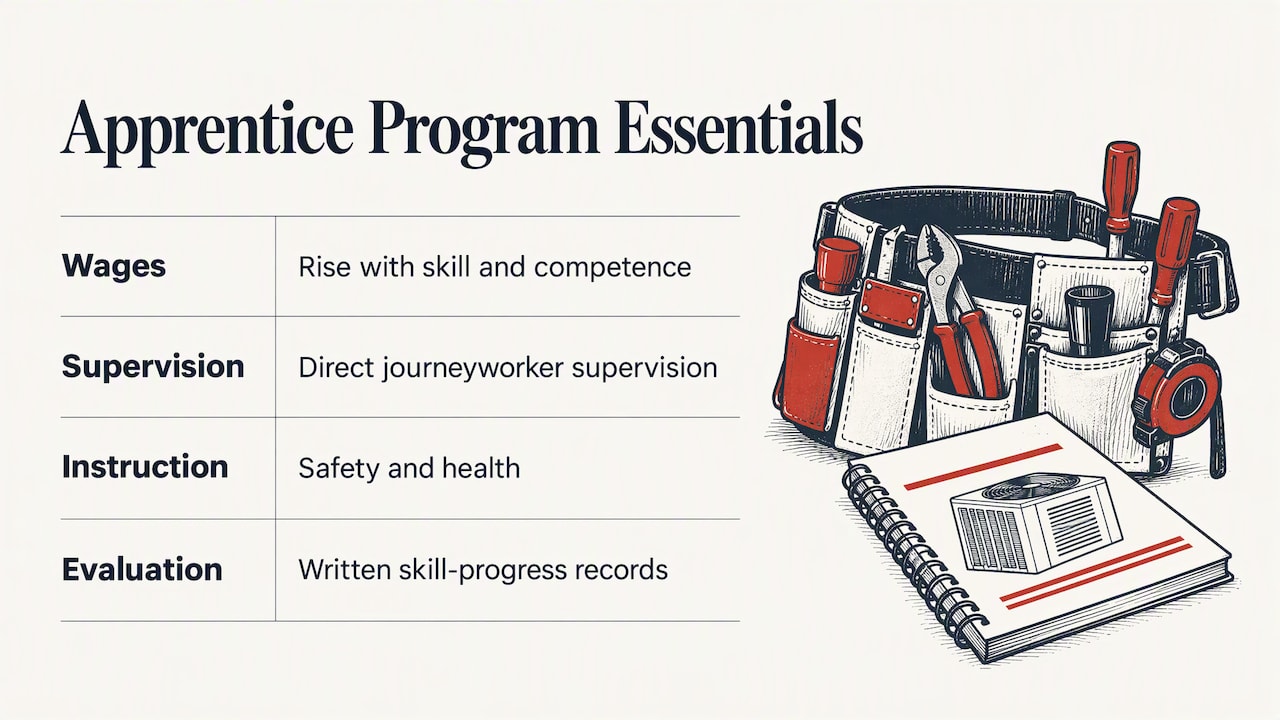
A structured program is not just good will. The Department of Labor’s apprenticeship standard calls for progressively increasing wages based on skill and competence, direct supervision by journeyworkers, safety and health instruction, and written progress evaluation records. That is a decent skeleton for any in-house program, registered or not: a clear wage ladder, a named mentor, and a written record of skills mastered.

Apprenticeship progression and support framework

Trade schools help too. The Department of Energy’s 2023 STEP recognition highlighted a career center whose HVAC program has a 97% job placement rate for students who complete it. Build relationships with instructors in your area. Show up, bring a truck, talk about what the job is really like, and offer ride-alongs.

Training format matters as well. A DOE heat-pump training report recommends online, self-paced courses to address time constraints, and the same assessment identifies bus passes, child care and stipends as resources that may help people finish training. For a shop, that translates to flexible learning time, paid study hours, and removing the small barriers that push a good apprentice out.

The same DOE highlight found that smart diagnostic tools can halve the time it takes new technicians to become proficient. If you are bringing in newer techs, tools like that shorten the gap between hire and productive.

Apprentice learns heat pump diagnostics

Recruiting refrigeration technicians

Refrigeration is a different pool. The skills (rack systems, controls, food-safety urgency, emergency calls) do not map neatly onto residential comfort work, and many refrigeration techs think of themselves as separate from HVAC. A few things help:

  • Say “refrigeration” in the title and the first line, with the equipment types you service.
  • Be honest about emergency calls and how the rotation works. Refrigeration failures do not wait for business hours.
  • Offer a way in for HVAC techs who want to cross over, with training and mentorship.
  • Confirm Section 608 certification type, since it applies to anyone working on equipment that can release refrigerant.

Where to post so the right techs see it

There are three broad types of places to find techs: general job boards, your own network, and trade-specific communities. Each has a job.

  • General job boards give reach but also volume. You will sort through a lot of applicants who are not in the trade.
  • Referrals are often your best hires. Pay a referral bonus that is worth a tech’s effort, and pay it promptly.
  • Trade-only boards and communities put your opening in front of people who already work in HVAC and read about it.

That last category is what we built. HVAC Mafia is a job board and community for the trade, founded by a 36-year HVAC veteran and former dealership owner. Our listings and community are restricted to verified HVAC trade professionals, so there is no homeowner or outsider noise. Contractors reach a trade-only audience of nearly 100,000 HVAC followers, and applications go straight to your own hiring system, so you keep your process.

What it costs to post with us

Here is what we publish today. Job posting plans run $199 per month per position on Standard, $149 per month per position on Annual, and from $99 per month per position on Enterprise.

If you want more visibility, Company Spotlight profiles show off your culture, pay and benefits. The Monthly Plan is $149 per month and the Annual Plan is $1,699 per year. For featuring a specific opening, Spotlight pricing is $149 per week per position, $499 per 4 weeks per position, or $349 per month per position on the Ongoing plan.

Techs register for free to see openings, so you are never asking candidates to pay to talk to you.

Make HVAC Great Again™ Trucker Hat – Richardson Style Mesh Cap

Ready to post? Pick a plan on our job posting plans page and put your opening in front of techs who work in the trade.

Our perspective: culture beats copy

We have sat on both sides of this table. As a tech, you remember the shops that treated you like a number. As an owner, you remember the tech who left for fifty cents more an hour and what it cost you.

Here is what we believe, and it shapes everything we do at HVAC Mafia:

  • The trade is not short on people, it is short on connection. Techs with choices want to know who they will work for. That is why we built Company Spotlight profiles: so a shop can show its culture, pay and benefits instead of asking for trust.
  • Pay transparency is not a risk, it is a filter. Post the range. The people who apply are the people you can afford, and they know what they are getting into.
  • Respect is a recruiting tool. Mentorship, a fair on-call rotation, decent equipment and straight answers keep techs. They also tell other techs.
  • Build a career, not just another paycheck. Show an apprentice where lead tech and service manager sit on the map, and many will stay long enough to get there.

No corporate fluff, no shortcuts. Just knowledge, loyalty and respect.

— the author

Retention: the cheaper way to hire

Every tech who stays is a tech you do not have to recruit. Most reasons techs leave are fixable, and none of them are a secret. When techs compare employers, the things they weigh are the same ones HVAC Know It All lists: total compensation, work environment and culture, growth opportunities, work-life balance and job security. Audit your shop against that list.

Ask yourself:

  • Is our pay at or above what the local market pays for the same seat?
  • Do techs know how overtime and on-call are handled before they start?
  • Does every new hire have a named mentor in the first 90 days?
  • Can a good tech see a next step within the company?
  • When someone raises a problem, does anything change?

Run a simple exit and stay interview. Ask your best tech what would make them leave, and ask the one who just left what you could have done. You will hear things that no recruiting ad can fix.

A simple hiring process that respects the candidate’s time

Good techs get calls from several shops. A slow process loses them.

  1. Respond the same day. A phone call within hours beats a polite email in a week.
  2. Keep the first conversation short. Fifteen minutes on experience, certifications and what they want next.
  3. Do a ride-along or shop visit. Let them meet the crew and see the trucks. This is where candidates decide.
  4. Make the offer fast, in writing, with numbers. Pay, schedule, equipment, benefits and start date.
  5. Plan the first week. A tech who spends day one waiting around for a truck is already doubting the decision.

FAQ

Do I need to hire NATE-certified technicians?

No, NATE certification is not a legal requirement. It is a useful signal, and the Department of Energy notes contractors prefer NATE-certified technicians for their productivity and proven knowledge. Section 608 certification is different: the EPA requires it for technicians who work on equipment that can release refrigerants.

Can I hire an apprentice with no experience?

Yes. The EPA exempts apprentices from Section 608 testing only when a certified technician closely and continually supervises them. Plan the supervision, a mentor and a wage ladder before the first day, and get them certified as early as you can.

What should I put in an HVAC job posting?

Put in a pay range, schedule, on-call details, equipment, training support, advancement path and the city or service area. Techs read postings looking for these answers, and a posting that gives them stands out from vague ones.

How much does it cost to post a job on HVAC Mafia?

Job posting plans are $199 per month per position on Standard, $149 per month per position on Annual, and from $99 per month per position on Enterprise. Company Spotlight and Spotlight add-ons have separate pricing, listed on our site. Technicians join and browse openings for free.

How do I find refrigeration technicians?

Name refrigeration in the title and describe the equipment you service. Be upfront about emergency call rotation, and post where trade professionals gather, since refrigeration techs often do not search under general HVAC titles.

Sources

Created using BabyLoveGrowth

The Slow Season Is Coming.

The Slow Season Is Coming. Here’s What the Smart Techs Do in November.

By Randy Castricone, Founder, HVAC Mafia

Every year it’s the same story. Summer runs you into the ground. Sixty-hour weeks, no-cool calls stacked till dark, missed dinners, missed ballgames. Then the first cool front rolls through and the phone goes quiet.

And a week later you’re looking at a schedule with your name on it three days instead of five.

I’ve been in this trade 36 years. For 18 of those I owned a dealership, which means I was the guy making that schedule. So let me tell you what’s going on on the other side of the desk, and what you can do about it before it happens to you.

Shops are still hiring right now all around the country. Register free at thehvacmafia.com to see open role.

1. What your boss is thinking right now

Here’s the truth nobody says out loud. In November, an owner is looking at payroll and looking at the board, and the math doesn’t work. He’s got the same crew he had in July and half the calls.

So he’s sorting. Not by who’s the nicest guy. By who he can’t afford to lose.

The tech who closes maintenance agreements. The one customers ask for by name. The guy who can walk into a heat pump that’s been short-cycling for three visits and fix it on the first trip. Those guys get hours. Everybody else is a line item.

That’s not a knock on owners. I was one. It’s just how the business runs when the phone stops ringing. Your job is to make sure you’re on the first list.

2. Signs your hours are about to get cut

You can usually see it coming if you’re paying attention:

  • The newest guys are suddenly riding along instead of running their own calls.
  • Overtime disappeared before the weather even turned.
  • The office starts talking about “filling the schedule” with tune-ups.
  • Your service manager stops making eye contact when you ask about winter.
  • Nobody’s talking about training, trucks or anything past Christmas.

One of these is noise. Three of them is a forecast.

3. What to do with the downtime

Slow season isn’t dead time. It’s the only time all year you can actually get better without a customer waiting on you. The techs who move up the ladder are the ones who use it.

  • Get the certs you’ve been putting off. If you’re not current on the new A2L refrigerants, that’s first. Nobody’s going to hand the new equipment to the guy who hasn’t been trained on it.
  • Get good at heating and heat pumps. If you’re a summer-only tech, you’re a seasonal tech. Learn the side of the trade that pays in January.
  • Ask for the calls nobody wants. The weird intermittent problems. The commercial rooftop. The callback. That’s where you learn, and that’s where the owner notices you.
  • Learn to talk to customers. The tech who can explain a repair clearly and offer a maintenance plan without sounding like a salesman is worth his weight in gold. Owners know it.
  • Ask your boss straight up: “What do I need to do to be on your full-time list this winter?” Most guys never ask. The ones who do usually get an answer.

Know where the jobs are before you need one. Register free at thehvacmafia.com.

4. How to tell when it’s time to move

I’m not telling anybody to jump ship. Loyalty means something in this trade. It means something to me.

But loyalty runs both ways. If you’re getting cut every November with no plan, no training and no path up, that’s not a slow season. That’s a shop that doesn’t have a plan for you.

Ask yourself:

  • Has anyone here ever sat down with me about where I’m headed in five years?
  • Am I getting trained on anything new, or just running the same calls?
  • Is my pay keeping up with what the shop down the road is paying?
  • Do the good techs stay here, or do they leave?

If the answers are no, no, no and they leave, you already know.

5. The good shops don’t lay off in November

Here’s what nobody tells you. The best shops in this country have the same slow season everybody else does, and they don’t cut their people.

They use the winter to train. They run maintenance programs that keep the board full year-round. They techs get cross trained into heating, IAQ, plumbing or electrical and they plan for the slow season in March instead of panicking in November.

Those shops know what it costs to replace a good tech in April. They’d rather keep you.

Those are the shops we put on HVAC Mafia. Shops that want to hire, and want to keep who they hire.

The bottom line

You can’t control the weather. You can’t control the schedule. You can control whether you’re the tech they can’t afford to lose, and whether you know where the good shops are when it’s time.

That’s what the Family is for. We’ve got your back.

Shops are hiring right now. Register free at thehvacmafia.com to see every open role on the board. Takes a minute. Members only, so the shops see real techs, not scrapers.

No Shortcuts. Just Knowledge. Loyalty. Respect.

Who Taught You? Why the Trade Needs a Real Mentorship Program

Think back to your first week in the trade. You probably didn’t know a service valve from a Schrader core. You carried the ladder and handed over tools, and you stood in a 140-degree attic wondering what you’d gotten yourself into.

Then somebody showed you.

Maybe it was a crusty lead tech who made you check your own superheat three times before he’d look at it. Maybe it was a service manager who stayed late on a Friday to walk you through a wiring diagram. Whoever it was, you didn’t get where you are alone. Somebody reached back and pulled you up.

Here’s my problem. In most of this trade, that happened by luck.

Mentorship by accident isn’t a plan

Right now, whether a new helper grows or quits usually comes down to which truck they get put on. One kid lands with a lead who teaches. Two years later he’s running calls on his own and thinking about his next step. Another kid lands with a guy who treats him like a gofer. He never touches a set of gauges, never learns why anything works, and one day he leaves for a job that at least has air conditioning.

We didn’t lose that second kid because the work was too hard. We lost him because nobody showed him where it leads, and nobody walked him there.

The map is drawn. Now somebody has to walk it with them.

In “Somebody Draw the Map,” I said this trade has a map problem. Young people can’t see a career in HVAC because nobody ever lays it out for them. So I drew one: the ladder, eight rungs from Helper to Owner. Each rung is a real job with real skills. Each one gets you ready for the next.

A map shows you where you can go. It doesn’t get you there. That’s the mentor’s job. Somebody on a higher rung knows the next step because they’ve already taken it. They can tell you when you’re ready and when you’re not, and what you’re missing.

Distribution figured this out a long time ago

Look at the distribution side of our business. For years, the big wholesalers and OEMs have run Leadership Development Programs. It’s a known path: a guy starts out driving a forklift in the warehouse. Somebody sees something in him. He moves to the counter, then inside sales, then outside sales or branch operations. Eventually he’s running a branch, then a region. Some of those forklift drivers end up on the leadership team of a major manufacturer.

That wasn’t luck. The company decided to spot talent early and invest in it. They put people next to leaders who had already done the job, and they built a path with checkpoints along the way. The companies that did it built a bench, so when a leader retired, the next one was already in the building and ready to step in.

Now look at the field side. Our “leadership development program” is usually a ride-along and a prayer.

What it looks like in a shop

This doesn’t take a corporate HR department. It takes intention. A real mentorship program in a contractor shop comes down to a few things:

  • Every new hire gets a named mentor. Not “ride with whoever’s open today.” One person who owns that helper’s growth and whose name is attached to it.
  • Expectations match the ladder. The mentor and the mentee both know what’s needed to move from the current rung to the next one, and they track progress against it.
  • Check-ins happen on the calendar. Fifteen minutes every couple of weeks. What did you learn, what are you stuck on, what’s next?
  • Mentors get recognized for it. Whether that’s a bump in pay, a bonus when their mentee moves up a rung, or just a thank-you in front of the whole shop, teaching should count.
  • Mentorship doesn’t stop at helper. The lead tech moving into a service manager role needs a mentor just as much as the kid on his first week. Probably more. Managing people is a whole different trade, and most of us learned it the hard way.

“I don’t have time for this”

I’ve heard every objection, and I’ve made a few of them myself.

“I don’t have time.” You’re already teaching. You’re just doing it badly, on the fly, in the middle of a call. Putting a little structure around it saves you time.

“I’ll train them and they’ll leave for the shop down the road.” Some will. They’ll leave either way. The difference is whether they leave the trade or just leave your shop. The ones who got real mentoring tend to stay in the industry, send people your way, and a lot of the time they come back. The shops that keep their people aren’t the ones that teach the least. They’re the ones that teach the most.

“Nobody mentored me. I figured it out.” Maybe you did. Now think about the guys who started when you did. How many are still in the trade?

This is on us

To the veterans out there, the 20- and 30-year techs, the service managers who climbed every rung, and the owners who started out holding the flashlight: you carry knowledge that isn’t in any manual. You know what a compressor sounds like right before it fails. You know how to walk into a house and read the homeowner in thirty seconds, and how to tell when a callback is really a sales problem. If you don’t pass that on, it retires when you do.

I’m not asking you to build a corporate program. I’m asking you to pick one. Take one helper and make them yours. Answer their calls, show them the next rung, and tell them the truth when they’re not ready yet.

Somebody reached back for you. Now it’s your turn.

We’re building mentorship into what we do here at HVAC Mafia, and there’s more coming on that soon. In the meantime, head over to Tech Talk and tell the Family who mentored you, what they taught you that stuck, and who you’re bringing up now.

No Shortcuts. Just Knowledge. Loyalty. Respect.

We’re Not Failing to Recruit Them. We’re Failing to Keep Them

Everybody in this trade is talking about the labor shortage. Not enough young people coming in. Nobody wants to work anymore. You’ve heard it at every supply house counter in America.

I’ve been in this trade 36 years, and I’ll tell you what I actually see: we’re getting them in the door. We’re losing them in the first year.

The First Twelve Months

Think about what we hand a kid on day one.

He’s in the attic in July, digging the trench, carrying the condenser, pulling the old system out, hauling the trash, cleaning the truck at the end of the day. He’s doing the hardest, hottest, dirtiest work on the job site — for the least money on the truck.

And nobody has told him why.

So around month eight, his buddy at the warehouse mentions they’re hiring at eighteen an hour, air conditioned, no attics. And he’s gone. We never see him again, and we tell ourselves the younger generation doesn’t want to work.

That’s not what happened. What happened is we let him believe the worst part of the job was the job.

The Trenches Are the Foundation, Not the Destination

Let me be clear about something, because I’m not arguing we should make it easy.

That first year is a rite of passage. It always has been. You learn the equipment by carrying it, learn airflow by pulling duct and why a system fails by being the guy who tears the failed one out. Every good tech I know can tell you exactly what he learned crawling around under a house in August, and most of them are proud of it.

The trenches aren’t the problem. The problem is that we never show them what’s on the other side.

Nobody sat that kid down and said: two years from now you’re diagnosing. Five years from now you’re running your own truck, making six figures on the right pay plan. Ten years from now you’re a comfort advisor, or a service manager, or you own the shop. Nobody drew him the map.

We just handed him a shovel and hoped he’d figure it out.

What Shops Can Actually Do

Assign a mentor on day one. Not a supervisor — a mentor. Somebody whose job it is to answer the dumb questions without making him feel dumb for asking. A tech who quit in month nine almost never had one.

Show them the ladder in writing. What does it take to move up? What does each step pay? If you can’t put it on one page, your people can’t see a future in it, and neither can the kid you’re about to lose.

Tell them why they’re doing it. Explain what the grunt work is teaching. The same task feels completely different when it’s framed as training instead of punishment.

Be honest about the money. The trade has an image problem partly because we’re vague about pay. Young people are more comfortable talking about compensation than we ever were. Meet them there.

Meet Them Where They Are

We also have to stop expecting them to find us.

The kids we need are on TikTok and YouTube watching people do real work. They’re in high school shop classes — if their school still has one. They’re at career days where nobody from our trade bothered to show up.

Get in the high schools. Sponsor the program. Put your best young tech on camera instead of the owner. Show a real service call, a real diagnosis, a real paycheck. The trade sells itself when people can actually see it.

Nobody Should Do the First Year Alone

That’s a big part of why HVAC Mafia exists.

When a first-year guy hits the wall — and he will — he needs somebody who’s been there to tell him it gets better, and to prove it. That’s what Tech Talk is for. Real techs, real answers, no gatekeeping. Ask the question you’re embarrassed to ask your foreman.

If you’re a shop owner: point your new hires here. Give them a place to go on the bad days.

If you’re the guy in the attic right now wondering if this trade is worth it — it is. Find somebody who’s twenty years in and ask them about their first year. Every single one of us has that story.

Then stick around long enough to have one of your own.

No Shortcuts. Just Knowledge. Loyalty. Respect.

Talent Search

The HVAC Hiring Crisis Isn’t About a Labor Shortage—It’s About a Connection Problem

For years we’ve all heard the same thing:

“Nobody wants to work anymore.”

After spending over 35 years in this industry—as a technician, contractor, business owner, manufacturer, and now founder of HVAC Mafia—I can tell you that’s not what I’m seeing.

The problem isn’t that there aren’t talented technicians.

The problem is that the right technicians and the right companies are struggling to find each other.

That was the focus of the latest episode of HVAC Underground.

The Industry Has Changed

Today’s technicians aren’t looking for “just another job.”

They’re looking for a career.

They want to know:

  • Is this company going to invest in me?
  • Can I grow here?
  • Will I be treated with respect?
  • Is there a future beyond being a service technician?
  • Does the company have a culture I actually want to be part of?

Money matters—but it isn’t everything.

The best technicians have options. They’re interviewing your company just as much as you’re interviewing them.


Contractors Need to Stop Hiring Desperately

Too many companies only post a job after someone quits.

The phone starts ringing.

Customers are waiting.

Everyone panics.

Then they hire the first person with a pulse and a set of gauges.

Three months later they’re back looking again.

Great companies recruit continuously.

  • They’re building relationships before they need them.
  • They’re telling their story on social media.
  • They’re investing in training.
  • They’re showing technicians why they should choose their company instead of the one down the street.

Recruiting isn’t an emergency.

It’s a business strategy.


Job Seekers: Don’t Chase the Highest Hourly Wage

This might surprise some people.

The highest hourly wage doesn’t always create the best career.

Ask yourself:

  • Is there ongoing training?
  • Is there a clear path to leadership?
  • Are dispatchers organized?
  • Do managers support their technicians?
  • Is the equipment and technology up to date?
  • Do technicians stay with the company?
  • Is there opportunity to earn more through performance?

The right company will help you make more money over time than simply jumping from employer to employer chasing another dollar an hour.

Think long-term.

Build a career—not just another paycheck.


What Companies Should Be Advertising

Most job postings look exactly the same.

“We’re hiring.”

“Competitive pay.”

“Benefits.”

“401(k).”

That isn’t enough anymore.

Technicians want to know:

  • What makes your company different?
  • What does a typical day look like?
  • What kind of culture have you built?
  • Do you promote from within?
  • What training do you provide?
  • Why do your employees stay?

People don’t join companies.

They join missions.

Tell your story.


HVAC Mafia Exists to Bridge the Gap

That is exactly why I built HVAC Mafia.

We’re creating more than another website.

We’re building a community for the entire HVAC industry.

A place where:

  • Contractors can showcase who they really are.
  • Technicians can discover companies that fit their goals.
  • Industry professionals can connect, learn, and grow.
  • Careers are built—not just jobs filled.

Our job board isn’t simply a list of openings.

It’s becoming a destination where quality companies meet quality people.

Whether you’re looking for your next technician or your next opportunity, HVAC Mafia was built for you.


The Future Belongs to Companies That Invest in People

The technician shortage isn’t going away overnight.

But the companies that focus on culture, leadership, training, and opportunity will continue to attract the industry’s best talent.

Likewise, technicians who invest in learning, professionalism, and continuous improvement will always have opportunities.

The future of HVAC belongs to those who build relationships—not just resumes.


Join the Family

If you’re looking to hire, post your open positions on the HVAC Mafia Job Board.

If you’re looking for your next opportunity, don’t settle for scrolling endless job sites that don’t understand our trade.

Find companies that value what you bring to the table.

And while you’re there, subscribe to HVAC Underground for honest conversations about the challenges, opportunities, and future of our industry.

This industry has given me an incredible career.

Now it’s our turn to make it stronger for the next generation.

We’ll see you on the Job Board.

Welcome to the Family.

The Tariff Tax. Who’s Actually Paying It

The Tariff Tax. Who’s Actually Paying It.

Equipment costs are up 30%. The federal credits are gone. Summer heat is setting records. And the homeowner across the table from you is scared. Here’s how the Family navigates it.

By The Mafia Desk | June 2026 | ~8 min read

THE FIELD REPORT

The call you’re dreading this summer goes like this: homeowner books a tune-up, so you get on the roof or in the attic, and the system is cooked — compressor seized, coil eaten up, a 12-year-old R-22 dinosaur in Florida August. Then you sit down at the kitchen table with your iPad, you pull up a replacement quote, and the number is $18,000. The homeowner’s jaw hits the floor. And they say the same thing every homeowner is saying right now: “That’s twice what I paid last time.”

You’re not wrong. They’re not wrong. But the bill went up because the business of building HVAC equipment got expensive, fast, and for reasons nobody in this industry controls. First, tariffs on steel, aluminum, copper, and imported components hit in waves across 2025 and 2026. Second, the federal tax credits that made high-efficiency systems affordable — the 25C and 25D incentives — expired December 31, 2025, and Congress never renewed them. Third, A2L equipment costs more to produce than the 410A lines it replaces. All three of those tidal waves hit at the same time.

As a result, techs and contractors are fielding sticker shock on every replacement call, while customers, shops, and the economy all push them to fix rather than replace. So this is your Field Report on what’s actually happening, what the money looks like, and how the techs who will still be running strong in 2028 are handling it right now.

The Three Hits That Landed at Once

Let’s be clear about something: the price jump on your customers’ quotes is not one thing. It’s three things, stacked on top of each other, and all of them landed inside a 12-month window. That’s why the sticker shock is so severe. Any one of them would’ve been manageable. But all three together turned every major replacement into a negotiation.

Hit 1 — Tariffs on everything that goes in a box

Manufacturers build HVAC systems out of steel, aluminum, copper, compressors, and control boards. And almost none of that supply chain is domestic end-to-end. Steel and aluminum tariffs running at baseline 10–25% on most imports, with up to 145% on Chinese components, rippled through every manufacturer’s cost structure. Goodman, for example, announced up to 7% increases effective March 2026. Carrier, Trane, Lennox, and Rheem have all moved prices in the last 18 months, some of them multiple times. The manufacturers aren’t hiding it, either — ACHR News published price increase announcements from virtually every major OEM through spring 2026. And that cost lands on your quote sheet, every time.

Hit 2 — The federal credits expired and nobody replaced them

The Inflation Reduction Act’s Section 25C and 25D tax credits gave homeowners up to $2,000 annually on qualifying heat pumps and air conditioners, plus an uncapped 30% credit on geothermal systems worth $8,000–$10,000 on the right install. Then the One Big Beautiful Bill Act terminated both, effective December 31, 2025. Since then, nobody in Washington has introduced a replacement. State and local incentives still exist in some markets, but they’re patchwork, they vary wildly by utility, and the homeowner standing in front of you probably doesn’t know about them. You do — or you should.

Hit 3 — A2L equipment costs more to make

We covered the A2L transition in depth last month. But the cost side of that story deserves a standalone mention here, because A2L-compliant systems are running 15–40% more at the wholesale level than their 410A equivalents, depending on tonnage and efficiency tier. The new refrigerants, the updated coil designs, the leak detection sensors that UL 60335-2-40 requires — all of it adds cost. Meanwhile, the homeowner doesn’t see the engineering. They see the number on your proposal.

Equipment prices are up. Credits are gone. And the tech who can explain the why — not defensively, but clearly, like a professional — is the one who keeps the job. — The Mafia Desk

Repair vs. Replace — The Conversation Is Different Now

Here’s what the data is actually telling us: the repair-vs-replace math shifted, and it shifted in repair’s favor.

The spread that changed everything

By Q4 2025, average HVAC repair costs had dropped 26% below their 2023 peak and were running roughly 6% below 2022 levels. At the same time, replacement system costs went up. That spread — cheaper repairs, more expensive replacements — is driving homeowners to fix things they would have replaced two years ago.

Diagnosticians win. Parts-changers lose.

For the diagnostician on the truck, this is the best market in 20 years. When a tech can walk into a system, run a proper superheat and subcooling check, test the TXV, pull voltage and amperage data, and then come back out with a definitive diagnosis and a repair quote that holds — that tech is printing money right now. Because $900 is not $18,000, the homeowner who was going to replace suddenly gets very interested in a $900 repair on a 10-year-old system.

For the parts-changer, however — the guy who throws a capacitor and a contactor at everything, sends a quote for a new system when diagnostics get complicated, and doesn’t actually understand what he’s looking at — this market is punishing. Customers are asking more questions now. Somebody burned them before. So they’re shopping the quote. And if you can’t explain your diagnosis with confidence and evidence, they’ll find someone who can.

SUMMER 2026 IS ALREADY RUNNING HOT — LITERALLY.

NOAA forecasts above-normal temperatures across most of the country through Q3, with June–August landing in the top-10 probability range for extreme heat in the Southeast, Texas, and the Plains. So record heat plus 110,000 missing techs plus sticker-shocked customers equals the most complex summer service environment in a decade. The prepared crews will run flat out on profitable work. The unprepared will drown. There is no middle lane.

How to Have the Price Conversation Without Losing the Job

Nobody trained you for kitchen table negotiations. But that’s the job now, as much as the gauges are. So here’s what the best contractors in the trade are doing to hold close rates while customers flinch at every number.

Lead with the why, not the price

Before you show a number, spend 90 seconds explaining what’s driving equipment costs right now. Mention the refrigerant changeover, the federal incentives that expired at year-end, and the fact that every brand moved prices. Not defensively — matter-of-factly, the way a doctor explains why your medication costs what it costs. Because the customer who understands why is twice as likely to trust the number. The customer who gets a number with no context just feels like somebody’s taking him for a ride.

Give them real options — not a fake choice

Present repair and replace as genuine options when both are viable. For example, if the system is 15 years old but the repair is real and will hold for 2–3 more seasons, say so. And don’t manufacture urgency you don’t believe. But if the system is genuinely at end of life, make that case clearly with the data: corrosion photos, refrigerant type, energy comparison, and the real math on what another summer of breakdowns costs versus a replacement done right now. Customers respect honest professionals. They resent a sales pitch.

Know the local incentives — and bring them to the table

The federal credits are gone, but utility rebates and state programs still exist across most markets. Even so, many contractors aren’t mentioning them. The ones who do — who walk in knowing the local utility’s rebate schedule, who can quote the net cost after incentives — are closing jobs their competition isn’t. That’s free money sitting on the table for your customer, and it costs you nothing to know about it. So call your utility rep. Check DSIRE.org. It takes 20 minutes, and it’ll make you money for the next six months.

Talk about financing before they ask

Over the past 18 months, contractors who offer financing upfront — before the customer balks — have consistently outperformed their peers on high-ticket replacement jobs. A $17,500 system at $0 down, 18 months same-as-cash, becomes a conversation about a monthly payment instead of a number that looks like a used car. So bring it up early. Make it feel normal. Because for a lot of families, it is the only realistic path to a new system, and helping them get there is part of the job.

// TARIFF FIELD GUIDE // WHAT YOU NEED TO KNOW ON THE TRUCK

Component Tariff exposure Price impact Your move
Compressors (China-sourced) Up to 145% Significant ↑ Expect OEM increases to keep coming; stock common sizes
Steel/aluminum coils 10–25% baseline Moderate–high ↑ Quote from today’s OEM pricing, not last year’s
Control boards Varies by origin Lead times ↑ Order early; some boards run 4–6 weeks behind
Copper line sets Moderate Moderate ↑ Don’t leave line sets on trucks in summer heat
25C/25D credits EXPIRED 12/31/25 −$2,000 to HO Push state/utility rebates; bring them to the table first
A2L-rated equipment Built-in cost add +10–40% vs 410A Explain the transition; set the context before quoting

The Shortage Nobody Fixed

We’ve said it before, and the numbers keep getting worse: the HVAC trade is approximately 110,000 technicians short right now. Industry projections put that number above 225,000 vacant positions by 2027. And for every technician who retires, fewer than one new worker enters the pipeline. In fact, the Bureau of Labor Statistics projects 40,000-plus new openings per year just to replace departures, not counting growth demand.

Here’s what that means this summer, practically. When the thermometer hits 98 and every AC unit in a ZIP code decides to fail on the same Tuesday, there aren’t enough hands. So the contractors who planned ahead — who have a full roster, who have their tools ready, who have their suppliers’ cell numbers — will run flat out on profitable work. Everybody else will turn jobs away or bleed callbacks because they ran their team ragged.

FAMILY BUSINESS

If you’re a shop owner reading this, the labor shortage is your most urgent problem — not tariffs, not A2L, not the digital marketing landscape. After all, a truck without a tech makes zero dollars. Meanwhile, an A2L-certified tech with the right tools in the right market makes both of you money for years. So invest in your people like the asset they are, because if you don’t, someone else will. Right now, the roll-up that just bought your competitor is actively recruiting your team. That is not a drill.

What the Lifers Are Doing

Same format as always. This isn’t inspiration. It’s operating standard.

  • Know the current OEM price sheets cold — your top 3 brands, right now, today. Because quoting from memory on last year’s pricing is how you undersell every job and kill your margin.
  • Carry a local incentive sheet. Know your utility’s rebate program, the current PACE financing options in your county, and any state programs still active. Then print it and show it to customers, because most contractors still aren’t doing this.
  • Sharpen your diagnostic game before the heat hits. Practice full system diagnostics — superheat, subcooling, TXV function, heat exchanger inspection — so that when you’re on call number seven on a 97-degree day, you’re still clean and accurate.
  • Stock your fast-movers before peak. Capacitors, contactors, and the control boards you see most. Tariff-driven backorders are already showing up on some parts, so don’t wait until you need it at 5 p.m. on a Friday.
  • Learn to explain the price without apologizing for it. You are not the one who raised equipment costs. Instead, you’re the one explaining a market reality — clearly, professionally, without squirming. So practice the words until they’re steady.
  • Offer financing as a tool, not a last resort. Bring it up before they hesitate. A customer who says yes to a payment plan says yes to a new system. But a customer who walks away because nobody offered financing is a job your competition is going to close.
  • Document everything on your repairs. Photos of the failed component, micron readings, and refrigerant weights added. Above all, that documentation is your warranty protection, your callback defense, and your reputation. So take 90 extra seconds. Every time.

Nobody said this summer was going to be easy.

But the techs who understand what’s driving the market, who diagnose sharply, explain prices honestly, and bring real solutions to the kitchen table, are the ones who will be busier than they’ve ever been. In short, the same cost environment that’s squeezing the parts-changers is rewarding the professionals. So be the professional.

Stay sharp, certified and in the Family.

— The Mafia Desk | Enforcing Excellence • Creating High Standards | HVAC Mafia // By Lifers, For Lifers


Enable Notifications OK No thanks