
Good HVAC technician recruitment starts with a simple fact: the techs you want already have jobs, and they will only look at yours if it is easy to find, honest about pay, and posted where techs actually spend time. Post a vague ad on a general job site and you get a pile of résumés from people who have never touched a manifold gauge. Post a clear, specific opening in front of the trade and you get calls from people who can run the work. This guide covers how to do it, whether you are hiring service techs, installers, apprentices or refrigeration techs.
TL;DR
- Techs compare total compensation, schedule, training and culture, so your posting needs real numbers and real details, not slogans.
- Know the certification baseline: EPA Section 608 is required for nearly everyone touching refrigerants, and NATE is a strong signal of skill.
- Apprentices are your pipeline. A structured path with supervision and rising wages keeps them.
- Retention is recruiting. The best hire is the one who never leaves, so fix scheduling, on-call and growth paths first.
- Post where the trade is. A trade-only audience beats a general board full of outside noise.
Table of Contents
- Why hiring techs feels so hard right now
- Know who you are actually hiring
- The certifications that matter when you screen
- What techs want to see in a job posting
- Apprentices are your pipeline
- Recruiting refrigeration technicians
- Where to post so the right techs see it
- Our perspective: culture beats copy
- Retention: the cheaper way to hire
- A simple hiring process that respects the candidate’s time
- FAQ
- Sources
Why hiring techs feels so hard right now
We hear the same complaint from contractors every week: “There are no techs out there.” We have a different read. We wrote about it in HVAC hiring is not a labor shortage, it is a connection problem. Plenty of skilled people work in this trade. Many are happy enough where they are, and many are quietly looking. They just are not seeing your opening, or they see it and can’t tell whether you are worth the move.
Demand is real, though. The Bureau of Labor Statistics reports that the median annual wage for heating, air conditioning and refrigeration mechanics and installers was $61,010 as of May 2025, with the lowest 10 percent earning under $40,050 and the highest 10 percent earning over $95,210. That spread is your opportunity. Techs at the top of it are not sitting on job boards waiting for a $20 an hour offer.
Know who you are actually hiring
“HVAC tech” covers a lot of ground. Before you write anything, decide which seat you are filling.
- Residential service tech: diagnoses and repairs in homes, talks to customers, often runs calls alone.
- Installer or lead installer: changeouts and new systems, heavy on electrical, brazing, ductwork and crew leadership.
- Commercial tech: rooftop units, chillers, controls, larger systems and more complex troubleshooting.
- Refrigeration tech: walk-ins, reach-ins, racks and supermarket or food-service systems.
- Apprentice or helper: learning the trade, needs structure and a person to learn from.
The BLS describes the work as installing, maintaining and repairing heating, cooling and refrigeration systems in homes, schools, hospitals and other buildings. Your posting should say which part of that you mean. A refrigeration tech reading “HVAC technician wanted” will often scroll past. A commercial refrigeration tech reading “service tech for walk-ins and racks, no residential calls” will stop.
The certifications that matter when you screen
EPA Section 608
This one is not optional. The EPA says technicians who maintain, service, repair or dispose of equipment that could release refrigerants must pass an EPA-approved test for Section 608 certification. Apprentices are exempt only when they are closely and continually supervised by a certified technician. The agency also says anyone servicing, installing or disposing of stationary appliances, except disposal of small appliances, must be certified.
Practical takeaway: ask for the certification card at the interview, and plan to get your apprentices tested early. It protects you and speeds up how fast they can run calls alone.
NATE
NATE is not a legal requirement, but it is a useful signal. The Department of Energy says NATE has certified over 35,000 technicians and maintains over 5,500 registered contractors. It also notes that contractors prefer NATE-certified techs because they tend to be more productive, have proven knowledge and stay in the industry longer. If you pay for NATE testing and tell candidates so, you stand out.
State and local licenses
The BLS notes that some states and localities require a license. Rules differ widely, so say in the posting whether you need a license on day one or will help the hire get one. That one line saves you a lot of unqualified applications.
What techs want to see in a job posting
Most postings read the same: “competitive pay, great benefits, fun team.” Techs have learned to ignore all of it. The ones that get attention name specifics. Here is how one real employer posting reads: it lists overtime eligibility, uniforms, a boot voucher, a company vehicle and tools, optional weekly training, insurance, an HSA, a 401(k) with a 4% company match, paid time off and holidays, a referral bonus and disability coverage. You can disagree with any single item, but a tech can picture the job from that list.
NATE’s own advice to job seekers lines up with that. It tells techs to ask about continuing education, certification support, career paths, equipment, on-call work, overtime and scheduling, mentorship and hands-on training. If your posting answers those questions before they are asked, you are ahead of most of the shops you compete with.
A checklist for every posting
- A pay range, in dollars. Hourly, salary or commission, plus what is realistic with spiffs and overtime.
- The schedule. Hours, weekends, how on-call rotates and how it is paid.
- The equipment. Truck, tools, tablet, diagnostic gear. Is the truck take-home?
- The training. Who mentors, how often, and who pays for certifications.
- The path. Where does a tech go in two years: lead tech, trainer, service manager?
- The type of work. Replacement-heavy, service-heavy, new construction, commercial, refrigeration.
- The location. City and service area, not just “Southeast.”
Notice what is not on the list: mission statements and buzzwords. Techs want to know what a Tuesday looks like.
Apprentices are your pipeline
If you only hire fully trained techs, you are fishing in the smallest pond and competing on price. Growing your own is slower but it is how shops build loyal crews.
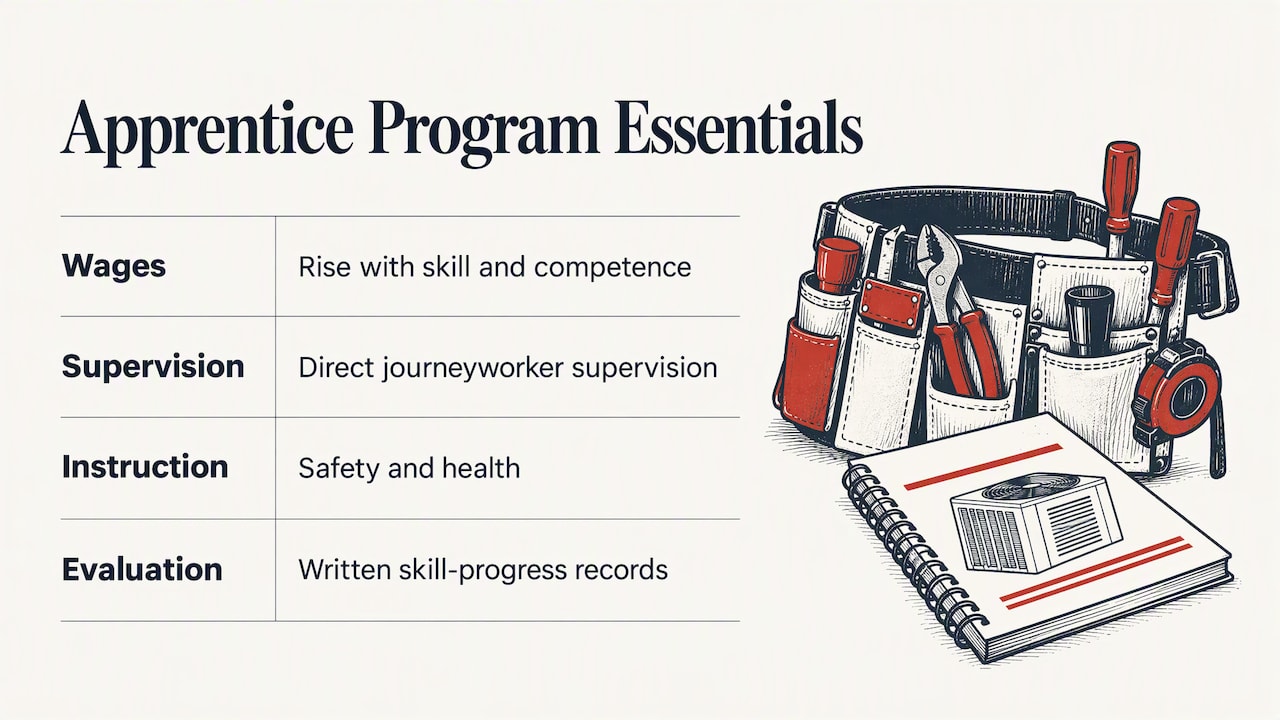
A structured program is not just good will. The Department of Labor’s apprenticeship standard calls for progressively increasing wages based on skill and competence, direct supervision by journeyworkers, safety and health instruction, and written progress evaluation records. That is a decent skeleton for any in-house program, registered or not: a clear wage ladder, a named mentor, and a written record of skills mastered.
Trade schools help too. The Department of Energy’s 2023 STEP recognition highlighted a career center whose HVAC program has a 97% job placement rate for students who complete it. Build relationships with instructors in your area. Show up, bring a truck, talk about what the job is really like, and offer ride-alongs.
Training format matters as well. A DOE heat-pump training report recommends online, self-paced courses to address time constraints, and the same assessment identifies bus passes, child care and stipends as resources that may help people finish training. For a shop, that translates to flexible learning time, paid study hours, and removing the small barriers that push a good apprentice out.
The same DOE highlight found that smart diagnostic tools can halve the time it takes new technicians to become proficient. If you are bringing in newer techs, tools like that shorten the gap between hire and productive.

Recruiting refrigeration technicians
Refrigeration is a different pool. The skills (rack systems, controls, food-safety urgency, emergency calls) do not map neatly onto residential comfort work, and many refrigeration techs think of themselves as separate from HVAC. A few things help:
- Say “refrigeration” in the title and the first line, with the equipment types you service.
- Be honest about emergency calls and how the rotation works. Refrigeration failures do not wait for business hours.
- Offer a way in for HVAC techs who want to cross over, with training and mentorship.
- Confirm Section 608 certification type, since it applies to anyone working on equipment that can release refrigerant.
Where to post so the right techs see it
There are three broad types of places to find techs: general job boards, your own network, and trade-specific communities. Each has a job.
- General job boards give reach but also volume. You will sort through a lot of applicants who are not in the trade.
- Referrals are often your best hires. Pay a referral bonus that is worth a tech’s effort, and pay it promptly.
- Trade-only boards and communities put your opening in front of people who already work in HVAC and read about it.
That last category is what we built. HVAC Mafia is a job board and community for the trade, founded by a 36-year HVAC veteran and former dealership owner. Our listings and community are restricted to verified HVAC trade professionals, so there is no homeowner or outsider noise. Contractors reach a trade-only audience of nearly 100,000 HVAC followers, and applications go straight to your own hiring system, so you keep your process.
What it costs to post with us
Here is what we publish today. Job posting plans run $199 per month per position on Standard, $149 per month per position on Annual, and from $99 per month per position on Enterprise.
If you want more visibility, Company Spotlight profiles show off your culture, pay and benefits. The Monthly Plan is $149 per month and the Annual Plan is $1,699 per year. For featuring a specific opening, Spotlight pricing is $149 per week per position, $499 per 4 weeks per position, or $349 per month per position on the Ongoing plan.
Techs register for free to see openings, so you are never asking candidates to pay to talk to you.

Ready to post? Pick a plan on our job posting plans page and put your opening in front of techs who work in the trade.
Our perspective: culture beats copy
We have sat on both sides of this table. As a tech, you remember the shops that treated you like a number. As an owner, you remember the tech who left for fifty cents more an hour and what it cost you.
Here is what we believe, and it shapes everything we do at HVAC Mafia:
- The trade is not short on people, it is short on connection. Techs with choices want to know who they will work for. That is why we built Company Spotlight profiles: so a shop can show its culture, pay and benefits instead of asking for trust.
- Pay transparency is not a risk, it is a filter. Post the range. The people who apply are the people you can afford, and they know what they are getting into.
- Respect is a recruiting tool. Mentorship, a fair on-call rotation, decent equipment and straight answers keep techs. They also tell other techs.
- Build a career, not just another paycheck. Show an apprentice where lead tech and service manager sit on the map, and many will stay long enough to get there.
No corporate fluff, no shortcuts. Just knowledge, loyalty and respect.
— the author
Retention: the cheaper way to hire
Every tech who stays is a tech you do not have to recruit. Most reasons techs leave are fixable, and none of them are a secret. When techs compare employers, the things they weigh are the same ones HVAC Know It All lists: total compensation, work environment and culture, growth opportunities, work-life balance and job security. Audit your shop against that list.
Ask yourself:
- Is our pay at or above what the local market pays for the same seat?
- Do techs know how overtime and on-call are handled before they start?
- Does every new hire have a named mentor in the first 90 days?
- Can a good tech see a next step within the company?
- When someone raises a problem, does anything change?
Run a simple exit and stay interview. Ask your best tech what would make them leave, and ask the one who just left what you could have done. You will hear things that no recruiting ad can fix.
A simple hiring process that respects the candidate’s time
Good techs get calls from several shops. A slow process loses them.
- Respond the same day. A phone call within hours beats a polite email in a week.
- Keep the first conversation short. Fifteen minutes on experience, certifications and what they want next.
- Do a ride-along or shop visit. Let them meet the crew and see the trucks. This is where candidates decide.
- Make the offer fast, in writing, with numbers. Pay, schedule, equipment, benefits and start date.
- Plan the first week. A tech who spends day one waiting around for a truck is already doubting the decision.
FAQ
Do I need to hire NATE-certified technicians?
No, NATE certification is not a legal requirement. It is a useful signal, and the Department of Energy notes contractors prefer NATE-certified technicians for their productivity and proven knowledge. Section 608 certification is different: the EPA requires it for technicians who work on equipment that can release refrigerants.
Can I hire an apprentice with no experience?
Yes. The EPA exempts apprentices from Section 608 testing only when a certified technician closely and continually supervises them. Plan the supervision, a mentor and a wage ladder before the first day, and get them certified as early as you can.
What should I put in an HVAC job posting?
Put in a pay range, schedule, on-call details, equipment, training support, advancement path and the city or service area. Techs read postings looking for these answers, and a posting that gives them stands out from vague ones.
How much does it cost to post a job on HVAC Mafia?
Job posting plans are $199 per month per position on Standard, $149 per month per position on Annual, and from $99 per month per position on Enterprise. Company Spotlight and Spotlight add-ons have separate pricing, listed on our site. Technicians join and browse openings for free.
How do I find refrigeration technicians?
Name refrigeration in the title and describe the equipment you service. Be upfront about emergency call rotation, and post where trade professionals gather, since refrigeration techs often do not search under general HVAC titles.
Sources
- Heating, Air Conditioning, and Refrigeration Mechanics and Installers, BLS (wages)
- Heating, Air Conditioning, and Refrigeration Mechanics and Installers, BLS (duties and licensing)
- Section 608 Technician Certification Requirements, US EPA
- Questions and Answers about the Refrigerant Sales Restriction, US EPA
- North American Technician Excellence, Department of Energy
- How to Look for a Job as an HVAC Technician, NATE
- HVAC® Technician job posting, Andrews Refrigeration
- Apprenticeship standard bulletin, US Department of Labor
- DOE STEP FY23 Recognition Highlight
- Training the Next Generation of Heat Pump HVAC Technicians, DOE
- Factors to Consider When Choosing Employment, HVAC Know It All