
It depends on which certification you mean. The EPA refrigerant exam you need to start working can be done in a few weeks. A school program usually runs 6 months to 2 years. A full apprenticeship usually takes several years. Most techs end up doing more than one of these, and they overlap more than people expect.
We built HVAC Mafia for techs who want straight answers, so here’s the breakdown by path, with real timelines and what each one gets you.
TL;DR
- EPA 608 is the federal certification you need to handle refrigerants. It’s a test, not a course, so it can take as little as a few weeks of studying.
- Trade school or a certificate program generally takes 6 months to 2 years, depending on the school and whether you go full time.
- Apprenticeships usually last several years, but you’re paid while you learn.
- NATE and state licenses come later. NATE expects experience first, and licensing rules depend on your state or city.
Table of Contents
- First, what “HVAC certification” actually means
- The timeline at a glance
- EPA 608: the fastest certification, and the one you can’t skip
- HVAC school and certificate programs: 6 months to 2 years
- Apprenticeships: longer, but you get paid
- NATE certification: it’s about experience, not just studying
- State and local licensing: the wild card
- A realistic timeline for someone starting from zero
- Is HVAC certification worth it?
- Where certification fits in the job hunt
- What we think, from the trade
- Find your first HVAC job with us
- FAQ
- Sources
First, what “HVAC certification” actually means
People use the phrase for four different things, and that’s why the answers online look so inconsistent.
- A school certificate or diploma. This is proof you finished a training program. It’s not a license and no law requires it.
- EPA Section 608 certification. This one is federal. It covers handling refrigerants.
- Industry certifications like NATE. These are voluntary, and some employers prefer them.
- A state or local license. Some places require one to do HVAC work or to run your own shop.
When a school says “you’ll be certified in 9 months,” it’s usually talking about the first item, maybe with an EPA exam bundled in. Keep the four separate in your head and the timelines make sense.
The timeline at a glance
| Path | Typical time | What you get | Required by law? |
|---|---|---|---|
| EPA Section 608 exam | Weeks of study, then one test | Lifetime refrigerant credential | Yes, to handle refrigerants |
| Certificate or associate program | 6 months to 2 years | Classroom and lab training | No |
| Registered apprenticeship | Several years (average 4.2 in construction) | Paid training, mentoring, a recognized credential | No |
| NATE certification | Usually after 6 months to 2 years in the field | Industry-recognized credential | No |
| State or local license | Varies by place | Legal authority to work or contract | In some states and localities |
The sections below explain each row.
EPA 608: the fastest certification, and the one you can’t skip
If you will maintain, service, repair or dispose of equipment that could release refrigerants, the EPA says you must pass an approved Section 608 test given by an EPA-approved certifying organization. There’s no required class and no required number of hours in a classroom. It’s an exam.
That’s why the time varies so much. A tech who already works around refrigerant every day might study a couple of weeks. Someone coming in cold may need longer to get comfortable with the regulations, recovery rules and leak-repair requirements.
A few things worth knowing:
- It doesn’t expire. According to the EPA, credentials do not expire, so you only do this once.
- Universal is the one most techs want. It covers all equipment types, and the EPA says Universal certification requires a proctored Core test.
- Online testing exists. The EPA keeps a list of approved certifying programs, and some of them offer remote or online testing. The EPA does not approve study materials, so check that the organization giving the test is on that list.
Can you work before you’re certified?
Yes, in the right setup. The EPA exempts apprentices from Section 608 certification while they’re closely and continually supervised by a certified technician. That is how many people start: hired as a helper, working alongside a certified tech, taking the exam when ready.
Don’t treat that as a reason to put the exam off for a year, though. Showing up to an interview already holding your 608 puts you ahead of other entry-level applicants.
HVAC school and certificate programs: 6 months to 2 years
The Bureau of Labor Statistics says HVAC programs at technical schools and community colleges generally last 6 months to 2 years. It also lists a postsecondary nondegree award as the usual entry-level education for the occupation.
Where you land in that range depends on a few things.
Certificate versus associate degree
A certificate or diploma focuses on the trade itself: electrical basics, refrigeration cycle, airflow, heating systems, controls. It sits at the short end of the range. An associate degree adds general education courses and takes closer to two years. For most techs headed to the field, the certificate is enough. The degree makes more sense if you’re thinking about management, estimating or controls work down the road.
Full time or part time
Full-time students can finish a certificate in under a year. Evening or weekend programs for people who already have a job stretch it out, sometimes to 18 months or more. Neither is better. The right one is the one you’ll actually finish.
Start dates and seasonal classes
Some schools start a new class every month. Others only start in fall and spring. If you miss a start date, you could wait months before you even begin, so ask about the next cohort when you call.
What the school gets you, and what it doesn’t
School gives you the fundamentals and lab time on real equipment. It does not give you years of troubleshooting experience. BLS notes that new technicians typically work alongside experienced technicians and go through a lengthy period of on-the-job training after they’re hired. Plan on learning the real trade on the truck, whatever school you pick.
Apprenticeships: longer, but you get paid
If you can’t afford to sit in a classroom full time, an apprenticeship may be the better route. The U.S. Department of Labor describes registered apprenticeship as paid employment that combines classroom instruction with on-the-job learning.
The time commitment is longer. In the Department of Labor’s American Apprenticeship Initiative data, the average time from start to end was 2.7 years overall and 4.2 years in construction. The Department also says program length varies with the employer, the complexity of the occupation, the industry and the program type, so ask any program for its exact hours.
What you get for that time, according to the Department of Labor:
- Paid work from day one
- Progressive wage increases
- Structured mentoring
- Classroom education
- A portable, nationally recognized credential
The real question isn’t “which is faster.” School is faster to finish. An apprenticeship gets you earning sooner and usually leaves you with less debt. Many techs do a bit of both: a short certificate program, then a job that trains them up on the truck.
NATE certification: it’s about experience, not just studying
NATE is the best-known industry certification, and it’s voluntary. Because it tests real-world knowledge, NATE itself recommends experience before you sit for its exams: 6 months to 1 year for the HVAC Support Technician certificate, and 2 years for the CHP-5 or traditional certification exams.
There are two main pathways. The traditional one requires a Core exam plus a Specialty exam. The CHP-5 pathway is five exams covering HVAC fundamentals, electrical and controls, comfort and airflow, installation, and service.
If you’re newer than that, NATE also offers Ready-to-Work and HVAC Support Technician credentials for technicians with less than 2 years of experience. So realistically, NATE is something you plan for in your first two years on the job, not something you finish before you apply.
BLS says many manufacturer and industry certifications are optional, although some employers prefer or require specific types. Before you pay for one, check the postings of the companies you’d like to work for and see what they ask for.
State and local licensing: the wild card
This is the part that can change your timeline the most. BLS says some states and localities require HVAC technicians to be licensed and tells applicants to check with their state and local authorities.
Licenses often hinge on documented experience, not a course. Wisconsin is one example. Its code says applicants for the HVAC qualifier exam need at least 1,000 hours per year for at least 4 years of qualifying experience, 4 years of qualifying school attendance, or a combination of the two. Other states set different numbers, and some have no statewide license at all.
Before you plan anything, call your state licensing board or look at its website. Ask two questions: what do I need to work as a technician, and what do I need to contract on my own?
A realistic timeline for someone starting from zero
Here are three common ways it plays out. These are illustrations of how the pieces fit together, not promises.
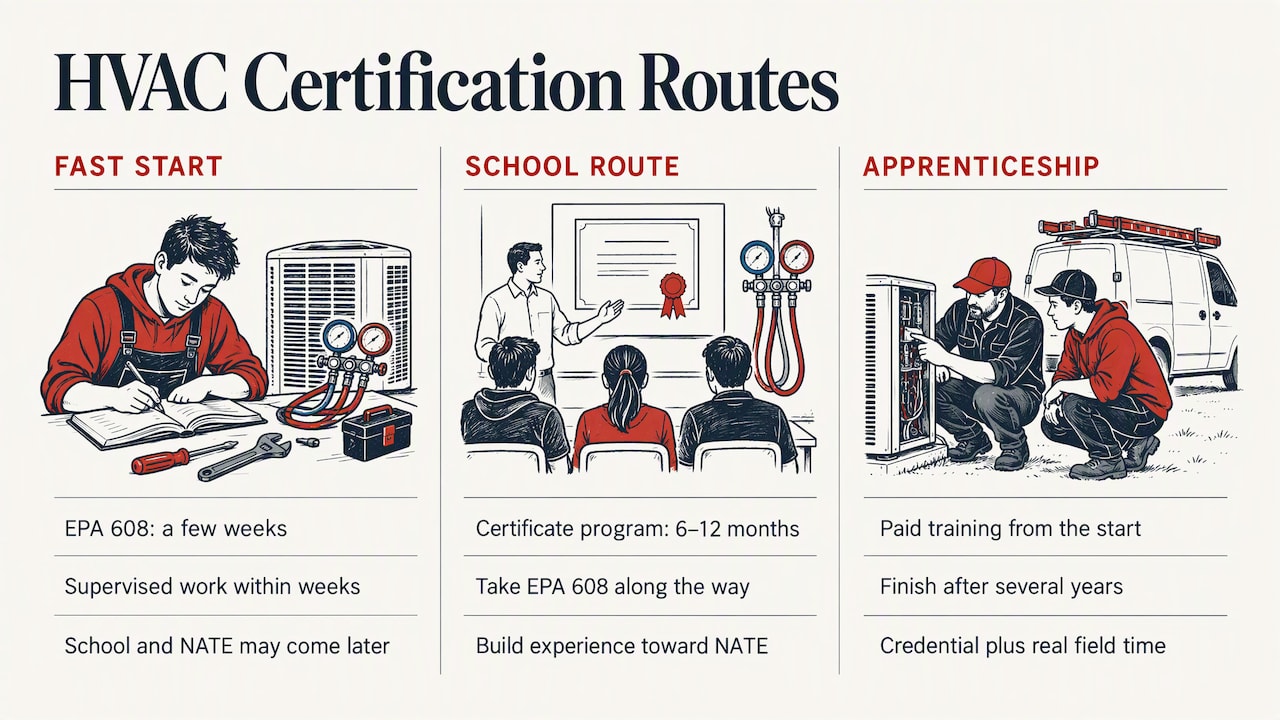
The fast start. You study for and pass the EPA 608 in a few weeks, then apply for helper or apprentice jobs. You’re working under a certified tech within weeks. School and NATE come later, if at all.
The school route. You enroll in a certificate program that runs 6 to 12 months. Along the way you take the 608. You graduate with a certificate and the EPA credential, then start as an entry-level tech and spend the next couple of years building the experience that makes NATE realistic.
The apprenticeship route. You join a registered apprenticeship. You’re paid from the start, take classes along the way, and finish after several years with a credential and real field time. The EPA exemption for supervised apprentices applies during the early stretch, but you still want the 608 in hand early.
In all three, most of what makes you valuable comes from time in the field. Certifications open the door. Experience is what gets you paid like a pro.
Is HVAC certification worth it?
Short answer: the EPA 608 is a must-have, and the rest depends on your goals.
Here are the facts. BLS reports 2025 median pay of $61,010 for heating, air-conditioning and refrigeration mechanics and installers. A year earlier, BLS reported a median of $59,810. That’s a median, so half of techs earn more and half earn less, and where you fall depends on your market, your specialty and your employer.
The 608 is worth it because the work is off-limits without it, and the exam is a small investment of time. School is worth it if you want structure and don’t have a mentor lined up. An apprenticeship is worth it if you need income while you learn. NATE is worth it when your employer values it or you want to prove skill in a specialty. Ask around first, because some shops reward it and others don’t care.
Where certification fits in the job hunt
If you’re searching for work, certification affects which jobs you can apply for and how much you start at. Many shops list the EPA 608 as a minimum. Some list NATE as a plus. Others will train the right person with no credentials.
On HVAC Mafia, you can see what real contractors are asking for. Look at a posting like this HVAC service technician role in Charleston, SC or a lead installer opening in Westchester, NY and compare the requirements with what you have. It’s a quick reality check on how much of the certification stack you actually need for the job you want.
What we think, from the trade
We’ve seen this question from both sides of the table. A lot of people ask how fast they can get certified, when the better question is what they want to be doing in five years.
Here’s what we’d tell a new tech sitting at our kitchen table. Get your EPA 608 first. It’s quick, it’s required, and it’s yours for good. Then find a contractor who’ll teach you, because the shop you land in matters more than the paper on the wall. A good employer pays you to learn, puts you with a patient lead tech and talks openly about where you can go. A bad one hands you keys and a ticket and calls it training.
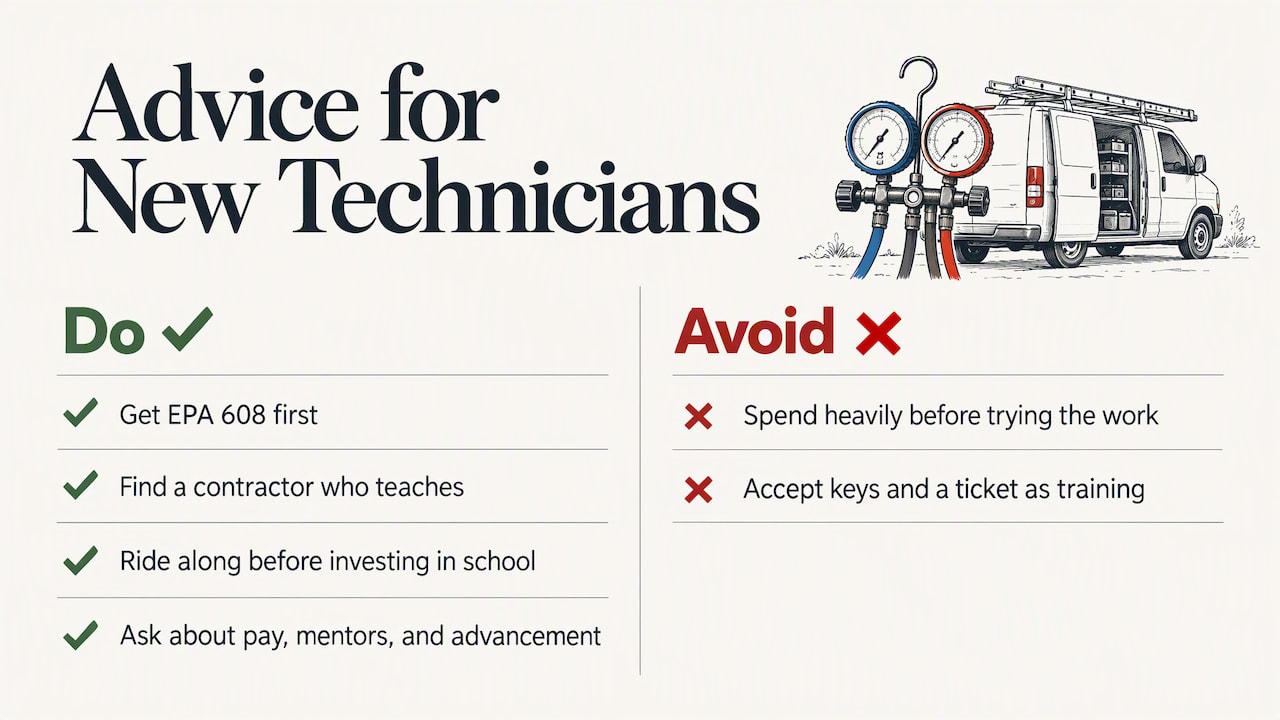
School is a fine start, and so is an apprenticeship. We just don’t think anyone should spend two years and a pile of money before they’ve ridden along on a single service call. Try the work, then decide how much more paper you need.
And don’t ignore what you’re walking into. Ask about pay, about who your mentor will be and about what the path from apprentice to lead tech looks like. That’s why we built this community: so techs can talk straight to each other about what’s real. Build a career, not just another paycheck.
— the author
Find your first HVAC job with us
Once you’ve got your 608, or you’re close, the next step is finding a contractor worth working for. Registering with HVAC Mafia is free for technicians, and job openings from real contractors are visible to members. You’ll also get straight talk on pay and career paths, plus the Tech Talk forums.

Join as a member and see who’s hiring near you. If you’re a contractor trying to hire techs, our job posting plans put your openings in front of a trade-only audience.
FAQ
Can I get HVAC certified in a few weeks?
You can get the EPA Section 608 certification in a few weeks, because it’s an exam and not a course. Other credentials take longer. School programs generally run 6 months to 2 years, and apprenticeships usually take several years.
Do I need a certificate from school to get hired?
Not always. BLS says employers sometimes consider candidates whose highest education is a high school diploma, and new hires typically work alongside experienced techs. Having your EPA 608 and some training will make you a stronger applicant.
Does the EPA 608 certification expire?
No. The EPA says Section 608 credentials do not expire. You only need to pass the test once, and Universal certification requires a proctored Core test.
Do I need a state license too?
It depends on where you work. BLS says some states and localities require licenses, so check with your state and local authorities before you plan your timeline.
How long should I work before going for NATE?
NATE recommends 6 months to 1 year of experience for its HVAC Support Technician certificate and 2 years for CHP-5 or traditional certification exams. If you have less than 2 years, it also offers Ready-to-Work and HVAC Support Technician credentials.
Sources
- BLS: Heating, Air Conditioning, and Refrigeration Mechanics and Installers
- BLS: Installation, Maintenance, and Repair Occupations
- EPA: Section 608 Technician Certification Requirements
- EPA: Certification Programs for Section 608 Technicians
- U.S. Department of Labor: American Apprenticeship Initiative infographic
- U.S. Department of Labor: Earn While You Learn career seeker fact sheet
- NATE: Getting Started
- Wisconsin Legislature: SPS 305.71(6)