
Everybody in this trade is talking about the labor shortage. Not enough young people coming in. Nobody wants to work anymore. You’ve heard it at every supply house counter in America.
I’ve been in this trade 36 years, and I’ll tell you what I actually see: we’re getting them in the door. We’re losing them in the first year.
The First Twelve Months
Think about what we hand a kid on day one.
He’s in the attic in July, digging the trench, carrying the condenser, pulling the old system out, hauling the trash, cleaning the truck at the end of the day. He’s doing the hardest, hottest, dirtiest work on the job site — for the least money on the truck.
And nobody has told him why.
So around month eight, his buddy at the warehouse mentions they’re hiring at eighteen an hour, air conditioned, no attics. And he’s gone. We never see him again, and we tell ourselves the younger generation doesn’t want to work.
That’s not what happened. What happened is we let him believe the worst part of the job was the job.
The Trenches Are the Foundation, Not the Destination
Let me be clear about something, because I’m not arguing we should make it easy.
That first year is a rite of passage. It always has been. You learn the equipment by carrying it, learn airflow by pulling duct and why a system fails by being the guy who tears the failed one out. Every good tech I know can tell you exactly what he learned crawling around under a house in August, and most of them are proud of it.
The trenches aren’t the problem. The problem is that we never show them what’s on the other side.
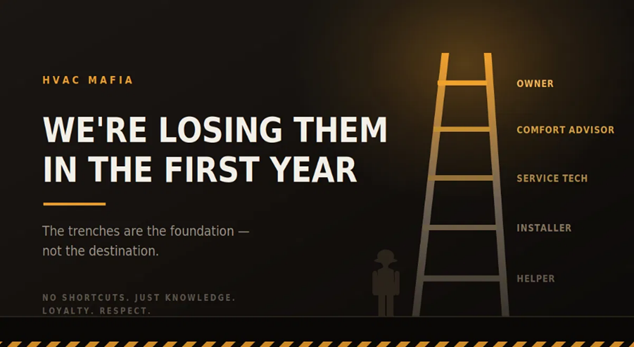
Nobody sat that kid down and said: two years from now you’re diagnosing. Five years from now you’re running your own truck, making six figures on the right pay plan. Ten years from now you’re a comfort advisor, or a service manager, or you own the shop. Nobody drew him the map.
We just handed him a shovel and hoped he’d figure it out.
What Shops Can Actually Do
Assign a mentor on day one. Not a supervisor — a mentor. Somebody whose job it is to answer the dumb questions without making him feel dumb for asking. A tech who quit in month nine almost never had one.
Show them the ladder in writing. What does it take to move up? What does each step pay? If you can’t put it on one page, your people can’t see a future in it, and neither can the kid you’re about to lose.
Tell them why they’re doing it. Explain what the grunt work is teaching. The same task feels completely different when it’s framed as training instead of punishment.
Be honest about the money. The trade has an image problem partly because we’re vague about pay. Young people are more comfortable talking about compensation than we ever were. Meet them there.
Meet Them Where They Are
We also have to stop expecting them to find us.
The kids we need are on TikTok and YouTube watching people do real work. They’re in high school shop classes — if their school still has one. They’re at career days where nobody from our trade bothered to show up.
Get in the high schools. Sponsor the program. Put your best young tech on camera instead of the owner. Show a real service call, a real diagnosis, a real paycheck. The trade sells itself when people can actually see it.
Nobody Should Do the First Year Alone
That’s a big part of why HVAC Mafia exists.
When a first-year guy hits the wall — and he will — he needs somebody who’s been there to tell him it gets better, and to prove it. That’s what Tech Talk is for. Real techs, real answers, no gatekeeping. Ask the question you’re embarrassed to ask your foreman.
If you’re a shop owner: point your new hires here. Give them a place to go on the bad days.
If you’re the guy in the attic right now wondering if this trade is worth it — it is. Find somebody who’s twenty years in and ask them about their first year. Every single one of us has that story.
Then stick around long enough to have one of your own.
No Shortcuts. Just Knowledge. Loyalty. Respect.