The A2L Era
Has Arrived.
R-410A Is Dead.
R-32 and R-454B are on every truck now. Some of you are running them clean. Some of you are still showing up with the wrong gauges, no leak detector, and a 2018 attitude. This is your wake-up call from the Family.
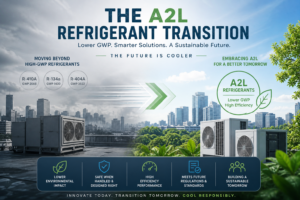
If you’ve cracked open a brand-new condenser in the last six months, you’ve already met the new boss. The sticker doesn’t say R-410A anymore. It says R-454B, or it says R-32, and either way it’s mildly flammable, mildly aggravating, and entirely the future of this trade. The factories shut the door on 410A production for new residential equipment. There is nothing else coming down the line. The transition isn’t a rumor on a podcast — it’s already in the back of your truck.
Some techs adapted in 2024. A lot more got dragged into it in 2025. And here in 2026, there’s still a stubborn pocket of guys out there pretending the rules haven’t changed. The same guys leaving caps off cores. The same guys flushing line sets with nitrogen “when they have time.” The same guys giving the rest of us a bad name in every kitchen and on every Google review page in the country.
The Mafia doesn’t carry those guys. Never has, never will. So let’s break down what the A2L era actually means for the technician on the truck — what’s changed, what hasn’t, and what’ll separate the lifers from the parts-changers over the next 24 months.
First — What Even Is an A2L?
An A2L refrigerant, in plain English, is a refrigerant with lower toxicity and lower flammability than the propane in your buddy’s grill. ASHRAE Standard 34 puts everything in a class. A1 is the old world: non-flammable, low-tox. That’s where 410A lived. A2L is mildly flammable, low-tox. That’s R-32 and R-454B. A3 is full-on flammable — that’s propane (R-290) used in some commercial reach-ins.
“Mildly flammable” gets people spun up. It shouldn’t. Your customer’s gas range is a real flamethrower. Their water heater has an open burner. Their hairspray is propellant. An A2L charge in a sealed system requires a specific concentration, a specific ignition energy, and a specific geometry to even consider lighting off. You are not going to vent a 4-ton split into a living room and watch it explode. You will, however, fail an inspection, lose a callback war, and look like an amateur if you handle it like 410A.
The two refrigerants you’ll actually see:
- R-454B — A blend (R-32 + R-1234yf). GWP around 466. Picked by Carrier, Trane, Lennox, Rheem, and most of the heavyweights. Pressures behave a lot like 410A, which is why the OEMs love it.
- R-32 — Single-component, not a blend. GWP 675. Picked by Daikin (because of course), Goodman/Amana, and most mini-split lines. Single-component means no fractionation, you can top it off without dumping the charge.
What Actually Changes on the Truck
Forget the marketing decks. Here’s what changes for the man or woman holding the gauges.
1. Your tools.
Your old vacuum pump? It’s not rated for A2Ls unless it explicitly says so. Use it and you’ve voided your warranty, your insurance, and possibly your eyebrows. Spark-resistant pumps, A2L-rated recovery machines, and A2L leak detectors are no longer optional. Manifold gauges need 1/4″ SAE left-hand thread on the small port for A2L cylinders — it’s a federal cylinder design choice to prevent cross-contamination. If you don’t own the adapter yet, you should already be on the supply house’s website.
2. Your charging procedure.
R-454B is a blend. You charge it as a liquid, not a vapor. Period. Pull vapor off the top of a blend and you’re cherry-picking the lighter component, which means the charge that goes into the system is no longer the spec on the label. The system runs wrong, the customer calls back, the company eats it. R-32 is single-component, so vapor charging is technically fine — but you should still default to liquid because the habit will save you when you switch trucks next week.
3. Your leak detection game.
A traditional electronic leak detector calibrated for 410A may not even chirp on R-32 or 454B. You need an A2L-capable detector. Bubbles still work. Nitrogen pressure tests still work. But sniffer time means upgrading. Some of the new equipment also includes a built-in Refrigerant Detection System (RDS) in the air handler — required by UL 60335-2-40, fourth edition, on most residential A2L installs. That sensor will trigger the blower and shut down the compressor if it sees a leak. Don’t disable it. Don’t bypass it. Don’t be that guy.
4. Your evacuation discipline.
500 microns or better. This wasn’t optional on 410A either, but a sloppy 800-micron pull-down “got by” on plenty of jobs. With A2Ls and the tighter design pressures, moisture and non-condensables show up as warranty failures faster. Pull deep. Hold the vacuum. Document the gauge reading. Send it to the homeowner if you have to. A2L work is an audit-trail trade now.
The Money Side No One Wants to Say Out Loud
A2L equipment is running 15% to 40% more than 410A equivalents at the wholesale level, depending on tonnage and tier. That cost gets passed to the homeowner. The homeowner who already lost his mind over a $14,000 quote in 2023 is now looking at $18,000 to $22,000 for the same nominal system. Repair vs. replace conversations are landing differently. A lot of customers are choosing to keep the old 410A unit limping along — and the data backs it up. Repair revenue share across the trade has climbed every quarter for four straight years.
Read that twice. Repair work is becoming a bigger slice of the pie. For techs who can actually diagnose — who can read a superheat chart, who can spot a TXV failure without throwing parts at it, who can hold a system on a manifold for an hour and tell you exactly what’s wrong — this is the best market in 20 years. For the parts-changers? It’s about to get rough. The customer who used to replace at the first sign of trouble is now asking real questions. If you don’t have real answers, you don’t get the work.
Certifications: The Bar Got Higher
EPA Section 608 was always required to handle refrigerant. That’s not new. What’s new is that 608 has been updated to include A2L-specific handling, and most distributors will not sell you 454B or R-32 cylinders without proof you’ve completed updated training. ESCO, ACCA, RSES, and most manufacturer programs now offer A2L-specific certs. They’re not expensive. They’re not hard. The guys who skip them are the guys who’ll be standing on the curb in 2027 wondering where the work went.
- EPA 608 — base certification, A2L module updated. Required.
- UL 60335-2-40 familiarity — the standard governing A2L equipment. Read it. At least skim it.
- Manufacturer A2L training — Carrier, Trane, Daikin, Goodman, Lennox all offer factory courses. Most are free if your shop is a dealer.
- Local code knowledge — Some AHJs are still catching up. Some require A2L permits and inspections separately. Know your jurisdiction.
What the Lifers Are Doing Right Now
Here’s the operating standard for techs who plan to still be working — and earning more — in 2027 and beyond:
- A2L-rated detector, recovery machine, and vacuum pump on the truck. Not the shop. The truck.
- Left-hand thread adapters for both R-32 and R-454B cylinders, organized, accessible, and not buried under a roll of duct tape.
- Liquid-charge by default, every time, every refrigerant, no exceptions.
- 500-micron evacuation, documented with a photo of the digital micron gauge.
- Up-to-date 608 card and at least one OEM A2L cert in your binder.
- The ability to explain GWP, A2L classification, and why this system costs more — to a homeowner — in language they understand. Without panicking them.
- Respect for the RDS sensor in the air handler. Don’t unplug it. Don’t ignore the alarm. Don’t tell the customer it’s a “false trip.”
None of that is heroic. None of that is above-and-beyond. That’s the new baseline. That’s the floor. Anybody not at the floor is below it, and that’s where reputation goes to die.
The Mafia Take
The A2L transition isn’t the end of anything. It’s a filter. Every major shift this trade has gone through — R-22 phase-out, SEER2, communicating controls, smart thermostats, inverter compressors — every one of them sorted the techs who learn from the techs who hide. A2L is doing the same thing right now, and it’s doing it faster because the regulatory clock is real and the cylinders on the rack changed colors overnight.
The good news is the bar is right there in front of you. It’s not hidden. It’s not gatekept by an old-boys’ network. It’s training, tools, and discipline, and any tech who wants it can have it. The Mafia exists to remind you that you’re better than the version of yourself that takes shortcuts. Wear the patch. Stand for something. Show up cleaner, sharper, and more certified than the guy down the street, and the work will follow you for the rest of your career.
The 410A era was good to a lot of us. Tip your hat to it. Then close the door.
Welcome to the A2L era. Don’t be the guy left behind.
— The Mafia Desk Enforcing Excellence • Creating High Standards