
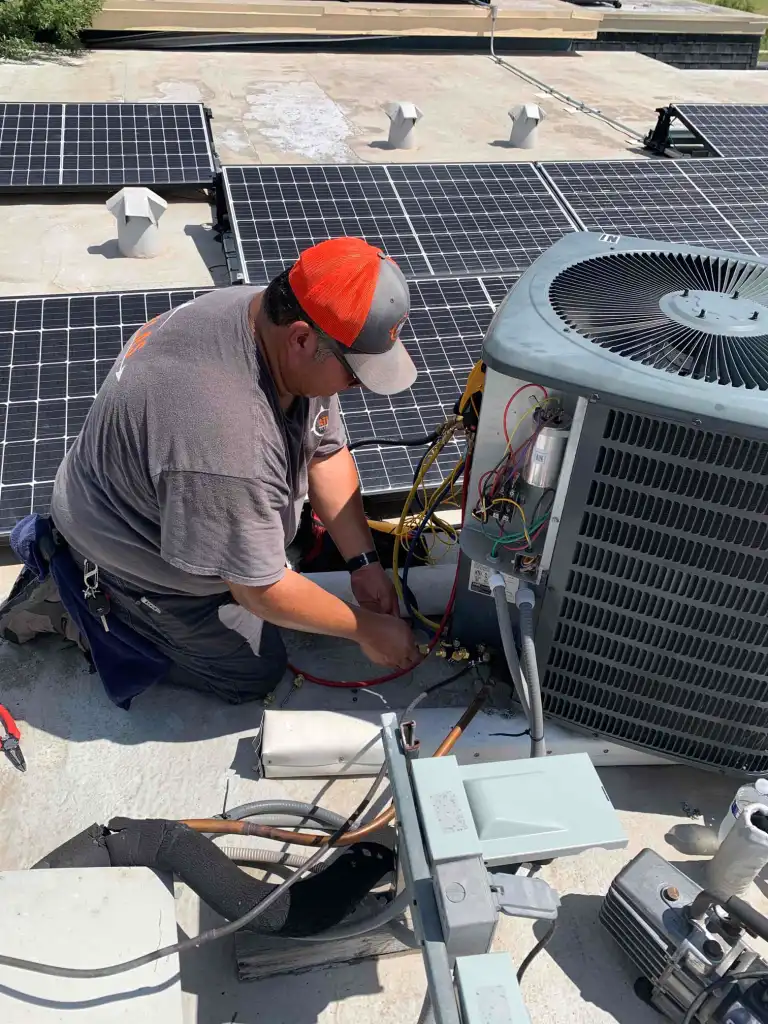
The family shop down the street might not be a family shop anymore. It might be a portfolio company — same trucks, same logo, same guys you grab a beer with — quietly owned by a fund in a glass tower that has never once felt an attic in August. This is your heads-up from the Family. The suits found us. Here’s what it means for the man and woman holding the gauges.
You’ve heard the rumors. The shop two towns over got “investment.” Your buddy’s company suddenly has a new dispatch app, a new pay plan, and a regional manager nobody’s ever met. A competitor you used to bid against turns out to share an owner with three other “competitors” in the same county. None of that is a coincidence. That’s the roll-up, and it’s already on your block.
This one isn’t about refrigerant or tools. It’s about who signs your check, what they expect from you, and how much leverage you actually have — which is more than they want you to know.
First — What’s Actually Happening
Private equity figured out something the trade always knew: people will always need air conditioning, the work can’t be offshored, and the maintenance revenue comes back every single year like clockwork. To a fund, that’s not a trade. That’s a “recession-proof, recurring-revenue platform.” So they started buying.
The pace is not subtle. PE made up about 8% of HVAC deals in 2023. One year later it was 23%. Add-on acquisitions — the funds buying up small shops to bolt onto a bigger platform — jumped 88% year-over-year into mid-2025, and in the first half of that year PE-backed buyers were behind 39 of 77 HVAC deals on record. There are now roughly 27 active HVAC platforms in the country with names most techs have never heard, because the name on your shirt usually doesn’t change for a while after the ink dries.
The play is simple. Buy a solid local shop with a founder ready to retire. Buy four more like it. Centralize the call center, the dispatch, the pricing, the purchasing. Squeeze a few more points of margin out of every truck. Then — and this is the part that’s accelerating in 2026 — sell the whole stack of regional platforms to an even bigger fund. The industry calls it the roll-up of the roll-ups. The brand on your truck may change hands twice before you finish paying off your own.
SPEC SHEET // THE ROLL-UP BY THE NUMBERS
PE share of HVAC deals — 8% (2023) → 23% (2024)
Add-on acquisitions — up ~88% year-over-year into mid-2025
US HVAC contractor revenue — roughly $159 billion in 2026
US home services market — projected near $842 billion in 2026
Typical target — a founder-led shop doing $2M–$10M EBITDA
What that sells for — a $1.5M-EBITDA shop can fetch $9–10.5M at current multiples
Active US HVAC platforms — ~27 and counting
What It Looks Like From the Truck
Here’s what nobody puts in the press release. When a profitability algorithm starts routing your day, the work changes. Not all at once. Quietly.
The replacement-over-repair pressure shows up first. A consolidated operator makes more money swapping a system than fixing a $40 capacitor, so the incentives — your spiffs, your scorecard, your “options presented” metric — start nudging you toward the sale. The tech who used to fix what could be fixed gets reminded, in a Monday meeting, that his “average ticket” is low. Your honesty becomes a line item somebody wants to optimize.
Then comes the scorecard culture. Close rate. Membership conversion. Callback percentage. Revenue per truck. None of those numbers are evil by themselves — a good shop tracks them too. But under a fund whose only job is to fatten EBITDA before resale, the numbers stop being tools to make you better and start being the thing you serve. You’re not a craftsman anymore. You’re a route.
And the part that stings the most: the loyalty stops being mutual. The founder who knew your kids’ names sold and walked. The new ownership knows you as a cost center with a turnover rate.
They didn’t buy the equipment. They didn’t even really buy the trucks. They bought your relationships, your reputation, and your recurring revenue — and every one of those things lives in you, not in the spreadsheet. — The Mafia Desk
Now — let’s be straight, because the Mafia doesn’t deal in fairy tales. Not every rollup is a horror story. Some of these platforms bring real benefits: actual health insurance, a real 401(k) match, structured training ladders, paid certs, equity or retention packages for the techs they can’t afford to lose. A well-run platform can be a better employer than the broke, disorganized family shop that paid late and never trained anybody. The point isn’t “PE bad.” The point is know what you’re standing in, and know what you’re worth inside it.
The Part They Don’t Want You to Do the Math On
Here’s the leverage nobody handed you. This entire model — every multiple, every resale, every fund’s whole thesis — runs on one thing they cannot manufacture, cannot import, and cannot automate: a skilled technician who shows up.
The trade is short on people and getting shorter. For roughly every tech who retires, only about 0.6 new workers come in behind them. You don’t need a finance degree to see what that does to your bargaining position. They can buy a hundred shops. They cannot buy the body that fixes the system, and there aren’t enough of those bodies to go around.
The funds know this. It’s why “technician depth” and “retention” are on every due-diligence checklist. It’s why retention packages exist. You are not the easily-replaceable part of this equation — you are the scarce part. The whole game depends on you staying. Act like it.
// FAMILY BUSINESS Every time a good tech lets a rollup turn him into a commission-chasing parts-changer, he drops the floor for everyone in that ZIP code. And every time a good tech knows his numbers, holds his standards, and makes them pay for his skill, he raises it. We are all on the same crew. Don’t sell your reputation cheap — yours is the one thing in this deal that isn’t for sale.
How to Tell Your Shop Just Got Bought
Sometimes they announce it. Often they don’t, not at first. Watch for the tells:
- A new dispatch or “field service” software shows up overnight, with metrics attached.
- The pay plan “gets updated” — usually more commission, more conditions, more fine print.
- Suddenly there’s a “regional” or “operations” layer of management that didn’t exist last month.
- A hard push on memberships, financing, and “presenting all options” on every call.
- “Efficiency consultants” or new corporate trainers running ride-alongs with a clipboard.
- The founder goes quiet, then gone.
None of those mean run. They mean pay attention and read everything before you sign it.
What the Lifers Are Doing Right Now
Here’s the operating standard for techs who plan to come out of this consolidation wave with more money and more options than they went in with:
- Know your numbers cold. Your close rate, your callback rate, your average repair-vs-replace honesty. Track them yourself. They’re your résumé and your leverage in any pay conversation.
- Keep your credentials portable. EPA 608, NATE, manufacturer certs, your state license — in your name, in your binder. They travel with you, not the shop.
- Read what you sign. Non-competes, non-solicits, “training repayment agreements.” Know what you’re agreeing to before a new owner asks for your signature. If you don’t understand it, don’t sign it that day.
- Benchmark your wage. Know what your skill pays three shops over. You can’t negotiate against a number you don’t have.
- Be the diagnostician, not the parts-changer. The tech who can hold a system on a manifold and tell you exactly what’s wrong is the one no algorithm and no rollup can replace.
- Keep your reputation yours. Your name in your market is an asset you built. No acquisition gets to spend it for you.
That’s not paranoia. That’s a professional knowing the value of his own hands in a market that’s being repriced around him.
The Mafia Take
Consolidation isn’t the end of the independent tech. It’s a sorting. Same as R-22, same as SEER2, same as A2L — every shift in this trade separates the people who understand the game from the people who get played by it. Private equity is the newest version of that test, and it’s a money test instead of a refrigerant one.
Here’s the truth the glass-tower spreadsheet leaves out: they are buying us. The recurring revenue they’re paying nine-figure multiples for is the trust you built one honest service call at a time. That’s the whole asset. And the moment enough techs understand that — understand that the scarce, irreplaceable, can’t-be-rolled-up part of this entire industry is the skilled professional on the truck — the leverage swings back to where it belongs.
So whether the name on your shirt is your buddy’s last name or a brand a fund invented last quarter, the move is the same. Know your worth. Hold your standards. Keep your skills sharp and your credentials in your own name. Make them pay for the one thing they can’t buy without you.
They can roll up the shops. They can’t roll up the Family.
— The Mafia Desk Enforcing Excellence • Creating High Standards