
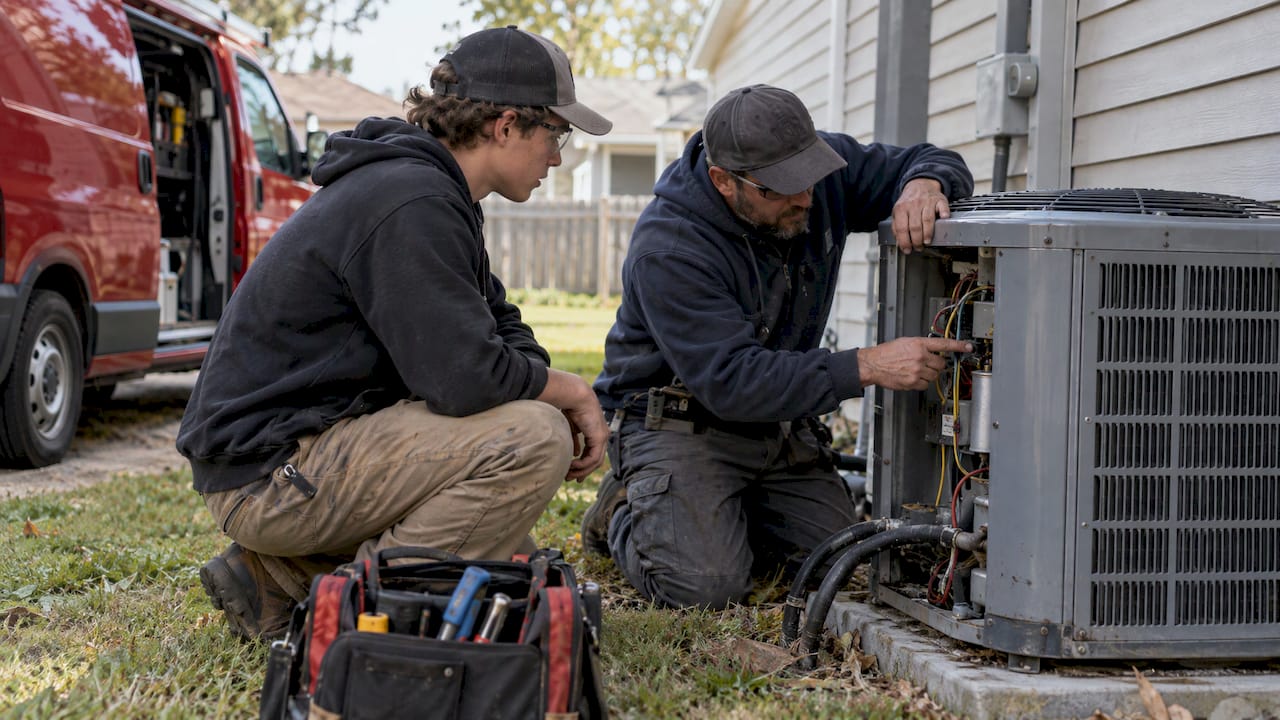
Yes, you can get paid while you learn HVAC, and you do not need experience or a tuition bill to start. Contractors across the country hire beginners as full-time employees, pay them during training, and move them into a technician role when they are ready. The trick is telling a real training program from a job that just says “will train” in the ad. That is what this guide is for.
We built HVAC Mafia as a job board and community for the trade, and the founder has 36 years in HVAC, so we have seen both kinds of employer. Registered members see openings from real contractors, and membership is free for techs. More on that below.
TL;DR
- Paid HVAC training comes in three forms: a company academy of about 8 to 12 weeks, a multi-year registered apprenticeship, and an entry-level helper or trainee role.
- Most employers want you to be 18, hold a high school diploma or GED, and have a valid driver’s license. Most do not require HVAC experience.
- Pay starts modest and rises with skill. Benefits such as health insurance, a 401(k), tools and a company vehicle often matter as much as the hourly rate.
- Ask every employer about hours, classroom time, certification support and the path after training before you accept.
- Join the free HVAC Mafia membership to see trade-only openings that regular visitors cannot.
Table of Contents
- The three kinds of paid HVAC training
- What you need to qualify
- How the training actually works
- Pay and benefits to expect
- Where paid training leads
- Questions to ask before you accept
- Perspective
- Find paid training openings on HVAC Mafia
- FAQ
- Sources
The three kinds of paid HVAC training
Not every “paid training” job works the same way. Knowing the type tells you how long you will be a trainee and what you will have at the end.
Company academies
Some contractors run their own short programs. Peterman Brothers hires you as a full-time employee, pays you while you learn, charges no tuition, and trains you in the classroom, a lab and the field, including ride-alongs on real service calls. Cheeky Tech Academy pays $16 to $20 an hour through 8 to 12 weeks of structured training and asks for no experience.
Morris-Jenkins runs a 10-week Tech Builder program of paid training that leads to a full-time technician job. HELP’s HVAC Maintenance Trainee role in Cincinnati, Ohio is also 10 weeks of paid training with no prior experience required.
Registered apprenticeships
An apprenticeship is the longer road. You work full time, learn on the job under experienced techs, and attend classroom instruction on top of it. Programs registered with the U.S. Department of Labor follow set standards, and the hours you log count toward journeyman status.
The Tustin Group’s BUILT TO LEAD apprenticeship is a four-year, self-paced commercial HVAC program with 2,000 field hours a year. Trane’s posting describes a four-year apprenticeship registered nationally through the Department of Labor, with paid instruction and on-the-job training.
Union programs run longer. Plumbers and Pipefitters Local 94’s apprenticeship is a five-year paid program with 1,700 to 2,000 on-the-job hours and at least 252 classroom hours a year, benefits after 300 working hours, and a progressive wage scale.
Entry-level helper and trainee roles
These are the “we will train you” jobs. Upton Air in Sacramento lists an entry-level apprentice and helper role that needs no HVAC experience and includes paid onboarding, ride-alongs, mentorship, and company-paid EPA 608, NATE and manufacturer training. Just Right Plumbing, Heating & Cooling’s paid trainee role also needs no experience and includes company-paid certifications.
These roles can be great, as long as the employer spells out what the training is. We get to that checklist further down.
What you need to qualify
The bar is lower than most people expect. Employers are hiring for attitude, reliability and a willingness to learn.
The Trane posting says no industry experience is required. Applicants must be at least 18, hold a high school diploma or equivalent, and have had a valid driver’s license for at least 12 months, with no major or frequent traffic violations in the past three years. Formal HVAC schooling is not required, but it is considered when setting your starting pay.
Crosstown Mechanical asks for the same basics: 18 or older, a diploma or GED, a clean enough background check and a valid license. No HVACR experience needed.
Two takeaways for you:
- Your driving record matters. You will likely drive a service vehicle, so a clean record opens more doors than a trade school certificate does.
- Schooling can raise your starting wage. If you have completed a trade school program, say so. It can move your starting pay up.
You will also hear about EPA Section 608, the federal certification required to handle refrigerants. Many paid-training employers cover it. If you want to see how long certification takes, read our guide on how long it takes to get HVAC certified.
How the training actually works
A good program has structure: hours in the field, hours in the classroom and a clear schedule. Here is how the numbers look in some real programs.
| Program type | Length | Training hours | Source |
|---|---|---|---|
| Company academy | 8 to 12 weeks | Classroom, lab and field | Cheeky Tech Academy |
| Company academy | 10 weeks | Intensive paid training, then a technician job | Morris-Jenkins |
| Employer apprenticeship | 4 years | 2,000 field hours a year | The Tustin Group |
| UA-partnered apprenticeship | Multi-year | 2,000 paid OJT hours and 216 classroom hours a year | Crosstown Mechanical |
| Union apprenticeship | 5 years | 1,700 to 2,000 OJT hours and 252+ classroom hours a year | Plumbers and Pipefitters Local 94 |
Crosstown Mechanical’s program, run with the United Association, also offers up to 45 transferable college credits and says apprentices often see their pay double when they become journeymen. A journeyman is a fully qualified tech who has completed the apprenticeship.
Wage scales climb over time. The Mechanical Contractors Association of America’s apprenticeship standards describe a five-year term with at least 8,500 on-the-job hours, with pay rising from 45% of the journeyworker rate in the first 850 hours to 90% in the last 850. Those standards date from 2011 and were updated in 2012, so treat the percentages as the structure, not today’s wage. Your employer’s scale is what counts.
Want the year-by-year breakdown? We cover it in HVAC apprentice pay.
Pay and benefits to expect
Paid training pays less than a seasoned tech makes. You are trading some wage today for skills and a path. What the postings show:
- Trane’s apprentice posting listed a base-pay range of $15.07 to $26.37, day-one health insurance, up to 15 vacation days, paid holidays, a 401(k) match and tuition assistance.
- Howe, Inc. in Sioux Falls pays a $20 an hour starting wage with full benefits, a 40% raise over four years, and up to $3,000 in tools in year one.
- Cheeky lists medical, dental, vision and life insurance, a 401(k) with up to a 4% match, three-plus weeks of PTO, and a company vehicle after graduation.
- Lickety Split in Jacksonville and St. Augustine pays $600 a week during training with no tuition and EPA 608 prep.
Wages vary by region, so check local numbers too. We have state-level breakdowns for Texas and Florida, and a look at commercial HVAC salaries.
Don’t stop at the hourly number. Compare the whole package: insurance premiums, retirement match, tools, truck, paid certifications and time off. Our guide on HVAC employee benefits shows what techs should expect.
Be careful with big earnings claims in ads. Some employers say graduates reach six figures. Morris-Jenkins says many Tech Builder graduates make more than $100,000 a year, and Just Right says experienced service techs average $100,000. Those are employers’ own statements about their own shops. Read them as what the job can grow into, and ask what a typical second-year tech makes there.
Where paid training leads
The training is the start. The better question is what you can be in five years.
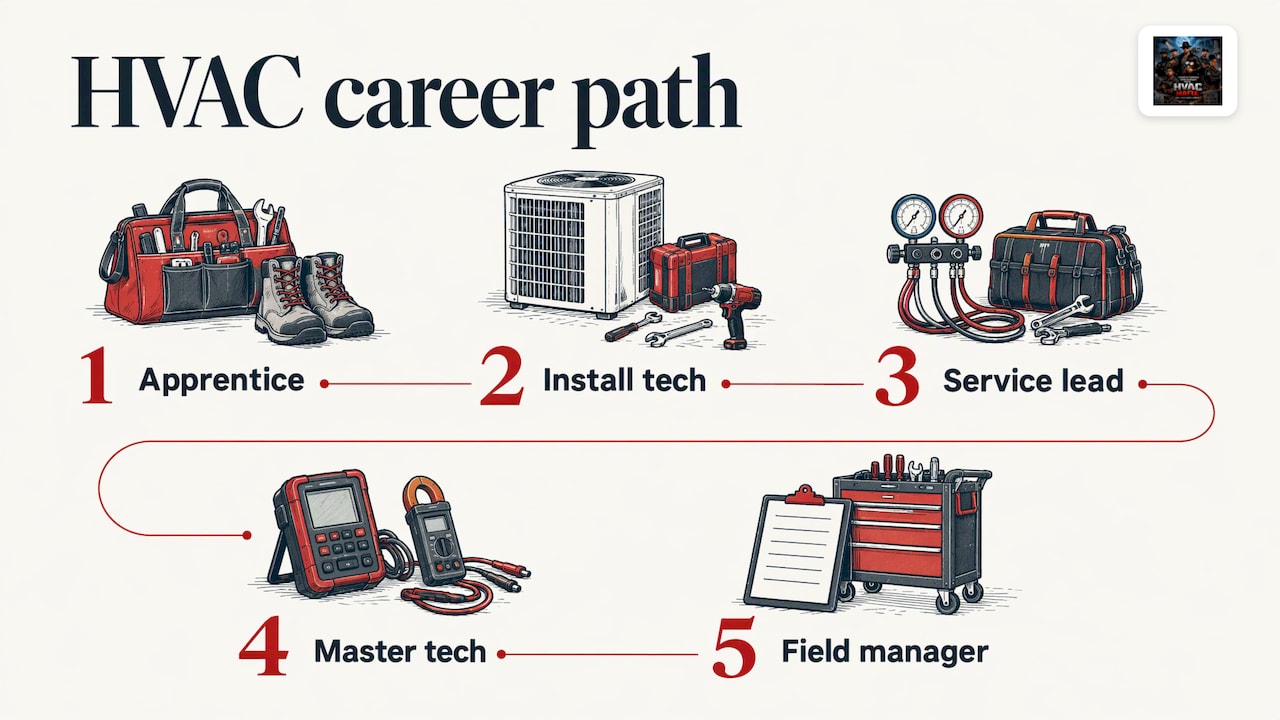
Upton Air lays out a career path from apprentice to install tech, service lead, master tech and field manager, with pay that scales by skill and certification level, plus bonuses for installs, repairs and customer-rated work. Cheeky’s ladder runs from Maintenance Technician at $18 to $24 an hour through Service, Senior and Master Technician, where Master Technicians are listed at $36 to $40-plus.
The Tustin Group says advancement can go toward technician, specialty, mentoring or leadership roles depending on performance. If you like the idea of running a team one day, see our look at HVAC service technician careers and service manager jobs. Still deciding whether the trade is for you? Start with Is HVAC a good career?
Questions to ask before you accept
A paid-training offer should survive a few plain questions. Ask them in the interview. A good employer likes that you asked.
- Is the apprenticeship registered with the Department of Labor, or union-run? Registered programs follow set standards, and your hours count toward journeyman status.
- How many field hours and classroom hours a year? Compare with the numbers in the table above.
- Who trains me, and how many techs do they train at once? A ride-along with a patient lead tech is worth more than a week alone in a van.
- Which certifications does the company pay for? EPA 608 is the baseline. Ask about NATE and manufacturer training.
- What are the tools and vehicle arrangements? Some employers give a tool allowance or a company vehicle after training. Get the conditions in writing.
- What happens at the end? Ask what the pay step is after training and what the next role is.
- How do you handle safety? You will work on rooftops, in attics and around electrical and refrigerant systems. Ask about safety training and equipment before day one.
And talk to the techs who work there. That is exactly why we built the Tech Talk forums: you can ask other techs what a company is really like.
Perspective
I have spent 36 years in this trade, and I owned a dealership. I know what it costs to hire a tech who walks off in month three, and I know what it costs a young person to take a job that never trains them.
Here is what we believe. The best paid-training jobs are an honest trade: you show up, work hard and learn, and the contractor invests in you with real hours, real mentors and a real path. When both sides take that seriously, you get a tech who stays and a shop that grows.
That is why HVAC Mafia is trade-only. Our job listings and community are restricted to verified HVAC trade professionals, so techs see openings from real contractors and talk with people who do the work, with no homeowner or outsider noise. We give techs straight talk on pay, career paths, certifications and how to spot good and bad employers, and Company Spotlight profiles let shops show their culture, pay and benefits up front.
If you are starting out, we would rather you find the right shop than the first shop. Join the family, ask the hard questions and build a career, not just another paycheck.
the author
Find paid training openings on HVAC Mafia
The openings on our board are hidden from non-members. Registering is free for technicians, apprentices and trade school students, and you never pay. Once you are in, you can browse jobs from real contractors, read about pay and employers, and join the Tech Talk forums and the HVAC Underground Podcast. Join as a member and start looking.
For contractors who train
If you run a shop with a training program, your ad should say so, with hours, pay and what happens after. Contractors post to a trade-only audience of nearly 100,000 HVAC followers, and applications go straight to your own hiring system. Our job posting plans are Standard at $199 per month per position, Annual at $149 per month per position, and Enterprise from $99 per month per position. A Company Spotlight profile is $149 per month or $1,699 per year, and shows techs your culture, pay and benefits. For help writing the ad, see our guide on HVAC installer recruitment.
FAQ
Can you get paid while learning HVAC?
Yes. Company academies, registered apprenticeships and entry-level trainee roles all pay you as an employee while you train. Programs like Peterman Brothers’ academy charge no tuition and include classroom, lab and field training.
Do I need experience or a certification to start?
Not usually. Many postings, including Crosstown Mechanical’s, require no HVACR experience. They do ask for a minimum age of 18, a diploma or GED and a valid driver’s license. Employers often pay for certifications such as EPA 608 once you are on board.
How long does paid HVAC training last?
It depends on the type. Company academies run about 8 to 12 weeks, such as Cheeky’s. Registered apprenticeships run four to five years, with about 2,000 field hours a year in programs like The Tustin Group’s.
What does a paid trainee earn?
It varies by employer and region. Postings range from $15.07 to $26.37 an hour in Trane’s apprentice listing to a $20 starting wage at Howe, Inc.. Pay rises as you gain skills and certifications.
How do I find HVAC jobs with paid training near me?
Register free with HVAC Mafia to see openings from real contractors. Then compare each one on training hours, certifications paid, benefits and the path after training.
Sources
- Top Tech Academy, Peterman Brothers
- Cheeky Tech Academy posting
- Morris-Jenkins Tech Builder
- HELP HVAC Maintenance Trainee
- The Tustin Group apprenticeship
- Trane HVAC Apprentice Technician
- Plumbers and Pipefitters Local 94 apprenticeship
- Upton Air employment
- Just Right paid trainee posting
- Crosstown Mechanical entry-level apprentice
- MCAA apprenticeship standards
- Howe, Inc. apprenticeships
- Lickety Split career training