
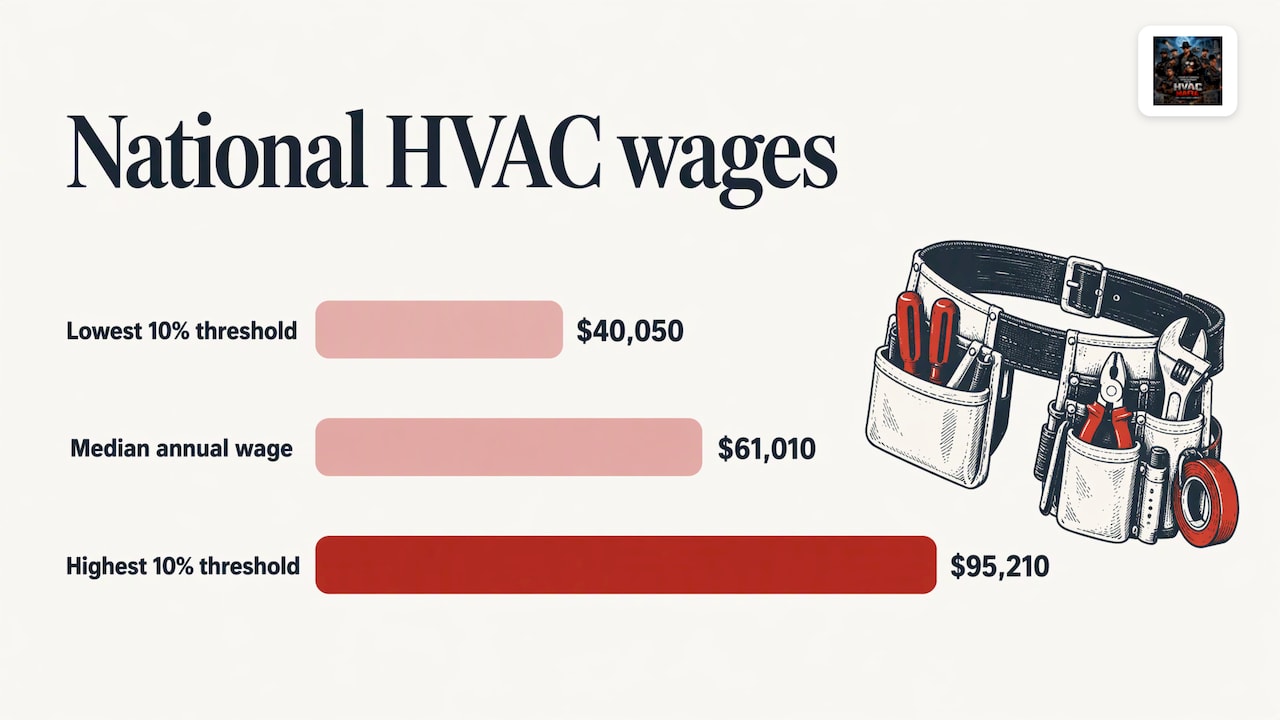
Most commercial HVAC techs land somewhere between $40,000 and $95,000 a year, with a national median around $61,000. Commercial work, refrigeration and controls skills, overtime and your zip code push you up or down inside that range. Below is what the numbers say, where they come from, and how to read them like a tech, not a salary website.
TL;DR
- The federal median for HVAC and refrigeration mechanics and installers is $61,010 a year, or $29.33 an hour, with the bottom 10% under $40,050 and the top 10% over $95,210.
- Commercial work is commonly reported to pay $10,000 to $20,000 more a year than residential, and specialties like refrigeration can pay more again.
- Location is the biggest swing. The same job pays about $28,000 more in Massachusetts than in Mississippi.
- Overtime, certifications and employer type all move the number. Compare total compensation, not just the hourly rate.
- Registering with HVAC Mafia is free for techs, and you can see real openings from real contractors.
Table of Contents
- What the national numbers say
- Commercial vs. residential pay
- Commercial HVAC salary by state
- What moves a commercial tech’s paycheck
- Can you make $200,000 in commercial HVAC?
- Why pay can feel low, and how to compare offers
- Our take: pay transparency is the trade’s biggest fix
- Find a commercial HVAC job that pays what you are worth
- FAQ
- Sources
What the national numbers say
Start with the most reliable source: the Bureau of Labor Statistics. For May 2025, the median annual wage for heating, air conditioning and refrigeration mechanics and installers was $61,010, which works out to $29.33 an hour. The lowest 10% earned less than $40,050. The highest 10% earned more than $95,210.
One honest note: BLS groups residential, commercial and refrigeration techs into one occupation. It does not publish a separate “commercial HVAC tech” number. So when you see a site quoting one exact commercial salary, it is blending BLS data with its own estimates or user-submitted pay.
Those estimates tend to land close to the federal figure. One industry blog projects the average commercial HVAC technician at about $60,000 to $65,000 in 2026, with entry-level near $40,000 and experienced techs in high-demand markets above $90,000 once overtime and bonuses are counted.
The occupation is also growing. BLS counted 440,900 jobs in 2025 and projects 11% growth from 2025 to 2035. More demand for techs means more leverage for you when you negotiate.
Commercial vs. residential pay
Why does commercial usually pay more? The work is more complex. You are on rooftop units, chillers, boilers, building automation and big refrigeration systems. Customers are businesses that lose money when equipment is down, and that urgency tends to show up in wages.
One contractor-software company reports that commercial HVAC pays $10,000 to $20,000 more per year on average than residential work. Treat that as a general pattern, not a promise. A strong residential service tech in a busy market can out-earn a weak commercial offer.
Employer type matters too. In May 2025, BLS puts the median for HVAC mechanics and installers in wholesale trade at $71,190, against $60,030 in plumbing, heating and air-conditioning contractors. Those wholesale jobs are often in equipment sales and support, so they are not a direct swap for a field role. They still show that who signs your check changes the number.
If you are weighing a move, our guide on how techs land commercial jobs and how shops hire them walks through what commercial employers look for.
Commercial HVAC salary by state
Location moves pay more than almost anything else. One analysis points out that moving from Mississippi, at a $48,680 median, to Massachusetts, at $77,300, is a $28,620 difference for doing the same work.
Here are BLS May 2025 state medians for HVAC mechanics and installers, as compiled by a trade-pay calculator that reports the official figures:
| Rank | State | Median annual wage |
|---|---|---|
| 1 | District of Columbia | $84,390 |
| 2 | Alaska | $77,430 |
| 3 | Illinois | $77,410 |
| 4 | Massachusetts | $77,300 |
| 5 | Connecticut | $76,610 |
| 6 | Minnesota | $76,350 |
| 7 | Washington | $75,660 |
| 8 | North Dakota | $74,490 |
| 9 | New Jersey | $74,450 |
| 10 | New York | $74,430 |
At the other end, the lowest medians are Arkansas at $48,110, Alabama at $48,370 and Mississippi at $48,680.
Different sites rank the states a little differently because they use different data years. An industry magazine’s 2025 roundup put California, New Jersey, Washington, Massachusetts and New York in the top five, with West Virginia, Mississippi, Wyoming, Arkansas and South Dakota at the bottom. Both lists tell the same story: the coasts, big northern states and Alaska pay the most, and the lower-cost South pays the least.
Beware of numbers that look too good. One team that tracks this data warns that some high-traffic salary pages publish figures well above BLS, such as $112,300 for Hawaii where the federal median is $65,450. If a number looks wild, find the BLS series behind it.
Working in Texas? We broke that market down in our Texas HVAC salary guide.
Pay by metro area
City matters inside a state, too. An analysis of BLS May 2025 data for the 30 largest metros found median hourly wages ranging from $38.51 in Seattle to $24.30 in Tampa, against a national median of $29.33. Nineteen of the 30 metros paid above the national median.
Higher pay usually comes with higher rent. Before you chase a big-city wage, compare it against what housing, insurance and fuel cost where you would live. A $28 an hour job in a cheaper town can leave you with more in your pocket than $36 an hour in an expensive one.
What moves a commercial tech’s paycheck
Specialization
After experience, specialty is one of the biggest levers. One industry company says commercial and industrial refrigeration techs who work cold storage, supermarket racks and large chillers routinely earn $85,000 to $120,000 with overtime. The same source flags building controls (BACnet, BMS, IoT) and heat pumps as growing niches.
The pattern is simple. Skills that fewer techs have, on equipment that costs a customer a lot when it fails, earn more.
Overtime and on-call
Peak season changes the math. One estimate says 50 to 60 hour weeks can add $7,000 to $15,000 or more per year. Another puts overtime and on-call work at $5,000 to $15,000 in annual take-home.
Ask how overtime is calculated, how on-call is paid, and how often you can expect it. A good hourly rate with no overtime can pay less than a modest rate with steady hours.
Certifications
Certifications help you get hired and give you something to point to in a pay conversation. One contractor-software source estimates NATE certification adds about $15,000 a year in earning power. Take that as an estimate, not a guarantee. What it does tell you is that shops pay for proven skill, so ask any employer whether they cover exam fees and reward certifications with a raise.
Productivity and value
Techs are paid in proportion to the value they create. A tech who diagnoses fast, runs more calls a day, spots legitimate repair opportunities and keeps callbacks low is worth more to a shop. One industry writer notes that owners often pay a premium to keep high-productivity techs because turnover is expensive. Track your own numbers. They are your best negotiating tool.
Can you make $200,000 in commercial HVAC?
As a salaried tech, rarely. One salary aggregator puts typical HVAC tech pay between $54,132 and $71,510, with a median near $61,841, and says reaching $200K is uncommon without extensive experience or additional roles.
The people who get there usually have a different job title. Here are the common routes:
- Service manager or operations roles. You trade the tools for people, scheduling and numbers. See our guide to HVAC service manager jobs, pay and path.
- Niche specialist. Refrigeration, controls or large chiller work, plus plenty of overtime, can push the top of the tech range well past the median.
- Owning the business. Owner income depends on revenue, overhead and how many trucks you run. It carries real risk and long hours, so it is a different path, not a raise.
For most techs, a realistic plan is to climb the ladder: apprentice, service tech, lead tech, specialist or manager. Each rung adds both pay and leverage.
Why pay can feel low, and how to compare offers
HVAC is physical, seasonal work in attics, rooftops and mechanical rooms. It is fair to ask whether the paycheck matches the effort. The answer often depends on what you count.
An hourly rate is only one piece. When you compare two offers, put these side by side:
- Base hourly rate or salary, and how raises are decided
- Overtime rules and typical hours in peak season
- On-call pay and rotation
- Health insurance, and what you pay in premiums
- Retirement match
- Paid time off
- Take-home truck, tools, uniforms and boot allowances
- Paid training and certification support
- A clear path from where you are to lead tech or manager
A lower hourly rate with a take-home truck, a retirement match and paid training can beat a higher rate with none of it. We cover what to expect in our guide to HVAC employee benefits.
Also ask what pay looks like in the slow season. Some shops keep techs busy year-round with maintenance and project work. Others cut hours. That answer changes your annual number more than a dollar-an-hour difference.
Our take: pay transparency is the trade’s biggest fix
We have spent a long time in this trade, and we have seen the same story over and over. Good techs leave because they never knew what they were worth, or because a shop would not talk about pay until the offer letter.
That is why we built HVAC Mafia as a place by and for the trade. Our job listings and community are restricted to verified HVAC trade professionals, so the conversation stays about the work, the money and the career. No homeowner noise. No corporate polish.
Here is our advice. Learn your market, because a number from another state tells you little. Learn the specialty that pays, whether that is refrigeration, controls or heat pumps. Ask the benefits questions before you sign. And pick a contractor who shows you their culture, pay and benefits up front, because a shop proud of how it treats techs has nothing to hide.
Build a career, not just another paycheck. That is what we are here for.
the author
Find a commercial HVAC job that pays what you are worth
If you are a tech, registering with us is free. You see openings from real contractors that non-members cannot, and you get straight talk on pay, certifications and spotting good and bad employers. Join HVAC Mafia as a free member and start comparing offers with real numbers.

If you are a contractor losing techs to better offers, publish your pay and benefits where techs are looking. Our job posting plans run from $199 per month per position on the Standard plan, $149 on the Annual plan, and from $99 on Enterprise. Postings reach a trade-only audience of nearly 100,000 HVAC followers, and applications go straight to your own hiring system. Our guide to how contractors hire and keep techs covers what works after the posting goes live.
FAQ
How much does a commercial HVAC technician make per hour?
The federal median for HVAC and refrigeration mechanics and installers is $29.33 an hour. Commercial roles often land at or above that, depending on your state, specialty and overtime. Metro medians run from about $24 an hour in Tampa to about $38 in Seattle.
Which states pay HVAC techs the most?
In BLS May 2025 data, the District of Columbia leads at $84,390, followed by Alaska, Illinois, Massachusetts and Connecticut. Rankings shift a little between data years, but the Northeast, the West Coast and Alaska show up near the top.
Does commercial HVAC pay more than residential?
Usually, yes. One industry source reports a gap of $10,000 to $20,000 a year on average. Your own result depends on the employer, the market and how much overtime you work.
Can you make $200K a year in HVAC?
It is uncommon for a salaried tech. One aggregator says it generally takes extensive experience or additional roles. Moving into management, a high-demand specialty, or business ownership are the usual routes.
How do I find a commercial HVAC job near me?
Register free with HVAC Mafia to see openings from real contractors, then use our commercial HVAC hiring guide and resume guide to prepare. Ask about pay, overtime and benefits in the first conversation.
Sources
- BLS Occupational Outlook Handbook: Heating, Air Conditioning, and Refrigeration Mechanics and Installers
- HVAC Technician Salary by City: 30 Largest Metros
- HVAC Technician Salary: 2026 Hourly & Annual Pay
- Commercial HVAC Salary 2026: Average Pay & Earning Potential
- HVAC Tech Salary 2026: Pay By State, Experience & Hourly
- How Much Does an HVAC Technician Make?
- HVAC Technician Salary Calculator 2026
- From $54K to $90K: What HVAC Techs Are Really Making in 2025
- Can HVAC make 200K a year?