
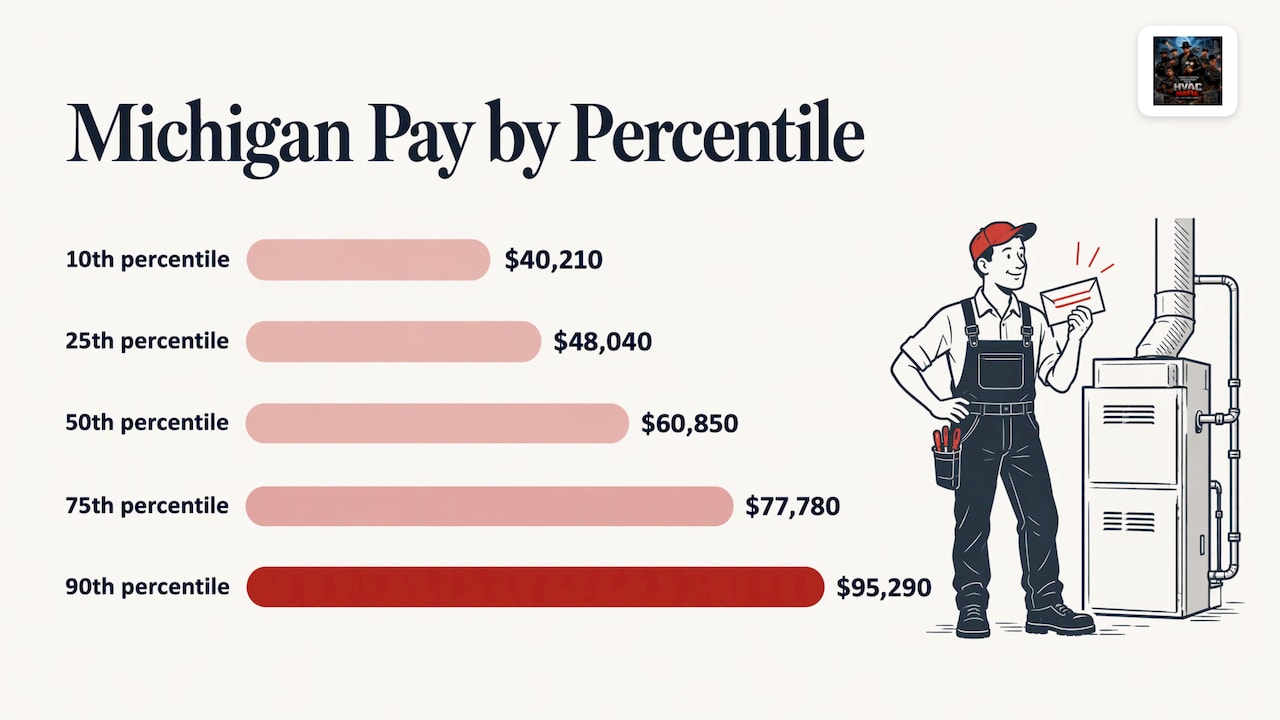
Michigan HVAC mechanics and installers earned a median of $60,850 a year, or $29.26 an hour, in the federal May 2025 wage data. Half of Michigan techs earn less than that and half earn more. Where you land depends on your experience, your specialty, your city and the shop you work for. The range is wide: the bottom tenth earns about $40,210 and the top tenth about $95,290.
We built HVAC Mafia as a job board and community for the trade, and pay transparency is a big part of why. Below is what the official numbers say, what moves them, and how to test a real offer against them.
TL;DR
- The Michigan median for HVAC mechanics and installers is $60,850 a year ($29.26 an hour), based on BLS May 2025 data. The U.S. median is $61,010.
- The spread is the story: $40,210 at the 10th percentile, $77,780 at the 75th and $95,290 at the 90th.
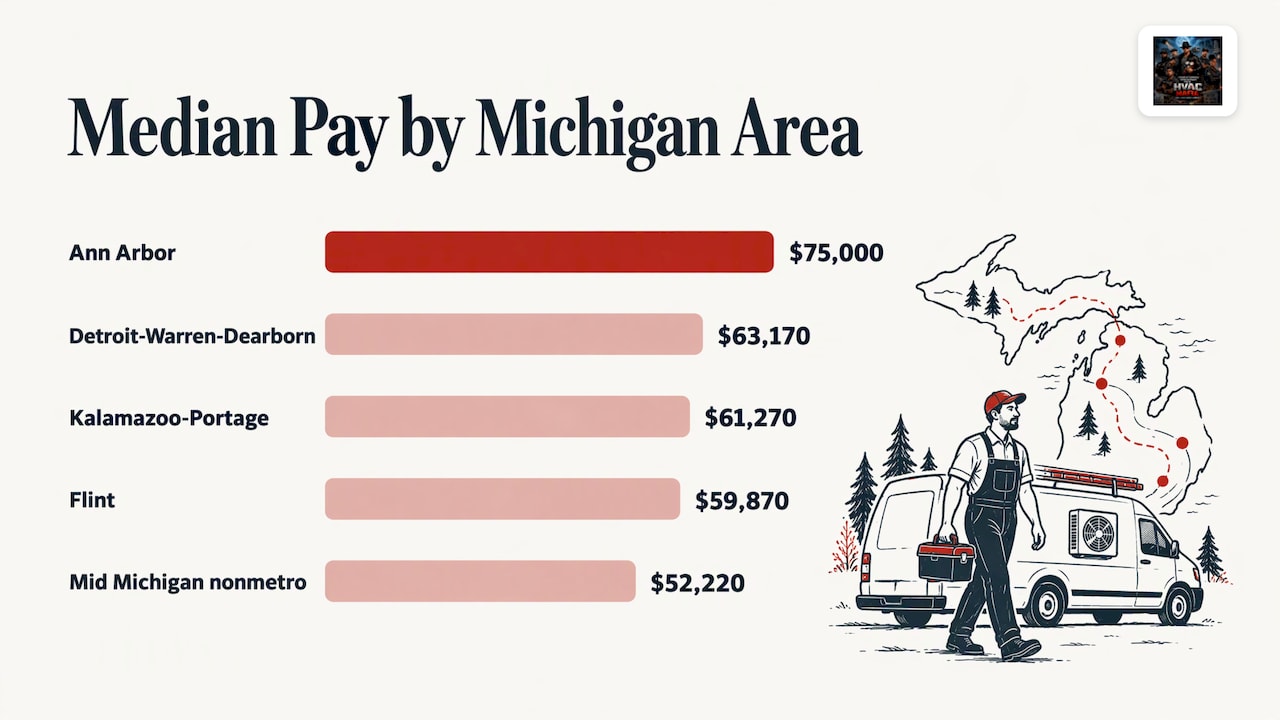
- Ann Arbor leads the state at a $75,000 median. Detroit-Warren-Dearborn sits at $63,170. Mid Michigan nonmetro areas sit at $52,220.
- Overtime, on-call pay, specialty skills and employer type can move your total pay more than the base rate suggests.
- Compare any offer to the percentile that matches your experience, not to a single average.
Table of Contents
- What Michigan HVAC techs earn
- Pay by career stage
- HVAC pay across Michigan cities
- What moves your pay beyond the base rate
- The outlook for Michigan techs
- How to check an offer against the numbers
- Perspective
- Find a Michigan HVAC job that pays what you are worth
- FAQ
- Sources
What Michigan HVAC techs earn
The most reliable numbers come from the Bureau of Labor Statistics (BLS) Occupational Employment and Wage Statistics survey, a federal survey of employers. O*NET, the Department of Labor’s occupation database, publishes the Michigan wage breakdown for HVAC mechanics and installers from the May 2025 survey.
| Percentile | Annual pay | What it usually means |
|---|---|---|
| 10th | $40,210 | Entry level, first-year helpers and apprentices |
| 25th | $48,040 | Early-career techs |
| 50th (median) | $60,850 | The middle of the Michigan market |
| 75th | $77,780 | Experienced, well-rounded techs |
| 90th | $95,290 | Top earners, specialists, leads |
A percentile is simple: at the 25th, a quarter of workers earn less and three quarters earn more. The median converts to $29.26 an hour. The national median is $61,010, or $29.33 an hour, so Michigan sits almost exactly on the national line, according to BLS’s Occupational Outlook Handbook.
These are published figures for a survey period, and BLS releases new ones once a year. Treat them as the yardstick, then check the latest release when you sit down with an offer.
Why the average and the median differ
You will see sites quoting a Michigan “average” that runs higher than $60,850. A few high earners pull an average up. The median ignores that pull and shows the middle tech. When you want to know what a typical offer looks like, the median and the percentiles tell you more.
Pay by career stage
The percentile table maps onto a career. It is not a promise, but it is a useful picture of the climb.
Apprentices and first-year techs
Most people start near the bottom of the range, around the 10th to 25th percentile ($40,210 to $48,040 a year). Registered apprenticeships raise pay in steps as you log hours and finish training periods, so your starting rate is a floor, not a ceiling. If you are just getting started, our guide to what HVAC apprentices earn each year walks through the steps. If you want to see what a rate means over a year, an hourly to yearly wage calculator turns any offer into annual gross pay in seconds. Remember to include the overtime you expect.
If you want paid learning, look at HVAC jobs with training and HVAC jobs with paid training. Those pages cover how to earn while you build skills.
Journeyman and experienced techs
Michigan’s own labor market agency lists HVAC and refrigeration mechanics and installers as a high-demand, high-wage occupation. Its 2026 Michigan Career Outlook gives a $23 to $37 hourly range between the 25th and 75th percentiles. That is the broad middle of the trade, and it is where most licensed, field-ready techs live.
Top earners
The top 10 percent earn about $95,290 or more. Techs get there by combining skills that are hard to hire for: strong diagnostics, commercial or refrigeration work, controls, and the ability to run a truck or a crew alone. Moving from tech to lead or service manager is another route. See HVAC service technician career paths and HVAC service manager jobs for how that step looks.
HVAC pay across Michigan cities
Location moves your number more than most people expect. CareerOneStop, a Department of Labor tool, publishes Michigan wages by area from the May 2025 data. Here are the median annual pay figures for several areas:
| Area | Median annual pay | Median hourly |
|---|---|---|
| Ann Arbor | $75,000 | $36.06 |
| Detroit-Warren-Dearborn | $63,170 | $30.37 |
| Kalamazoo-Portage | $61,270 | $29.46 |
| Jackson | $61,220 | n/a |
| Lansing-East Lansing | $60,440 | n/a |
| Flint | $59,870 | n/a |
| Mid Michigan nonmetro | $52,220 | $25.11 |
O*NET’s metro table shows the same pattern. Ann Arbor’s 90th percentile is $101,310, so the best-paid Ann Arbor techs clear six figures. Detroit’s 90th percentile is $95,610.
The gap between Ann Arbor and rural Mid Michigan is nearly $23,000 a year. Before you move or commute for money, weigh it against housing costs and drive time. A higher wage in an expensive market can leave you with about the same in your pocket. If you like comparing regional pay data in general, pay rankings by region give useful context on how wages stack up.
What moves your pay beyond the base rate
Two techs with the same hourly rate can take home very different amounts. Check these five things.
Overtime and on-call pay
BLS notes that most HVAC techs work full time, and that schedules can include evenings, weekends, on-call emergencies and overtime during peak heating and cooling seasons. In Michigan, that means January furnace failures and July heat waves.
As one worked example, the University of Michigan’s skilled trades contract for 2023 to 2027 pays overtime at 1.5 times the hourly rate beyond 8 hours a day or 40 hours a week. It pays on-call status at 20 percent of the hourly rate, with a minimum of 3 hours at the overtime rate for a return-to-campus call. That is one employer’s union agreement, not a rule for the state. Still, it shows the questions worth asking any employer: how is on-call time paid, and is there a minimum when you are called in?
Here is the math. At $29.26 an hour, 5 hours of overtime a week at time and a half adds roughly $219 a week, or more than $11,000 over 52 weeks. That is why base pay alone is a poor comparison.
Employer type
BLS reports that national median pay in May 2025 was $71,190 in wholesale trade and $60,030 at plumbing, heating and air-conditioning contractors. The same job pays differently depending on who signs the check: a residential contractor, a commercial mechanical company, a facility’s in-house team, a union shop or a distributor.
Specialty and work type
Service, commercial and refrigeration work tend to reward diagnostic skill, because that skill takes years to build and is hard to replace. Installers can reach the middle of the market quickly, but the climb from there depends on adding skills. If you are weighing commercial work, read our breakdown of commercial HVAC salaries.
Benefits
A $2 an hour difference can disappear into a health plan, a truck take-home policy, tool allowances or a retirement match. Ask for the numbers in writing.
Why customers pay more than you earn
A shop may bill $90 or more an hour while paying you $29. That does not mean someone is pocketing the difference. The billed rate has to cover payroll taxes, insurance, the truck, fuel, tools, parts stock, dispatch, unbilled drive time and warranty work, and then a margin. It is useful to know when you ask for a raise: the conversation is about the value you produce per billable hour, not the invoice total.
The outlook for Michigan techs
Demand supports pay. Michigan’s career outlook projects 6.6 percent growth for HVAC and refrigeration mechanics and installers through 2034, with 1,360 projected openings a year. Nationally, BLS projects 11 percent growth from 2025 to 2035, about 40,600 openings a year, from commercial construction including data centers, residential building and the replacement of older systems.
For a tech, that means leverage. Shops that cannot find people have to compete on pay, schedule and culture. If you are weighing the whole career, our piece on whether HVAC is a good career covers the pay and the hard parts.
How to check an offer against the numbers
BLS says to compare your wage with the full distribution and to consider experience, education, location and industry. Here is a simple routine:
- Pick your percentile honestly. Under two years in the field, start with the 10th to 25th percentile ($40,210 to $48,040). Five or more years with solid diagnostic skills, look at the 50th to 75th ($60,850 to $77,780).
- Use your area, not just the state. A Detroit offer belongs next to $63,170, not $60,850. A Lansing offer belongs next to $60,440.
- Convert to a yearly figure. Multiply the hourly rate by your real expected hours, including likely overtime.
- Price the extras. Add on-call pay, a take-home vehicle, tool allowance, health premiums and retirement match.
- Ask about the path. Find out how raises work, what certifications the company pays for and who moves up to lead tech or service manager.
If an offer lands below the percentile for your experience, you have a fact-based reason to negotiate or keep looking.
Perspective
I have spent 36 years in this trade, and I ran a dealership. I have sat on both sides of the pay conversation. Here is what I know: most techs underestimate what they are worth because nobody shows them the real numbers.
A salary page can tell you the state median. It cannot tell you which shop in your town respects its people, pays on time, trains, and promotes from within. That is why we built HVAC Mafia around the trade itself: a free membership for technicians, job openings from real contractors that non-members cannot see, and straight talk on pay, career paths, certifications and spotting good and bad employers.
For contractors, the same logic holds. If you cannot find or keep technicians, a vague job post will not fix it. Post where trade professionals already are, and show your pay, culture and benefits. Our Company Spotlight profiles exist so a shop can stand out to techs who have choices.
Build a career, not just another paycheck.
the author
Find a Michigan HVAC job that pays what you are worth
Techs register free at HVAC Mafia. Membership lets you see job openings from real contractors, and you never pay to use the platform. Join as a member and compare real openings against the numbers above.
If you are a contractor in Michigan who is struggling to hire, you can reach a trade-only audience of nearly 100,000 HVAC followers. Job posting plans are published at our posting plans page: Standard is $199 per month per position, Annual is $149 per month per position, and Enterprise starts from $99 per month per position. Company Spotlight is $149 per month or $1,699 per year, and it puts your pay, culture and benefits in front of techs.
FAQ
What is a good HVAC salary in Michigan?
The median is $60,850 a year, so anything above that is above the middle of the market. A tech with solid experience should look toward the 75th percentile of $77,780. In Ann Arbor, the median is already $75,000.
How much do HVAC apprentices make in Michigan?
Most start near the bottom of the range, around $40,210 a year at the 10th percentile of all HVAC workers. Registered apprenticeship pay rises in steps as you complete training periods. Exact starting rates depend on the program and employer, so ask for the full wage schedule.
Which city in Michigan pays HVAC techs the most?
Ann Arbor, with a median of $75,000 a year and a 90th percentile of $101,310 in the May 2025 data. Detroit-Warren-Dearborn follows at a median of $63,170. Rural Mid Michigan has the lowest median of the areas listed, at $52,220.
Is $30 an hour good for an HVAC tech in Michigan?
It is right at the state median of $29.26 an hour, so it is a solid, middle-of-the-market wage. Whether it is good for you depends on your experience, your city and the extras. Add overtime, on-call pay and benefits before you decide.
Sources
- O*NET OnLine: Michigan wages for HVAC mechanics and installers
- CareerOneStop: Michigan HVAC wages by area
- BLS Occupational Outlook Handbook: HVAC mechanics and installers
- BLS: How much could I be earning?
- Michigan Center for Data and Analytics: 2026 Michigan Career Outlook
- University of Michigan skilled trades contract 2023 to 2027