

HVAC installer recruitment works when a contractor puts a clear, honest job in front of people who already work in the trade, and when an installer can see real openings without wading through noise. That is why we built HVAC Mafia as a trade-only board: installers register free and see openings from real contractors, and contractors post to an audience of nearly 100,000 HVAC followers, with applications going straight to the employer’s own hiring system.
Whether you are a shop owner trying to fill a lead installer seat or an installer deciding where to go next, this guide covers what listings actually ask for, what pay looks like, how to screen and how to size up an employer.
TL;DR
- Installer hiring runs on a clear job description, a fast first response, a screening process you control and a pay and training story that holds up when the candidate asks about it.
- Most listings ask for hands-on installation experience, EPA refrigerant certification, a driver’s license and the ability to lift and work in tight spaces. Licensing beyond that depends on your state or city.
- Installers should compare total compensation, training support and the one-, three- and five-year path, not just the hourly number.
- Contractors reach installers fastest on a trade-only board. Our job plans run $199, $149 or from $99 per month per position, depending on the plan.
- Installers join free and never pay.
Table of Contents
- What installer recruitment actually involves
- What installer job listings commonly require
- Licensing: it depends where you work
- What installation jobs pay and where they lead
- For contractors: an installer hiring plan that works
- Where to post: what it costs on our board
- Promo: fill your next installer seat
- For installers: how to judge a job and an employer
- Retention starts with recruiting
- Our view from the trade
- FAQ
- Sources
What installer recruitment actually involves
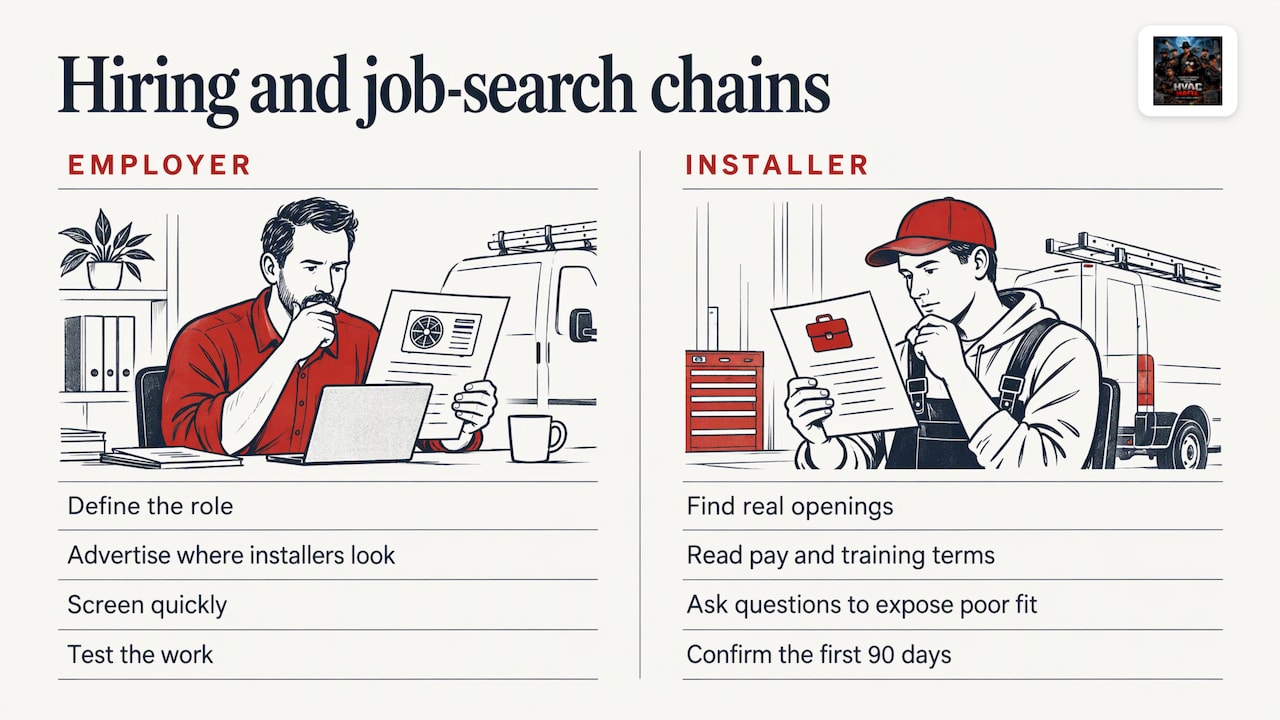
For an employer, it is a short chain: define the role, advertise it where installers look, screen quickly, test the work, make an offer that is specific and keep the person once they start. A break at any link costs you the hire. A vague ad draws the wrong applicants. A slow reply loses the good one to the shop that called back the same day.
For an installer, the same chain runs the other way: find openings that are real, read the pay and training terms closely, ask the questions that expose a bad fit and say yes only when the first 90 days are spelled out.
The demand behind it is steady. BLS-based projections compiled by JobStack Research show about 8% growth and roughly 40,100 openings a year for HVAC mechanics and installers. Installers have choices, and good contractors recruit like they know it.
What installer job listings commonly require
Read enough listings and the pattern is clear. Here is what shows up again and again.
Education and training
The Bureau of Labor Statistics says HVAC mechanics and installers typically need a postsecondary nondegree award, though some enter with less, and that they then go through a lengthy period of on-the-job training. HVAC programs generally run from six months to two years and lead to a certificate or an associate degree. For apprentices and trade school students, that means a green candidate can be a good hire if you have a real plan to train them.
Experience and certification
Lead installer listings ask for more. One 2026 lead installer posting in New Jersey required five or more years of residential installation experience, at least two years leading crews, EPA Type II or Universal certification, a driver’s license and the ability to lift up to 80 pounds and work in confined spaces.
An Iowa lead installer listing asked for two or more years of residential installation experience, a valid license with an acceptable driving record, and passing background, drug and physical screening. A journeyman license and technical school certification were listed as advantages.
The lesson for both sides: the title “installer” covers a wide range. An entry-level helper and a crew lead are different hires, and the ad should say which one you mean.
What the work includes
Residential lead roles now often involve heat pump and mini-split installs, startup and commissioning, low-voltage wiring, documentation, customer communication and mentoring apprentices, as in a 2026 Pennsylvania listing. BLS also lists customer service, detail orientation, math, mechanical ability, physical stamina, problem-solving and technology skills as important qualities for the trade. If your installers talk to homeowners and fill out digital paperwork, say so in the ad.
Licensing: it depends where you work
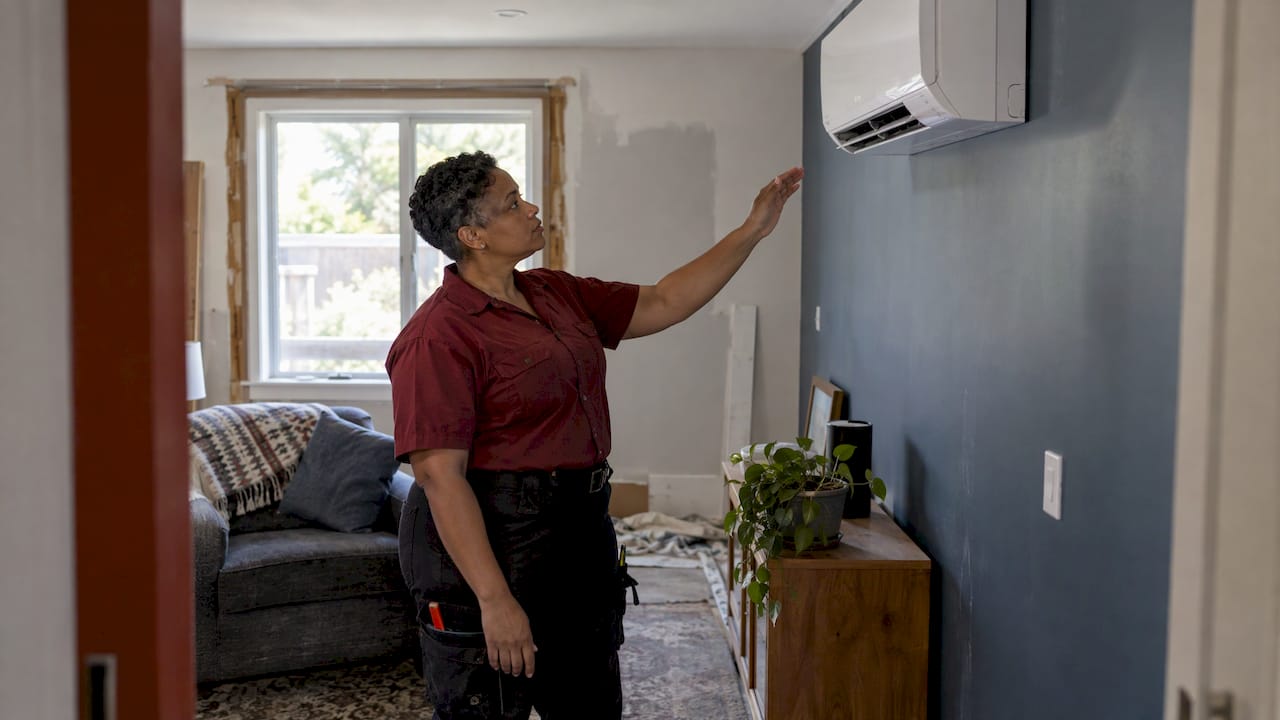
One requirement is national. BLS notes that the EPA requires nearly all HVAC technicians to be certified in proper refrigerant handling, which means passing an exam, and that state and local licensing may also apply.
That second layer varies a lot. NEEP’s workforce guide explains that EPA Section 608 is nationwide, while other licensing varies by state and municipality. Its examples: no statewide HVAC license in New York but local licensing, several license categories in Connecticut, and a master HVACR contractor license structure in New Jersey.
For contractors, this means your job post should name the exact credential you need, not just “licensed.” For installers moving across state lines, check with your state or local licensing board before you accept an offer, because a license that counts in one place may not count in the next.
What installation jobs pay and where they lead
BLS reported a May 2024 median annual wage of $59,810 for heating, air-conditioning and refrigeration mechanics and installers. That is the middle of the whole field. Lead installers, commercial installers and people in high-cost metros often land above it, and entry-level helpers below it.
Pay structures also differ. One 2026 lead installation listing from Cool Breeze offered $30 per hour during one to two weeks of training, then either $30 per hour or 6% commission on installations led. Commission applies if it exceeds the hourly pay, and commission jobs do not include overtime. Two jobs with the same headline rate can pay very differently depending on how the math works, so ask for it in writing.
The same employer lists a path from lead installation technician to technical trainer or mentor, to project management or HVAC sales, and to commercial installation leadership. That is the kind of ladder good candidates ask about. If you can describe yours in one sentence, you have a recruiting advantage.
Our own job board shows how wide the range is. Listings include a lead installer role in Westchester, NY with a published hourly range, a lead installer opening in New Cumberland, PA and an install lead technician role in Sharonville, OH. Registered members can see the full openings.
For contractors: an installer hiring plan that works
If you are hiring now, this is the routine. For each step, we note where it tends to go wrong.
- Define the seat. Decide whether you need a helper, a journeyman installer or a crew lead. ServiceTitan’s recruiting guidance suggests the job description should cover title, responsibilities, required licenses and certifications, experience level, equipment specialization, pay, benefits, schedule and how to apply. Where it goes wrong: ads that list a wish list of skills and no pay. Installers skip them.
- Publish the pay. Put the range, any commission formula and overtime rules in the ad. Pay transparency is one of the things we hear technicians ask about most, and an ad that hides it looks like a shop that will hide other things.
- Post where installers already are. The same ServiceTitan guidance lists trade schools, unions, job fairs, trade shows, social channels, resume databases, LinkedIn and past applicants as sources. A trade-only board adds one thing the broad sites can’t: every person reading is already in the business. Our listings are restricted to verified HVAC trade professionals, so your post is not competing with homeowner and outsider noise.
- Screen by phone first. Ten minutes on the phone filters most mismatches before anyone drives to your shop. Confirm certification, license, driving record, availability and pay expectations.
- Test the work, not just the talk. ACHR News reported that Atticman personally screens candidates, builds a model of the ideal installation, uses job photos and checklists and performs next-day quality inspections. You can borrow the idea: define what a good install looks like before you hire, then check every early job against it.
- Use a probation period. The same report describes a deliberate 90-day probation. A defined window protects both sides and gives you a natural moment to review.
- Make the offer fast and specific. Pay, start date, training plan, truck and tools, and the path to the next role. Good installers are often fielding more than one offer.
Budget the hire as a whole, too. Pay, onboarding time, tools, a truck and training all hit your books before the first install pays back, so many owners bring in accounting support for HVAC companies to forecast cash flow and payroll before they add a crew.
We also cover the wider process in our guide on how contractors hire and keep techs, and the commercial side in commercial HVAC hiring.
Where to post: what it costs on our board
Our plans are priced per open position, so you pay for the seats you are actually filling:
| Plan | Price |
|---|---|
| Standard | $199 per month per position |
| Annual | $149 per month per position |
| Enterprise | from $99 per month per position |
Applications go straight to your own hiring system, so your process stays yours. If you want to stand out to installers who have choices, a Company Spotlight profile shows your culture, pay and benefits. The monthly plan is $149 per month and the annual plan is $1699 per year. For a single urgent seat, Spotlight placements are also sold by the week: $149 per week per position, $499 per 4 weeks per position, or $349 per month per position on the ongoing plan.
Promo: fill your next installer seat
If you have an installer or lead installer role open, post it where trade professionals are already browsing. Pick a plan on the job posting plans page, and add a Company Spotlight profile if you want installers to see your culture and benefits before they apply.

Installers and apprentices do not pay anything. You can join as a member to see the openings that are hidden from non-members.
For installers: how to judge a job and an employer
A posting is only the start. TechForce, a nonprofit supporting technician careers, advises job seekers to look at transparent pay, training and certification support, advancement at one-, three- and five-year points, workplace respect and voluntary turnover. It names vague pay, no answer on advancement, weak onboarding and dismissive attitudes toward training as warning signs.
Turn that into questions you can ask in the interview:
- What is the full pay structure, including commission, overtime and any training-period rate?
- Do you reimburse training or certification, and is education time scheduled?
- What will my first 90 days look like, and who mentors me?
- Where do installers here usually end up in one, three and five years?
- How many installers have left in the last year, and why?
TechForce also recommends comparing total compensation rather than hourly pay alone. A $30 base with commission on top and a paid training plan can beat a higher hourly rate with none of that.
Interviews go better with practice, so see our guide to HVAC interview questions and what techs get asked. If you are weighing a specific job, our board has listings like this lead installer role in Glastonbury, CT and an install technician role in Charleston, SC.
Retention starts with recruiting
Hiring an installer you then lose in six months is expensive. The best recruiting message is one you can keep. NEEP found that successful workforce programs combine manufacturers, schools, utilities and trade associations with stipends, paid courses and wraparound support to grow the installer pipeline, in a market where heat pump demand is rising and equipment is getting more complex.
For a single shop, the same ideas scale down:
- Pay for training. A paid route from helper to journeyman gives people a reason to stay.
- Show the ladder. Installer to lead, lead to trainer, trainer to project manager or sales. Say it in the ad and in the interview.
- Respect the crew. Respect shows up in scheduling, tools, trucks and how you handle mistakes.
- Let people see the culture. A Company Spotlight profile lets candidates see how your shop treats people before they ever walk in.
Our view from the trade
We started HVAC Mafia because the trade deserved a place of its own. Our founder has 36 years in HVAC and ran a dealership, so he has sat on both sides of the hiring table. He knows what it is like to be a contractor with trucks that need to roll and no one to drive them. He also knows what it is like to be a tech who has been sold a job that was not what the ad said.
Here is what we believe about installer recruitment. First, the best installers are not scrolling general job sites for fun. They are in the trade, talking to other techs, and they trust people who talk straight about pay, training and culture. That is why our listings and community are restricted to verified HVAC trade professionals.
Second, the contractor who shows the work wins. A clear pay range, a real career path and a Company Spotlight profile that tells the truth about your shop do more than any slogan. Techs have choices. Give them reasons.
Third, nobody should have to pay to look for a job. Installers, apprentices and trade school students join free, and openings come straight from real contractors. Contractors pay to post, and applications go to their own hiring system, so the process stays theirs.
If you are hiring, post your role with us. If you are looking, join and see who is hiring. Build a career, not just another paycheck.
the author
FAQ
What does an HVAC installer recruiter or hiring manager look for first?
Most listings start with hands-on installation experience, EPA refrigerant certification and a valid driver’s license. Lead roles add crew-leading experience and often a clean driving record. Hiring managers also look for the soft side that BLS lists, such as customer service, detail orientation and problem-solving.
Do HVAC installers need a license?
Nearly all HVAC technicians need EPA refrigerant handling certification, according to BLS. Beyond that, licensing depends on your state or city, and some states have no statewide license while some cities do. Check with your state or local licensing board before you apply or hire across state lines.
How much does an HVAC installer make?
BLS reported a May 2024 median annual wage of $59,810 for HVAC and refrigeration mechanics and installers overall. Individual jobs vary by region, experience and pay structure. Some, like one 2026 lead installer listing, mix an hourly rate with commission, so ask how it works before you accept.
How can contractors hire HVAC installers faster?
Publish the pay, name the exact credentials you need and reply to applicants the same day. Post where HVAC professionals already look. On our board, plans start from $99 per month per position, and applications go to your own hiring system.
Is it free for installers to look for jobs on HVAC Mafia?
Yes. Installers, apprentices and trade school students register for free to see openings, and they never pay. Openings are hidden from non-members, so you need to join to view them.
Sources
- BLS: Heating, Air Conditioning, and Refrigeration Mechanics and Installers
- BLS: Heating, Air Conditioning, and Refrigeration Mechanics and Installers (print version)
- BLS: Installation, Maintenance, and Repair Occupations
- HVAC Lead Install Technician listing, New Jersey
- Licensed HVAC Lead Installer listing, Dubuque, Iowa
- HVAC Lead Installation Technicians, Cool Breeze
- NEEP: High-Performance HVAC Workforce Development Program Best Practice Guide
- TechForce: Know Who You’re Working For
- ACHR News: How Atticman Raised the Bar, Not Their Headcount
- ServiceTitan: Top HVAC Recruiting Strategies
- JobStack Research: Skilled Trades Wage and Job-Outlook Benchmarks