

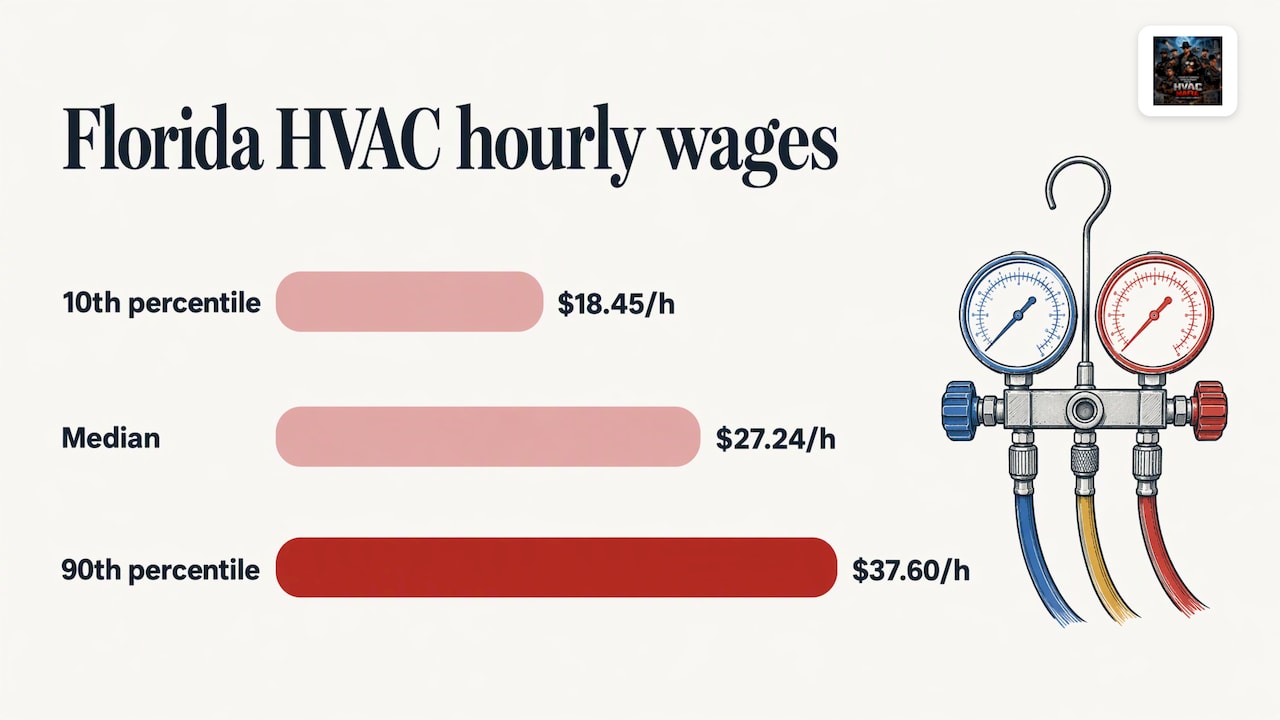
A typical Florida HVAC technician earns a median of $27.24 an hour, or $56,670 a year, according to O*NET’s Florida wage data. The range is wide. The bottom 10 percent earn about $38,370 and the top 10 percent earn about $78,210. Where you land depends on your experience, your license, your specialty, your city and, most of all, who you work for.
This guide breaks down the Florida numbers, shows how they compare with the rest of the country, and explains what actually moves a paycheck. It also covers how to find openings that fit your skills. We built HVAC Mafia for techs, so we’ll be straight with you about all of it.
TL;DR
- Florida’s median for HVAC mechanics and installers is $27.24 per hour ($56,670 per year). The middle 80 percent earn roughly $18.45 to $37.60 per hour.
- That sits below the U.S. median of $61,010 per year, but Florida has no state income tax on wages, and pay varies a lot by metro and employer.
- Experience, certifications, specialty work, overtime in peak cooling season and employer type move your number more than the state average does.
- Apprentices start much lower, often in the high teens per hour, and the pay climbs as hours and skills stack up.
- Free HVAC Mafia membership shows you openings from real contractors that non-members can’t see.
Table of Contents
- How much do HVAC technicians make in Florida?
- Florida vs. the national average
- Pay by city in Florida
- What an employer actually posts
- What moves your pay in Florida
- What do apprentices earn in Florida?
- How to earn more as a Florida HVAC tech
- Spotting a good Florida employer
- Our perspective
- Find Florida HVAC openings
- FAQ
- Sources
How much do HVAC technicians make in Florida?
Start with the official numbers. They come from the federal Occupational Employment and Wage Statistics survey, which O*NET republishes by state. For heating, air conditioning and refrigeration mechanics and installers in Florida, the published figures look like this:
| Measure | Hourly | Annual |
|---|---|---|
| 10th percentile | $18.45 | $38,370 |
| Median | $27.24 | $56,670 |
| 90th percentile | $37.60 | $78,210 |
Read those three rows as three different careers. The 10th percentile is usually a newer tech or a helper, often at a small shop with little room to grow. The median is a solid, experienced tech doing steady work. The 90th percentile is someone who has built real skill, usually in a specialty, a lead role or a commercial setting, and works for an employer that pays for it.
One thing to keep in mind: these are wage figures from a survey, and they measure what employers report paying. They don’t automatically include every bonus, commission or spiff, and they don’t include the overtime you work in July. We’ll get to that.
Why you’ll see different numbers online
Search for Florida HVAC pay and you’ll see a lot of different figures. Some are higher than the official median, some are lower. That’s normal. Salary sites mix job-posting data, self-reported pay and company-specific averages, and they often blend job titles. A “commercial HVAC technician” page, an “installer” page and a “service tech” page will never match, because they’re different jobs at different points on the ladder.
When you want a number to negotiate with, use the official wage tables as your baseline. Then look at actual job postings in your city for the specific role you want. Postings show what employers are willing to pay this month, not what they paid on average last year.
Florida vs. the national average
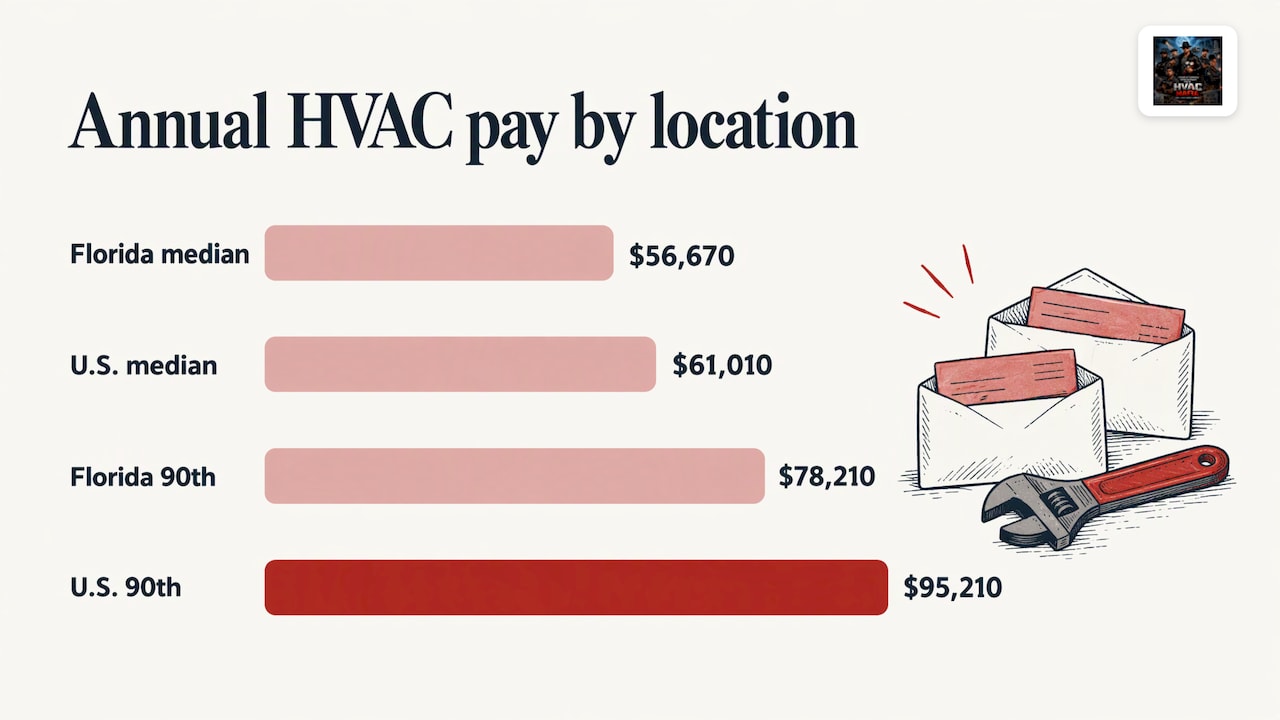
The U.S. median for the same occupation is $61,010 per year, or $29.33 per hour, with a 10th percentile of $40,050 and a 90th percentile of $95,210, per the Bureau of Labor Statistics. Here’s the side-by-side:
| Measure | Florida | United States |
|---|---|---|
| Median hourly | $27.24 | $29.33 |
| Median annual | $56,670 | $61,010 |
| 10th percentile annual | $38,370 | $40,050 |
| 90th percentile annual | $78,210 | $95,210 |
Florida’s median is about $4,340 a year below the national figure. The gap widens at the top: the best-paid U.S. techs earn more than $95,000, while Florida’s 90th percentile is about $78,000. Much of the high end nationally comes from markets with heavy union presence, big industrial and commercial systems and a high cost of living.
But the raw number isn’t the whole story. Florida doesn’t tax wages at the state level, so more of each check stays with you. And demand is steady. In a state where air conditioning isn’t a luxury for most of the year, systems run hard and break down. That’s the kind of market where a skilled tech has choices.
If you’re weighing another big HVAC state, we broke down what techs make in Texas so you can compare.
Pay by city in Florida
Florida isn’t one labor market. It’s several, and they pay differently. The O*NET table shows the spread between metros:
- Naples-Marco Island: a median of $28.62 per hour, or $59,540 per year.
- Tampa-St. Petersburg-Clearwater: a median of $24.30 per hour, which works out to roughly $50,500 for a full-time year of 2,080 hours.
That’s a $4.32-an-hour difference between two Gulf Coast markets. Part of it is cost of living and part is the mix of employers. Naples has a lot of high-end residential work, where homeowners expect premium service and companies price accordingly. Tampa has a deep pool of techs and a lot of competition among contractors.
Before you move for a few extra dollars an hour, run the math on rent, commute and housing. A higher wage in an expensive coastal market can leave you with less than a lower wage somewhere cheaper. And remember a metro median is an average of good and bad employers. The best shop in a lower-paying metro often beats the worst shop in a higher-paying one.
We list real Florida openings from contractors who want trade-only applicants. For example, you can see what a service technician role in West Palm Beach looks like, or browse an installer opening in Lake Worth. Pay, benefits and requirements are laid out so you can compare them yourself.
What an employer actually posts
Official medians are useful. Job postings are where you see the real range. A major manufacturer’s HVAC Service Technician I posting in Tampa lists an hourly range of $20.80 to $33.27, and says base pay depends on skills, qualifications, experience and location. For a full-time year that’s roughly $43,000 to $69,000 before overtime.
That single posting shows how much room there is inside one job title. The low end is for someone who just meets the requirements. The high end is for someone who brings more. When you read a range, ask what you’d need to bring to land at the top of it.
What moves your pay in Florida
Experience and skill level
HVAC pay tracks what you can do without supervision. A tech who can run a call alone, diagnose a problem on the first visit and explain it clearly to a customer is worth much more than one who needs a lead on the truck. That’s why the spread between the 10th and 90th percentile is so big.
Certifications and training
Nearly every HVAC technician must be certified in proper refrigerant handling by the EPA, and technicians typically complete a postsecondary nondegree award plus long-term on-the-job training, according to BLS. In Florida, training programs often bundle those credentials. Orange Technical College, for instance, describes OSHA 10-hour training and employment-ready exams, including EPA Section 608, within its HVAC/R program.
Certificate programs typically run six months to a year, associate degree programs about two years, and apprenticeships about four years, according to one Florida school’s licensing guide. If you’re sorting out the timeline, our guide to how long it takes to get HVAC certified walks through it.
If you’re aiming for contractor-level work, check the Florida licensing requirements on the state’s official licensing board site, since rules for who can pull permits and run their own business are specific to the state.
Overtime and season
BLS notes that technicians may work overtime or irregular schedules during peak heating and cooling seasons. In Florida, cooling season is long. A tech at a shop that pays time and a half and has plenty of calls can earn well above the hourly rate times 2,080 hours. A tech at a shop that cuts hours in slow months, or pays straight time for everything, will earn less than the same hourly rate suggests.
So when you compare offers, ask how overtime is paid and how many hours techs typically get across the year.
Service, install, commercial and refrigeration
The job you do shapes the paycheck:
- Residential service: often hourly, sometimes with commission or spiffs on repairs and sales. Great upside for techs who communicate well.
- Installation: physically demanding, often paid hourly or by the job. Crew leads and install managers earn more.
- Commercial and refrigeration: typically requires deeper technical skill with larger and more complex equipment. Our breakdown of commercial HVAC salaries covers what that path pays.
- Service management: a step off the tools. See our guide to HVAC service manager jobs for pay and path.
Employer type
A small family shop, a large regional contractor, a national company, a facilities department and a manufacturer’s service arm all pay differently and offer different benefits. Compare the whole package: base pay, overtime rules, a take-home truck, tools, training, health coverage, retirement matching, paid time off and a real path up.
What do apprentices earn in Florida?
Everyone starts somewhere. A county government posting for HVAC apprentice positions in Fort Myers lists a starting pay of $17.00 per hour. It describes a four-year, state-certified apprenticeship with 8,000 total hours of on-the-job training plus classroom instruction.
At $17.00 an hour, a full-time year comes to about $35,360. That’s well under the state median, and that’s normal for the first rung. What matters is the direction. An apprenticeship pays you while you learn, and the pay generally steps up as your hours and skills grow. Compared with paying for school out of pocket, earning while you train is a big advantage.
If you’re thinking about whether the trade is worth it overall, read our honest take in Is HVAC a Good Career?. It covers pay, outlook and the hard parts.
How to earn more as a Florida HVAC tech
The state median is a starting point, not a ceiling. Here’s what we’ve seen work across the trade.
- Get your credentials in order. Get EPA 608 certification early, and keep adding the credentials your target employers ask for.
- Pick a lane and get good. Techs who master heat pump diagnostics, commercial rooftop units, refrigeration or controls become the person the shop can’t afford to lose.
- Learn to talk to customers. In residential service, the techs who explain a problem clearly and honestly often earn the most.
- Know what the market pays. Look at postings in your metro before any pay conversation.
- Ask the right questions. How is overtime paid? Is there a take-home truck? Who pays for training? What do people in this role earn after two years?
- Build a resume that shows results. Use numbers: calls run, installs completed, callbacks reduced. Our guide to writing an HVAC technician resume shows how.
- Don’t stay somewhere that won’t grow you. If your employer won’t pay for your skill, another one will.
Spotting a good Florida employer
Pay is one piece. A good employer in Florida should be able to answer these without dodging:
- What’s the pay range for this role, and how is it decided?
- How is overtime handled in peak season?
- What does training look like, and who pays?
- How are on-call and after-hours calls rotated?
- What’s the plan for someone who wants to move up?
- Why is this position open?
Shops that are proud of how they treat techs tend to say so plainly. Ones that stay vague about pay usually have a reason.
Our perspective
We started HVAC Mafia because the people who actually do this work were tired of being filtered through corporate messaging and general job sites. A Florida tech shouldn’t have to dig through homeowner ads and staffing spam to find out what a real shop pays.
Here’s what we believe after a lifetime in the trade. The median tells you where the middle is. It doesn’t tell you what you’re worth. Your number depends on your skills, your effort and, honestly, on whether you’ve found an employer who values them. We built the platform so techs can see real openings from real contractors, get straight talk on pay, career paths and certifications, and talk to other techs who’ve been there.
Florida is a great place to build a career: long cooling seasons, constant demand and plenty of room to grow from apprentice to lead tech to service manager. Know what you’re worth, choose your employer carefully and build a career, not just another paycheck.
the author
Find Florida HVAC openings
If you’re a tech, registration is free. Members see job openings from real contractors that non-members can’t see. You also get Tech Talk forums with other techs and the HVAC Underground Podcast. Join HVAC Mafia for free and start comparing openings in your part of Florida.
If you run a shop and can’t find or keep good techs, you can post where the trade is already looking. Our job posting plans are $199 per month per position on Standard and $149 per month per position on Annual, with Enterprise from $99 per month per position. Applications go straight to your own hiring system. See the job posting plans, or put your culture, pay and benefits front and center with a Company Spotlight.

Pay transparency wins hiring. Florida techs have options, so the shops that show their pay and benefits up front get the best applicants.
FAQ
How much do HVAC technicians make in Florida?
The median is $27.24 per hour, or $56,670 per year, according to O*NET’s Florida wage data. The 10th percentile earns about $38,370 and the 90th percentile about $78,210. Your own number depends on experience, specialty, employer and overtime.
Is HVAC pay in Florida lower than the national average?
The Florida median of $56,670 is below the U.S. median of $61,010, per the same O*NET and BLS data. Florida doesn’t tax wages at the state level, and demand for cooling work is strong. A good employer in the right metro can easily beat the average.
Which Florida cities pay HVAC techs the most?
It varies by metro. In the O*NET table, Naples-Marco Island has a median of $28.62 per hour, while Tampa-St. Petersburg-Clearwater is at $24.30. Compare the full table and weigh your cost of living before you move.
What does an HVAC apprentice earn in Florida?
One Lee County apprenticeship posting lists $17.00 per hour to start in a four-year program with 8,000 on-the-job hours. Pay generally rises as you gain hours and skills. Check each program’s current pay schedule.
Do I need a certification to work as an HVAC tech in Florida?
Nearly all HVAC technicians must hold EPA refrigerant handling certification, per BLS. Many start through a certificate program, a degree or an apprenticeship. For running your own contracting business in Florida, confirm current licensing requirements with the state’s licensing board.
Sources
- O*NET OnLine: Florida wages for heating, air conditioning and refrigeration mechanics and installers
- BLS Occupational Outlook Handbook: Heating, Air Conditioning, and Refrigeration Mechanics and Installers
- HVAC Service Technician I, Tampa, FL job posting
- Orange Technical College HVAC/R 1 program
- How to get your Florida HVAC license: step by step