
An HVAC company profile is the page where a contractor says who it is, what work it does, and what it is like to work there. A good one serves two readers at once. Homeowners and commercial customers want to know if they can trust you. Technicians want to know if they should quit their current shop and join yours. This guide covers both, with a focus on the second reader, because that is where most contractors are losing ground right now.
TL;DR
- A solid profile covers the basics (name, location, founding year, services, licenses, service area) and the human side (people, values, training, pay, schedule).
- Technicians read profiles for proof: real photos, named training programs, clear career paths and honest talk about pay and on-call time.
- Generic marketing language is the fastest way to lose a tech’s trust. Specific, checkable details win.
- Hiring is hard across the industry, so a profile that answers a tech’s questions up front gives you an edge.
- If you want a profile in front of a trade-only audience, we offer Company Spotlight profiles at HVAC Mafia.
Table of Contents
- What an HVAC company profile actually is
- The basics every profile needs
- What technicians look for that customers don’t
- Showing culture without sounding like an ad
- Why the profile matters more in a tight labor market
- How techs can read a profile like a pro
- A simple template for your own profile
- Spotlight profiles at HVAC Mafia
- Perspective
- FAQ
- Sources
What an HVAC company profile actually is
People use the phrase for a few different things. A directory listing is a profile. So is the About Us page on your website, a one-page company overview for a bid package, or a spotlight on a job board. They share a job: to introduce a business quickly and credibly.
ACHR News describes the About Us page as the place to communicate the brand story, experience, certifications, awards and values. That is a fair baseline. The problem is that most profiles stop there, and most are written for customers only. If you are trying to hire, you need a second layer written for the person who will actually turn the wrenches.
The basics every profile needs
Start with the facts anyone would look for. A January 2026 profile guide lists the usual elements: company name, logo, location, founding year, history, mission, service areas, detailed services, licenses, certifications, awards and contact details. Business data providers track similar attributes, such as employee count, number of trucks, residential or commercial focus, and manufacturer relationships.
Here is a practical checklist:
- Who you are: legal name, year founded, who owns it, how big the team is.
- Where you work: cities, counties or states you serve, and whether you are residential, light commercial, commercial or refrigeration.
- What you do: installs, service, maintenance agreements, new construction, controls. Name the equipment you work on.
- Proof: license numbers where appropriate, NATE or other certifications, manufacturer programs, awards.
- How to reach you: phone, email, address, and a clear way to apply for a job.
Keep it plain. If a stranger can’t tell in ten seconds what you do and where, rewrite it.
What technicians look for that customers don’t
A customer asks, “Will this company show up and fix my system?” A tech asks a different set of questions:
- What will I make, and how does it grow?
- Will I get real training, or a ride-along and a good luck?
- How often am I on call?
- Who will I work for? Is the owner involved, or is it a revolving door of managers?
- Is there a path from apprentice to lead tech to service manager?
- Does the company run like the profile says it does?
You don’t have to answer every one in a paragraph. You do have to answer them somewhere. The best profiles treat the tech as a customer, because that is what a hire is: a person choosing between offers.
Pay and benefits
Pay transparency matters in this trade. Techs talk to each other constantly, and they know what the going rate is. The Bureau of Labor Statistics reported a median annual wage of $61,010 for heating, air conditioning and refrigeration mechanics and installers in May 2025. That is a national median, and your market may sit well above or below it. Use it as context, then show where you land and why.
You don’t have to publish every salary band. But a range, a description of how raises work, and a list of benefits (health coverage, retirement match, tools, truck policy, paid time off) tells a tech you aren’t hiding anything. Job posts that show a range get noticed. Look at how one Nevada listing leads with its pay range for a service technician in Reno. That is the kind of clarity techs respond to.
Training and career path
Training is where profiles can be the most specific, and the most convincing. A few examples from ACHR News coverage of contractors recognized as good places to work:
- One Pennsylvania-area contractor’s technician school offers classroom, lab and on-the-job training without tuition, plus paid apprenticeships that provide licensing and training, with the chance at full-time work and higher wages as skills develop.
- A Missouri contractor runs a 30,000-square-foot facility for live training on geothermal and high-efficiency systems.
- Another company runs paid training through its own internal university and expects technicians to become NATE certified.
Notice what these have in common: a named program, a concrete detail, a reason a tech would care. “We invest in our people” says nothing. “New hires spend their first 90 days with a mentor and a written skills checklist” says something, if it is true for you.
Training also connects to where the work is heading. The Department of Energy backs workforce efforts such as an initiative to train HVAC technicians in heat pump installation, design and maintenance. If you train on heat pumps or other newer equipment, say so.
Schedule and work-life balance
Burnout drives techs out of the trade and out of shops. One Washington contractor addressed it with a four 10-hour day schedule that limits on-call to about two days a month, according to ACHR News in 2012. You don’t need to copy that. You do need to say what your schedule is and how on-call works. Silence on the subject reads as bad news.
Showing culture without sounding like an ad
“Family-owned, customer-focused, committed to excellence.” Every tech has read that sentence a hundred times, and none believe it. A profile that shows culture has to be specific.
Research on web usability backs this up: Nielsen Norman Group reports that people expect About Us content to be clear, authentic and transparent, especially about purpose and values. Gallup adds that values become credible when leaders model them, stories are shared on an ongoing basis, and recognition and accountability reinforce them.
Translate that into your profile:
- Use real people. Real team photos, real trucks, real shop. An HVAC marketing firm recommends real photos of team members, technicians at work, vehicles and training over stock images. Show safety gear on, too. A photography guide for trades suggests wide and close-up shots of technicians doing representative work, with PPE visible.
- Tell the founding story honestly. Who started the company, why, and what changed over the years. Short and plain beats polished and vague. Testimonials that build real trust do the same thing for customers: they sound like actual people, not copy.
- Describe how you hire. One Washington contractor hires for character first and trains for technical performance once the candidate is a cultural fit. Another owner meets applicants personally before offering an introductory period. Details like that tell a candidate how they will be treated.
- Share ownership and structure. Arizona’s HACI Mechanical became employee-owned in August 2025, affecting 350 employees. If you have profit sharing, an ownership path or a promote-from-within record, that belongs in the profile.
- Let your techs talk. HVAC marketing specialists suggest voluntary, employee-led content, employee spotlights, work-anniversary recognition and team events, with customer permission and a simple approval process. Behind-the-scenes footage of technician prep, equipment organization and training works as well.
HVACR Business makes a related point: explain the people behind the work and what training and certifications mean for the customer, instead of just listing credentials. The same goes for techs. “NATE-certified” is a badge. “We pay for your NATE exams and a raise follows” is a reason to apply, if that is your policy.
Why the profile matters more in a tight labor market
Techs have choices. The Department of Energy’s 2026 U.S. Energy & Employment Report found that 70% or more of establishments in the Energy Efficiency sector reported difficulty finding workers in 2025, and that construction establishments in that sector reported a 78% hiring difficulty rate. When most employers are struggling to hire, a candidate who sees ten similar job posts will click through to the company that explains itself best.
Credentials help too. The DOE worked with Google so that contractors with Energy Skilled-recognized credentials can display a label on Google Business Profiles. The same announcement says more than 20,000 people have earned a credential from a recognized training program, and that states may use the recognition as a criterion for federal workforce funding. If your techs hold such credentials, say it in your profile.
How techs can read a profile like a pro
If you are a tech, apprentice or trade school student, here is how to size up a company from what it publishes:
- Look for specifics. Named training programs, schedules, pay ranges and benefits beat slogans.
- Check the photos. Are they real people in real shops and trucks, or stock images?
- Find the career path. Does the profile mention apprenticeships, mentoring, lead tech or management tracks?
- Notice what’s missing. No mention of pay, schedule or on-call may mean those aren’t selling points.
- Ask for proof in the interview. Ask to meet the team you’d work with and ask how long the average tech has stayed.
- Talk to other techs. Forums and podcasts are good for the straight story on how a shop treats its people.
When you find a shop you like, make your own side of the paper strong. Our guide on what to include in an HVAC technician resume walks through it. And when you browse openings, the listing itself tells you a lot. Compare a service technician opening in Spring, TX with an install lead role in Sharonville, OH and see which details each employer chose to share.
A simple template for your own profile
Use this outline and fill each part with specifics:
- Opening paragraph: who you are, where you work, and the kind of tech you want to hire.
- Our story: founding year, founder, how you grew.
- What we do: services, equipment, residential or commercial mix.
- How we treat techs: pay structure, benefits, schedule, on-call, tools and truck.
- How you grow here: training, certifications paid for, mentoring, promotion examples.
- Meet the team: photos and a line about each person, with their permission.
- How to apply: one clear link, one clear contact.
Keep every claim something a current employee would confirm. Techs will check.
Spotlight profiles at HVAC Mafia
If you want your profile in front of the people you are trying to hire, our Company Spotlight is built for that. It lets a shop show its culture, pay and benefits to a trade-only audience, so it stands out to techs who have options. HVAC Mafia was founded by a 36-year HVAC veteran and former dealership owner, and our listings and community are limited to verified HVAC trade professionals.
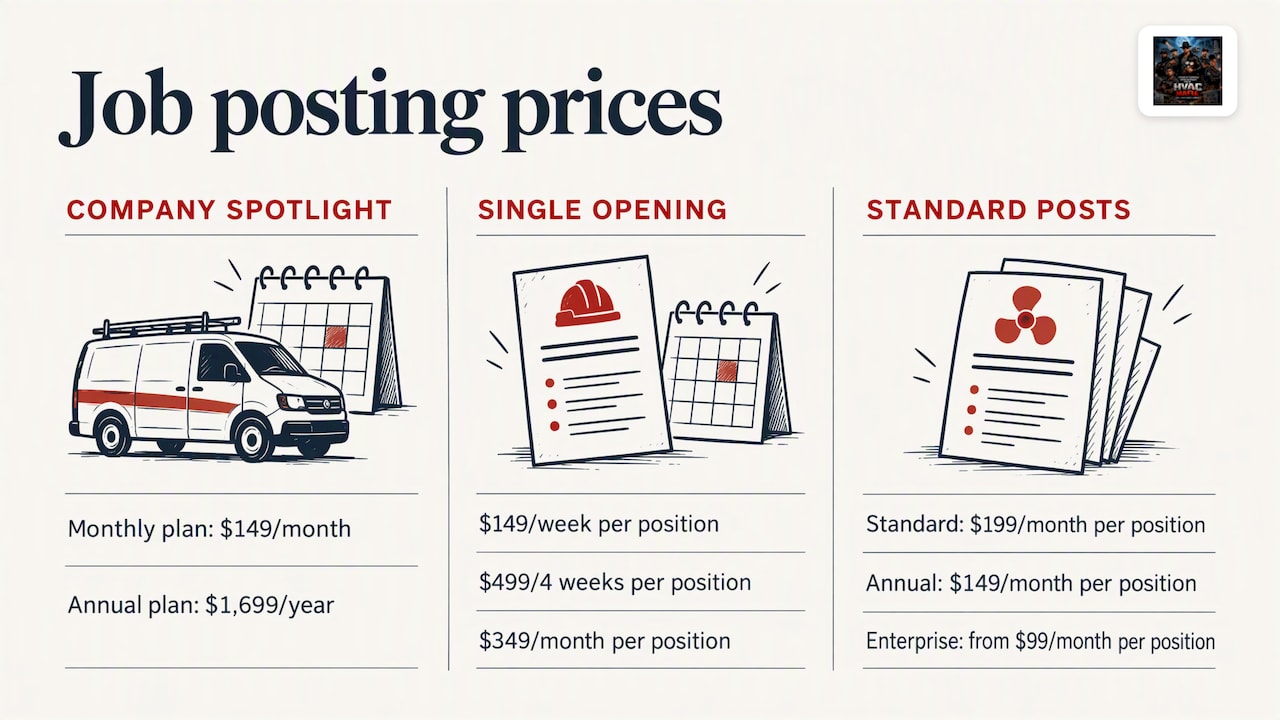
Company Spotlight is $149 per month on the monthly plan or $1,699 per year on the annual plan. If you’d rather promote a single opening, Spotlight pricing runs $149 per week per position, $499 per four weeks per position, or $349 per month per position for ongoing placement. Standard job posts are listed on our job posting plans page: $199 per month per position on Standard, $149 per month per position on Annual, and Enterprise from $99 per month per position.

Techs register free, and openings are visible to members. If you are a tech, join as a member and see who is hiring.
Perspective
We have spent decades in this trade, and we have seen both sides of the hiring table. Most contractors don’t have a hiring problem so much as a visibility problem. They run a good shop, pay fairly, and train their people, but the tech scrolling job listings never finds that out.
That is why we think a company profile is a recruiting tool first and a marketing piece second. A tech wants to know what you pay, how you train, who they’d work for and whether people stick around. If your profile answers that honestly, you won’t need big promises.
We built HVAC Mafia as a place where those answers can be shared with the people who care, and only those people: verified trade professionals, not homeowners or outsiders. Our Company Spotlight is designed to put your culture, pay and benefits in front of them. Build a career, not just another paycheck. That works for the tech and for the shop.
the author
FAQ
What should an HVAC contractor company profile include?
Start with the business name, location, founding year, services, service area, licenses and certifications. Then add the human side: your team, values, training, pay approach and how to apply. Real photos and honest detail matter more than polished slogans.
How do I showcase HVAC company culture?
Use specifics instead of adjectives. Show real team photos, describe how you hire and train, explain your schedule and on-call approach, and let your techs share their own stories. Anything you claim should be something a current employee would confirm.
Should I list pay in my company profile?
A range or a clear explanation of how pay and raises work builds trust with technicians, who compare offers constantly. For context, the BLS median for HVAC mechanics and installers was $61,010 in May 2025, but your local market may differ. Be clear about benefits, tools and truck policy too.
How can a technician judge an employer from its profile?
Look for named training programs, a described career path, real photos, clear schedule details and pay information. Missing details are a signal. Confirm what you read by asking to meet the team and by talking with other techs.
What is a Company Spotlight at HVAC Mafia?
It is a profile that shows a shop’s culture, pay and benefits to our trade-only audience of HVAC professionals. It is sold as a monthly plan at $149 per month or an annual plan at $1,699 per year. You can see the options on the Company Spotlight page.
Sources
- Creatively Introducing Your Business to Customers Online, ACHR News
- HVAC Company Profile: Your Go-To Guide
- HVAC Contractors data sheet, AdDaptive
- BLS: Heating, Air Conditioning, and Refrigeration Mechanics and Installers
- 2018 Best Contractors to Work For: HVAC Company Takes Care of Internal Customers, ACHR News
- 2018 Best Contractors to Work For: Technology Delivers Convenience, ACHR News
- History and Experience Fans This Flame, ACHR News
- Core Values and Integrity Yield Success, ACHR News
- Training the Next Generation of Heat Pump HVAC Technicians, U.S. DOE
- Presenting Company Information on Corporate Websites, Nielsen Norman Group
- Are Your Company Values More Than Just Words?, Gallup
- Your About Us Page Matters More Than You Think
- Photography Shot List for Home Service Businesses
- Southwest Specialty Contractor of the Year, ENR
- Engage HVAC Technicians on Social Media
- Behind the Scenes: Filming Brand Story Videos
- Storytelling to Brand Your Home Service Company, HVACR Business
- 2026 United States Energy & Employment Report, U.S. DOE
- DOE-Google Collaboration Will Help Consumers Identify Qualified Technicians
- Testimonials on your website