

A strong HVAC technician resume fits on one page, leads with your certifications, and shows what you actually fixed, installed or maintained, with numbers. Hiring managers in this trade skim. They want to know three things in ten seconds: are you certified, what equipment have you worked on, and can you run a call on your own. Build the page around those answers and you are most of the way there.
We built HVAC Mafia for techs, and we see what makes a contractor pick up the phone. This guide walks you through the layout, the wording, and two full examples you can adapt to your own background.
TL;DR
- Keep it to one page. Two pages only make sense for senior commercial roles.
- Put EPA 608 (with your type), NATE, OSHA and license level where a hiring manager sees them first.
- Write bullets about results, not duties: first-visit fixes, installs per year, tonnage serviced.
- Mirror the equipment and controls named in the job posting, and be honest about dates and seasonal work.
- Entry-level? Lead with trade school hours, EPA 608 and hands-on lab or helper work.
Table of Contents
- What belongs on an HVAC technician resume
- Certifications, licenses and training: list them the way employers read them
- Technical skills that earn interviews
- How to write your experience bullets
- Example: experienced service technician
- Example: entry-level tech or apprentice
- Tailor it to the job: service, install, commercial and refrigeration
- Make it ATS-friendly and avoid common mistakes
- Our perspective: a resume is half the story
- Put your resume to work
- A final checklist before you hit send
- FAQ
- Sources
What belongs on an HVAC technician resume
The NAHB trades resume guide recommends a clean format with clear headings such as Education, Certifications and Professional Experience. It also says to list positions in reverse chronological order, use concise bullets with strong action verbs, quantify results, and put the most impressive item first under each job. A short profile at the top is optional but useful.
Here is the order that works for most techs:
- Contact block: name, phone, professional-sounding email, city and state. You do not need a full street address.
- Summary: two or three sentences. Who you are, how many years, what you work on, what you are certified in.
- Certifications and licenses: right under the summary for most techs. This is the first filter.
- Technical skills: six to ten items that match the job.
- Experience: newest job first.
- Education and training: trade school, apprenticeship hours, manufacturer classes.
If your certifications are your strongest card, they go high. If you have ten years of solid service work and a license, your experience can come first and certifications can sit in a tight line below the summary. Either way, nobody should have to hunt for them.
One page, with one exception
One page is the standard. A free HVAC resume template guide notes that two pages are acceptable for senior commercial roles. If you are a lead tech, a controls specialist or a service manager with a long list of large projects, a second page can earn its place. If you are an installer with four years in, it cannot.
Pick a structure that fits your story
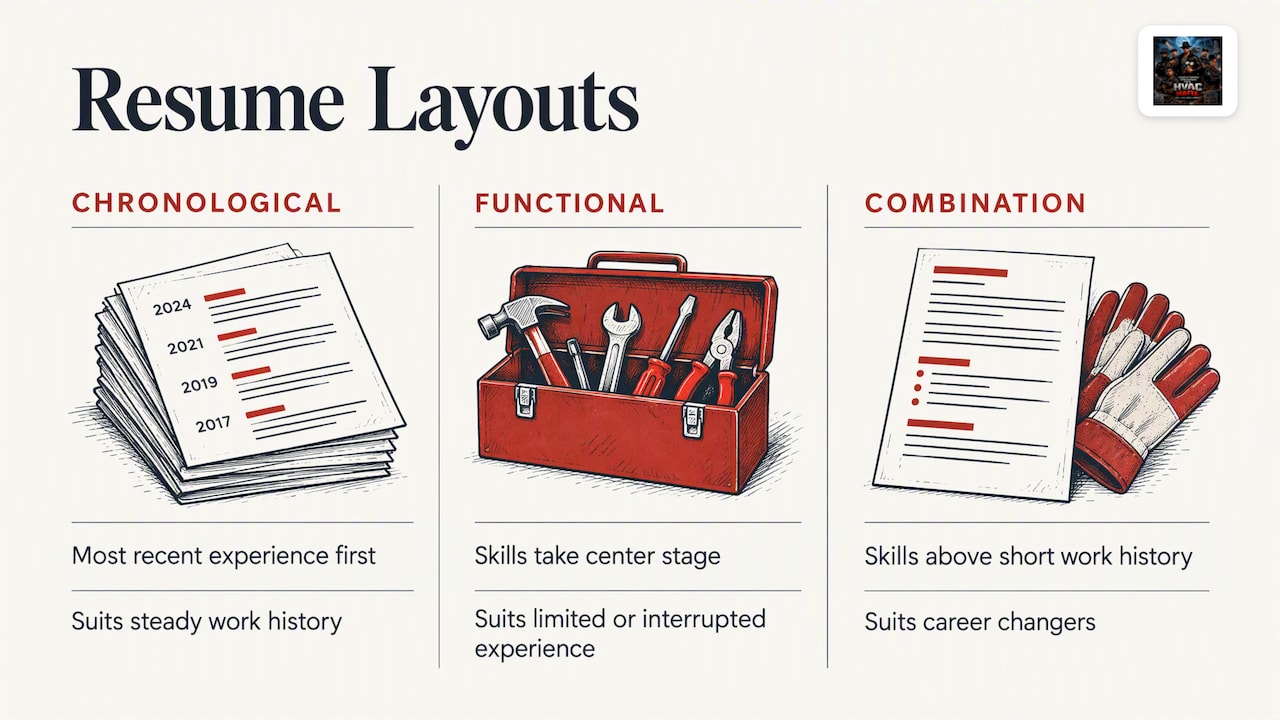
There are three common layouts: chronological, functional and combination. Chronological puts your most recent experience first and suits almost everyone with steady work. Functional leans on skills and suits people with limited or interrupted experience. Combination blends both. A career changer coming out of the military or a different trade can use a combination layout, with skills up top and a short work history below. A tech with a clean work record should use chronological and not overthink it.
Certifications, licenses and training: list them the way employers read them
This is where most HVAC resumes win or lose. The Bureau of Labor Statistics says the EPA requires nearly all HVAC technicians to be certified in refrigerant handling, and that certification requires passing an exam. So an employer is looking for it before anything else.
How to write each credential:
- EPA 608: state the type. “EPA 608 Universal” tells a hiring manager more than “EPA certified.” If you hold Type I, II or III only, list exactly that.
- NATE: list the specialty (for example, air conditioning service or gas heating) if you hold one.
- OSHA 10 or 30: include the hour count. It matters to commercial and industrial employers.
- State or local license: name the level and the state.
- Driver’s license: a clean license is a real requirement for any tech who drives a service truck. Say so.
- Manufacturer training: list brand-specific classes if you have them, such as controls or variable-speed equipment.
For each, add the issuing body and the year. For a diploma or trade school certificate, name the school, the program and the date you finished.
How much schooling is typical? The BLS says technicians typically need postsecondary instruction from technical or trade schools or community colleges, with programs generally running from 6 months to 2 years, and that employers sometimes consider candidates whose highest education is a high school diploma. If you are still working out your own timeline, our guide on how long it takes to get HVAC certified lays it out.
Technical skills that earn interviews
Keep the skills section short and specific. The same template guide lists examples such as refrigerant recovery and charging, brazing, electrical diagnostics, VFDs, BAS and thermostat controls, and Manual J load calculations. Pick the ones you can do and defend in an interview.
A few rules:
- Match the posting. If the job lists heat pumps, mini-splits and communicating thermostats, those words belong on your page, as long as they are true.
- Name equipment, not traits. “Hard worker” tells nobody anything. “Diagnosed and repaired residential split systems and packaged rooftop units up to 20 tons” does.
- Group them. Residential service, light commercial, refrigeration, controls and tools can each get a short line.
- Do not pad. If you have never touched a chiller, leave it off. Someone will ask you about it.
How to write your experience bullets
The NAHB guide says to describe accomplishments or skills gained instead of tasks, and to put numbers on results. That is the single biggest upgrade most tech resumes need. “Responsible for service calls” is a duty. “Ran 6 to 8 residential service calls a day with a high first-visit fix rate” is a result.
Each job entry needs a title, employer and location, dates in month and year, and bullets. For length, one HVAC service technician guide suggests five to eight bullets for your most recent role and three to five for older ones, with a summary of two to three sentences. Apprenticeships, hands-on training and work placements count as experience if you are early in your career.
Numbers a tech can actually use
Field work is easy to measure when you know where to look. The template guide points to metrics like first-visit fix rate, calls per week, installs per year and tonnage serviced. Others that carry weight:
- Callback rate or number of repeat visits
- Maintenance agreements you sold or renewed
- Install crew size you worked on or led
- Number of apprentices you trained
- Equipment tonnage or number of units on a commercial route
- Average ticket or revenue per call, if your company shares it
If you do not know an exact figure, estimate honestly and keep it modest, or ask your service manager. Do not invent numbers. Hiring managers in this trade talk to each other.
Before and after
| Weak bullet | Stronger bullet |
|---|---|
| Did maintenance on HVAC systems | Performed seasonal tune-ups on 12 to 15 residential systems per week, cleaning coils and checking charge and airflow |
| Installed furnaces and AC units | Installed 150+ split systems per year as part of a three-person crew, from line set to startup |
| Good with customers | Explained repairs and options on site, helping convert repair calls into maintenance agreements |
| Worked on commercial equipment | Serviced rooftop units and chillers across 40 light-commercial accounts, 5 to 50 tons |
Every number above is a placeholder showing the shape. Swap in your own.
Example: experienced service technician
Here is a sample you can model. Replace every detail with your real information.
Jordan Reyes | Tampa, FL | 555-555-0142 | jordan.reyes@email.com
Summary: Residential and light commercial HVAC service technician with 9 years of field experience, EPA 608 Universal and NATE certified. Strong diagnostics on heat pumps, split systems and rooftop units. Comfortable running calls solo and on-call rotation.
Certifications: EPA 608 Universal (2017) | NATE Air Conditioning Service (2019) | OSHA 10 (2021) | Florida Class B license (2022) | Valid driver’s license, clean record
Technical skills: Refrigerant recovery and charging | Brazing | Electrical and compressor diagnostics | Variable-speed and communicating systems | Smart thermostat setup | Airflow and static pressure testing
Experience
Service Technician, Coastal Comfort Heating & Air, Tampa, FL (03/2019 to Present)
- Run 6 to 8 service calls a day across residential and light commercial accounts, with a first-visit fix rate above 85% (confirmed with dispatch).
- Diagnose and repair heat pumps, split systems and packaged rooftop units up to 15 tons.
- Sell and renew maintenance agreements, adding roughly 60 members in 2025.
- Mentor two apprentices on brazing, gauge reading and customer communication.
- Reduce callbacks by documenting readings and photos on every ticket.
Installer, Bayshore Air Systems, Tampa, FL (06/2016 to 02/2019)
- Installed 120+ residential systems per year with a three-person crew.
- Handled line sets, pressure testing, evacuation and startup.
- Passed all inspections on first visit across my final 18 months.
Education: Hillsborough Community College, HVAC Certificate (2016)
Notice what this does. Credentials are in one scannable line. Bullets name equipment and results. Dates are month and year. There is no fluff.
Example: entry-level tech or apprentice
If you do not have years of field work, do not apologize for it. Danfoss, in its HVACR resume guide for students, advises entry-level candidates to lead with EPA 608 and trade school training, including lab hours and coursework, then frame helper or maintenance work in terms of results. It also suggests featuring tools you can use and OSHA 10.
Here is how that looks in practice:
- Summary: Recent HVAC program graduate with EPA 608 Universal certification and 600 hours of hands-on lab training. Reliable, punctual and eager to learn residential service and installation.
- Certifications: EPA 608 Universal | OSHA 10 | Valid driver’s license
- Training: Program name, school, graduation date, and a line on lab work, such as refrigerant recovery, brazing, and electrical troubleshooting on training units.
- Experience: Helper, warehouse, maintenance, or any trade job. Show what you did with numbers: “Loaded and organized truck stock for a 6-van fleet daily, cutting missing-part delays.”
- Tools: Gauges, multimeter, recovery machine, torch, tubing tools, whatever you can use confidently.
For an apprenticeship application specifically, pull keywords from the job description, add quantified achievements where you can, keep the layout neat, and proofread before sending. A typo on a trades resume tells a manager how you will fill out a work order.
Tailor it to the job: service, install, commercial and refrigeration
One generic resume sent to fifty shops does worse than three targeted versions sent to ten. Keep a master document with everything, then trim.
- Service technician: lead with diagnostics, first-visit fix rate, customer communication, maintenance agreements. Service managers want someone who can run a ticket from arrival to payment. See a few real examples of what contractors post in listings like this service technician opening in Spring, TX or this service technician role in Loveland, CO.
- Installer or lead installer: lead with installs per year, crew size, system types, permitting and inspection pass rate. Compare against a posting such as this install lead technician opening in Sharonville, OH to see which skills employers name.
- Commercial and refrigeration: name the equipment (rooftops, chillers, walk-ins, reach-ins), tonnage, controls platforms, and safety training like OSHA 30.
- Apprentice: training hours, EPA 608, attendance, and willingness to learn.
Also reflect the realities of the job. CareerOneStop notes that technicians must follow government regulations on handling and disposing of fluids and pressurized gases and on refrigerant recycling. If you have a clean record on refrigerant logs and compliance paperwork, say so. The same source describes work in cramped spaces, in high heat or deep cold, where heavy equipment can cause injuries. A line about your safety training, such as OSHA 10 or a clean safety record, speaks to that directly.
Make it ATS-friendly and avoid common mistakes
Many mid-size and large contractors use applicant tracking software to sort resumes before a human sees them. You do not need tricks. You need clarity.
- Mirror the posting. If it says “BAS controls” or “mini-split installation,” use those words if they apply to you. The template guide recommends mirroring the equipment and controls language in the posting.
- State the EPA 608 type rather than just “EPA certified.”
- Use real numbers. Round, honest figures beat fake precision.
- Format dates consistently. Month and year throughout. A HVAC resume guide from Rezoom lists consistent dates and honesty about seasonal work among the expectations in this trade. If you were laid off in the slow season or worked winters elsewhere, say it plainly.
- Use a simple layout. Standard fonts, clear headings, no text boxes, no photos, no graphics. Save as PDF unless the application asks for Word.
- Skip the objective statement. “Seeking a challenging position” says nothing. Use the summary instead.
- Proofread out loud. Then have someone else read it.
A practical example resume also puts credentials and equipment scope near the top, then names systems and tonnage, refrigerants and tools, and measurable outcomes like first-time-fix or callback rate. Add field qualities such as customer communication and comfort working independently or on call.
Our perspective: a resume is half the story
We have been in this trade a long time, and we have sat on both sides of the hiring table. Our founder spent 36 years as an HVAC veteran and a dealership owner. Here is what we know: a good resume gets you a conversation, but the right employer keeps you.
Too many techs send out resumes blind and take the first offer. Then they find out the pay was vague, the truck was a wreck, and nobody invested in training. We think you deserve better. You should be able to compare real openings from real contractors, ask other techs what a shop is like, and pick a place where you can build a career, not just another paycheck.
That is why HVAC Mafia is a trade-only community with job openings visible to registered members, a Tech Talk forum where techs talk straight about pay and employers, and Company Spotlight profiles where shops show their culture, pay and benefits. Our listings and discussions are restricted to verified HVAC trade professionals, so there is no homeowner or outsider noise. Use your resume to show what you can do. Use the community to find out where it will be respected.
the author
Put your resume to work
A finished resume does nothing sitting in a folder. Register as a member of HVAC Mafia and you can see openings from real contractors, including service, install, commercial and refrigeration roles. Membership is free for technicians, apprentices and trade school students.

Ready to use it? Join HVAC Mafia as a member, then match your resume to the openings that fit. Compare how employers word their postings, and tailor each version. For example, here is how a contractor describes a service technician role near Jupiter, FL.
A final checklist before you hit send
- Is it one page (or two only for a senior commercial role)?
- Are EPA 608 type, NATE, OSHA and license level easy to spot?
- Does every job have month and year dates?
- Does each recent bullet show a result or number?
- Did you use the equipment and controls words from the posting?
- Is your email professional and your voicemail set up?
- Did someone else proofread it?
- Can you talk through every line in an interview?
That last one matters most. Everything you list is something a service manager can ask about on a ride-along.
FAQ
How long should an HVAC technician resume be?
One page is the standard for almost every tech. Two pages can work for senior commercial roles with a long list of projects and certifications. If you have to cut, drop older, unrelated jobs before you drop recent results.
What certifications should I list first?
Start with EPA 608 and state the type, since the BLS says nearly all HVAC technicians need refrigerant-handling certification. Then add NATE, OSHA 10 or 30, and your state or local license level. Put them in a short block near the top so they are easy to find.
What if I have no HVAC experience?
Lead with your trade school training, lab hours and EPA 608 if you have it. Then show results from any helper, maintenance, warehouse or other hands-on work. Add the tools you can use and OSHA 10 if you hold it.
Should I use a resume template?
A simple template is fine if it is clean, one column and easy to read. Avoid graphics, photos and text boxes that confuse applicant tracking systems. Fill it with your own specific numbers and equipment, because the content is what gets you the call.
Sources
- NAHB Trades Resume Guide
- BLS: Heating, Air Conditioning, and Refrigeration Mechanics and Installers
- Free HVAC technician resume template guide
- Danfoss HVACR resume guide
- CareerOneStop: HVACR mechanics and installers
- HVAC service technician resume examples
- Rezoom HVAC technician resume examples
- HVAC technician resume example