
Think back to your first week in the trade. You probably didn’t know a service valve from a Schrader core. You carried the ladder and handed over tools, and you stood in a 140-degree attic wondering what you’d gotten yourself into.
Then somebody showed you.
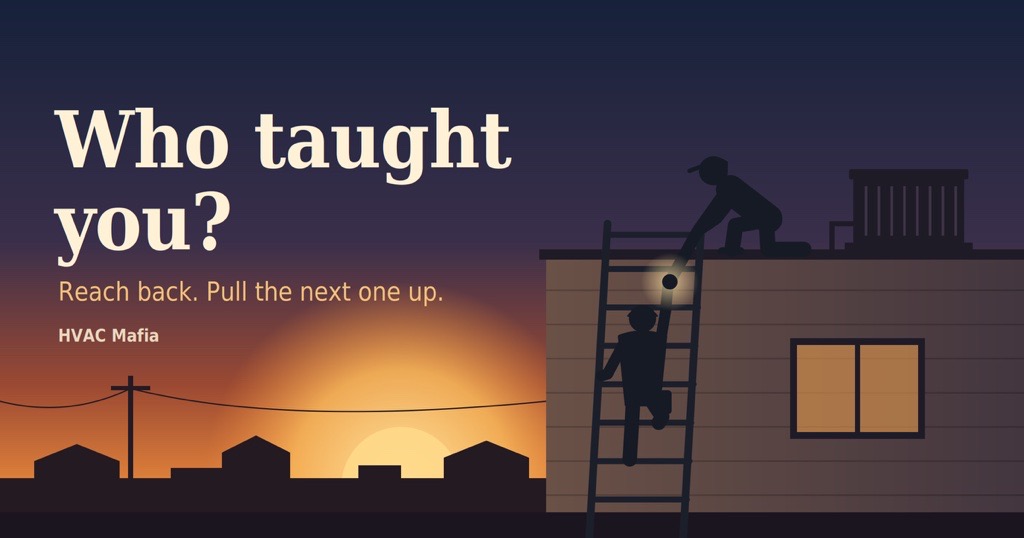
Maybe it was a crusty lead tech who made you check your own superheat three times before he’d look at it. Maybe it was a service manager who stayed late on a Friday to walk you through a wiring diagram. Whoever it was, you didn’t get where you are alone. Somebody reached back and pulled you up.
Here’s my problem. In most of this trade, that happened by luck.
Mentorship by accident isn’t a plan
Right now, whether a new helper grows or quits usually comes down to which truck they get put on. One kid lands with a lead who teaches. Two years later he’s running calls on his own and thinking about his next step. Another kid lands with a guy who treats him like a gofer. He never touches a set of gauges, never learns why anything works, and one day he leaves for a job that at least has air conditioning.
We didn’t lose that second kid because the work was too hard. We lost him because nobody showed him where it leads, and nobody walked him there.
The map is drawn. Now somebody has to walk it with them.
In “Somebody Draw the Map,” I said this trade has a map problem. Young people can’t see a career in HVAC because nobody ever lays it out for them. So I drew one: the ladder, eight rungs from Helper to Owner. Each rung is a real job with real skills. Each one gets you ready for the next.
A map shows you where you can go. It doesn’t get you there. That’s the mentor’s job. Somebody on a higher rung knows the next step because they’ve already taken it. They can tell you when you’re ready and when you’re not, and what you’re missing.
Distribution figured this out a long time ago
Look at the distribution side of our business. For years, the big wholesalers and OEMs have run Leadership Development Programs. It’s a known path: a guy starts out driving a forklift in the warehouse. Somebody sees something in him. He moves to the counter, then inside sales, then outside sales or branch operations. Eventually he’s running a branch, then a region. Some of those forklift drivers end up on the leadership team of a major manufacturer.
That wasn’t luck. The company decided to spot talent early and invest in it. They put people next to leaders who had already done the job, and they built a path with checkpoints along the way. The companies that did it built a bench, so when a leader retired, the next one was already in the building and ready to step in.
Now look at the field side. Our “leadership development program” is usually a ride-along and a prayer.
What it looks like in a shop
This doesn’t take a corporate HR department. It takes intention. A real mentorship program in a contractor shop comes down to a few things:
- Every new hire gets a named mentor. Not “ride with whoever’s open today.” One person who owns that helper’s growth and whose name is attached to it.
- Expectations match the ladder. The mentor and the mentee both know what’s needed to move from the current rung to the next one, and they track progress against it.
- Check-ins happen on the calendar. Fifteen minutes every couple of weeks. What did you learn, what are you stuck on, what’s next?
- Mentors get recognized for it. Whether that’s a bump in pay, a bonus when their mentee moves up a rung, or just a thank-you in front of the whole shop, teaching should count.
- Mentorship doesn’t stop at helper. The lead tech moving into a service manager role needs a mentor just as much as the kid on his first week. Probably more. Managing people is a whole different trade, and most of us learned it the hard way.
“I don’t have time for this”
I’ve heard every objection, and I’ve made a few of them myself.
“I don’t have time.” You’re already teaching. You’re just doing it badly, on the fly, in the middle of a call. Putting a little structure around it saves you time.
“I’ll train them and they’ll leave for the shop down the road.” Some will. They’ll leave either way. The difference is whether they leave the trade or just leave your shop. The ones who got real mentoring tend to stay in the industry, send people your way, and a lot of the time they come back. The shops that keep their people aren’t the ones that teach the least. They’re the ones that teach the most.
“Nobody mentored me. I figured it out.” Maybe you did. Now think about the guys who started when you did. How many are still in the trade?
This is on us
To the veterans out there, the 20- and 30-year techs, the service managers who climbed every rung, and the owners who started out holding the flashlight: you carry knowledge that isn’t in any manual. You know what a compressor sounds like right before it fails. You know how to walk into a house and read the homeowner in thirty seconds, and how to tell when a callback is really a sales problem. If you don’t pass that on, it retires when you do.
I’m not asking you to build a corporate program. I’m asking you to pick one. Take one helper and make them yours. Answer their calls, show them the next rung, and tell them the truth when they’re not ready yet.
Somebody reached back for you. Now it’s your turn.
We’re building mentorship into what we do here at HVAC Mafia, and there’s more coming on that soon. In the meantime, head over to Tech Talk and tell the Family who mentored you, what they taught you that stuck, and who you’re bringing up now.
No Shortcuts. Just Knowledge. Loyalty. Respect.